Offers insight into the complex relationship between religion and law in contemporary America
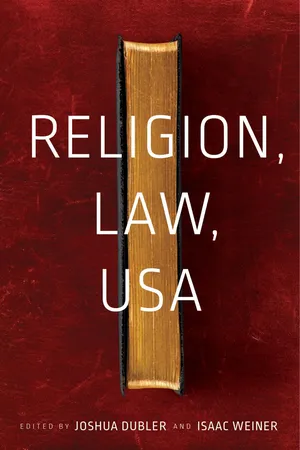
Why religion? Why law? Why now? In recent years, the United States has witnessed a number of high-profile court cases involving religion, forcing Americans to grapple with questions regarding the relationship between religion and law. This volume maps the contemporary interplay of religion and law within the study of American religions.
What rights are protected by the Constitution's free exercise clause? What are the boundaries of religion, and what is the constitutional basis for protecting some religious beliefs but not others? What characterizes a religious-studies approach to religion and law today? What is gained by approaching law from the vantage point of religious studies, and what does attention to the law offer back to scholars of religion? Religion, Law, USA considers all these questions and more.
Each chapter considers a specific keyword in the study of religion and law, such as "conscience," "establishment," "secularity," and "personhood." Contributors consider specific case studies related to each term, and then expand their analyses to discuss broader implications for the practice and study of American religion. Incorporating pieces from leading voices in the field, this book is an indispensable addition to the scholarship on religion and law in America.
- English
- ePUB (mobile friendly)
- Available on iOS & Android
eBook - ePub
Religion, Law, USA
About this book
Information
Topic
Theology & ReligionSubtopic
Law Theory & PracticePart I
Definition
The chapters of the volume’s first section break down the heralded promise of religious freedom into some of its constitutive parts: belief, conscience, exercise, establishment. If, in certain scholarly modes, terms for analysis are stipulated, and analysis proceeds from there, here the impulse to define is turned inside out. For our contributors, definitions are themselves products of discursive practices. To define a term is to uncover the history by which a given term acquired its meaning and significance. We zero in on definition not to fix terms’ meanings but rather to track and assess how the meanings that have been affixed have served, knowingly and unknowingly, to advance certain ends.
In the United States, religious freedom is generally associated with the freedom to believe, not the freedom to act on those beliefs. By means of a genealogy that spans nineteenth-century rulings over the regulation of polygamy and twenty-first century corporate exemptions over the Affordable Care Act’s birth control mandate, Sarah Imhoff shows that while the jurisprudence has continually centered on religious belief, the precise contours of what belief entails have in no way remained stable. Sliding around as well has been the relationship between belief and practice. Landing on the category of sincerity, Imhoff argues that if the court has had a pervasive tendency, it has been its will to obscure the obvious fact that within any religious group there necessarily exists a diversity of religious beliefs.
A legal concept that has floated in and out of alignment with religious belief is “conscience.” Excavating the history of conscientious objection to military service, Ronit Stahl traces the secular drift of the court’s reasoning, which has afforded conscience ever greater prominence. Whereas in the nineteenth century an objector needed to establish his membership in a peace church, by the middle of the twentieth century, religion’s putative monopoly over acts of conscience had been busted. Nonetheless, to avoid conscription, objectors had to establish that their motivation transcended “personal moral code” and was rooted in more than politics, sociology, or philosophy. Belief in God had been rendered optional, but to qualify for conscientious-objector status petitioners nonetheless had to articulate their ethics in universalizing terms. This life-saving lane that liberal petitioners and jurists had expanded for the purposes of individual protection invited new travelers as the court shifted to the right. In the sphere of women’s reproductive health most especially, a tool crafted by individuals to evade war now enables corporations to evade legislatively mandated obligations to their workers.
In writing for the majority in Hobby Lobby, for example, Justice Samuel Alito cites the company’s statement of purpose, which binds its owners with the obligation to operate “in a manner consistent with Biblical principles.” This, the court intimates with a nod to the fact that Hobby Lobby shops are closed on Sundays, entails substantial sacrifice to the tune of the millions of dollars lost annually. The resulting paradox, as Finbarr Curtis observes, is that free religious exercise is anything but “free.” Precisely the opposite, actually. To win in court one must present the putative demands of their free-exercise claim as being nothing short of obligatory. What then, Curtis asks, is being “exercised” in free religious exercise? His answer? The religious person’s body, resolve, and conviction. Rigid regimentation, discipline, and self-governance: these are the bodily expressions that one is “free” to religiously exercise. Deference to exercise claims, one might say, is the tribute secular slack pays to religious virtue. Whereas liberals have long glorified the principle of tolerance exhibited in such deference, they are suspicious of the excessive sovereignty it grants to religious individuals and groups. Meanwhile, conservatives’ celebration of religious freedom as an absolute and inalienable individual right masks the coercive force exerted upon these putatively sovereign selves by family structures, religious institutions, and, perhaps most saliently, capital.
If free exercise jurisprudence favors rigidity, then by contrast, disputes on the establishment side have incentivized various kinds of flexibility. Returning to the early republic, Anna Su tracks the ways that the disestablishment of religion fostered the disaggregation of religious practices from religious behaviors. The result—what would come to be known as the Second Great Awakening—was the saturation of religion into American public and social life. It was not until after World War II, and the school prayer cases, that courts substantively enforced Jefferson’s now famous “wall of separation.” But the story did not end there. As driven by movement conservatives and, eventually, by conservative jurists as well, religious expressions were welcomed back into the public square—so long as the symbols were used in a vague cultural way that stopped short of endorsing these symbols’ religious content. As comes as little surprise, however, these symbols have a curious way of lining up with the religious preferences of the majority culture.
1
Belief
Sarah Imhoff
Wikipedia redirects the “Freedom of Worship” page and the “Freedom to Worship” page to the “Freedom of Religion” page, where the first sentence glosses freedom of religion as “freedom of belief.” So, at least as I write this, a person curious about something called freedom of worship would be quickly redirected to a page about something called freedom of belief, which suggests that if you want to understand something about worship in the context of law and rights, you had better start with reading about belief. Why trust Wikipedia, that online compendium of crowdsourced knowledge about which scholars warn their students, to tell us anything? Precisely because Wikipedia draws on lay understandings, it provides an ethnographic window into how American culture sees itself.
The state also engages in freedom-talk and religion-talk. New applicants for American citizenship read that the Bill of Rights guarantees “freedom of religion.”1 Unlike “freedom of assembly” or “freedom of speech,” which the new citizen civics test also lists, there is no apparent verb for “religion”: one is free to assemble, one is free to speak, but we would not say that one is free to religion. So what is the right verb? What freedoms, precisely, does a person have if she has freedom of religion?
Two common contenders are “to believe” and “to practice.” Americans have imagined religion—not just freedom of religion, but also religion more generally, as a matter of belief and a matter of practice. Under US law, for example, Christians can believe in the divinity of Jesus Christ, Jews can believe in a law-giving God, and Rastafarians can believe in the return of Haile Selassie. Then everyone can act accordingly: Catholics can take communion, Jews can fast on Yom Kippur, and Rastafarians can address a God who was incarnated as an emperor of Ethiopia in their prayers. Or so the story goes.
But unlike this understanding of religion as a combination of belief and practice might at first suggest, it does not give the two equal roles: in this picture, religion is fundamentally a matter of belief and faith. The law protects (to some extent) what a person does with her body because of belief or faith, but the real essence of religion is what goes on in her head and her heart. Religious practice is an outgrowth, a second-order occurrence stemming from religious belief. The mind and the heart are primary; the body is secondary. Americans often talk about a “belief system” as a way to describe a religion, or “believers” to denote members of a religious community. They talk about “interfaith” events to describe gatherings of multiple religious groups. Courts talk about “faith or creed,” “faith traditions,” and a “person of another faith” when they mean religion and religious affiliation.2 Even scholar Wilfred Cantwell Smith, in his groundbreaking historicization of the concept of religion in the West, The Meaning and the End of Religion, called religion “faith.”3
The concept of belief, then, is crucial to understanding religion in the United States. From the vernacular, such as Wikipedia and “interfaith” community events, to formal appearances of law, such as Supreme Court rulings, belief most frequently appears as the true center of religion. Thinking about belief gets to the heart of fundamental cultural assumptions about what religion is. This chapter shows that through shifting histories of American law, the idea that belief is central has remained a constant, though what exactly “belief” entails and the scope of its protection has continually shifted.
To explore this idea of belief, this chapter will first gesture toward a genealogy of belief and then look briefly at three separate cases—the 1879 Reynolds v. United States, the 1914 Order of St. Benedict v. Steinhauser, and the 2014 Burwell v. Hobby Lobby—to show some of the different ways the Supreme Court has posited the scope and meaning of religious belief. These three cases are not intended to be a history, or even to mark the most important legal moments for the idea of religious belief, but rather to be three examples of the diverse ways that Americans, as actors within the legal system, have worked to configure religious belief. As each case shows, the law never creates religion in a vacuum; it is always in conversation with other cultural and legal movements. Whether these larger political issues involve the inclusion of territory, the ascendency of contracts, the social role of corporations, or other things, legal understandings and court documents construct religion in dialogue with these elements. Put more forcefully, even when the courts discuss religion as if it is a transhistorical phenomenon, it isn’t: religion is a product of its time, place, culture, politics, and other contextual factors.
One place we can see this contextual nature of religion is in American assumptions about what religion is: because of the historical, social, and legal power of Protestants, many contemporary American assumptions are indebted to Protestant Christianity. Scholars from a variety of disciplines have noted that one feature of this indebtedness is the idea that belief is—or at least should be—central to religion.4 Donald Lopez Jr. explains that Christian theologians, philosophers, and even scholars of religion have long figured belief as the foundational aspect of religion. “The accumulated weight of this discourse has resulted in the generally unquestioned assumption that adherents of a given religion, any religion, understand that adherence in terms of belief.”5 Americans have also tended to assume the same, both in the past and in the present. They also see religions across the globe in these same terms. These constructions of religion do not stop with cognitive or imaginative constructions; rather, courts, legislatures, town councils, and even many religious communities themselves use this assumption when they make practical decisions about religion. As Talal Asad argues, “In all these legal functions, liberal democracy (whether at home or abroad in its colonies) not only works through secularity, it requires that belief be taken as the essence of religiosity.”6 Religious people and communities can express their beliefs through practices like worship and rituals, but these embodied acts stem from belief. And as Elizabeth Shakman Hurd argues, American projects dedicated to promoting religious freedom abroad likewise assume that what they are protecting is the freedom to believe.7 Protestant notions of belief as the essence of religion permeate American culture, from philosophers to courts and government.
What, then, is belief? It has something to do with interiority, it is usually something other than what we would call knowledge, it seems personal, and it often has some sort of relationship to conscience. There is belief in, and there is belief that. There might be belief in a God or belief that there is an afterlife. But the idea of religious belief and how it can be known are not constants. Belief’s relationship to practice is similarly unsteady: different people in different hi...
Table of contents
- Cover
- Title Page
- Copyright Page
- Contents
- Introduction: Religion, Law, USA
- Part I. Definition
- Part II. Contestation
- Part III. Management
- Part IV. Limits
- Acknowledgments
- About the Editors
- About the Contributors
- Index
Trusted by 375,005 students
Access to over 1.5 million titles for a fair monthly price.
Study more efficiently using our study tools.
Frequently asked questions
Yes, you can cancel anytime from the Subscription tab in your account settings on the Perlego website. Your subscription will stay active until the end of your current billing period. Learn how to cancel your subscription
No, books cannot be downloaded as external files, such as PDFs, for use outside of Perlego. However, you can download books within the Perlego app for offline reading on mobile or tablet. Learn how to download books offline
Perlego offers two plans: Essential and Complete
- Essential is ideal for learners and professionals who enjoy exploring a wide range of subjects. Access the Essential Library with 800,000+ trusted titles and best-sellers across business, personal growth, and the humanities. Includes unlimited reading time and Standard Read Aloud voice.
- Complete: Perfect for advanced learners and researchers needing full, unrestricted access. Unlock 1.5M+ books across hundreds of subjects, including academic and specialized titles. The Complete Plan also includes advanced features like Premium Read Aloud and Research Assistant.
We are an online textbook subscription service, where you can get access to an entire online library for less than the price of a single book per month. With over 1.5 million books across 990+ topics, we’ve got you covered! Learn about our mission
Look out for the read-aloud symbol on your next book to see if you can listen to it. The read-aloud tool reads text aloud for you, highlighting the text as it is being read. You can pause it, speed it up and slow it down. Learn more about Read Aloud
Yes! You can use the Perlego app on both iOS and Android devices to read anytime, anywhere — even offline. Perfect for commutes or when you’re on the go.
Please note we cannot support devices running on iOS 13 and Android 7 or earlier. Learn more about using the app
Please note we cannot support devices running on iOS 13 and Android 7 or earlier. Learn more about using the app
Yes, you can access Religion, Law, USA by Isaac Weiner, Isaac Weiner,Joshua Dubler, Joshua Dubler in PDF and/or ePUB format, as well as other popular books in Theology & Religion & Law Theory & Practice. We have over 1.5 million books available in our catalogue for you to explore.