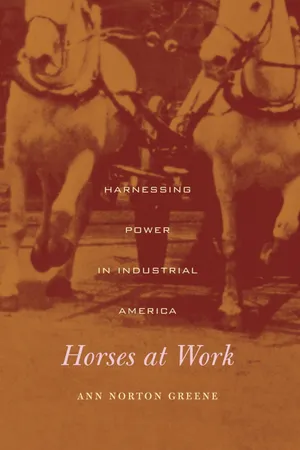
Historians have long assumed that new industrial machines and power sources eliminated work animals from nineteenth-century America, yet a bird's-eye view of nineteenth-century society would show millions of horses supplying the energy necessary for industrial development. Horses were ubiquitous in cities and on farms, providing power for transportation, construction, manufacturing, and agriculture. On Civil War battlefields, thousands of horses labored and died for the Union and the Confederacy hauling wagons and mechanized weaponry.
The innovations that brought machinery to the forefront of American society made horses the prime movers of these machines for most of the nineteenth century. Mechanization actually increased the need for horsepower by expanding the range of tasks requiring it. Indeed, the single most significant energy transition of the antebellum era may have been the dramatic expansion in the use of living, breathing horses as a power technology in the development of industrial America.
Ann Greene argues for recognition of horses' critical contribution to the history of American energy and the rise of American industrial power, and a new understanding of the reasons for their replacement as prime movers. Rather than a result of "inevitable" technological change, it was Americans' social and political choices about power consumption that sealed this animal's fate. The rise and fall of the workhorse was defined by the kinds of choices that Americans made and would continue to make—choices that emphasized individual mobility and autonomy, and assumed, above all, abundant energy resources.
- 337 pages
- English
- PDF
- Available on iOS & Android
eBook - PDF
About this book
Information
Topic
StoriaSubtopic
Storia economicaTable of contents
- CONTENTS
- List of Illustrations
- Preface
- Introduction
- 1 Why Horses
- 2 A Landscape for Horses
- 3 Remaking Horses
- 4 Civil War Horses
- 5 Horses as Industrial Workers
- 6 Studying Horses
- 7 From Horse Powered to Horseless
- Epilogue
- Appendix: Horse Population and Power
- Notes
- Index
Trusted by 375,005 students
Access to over 1.5 million titles for a fair monthly price.
Study more efficiently using our study tools.
Frequently asked questions
Yes, you can cancel anytime from the Subscription tab in your account settings on the Perlego website. Your subscription will stay active until the end of your current billing period. Learn how to cancel your subscription
No, books cannot be downloaded as external files, such as PDFs, for use outside of Perlego. However, you can download books within the Perlego app for offline reading on mobile or tablet. Learn how to download books offline
Perlego offers two plans: Essential and Complete
- Essential is ideal for learners and professionals who enjoy exploring a wide range of subjects. Access the Essential Library with 800,000+ trusted titles and best-sellers across business, personal growth, and the humanities. Includes unlimited reading time and Standard Read Aloud voice.
- Complete: Perfect for advanced learners and researchers needing full, unrestricted access. Unlock 1.5M+ books across hundreds of subjects, including academic and specialized titles. The Complete Plan also includes advanced features like Premium Read Aloud and Research Assistant.
We are an online textbook subscription service, where you can get access to an entire online library for less than the price of a single book per month. With over 1.5 million books across 990+ topics, we’ve got you covered! Learn about our mission
Look out for the read-aloud symbol on your next book to see if you can listen to it. The read-aloud tool reads text aloud for you, highlighting the text as it is being read. You can pause it, speed it up and slow it down. Learn more about Read Aloud
Yes! You can use the Perlego app on both iOS and Android devices to read anytime, anywhere — even offline. Perfect for commutes or when you’re on the go.
Please note we cannot support devices running on iOS 13 and Android 7 or earlier. Learn more about using the app
Please note we cannot support devices running on iOS 13 and Android 7 or earlier. Learn more about using the app
Yes, you can access Horses at Work by Ann Norton Greene,Ann Norton GREENE in PDF and/or ePUB format, as well as other popular books in Storia & Storia economica. We have over 1.5 million books available in our catalogue for you to explore.