In the early twenty-first century animals are news. Parliamentary debates, protests against fox hunting and television programmes like Animal Hospital all focus on the way in which we treat animals and on what that says about our own humanity. As vegetarianism becomes ever more popular, and animal experimentation more controversial, it is time to trace the background to contemporary debates and to situate them in a broader historical context.
Hilda Kean looks at the cultural and social role of animals from 1800 to the present – at the way in which visual images and myths captured the popular imagination and encouraged sympathy for animals and outrage at their exploitation. From early campaigns against the beating of cattle and ill-treatment of horses to concern for dogs in war and cats in laboratories, she explores the relationship between popular images and public debate and action. She also illustrates how interest in animal rights and welfare was closely aligned with campaigns for political and social reform by feminists, radicals and socialists.
- English
- ePUB (mobile friendly)
- Available on iOS & Android
eBook - ePub
About this book
Information
Topic
EducationSubtopic
Education GeneralONE
Radicals, Methodists and the law for animals in the streets
What returns for their life and faithful service do many of these poor creatures find?1
The attitude towards animals did not suddenly change at the start of the nineteenth century. Rather there was a coming together of different ideologies and practices emanating from political activists, philosophers, religious thinkers and artists. During the late eighteenth and early nineteenth centuries animals continued to be a highly visible aspect of British life. Agricultural developments had led to the presence of animals on farms throughout the year: no longer was it necessary to slaughter animals in the winter months, for increased crop production provided fodder all the year round.2 Wild animals – deer, foxes, badgers, otters – continued to be hunted for sport and some to be routinely slaughtered for food. Animals were seen to be useful. But they were increasingly being depicted as human companions, possessing individual identities and characteristics.
Parrots, fluffy dogs and an exotic cockatoo
In medieval and Renaissance art animals had been routinely painted as symbols of virtues, vices and human characteristics. This practice started to change. Horses were no longer depicted just as symbols of lust, nor dogs merely as embodiments of fidelity;3 their relationship to humans began to be envisaged in different ways. Thoroughbred horses, particularly in the canvases of Stubbs, or pedigree dogs, as painted by Gainsborough, became representative of the wealth of their owners.4 The depiction of animals gave a particular status to the people in whose domestic space the animals lived. Animals were increasingly portrayed as loved members of a human family. In the rooms in the National Gallery devoted to British eighteenth-century painting, the walls are covered with images of animals. Alongside the popular Gainsborough painting of Mr and Mrs Andrews with their loyal hunting dog and expanses of agricultural land hang images by Stubbs, Wright, Hogarth and Richard Wilson.5 In nearly all of these paintings animals are present in different guises: here are hunting dogs, a lady’s fluffy terrier, a scavenging mutt, horses pulling a phaeton, and children teasing a cat or chasing a butterfly. Within the separate paintings the animals perform different functions, but they demonstrate collectively that animals were an integral part of the cultural depiction of life in Britain at this time. The wealth of the aristocracy, the respectability of the developing middle class or the immorality of the dissolute subjects of Hogarth’s work are all given increased intensity by the inclusion of animals in the image.6
Further, the animals depicted in the environs of the wealthy British home are different types of creatures from those seen in some contemporary European images. While rapacious mogs and scavenging mutts eat their way through the kitchens of Dutch paintings of a similar era these are not portrayed as animals with distinct personalities. In contrast, creatures such as the white fluffy-tailed dog accompanying Mr and Mrs Hallett on their morning walk in Gainsborough’s eponymous painting is an animal particular to the couple, no doubt bearing its own name, as well as representing canine characteristics of fidelity.7 Exotic animals, too, start to be portrayed as part of family life. Joshua Reynolds’ portrait Lady Cockburn and her eldest three sons (1773), for example, contains a splendid image of a huge red and blue parrot on the back of the chair in which Lady Cockburn sits. The parrot is a pet and as much part of the family scene as the little children and the suckling baby. A less benign depiction of household pets is William Hogarth’s portrait The Graham Children (1742), set within the family’s drawing-room. Here is a cat, a family pet, in the room where visitors would be entertained. It is not in the kitchen with the servants, simply performing the role of mouse-catcher. Instead it is in the family space designated for leisure – and about to pounce on the caged bird. The children are alone in the room with no adult to protect them – or their bird – while a statue of Father Time looks knowingly upon the scene. These are children, little adults, who look beyond the years of innocence. Yet the animals used to convey this threat to innocence are not allegories but pets which thrived within the home, a safe domestic terrain, making the scene even more ominous. As Keith Thomas has suggested, by 1700 the keeping of pets was widespread;8 what has changed is the way in which such practices are acknowledged and validated within art and literature.
Attitudes towards animals, however – including family pets – were complex, as indicated most strikingly in An Experiment on a Bird in the Air Pump (1768), by Joseph Wright of Derby. Today it hangs in the National Gallery in London, drawing a great deal of attention from visitors. A regular subject of gallery talks, and pastiches by students and other artists, it is a disturbing image for the late twentieth-century spectator, as it may also have been for an eighteenth-century counterpart.9 It appears to be a conventional contemporary domestic portrait of a family sufficiently wealthy to employ a servant and to be entertained by a travelling scientist. But at the heart of the painting is a disturbing image of a bird, a rare white cockatoo, struggling for breath within an air pump. The travelling lecturer – an outsider and a scientist – is seeking to demonstrate that animals need air to survive and are unable to do so in a vacuum.10 The practice of using animals in an air pump had already drawn criticism, and frequently a lung glass with a bladder, demonstrating how the lungs of an animal contracted, was employed instead, because according to a contemporary scientist, ‘this experiment is too shocking to every spectator who has the least degree of humanity’.11
Here Wright develops the domestic domain to produce a contradictory image. We have the depiction of a family pet, a beautiful cockatoo, which would be kept in the cage next to the window. But we are also watching a scientific experiment performed upon that pet, albeit before respectable men thought to be members of the Lunar Society, a prestigious group of Enlightenment thinkers led by Erasmus Darwin, grandfather of the better known Charles. The site of their scientific enquiry is not a laboratory or lecture hall but a domestic parlour.12 Simultaneously we are presented with different readings of the cockatoo: exotic object of spectacle, valued pet, subject of scientific research. The bird has been interpreted as an allegory for the phoenix stage of alchemical transmutation, with the lecturer acting as a utopian philosopher enacting Enlightenment rituals for a select audience.13 It is also a domestic pet, precisely the sort of animal in fact to be protected from danger and experimentation. This contradiction, coupled with the disturbing object in the chemical jar reminiscent of a memento mori (causing the onlooker on the right for one to ponder on the proceedings) and the presence of distressed children devoid of a mother’s protection, asks the viewer of the painting, like the people within, to consider the events critically.
Wright emphasized the shocking nature of the event we are witnessing. The scene is dominated by men, one of the women present being a young girl more keen on flirting with her beau than on watching the experiment. Here the men are not simply rich individuals displaying their wealth, but present us with a narrative dominated by the sense of sight. Only two of the ten seem to be looking directly at the bird: the little girl anxious about its fate and the servant checking to see whether the bird’s cage will be needed or not. Others in the painting choose not to see the struggles of the bird for air; even the moon does not want to see and hides behind the clouds to deprive the room of light. The setting for the experimentation then becomes hidden, covert and redolent of shame prefiguring later critical depictions of animal experimentation.14 Although this painting is a narrative about experimentation and attitudes towards it, it is also about the role of sight in this process. These are men of the Enlightenment, apparently interested in scientific enquiry, yet their night-time activities are hidden from the light and they turn aside to ponder on the spectacle performed for them rather than choosing to witness the struggling bird. As viewers we look both at the suffocating bird but also at those within the painting who choose not to look and turn away. We adopt different roles in our approach to the painting by the very act of looking and identification with a number of the characters in the painting: we too want to look but not to see the distress of the bird.
Most of the commentators on the Wright painting have viewed it within a context of scientific experimentation.15 They conclude that the bird will live, that the servant is bringing down the cage in which to replace the soon-to-be revived bird – and that the eighteenth-century observer at least would see the image in this way.16 Such unproblematic reading is very limited: this one painting includes a number of different cultural contexts, reflecting the range of attitudes towards animals at this time. There is the scientist’s quest for knowledge, entailing the experimentation on living creatures. There is the observation of animal behaviour imitating the discourse being developed by naturalists.17 Also depicted is humanity towards creatures, even if in this image such a sentiment is confined to children. In its explicit reference to the choice of whether to acknowledge cruelty or to turn away the painting epitomizes much of the debates to follow. Critical to campaigns for the amelioration of the plight of animals was an emphasis on seeing and acknowledging cruelty as an precondition for positive change. The painting also reminds us that many of the impulses in the interests of animals in the nineteenth century had their origins in earlier decades.
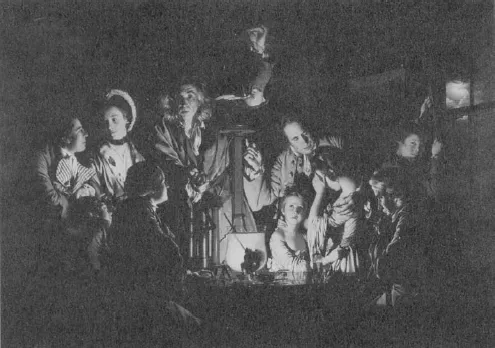
Life or death for the family cockatoo? Joseph Wright, An Experiment on a Bird in the Air Pump, 1768.
Changing religious views
The questioning stance that Wright depicted in his painting of 1768 was not unique but a visual depiction of an approach being developed by those concerned with religious, moral, and political interpretations of the relationship between animals and humans. In 1776 Humphry Primatt, an Anglican vicar from Swardeston in Norfolk and a doctor of divinity, first published his tract The Duty of Mercy and the Sin of Cruelty to Brute Animals.18 In language which prefigures that used by parliamentarians in their debates of the early nineteenth century to argue the case for legislative protection of animals, Primatt drew analogies between the plight of different peoples and those of animals:
It has pleased God the father of all men, to cover some men with white skins, and others with black skins; but as there is neither merit not demerit in complexion, the white man, notwithstanding the barbarity of custom and prejudice can have no right, by virtue of his colour, to enslave and tyrannise over a black man; nor has any fair man any right to despise, abuse, and insult a brown man.
Accordingly if certain groups of men have no authority to abuse others on account of differences of appearance such practice should also apply to animals since ‘an animal [is] no less sensible of pain than a man’.19 Cruelty was practised by all ranks of society, Primatt indicated, giving a range of examples including negligence towards cattle, fox hunting, bull-baiting and boiling lobsters alive.20 The solution was situated within a religious discourse, namely to practise mercy towards animals, mirroring God’s mercy towards humanity.21 Although such ideas were not prevalent within the established Church, similar views gained greater currency within the growing Nonconformist sects, particularly Methodism.
John Wesley, the eighteenth-century founder of Methodism, offered a vision of a more equal and free community of souls living together on earth.22 This ideal was reflected in the preaching practices of the Methodists: lay preachers often from working backgrounds delivered their messages, as did their founder, in the open spaces of villages and towns throughout the country.23 Market squares, the same places where animals lived, worked and were harassed, became the site of Methodist open-air preaching.24 Wesley emphasized the creation of distinctive moral and religious characters for his followers, centring on the practice of Methodism as a social religion which demanded positive action. As he famously put it, ‘It is nonsense for a woman to consider herself virtuous because she is not a prostitute, or a man honest because he does not steal.’25 Positive change – not merely an absence of wrongdoing – was required in the lifestyle of his adherents, and such change extended to the treatment of animals. In terms which were anathema to Catholics and many Anglicans, Wesley declared that animals did indeed have an afterlife and wrote extensively on the part animals played in the natural world.26 For it was, he believed, through natural phenomena that God demonstrated his power. Wesley’s three-volume ...
Table of contents
- Front Cover
- Half Title
- Title Page
- Copyright
- Contents
- PREFACE
- 1 Radicals, Methodists and the law for animals in the streets
- 2 Sight, spectacle and education: from Regent’s Park zoo to Smithfield cattle market
- 3 Continuity and change: fallen dogs and Victorian tales
- 4 Bringing light into dark places: anti-vivisection and the animals of the home
- 5 Dead animals: spectacle and food
- 6 New century: new campaigns
- 7 Greyfriars Bobby and Black Beauty go to war
- 8 A meeting of the country and the town
- 9 Continuing cruelty: unconcluded campaigns
- REFERENCES
- SELECT BIBLIOGRAPHY
- INDEX
Trusted by 375,005 students
Access to over 1.5 million titles for a fair monthly price.
Study more efficiently using our study tools.
Frequently asked questions
Yes, you can cancel anytime from the Subscription tab in your account settings on the Perlego website. Your subscription will stay active until the end of your current billing period. Learn how to cancel your subscription
No, books cannot be downloaded as external files, such as PDFs, for use outside of Perlego. However, you can download books within the Perlego app for offline reading on mobile or tablet. Learn how to download books offline
Perlego offers two plans: Essential and Complete
- Essential is ideal for learners and professionals who enjoy exploring a wide range of subjects. Access the Essential Library with 800,000+ trusted titles and best-sellers across business, personal growth, and the humanities. Includes unlimited reading time and Standard Read Aloud voice.
- Complete: Perfect for advanced learners and researchers needing full, unrestricted access. Unlock 1.5M+ books across hundreds of subjects, including academic and specialized titles. The Complete Plan also includes advanced features like Premium Read Aloud and Research Assistant.
We are an online textbook subscription service, where you can get access to an entire online library for less than the price of a single book per month. With over 1.5 million books across 990+ topics, we’ve got you covered! Learn about our mission
Look out for the read-aloud symbol on your next book to see if you can listen to it. The read-aloud tool reads text aloud for you, highlighting the text as it is being read. You can pause it, speed it up and slow it down. Learn more about Read Aloud
Yes! You can use the Perlego app on both iOS and Android devices to read anytime, anywhere — even offline. Perfect for commutes or when you’re on the go.
Please note we cannot support devices running on iOS 13 and Android 7 or earlier. Learn more about using the app
Please note we cannot support devices running on iOS 13 and Android 7 or earlier. Learn more about using the app
Yes, you can access Animal Rights by Hilda Kean in PDF and/or ePUB format, as well as other popular books in Education & Education General. We have over 1.5 million books available in our catalogue for you to explore.