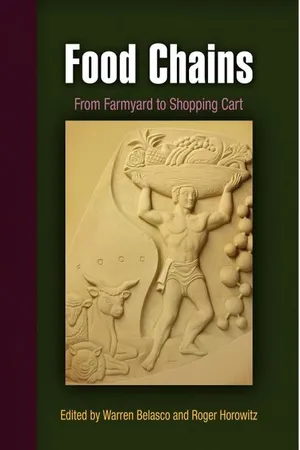
In recent years, the integrity of food production and distribution has become an issue of wide social concern. The media frequently report on cases of food contamination as well as on the risks of hormones and cloning. Journalists, documentary filmmakers, and activists have had their say, but until now a survey of the latest research on the history of the modern food-provisioning system—the network that connects farms and fields to supermarkets and the dining table—has been unavailable. In Food Chains, Warren Belasco and Roger Horowitz present a collection of fascinating case studies that reveal the historical underpinnings and institutional arrangements that compose this system.
The dozen essays in Food Chains range widely in subject, from the pig, poultry, and seafood industries to the origins of the shopping cart. The book examines what it took to put ice in nineteenth-century refrigerators, why Soviet citizens could buy ice cream whenever they wanted, what made Mexican food popular in France, and why Americans turned to commercial pet food in place of table scraps for their dogs and cats. Food Chains goes behind the grocery shelves, explaining why Americans in the early twentieth century preferred to buy bread rather than make it and how Southerners learned to like self-serve shopping. Taken together, these essays demonstrate the value of a historical perspective on the modern food-provisioning system.
eBook - ePub
Food Chains
From Farmyard to Shopping Cart
- 304 pages
- English
- ePUB (mobile friendly)
- Available on iOS & Android
eBook - ePub
Food Chains
From Farmyard to Shopping Cart
About this book
Information
Chapter 1
Making Food Chains: The Book
I begin my food-history classes by drawing a simple line on the blackboard with the word “farm” at one end and the word “dinner” at the other. Then I ask the students to explain some of the steps that are necessary for food to move from one end to the other. Within a few minutes the simple line is a complex tree bristling with stages such as “processing,” “trucking,” “scientific research,” “retailing,” and so on. When it starts to get too hard to read the board—which does not take long—I stop, to make the point of how complicated it is to bring food to our tables.
Many students in my classes come with prior interest in food; often spirited discussions break out about the merits (and demerits) of particular Food Network chefs. Some are looking for careers in nutrition, others work in restaurants, and a few even cook themselves. Yet most have little knowledge of the complex chain of firms and social practices that are necessary to make our provisioning system work, and they want to learn more.
A somewhat equivalent gap exists in the growing food-studies field. Among the steady outpouring of books much is written on the culinary and cultural dimensions of food and food consumption practices, along with an astonishing proliferation of books that combine recipes with eating philosophies. Studies that consider provisioning are growing in number but remain small in proportion. Yet there is considerable interest in histories of food that engage with larger patterns of social development, especially how we get the food that we eat.
These insights informed the discussions between Phil Scranton, Susan Strasser, Warren Belasco, and me as we started planning a conference on food history at the Hagley Museum and Library, in Wilmington, Delaware, in the fall of 2006. As the nation's leading business history library, Hagley has considerable resources for the study of food that we wanted to bring attention to scholars in the field. We hold one or two conferences on varying subjects each year; we felt it was time to do another one on food. A 1999 conference, “Food Nations,” had been a big success and was the foundation for a highly successful book in our Hagley Perspectives on Business and Culture book series. While “Food Nations” dealt with—as the name implies—food, identity, and social practice, we titled the 2006 conference “Food Chains” as we wanted it to focus on the provisioning systems that supply our world with food. We defined “provisioning” in the call for papers as “the complex institutional arrangements necessary for food to move from farm to the dinner table.” To complement the conference's impact, we issued a guide to research materials at Hagley that can be used to study food history.
This volume includes all the essays presented at the conference plus two solicited specifically for this publication. All are original, not previously published. The book's structure emulates that of food chains, starting with animals from which food comes, moving to the processing necessary to turn natural products into palatable items, and concluding with the process of sales through which consumers obtain their meals. Some chapters hone in on one item each—pigs, chickens, crabs, ice, ice cream, or shopping carts—to show its role in provisioning systems. Other essays look at industry segments—foods processed in imperial nations, dog food, or Mexican food—to elaborate on their internally complex “chains” of acquisition, manufacturing, and distribution. A few consider places—kitchens or retail stores—where consumers make the decisions over what to buy and what to prepare for their families.
The opening “Overview” section contextualizes the volume's content through two synthetic essays. Warren Belasco surveys current literature in the food-studies field and suggests the contribution of taking food chains as an organizing principle to understand food in our society. Shane Hamilton looks closely at theoretical work by historians and social scientists employing commodity-chain analysis. He assesses the value of taking a comprehensive approach to identify actors, technologies, forms of knowledge, and forms of capital involved in transforming a raw material into a consumable good.
The section “Animals” follows with essays that discuss pigs, chicken, and crabs. The authors all consider how the nature of consumer demand and food distribution influences the use, and at times the very character, of these animals.
J. L. Anderson charts how farmers and agricultural colleges changed the form of the American pig following World War II in order to satisfy changing consumer demand. He argues that these efforts revealed tension about health and diet within postwar society that was sufficiently powerful to fuel a massive effort to remake a species. As incomes rose and concerns about fat content increased, firms, farmers, and other actors in the industry (such as the federal government) altered the hog from an animal intended to supply fat to a “lean” version whose principal purpose was to provide meat.
Andrew Godley and Bridget Williams show how poultry became the most popular type of meat consumed in the United Kingdom after 1960. In contrast to the United States (where the USDA was so influential), the modern poultry industry emerged in the first thirty years after World War II in Britain because of the deliberate investments by a select group of leading food retailers, who needed to economize on the costs of meat distribution as they pioneered self-service stores. The widespread distribution of cheap chicken led to its mass adoption throughout the country.
Kelly Feltault sees the expansion of the imported crabmeat industry as emerging from the development of global supply chains for American seafood restaurants. She emphasizes that scarcity of Chesapeake Bay crabmeat was not a factor in the efforts of large seafood firms to expand production in Thailand. The adoption of domestic quality standards known as HACCP regulations facilitated production and importation of Asian crabmeat into the American restaurant market. Expansion of the crab industry also intersected with Thailand's export-oriented development strategy.
All food has to move from producers to consumers in a market economy, a complex process that requires processing—in complex ways—of raw ingredients in which transportation, processing, and preservation are critical. The chapters in the “Processing” section consider such transitions, both the transformation of the foods that can take place and the complex matrix of production needs and consumer preferences that influence the firms engaged in such activities.
Richard Wilk considers how extended food chains create settings where the cultural significance of products can change as they are moved from place to place. He argues that the transformations that goods go through as they move along industrial commodity chains are just as significant as the conversion of cultural property into commodities such as “tribal” art, music, and traditional medicine. Wilk illustrates his argument by showing how raw foodstuffs from nineteenth-century colonized nations were transformed in substance and meaning when they were moved through trade networks, especially when goods were processed and packaged in imperial nations such as Britain to create genteel “civilized” food.
Jonathan Rees explores the unique character of ice in the late nineteenth-century United States, as it was both part of the food provisioning system and food itself. He adeptly shows that not all ice was the same. Natural ice, cut from lakes and rivers, varied considerably in quality. It could be a factor in food preservation when packed into railroad cars or grocers' freezers, as well as a consumer good when sold for use in home iceboxes or drinks. Rees shows how consumer concerns about the purity of the ice that came in contact with food bedeviled the natural ice industry.
Katherine C. Grier uncovers the roots of the American pet-food business that currently attracts annual expenditures of $18 billion. Curiously, it was a product that nobody really needed; certainly dogs and cats did not demand it. Grier identifies the development of pet food, then, in the way it met human needs in the American provisioning system. Pet food absorbed surpluses among producers of human food, and the decline of urban kitchens as sites for processing of raw materials left fewer table scraps for pets to eat. Pet food succeeded as it satisfied the needs of humans at several places along the provisioning axis.
Jenny Leigh Smith tells a fascinating story of how Joseph Stalin and his successors put the resources of the Soviet state behind the development of a national system of ice cream production and distribution. Soviet citizens could easily purchase ice cream from local vendors, unlike the many obstacles they encountered when buying other kinds of food or consumer goods. Smith sees two main factors explaining this curious paradox. First, the Soviet government wanted to create a cheap luxury product for citizens to counteract the social problems it faced with so much material scarcity. Second, it was easier for the command economy to distribute a frozen good such as ice cream than the more perishable ingredients that composed it, especially milk.
Jeffrey M. Pilcher unravels how Mexican food spread internationally. He focuses on the development of an infrastructure necessary to supply Mexican ingredients to restaurants and home cooks throughout the world. Globalizing Mexican food required basic structural transformations in the traditional labor-intensive nature of this cuisine. To supply such food profitably demanded considerable economies of scale, thereby hindering the competitive efforts of Mexican firms whose advantage lay in local knowledge and advantaging large American-based companies. As a result, Pilcher contends, Mexican food that has been globalized has been in its Americanized form.
Food exists to be consumed, so the next section considers the selling of food to men, women, and children for them to eat. The emergence of particular retail food stores and restaurants depended on changes in the production and distribution of products as well as patterns of consumer demand. We fittingly close this section—and the book—with a chapter on the shopping cart, so necessary for consumers to take their purchases from stores, leaving all other stages of the food chain behind.
Lisa C. Tolbert explains the attraction of self-service retail stores among white women in the early twentieth-century South by focusing on the Piggly Wiggly chain. Southern white women often preferred to call in their orders to stores as there were many challenges to respectability in public retail space. Tolbert shows how grocers strategically used the concept of self-service to transform the cultural message of the southern grocery store and food shopping. Piggly Wiggly created store interiors and advertising campaigns that successfully recast the cultural role of the grocery store as an emblem of modernity and food shopping as an appropriate activity for white southern ladies.
Patrick Hyder Patterson details the transformation of food retailing in Eastern Europe following World War II. He shows that by 1975 relatively prosperous Communist countries such as Hungary and Yugoslavia had markedly improved food production and distribution methods. At the retail end of the food chain, modern self-serve grocery stores paralleled the Western focus on consumer-oriented and well-stocked food emporiums. They were, however, state-owned stores wedded to a discourse of “socialist commerce.” Nonetheless they shared much of the theory, styles, and practices of privately owned Western supermarkets—and were able to deliver abundant food to their customers.
Katherine Leonard Turner identifies the choices facing working-class families in the late nineteenth and early twentieth centuries between cooking food and obtaining ready-to-eat food. Kitchen appliances, home sizes, and availability of space to grow food or harbor animals varied widely from city to city and influenced the calculations of housekeepers regarding whether to prepare or buy food for consumption by their families. Especially in the case of baker's bread she shows that locally prepared food did not entirely replace home cooking but provided an important supplement, thereby altering the nature of food preparation in the working-class home.
Catherine Grandclément sketches the technological and mythical processes of creating the supermarket shopping cart. Self-serve food stores needed a reliable means to prevent the weight of goods from determining how much shoppers would purchase to bring home. Yet the development of the proper vehicle was complex as it had to satisfy the customer and also address the needs of the retailer. Grandclément also shows that the traditional “creation myth” of the shopping cart elevated one inventor (Sylvan Goldman) above other claimants, when in fact the invention process was marked by simultaneous innovations all intended to meet the same shopping challenges.
We hope that readers will leave this volume with a richer understanding of the complex arrangements that bring food to our tables. Making this book also required complex relationships, and many thanks go to the Hagley Museum and Library staff, especially Carol Lockman, for their role in organizing the 2006 “Food Chains” conference. Commentators at that conference, including Shane Hamilton, Tracey Deutsch, Phil Scranton, Warren Belasco, and me, commenced the process of turning papers into chapters. Editor Robert Lockhart at the University of Pennsylvania Press expertly brought the book through the editorial review and subsequent manuscript preparation process. It is for me always a pleasure to play a role throughout the complex chain between imagining a book and seeing it finally appear in print.
Part I
Overview
Chapter 2
How Much Depends on Dinner?
The science-fiction writer Robert Heinlein is credited with popularizing the saying “There ain't no such thing as a free lunch” in his 1966 novel, The Moon Is a Harsh Mistress. Or maybe credit should go to Barry Commoner, whose fourth “Law of Ecology” (1971) said about the same thing, albeit more grammatically.1 Either way, the context was the late 1960s, when Americans were beginning to confront the environmental costs of their consumer economy. However, the “no free lunch” axiom dates at least as far back as the nineteenth century, when American saloons offered complimentary food as a way to lure workers who either paid for their meals by buying drinks (with all the added social costs of drunkenness) or were “bounced” as “free-lunch fiends” and “loafers.”2 Going back much further to mythical times, the principle applies even to our primordial meals. Think about this much-quoted passage from Lord Byron's epic poem “Don Juan” (1823), which directly links “dinner” and “sinner”:
All human history attests
That happiness for man—
The hungry sinner—
Since Eve ate apples,
Much depends on dinner!
So how much depends on dinner? Well, in Genesis at least, quite a lot—both before that primordial snack and afterward in the fateful consequences. As for the events upstream leading to the bite of the forbidden fruit, we might start with the six days of heavy lifting that it took God to establish the orchard. Then, in probing Eve's decision, we can cite motivations that often drive culinary experimentation—curiosity, boredom, hubris, ambition, sexual frustration, serpentine salesmanship, and so on. For the sad downstream aftereffects of Eve eating apples, Genesis suggests shame, pain, sweat, difficult childbirth, spousal abuse, the brutalization of animals, along with assorted bruised heals, dust, thorns, and thistles—the primal ecological and economic catastrophe.
In the classical Greek version of the “no free lunch” principle, Prometheus pities shivering, starving humanity and steals fire from his less compassionate boss, Zeus. Humans learn to cook meat and to forge metal; with that technological breakthrough, they proceed to conquer the earth. However, in punishment for his hubris, Prometheus is chained to a rock, where he is doomed to have his liver eaten daily by an eagle. In a rather literalist interpretation of the story, the vegetarian poet Percy Bysshe Shelley (1813) speculated that Prometheus's “vitals were devoured by the vulture of disease.” Adding in the ecological costs of feeding grass and grains to animals, Shelley went on to blast the meat eater who would “destroy his constitution by devouring an acre at a meal…. The quantity of nutritious vegetable matter, consumed in fattening the carcass of an ox, would afford ten times the sustenance…if gathered immediately from the bosom of the earth.” Such feed-conversion calculations were already a familiar part of vegetarian analysis a full two hundred years before Frances Moore Lappe's Diet for a Small Planet (1971), which educated many baby boomers about the external costs of a meat-based diet.3
The reality-based wisdom of “no free lunch” may well be universal, as it is possible to find stories of Promethean innovation (cooking) and punishment (the ravaged liver) in many cultures. For example, in some Native American versions, the people (humanity) steal fire to cook and to warm themselves; but with their new technological edge come dire consequences, including forest fires, rain, and mosquitoes. In one Polynesian tale the mischievous superhero Maui (Prometheus's Pacific counterpart) steals cooking fire from the underworld, but as he escapes to the surface the angry flames follow him, producing the first volcano. Claude Fischler detects more than a residue of such mythical thinking in an analysis of the recent European panic over bovine spongiform encephalopathy (BSE)—thought to be exacerbated by the thoroughly modern practice of feeding animal residues to animals. “The mad cow epidemic is perceived as punishment for some human misbehavior that caused it in the first place by attracting some sort of a sanction, the most common description of this behavior being the conversion of herbivores into carnivores or even into cannibals.”4
Connoisseurs of catastrophic thought might also relish this compelling reminder of eating's unforeseen consequences from The Road to Survival, a 1948 jeremiad by William Vogt, an ornithologist turned environment crusader: “We are paying for the foolishness of yesterday while we shape our own tomorrow. Today's white bread may force a break in the levees and flood New Orleans next spring. This year's wheat from Australia's eroding slopes may flare into a Japanese war three decades hence…. We must develop our sense of time and think of the availability of beefsteaks not only for this Saturday but for the Saturdays of our old age, and of our children.”5 Taking such a long view of the future obviously entails taking a long view of the past—that chain of events that brought food to our tables. Eden's pomaceous food chain was blessedly short, a localvore's delight: God–tree–Eve. Thinking about what it takes to assemble dinner nowadays, however, it is a miracle that anyone ever gets fed. Multiply this by billions of meals a day and you have more miracles than any one religion can handle. Yet, this extraordinary food chain is taken for granted, and has been for many years, thanks in part to the efforts of the corporate deities who supply our modern, genetically enhanced apples so quietly, out of sight, mind, and sensibility.
The global supermarket has been open for business for quite a long time. In 1919 the geographer J. Russell Smith marveled at the dependence of a typical Massachusetts consumer on distant sources:
The man of today starts his breakfast with an orange from California or Florida, or a banana from Central America, or an apple from Oregon, Virginia, or New York. He takes a shredded wheat biscuit made in Niagara Falls with Dakota wheat. He sugars it with the extract of Cuban cane. He puts Wisconsin butter on bread baked of Minneapolis wheat flour mixed with Illinois corn flour. He has a potato. In June it comes from Virginia, in July from New Jersey, in November from New York, Maine, or Michigan. If he indulges in meat, it is a lamb chop from a frisky little beast born on the high plains near the Rocky Mountains, and fattened in an Illinois feed lot before going up to Chicago to be inspected, slaughtered, and refrigerated. He warms and wakes himself up with a cup of coffee from Brazil (called Mocha perhaps) or tea from Ceylon or Japan, or cocoa from Ec...
Table of contents
- Cover Page
- Title Page
- Copyright Page
- Contents
- 1. Making Food Chains: The Book
- Part I. Overview
- Part II. Animals
- Part III. Processing
- Part IV. Sales
- Notes
- List of Contributors
Trusted by 375,005 students
Access to over 1.5 million titles for a fair monthly price.
Study more efficiently using our study tools.
Frequently asked questions
Yes, you can cancel anytime from the Subscription tab in your account settings on the Perlego website. Your subscription will stay active until the end of your current billing period. Learn how to cancel your subscription
No, books cannot be downloaded as external files, such as PDFs, for use outside of Perlego. However, you can download books within the Perlego app for offline reading on mobile or tablet. Learn how to download books offline
Perlego offers two plans: Essential and Complete
- Essential is ideal for learners and professionals who enjoy exploring a wide range of subjects. Access the Essential Library with 800,000+ trusted titles and best-sellers across business, personal growth, and the humanities. Includes unlimited reading time and Standard Read Aloud voice.
- Complete: Perfect for advanced learners and researchers needing full, unrestricted access. Unlock 1.5M+ books across hundreds of subjects, including academic and specialized titles. The Complete Plan also includes advanced features like Premium Read Aloud and Research Assistant.
We are an online textbook subscription service, where you can get access to an entire online library for less than the price of a single book per month. With over 1.5 million books across 990+ topics, we’ve got you covered! Learn about our mission
Look out for the read-aloud symbol on your next book to see if you can listen to it. The read-aloud tool reads text aloud for you, highlighting the text as it is being read. You can pause it, speed it up and slow it down. Learn more about Read Aloud
Yes! You can use the Perlego app on both iOS and Android devices to read anytime, anywhere — even offline. Perfect for commutes or when you’re on the go.
Please note we cannot support devices running on iOS 13 and Android 7 or earlier. Learn more about using the app
Please note we cannot support devices running on iOS 13 and Android 7 or earlier. Learn more about using the app
Yes, you can access Food Chains by Warren Belasco, Roger Horowitz, Warren Belasco,Roger Horowitz in PDF and/or ePUB format, as well as other popular books in Business & Agribusiness. We have over 1.5 million books available in our catalogue for you to explore.