The author's purpose is to understand the philosophical foundations of Hegel's social theory by articulating the normative standards at work in his claim that the three central social institutions of the modern era--the nuclear family, civil society, and the constitutional state--are rational or good. Its central question is: what, for Hegel, makes a rational social order rational? In addressing this question the book aspires to be faithful to Hegel's texts and to articulate a compelling theory of rational social institutions; its aim is not only to interpret Hegel correctly but also to demonstrate the richness and power that his vision of the rational social order possesses.
Frederick Neuhouser's task is to understand the conceptions of freedom on which Hegel's theory rests and to show how they ground his arguments in defense of the modern social world. In doing so, the author focuses on Hegel's most important and least understood contribution to social philosophy, the idea of "social freedom."
Neuhouser's strategy for making sense of social freedom is to show its affinities with Rousseau's conception of the general will. The main idea that Hegel appropriates from Rousseau is that rational social institutions must satisfy two conditions: first, they must furnish the basic social preconditions of their members' freedom; and, second, all social members must be able subjectively to affirm their freedom-conditioning institutions as good and thus to regard the principles that govern their social participation as coming from their own wills.
eBook - PDF
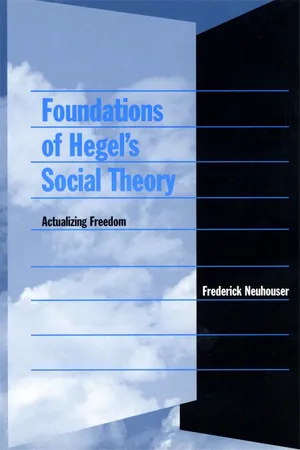
Foundations of Hegel’s Social Theory
Actualizing Freedom
- 353 pages
- English
- PDF
- Available on iOS & Android
eBook - PDF
About this book
Information
Publisher
Harvard University PressYear
2009Print ISBN
9780674011243
9780674001527
eBook ISBN
9780674041455
Topic
PhilosophySubtopic
Political PhilosophyTable of contents
- CONTENTS
- Abbreviations of Works Cited
- Introduction
- 1 Hegel’s Conception of Social Freedom: Preliminaries
- 2 Rousseau: Freedom, Dependence, and the General Will
- 3 The Subjective Component of Social Freedom
- 4 Objective Freedom, Part I: The Self-Determining Social Whole
- 5 Objective Freedom, Part II: Social Conditions of Individuals’ Freedom
- 6 Hegel’s Social Theory and Methodological Atomism
- 7 The Place of Moral Subjectivity in Ethical Life
- Notes
- Index
Trusted by 375,005 students
Access to over 1.5 million titles for a fair monthly price.
Study more efficiently using our study tools.
Frequently asked questions
Yes, you can cancel anytime from the Subscription tab in your account settings on the Perlego website. Your subscription will stay active until the end of your current billing period. Learn how to cancel your subscription
No, books cannot be downloaded as external files, such as PDFs, for use outside of Perlego. However, you can download books within the Perlego app for offline reading on mobile or tablet. Learn how to download books offline
Perlego offers two plans: Essential and Complete
- Essential is ideal for learners and professionals who enjoy exploring a wide range of subjects. Access the Essential Library with 800,000+ trusted titles and best-sellers across business, personal growth, and the humanities. Includes unlimited reading time and Standard Read Aloud voice.
- Complete: Perfect for advanced learners and researchers needing full, unrestricted access. Unlock 1.5M+ books across hundreds of subjects, including academic and specialized titles. The Complete Plan also includes advanced features like Premium Read Aloud and Research Assistant.
We are an online textbook subscription service, where you can get access to an entire online library for less than the price of a single book per month. With over 1.5 million books across 990+ topics, we’ve got you covered! Learn about our mission
Look out for the read-aloud symbol on your next book to see if you can listen to it. The read-aloud tool reads text aloud for you, highlighting the text as it is being read. You can pause it, speed it up and slow it down. Learn more about Read Aloud
Yes! You can use the Perlego app on both iOS and Android devices to read anytime, anywhere — even offline. Perfect for commutes or when you’re on the go.
Please note we cannot support devices running on iOS 13 and Android 7 or earlier. Learn more about using the app
Please note we cannot support devices running on iOS 13 and Android 7 or earlier. Learn more about using the app
Yes, you can access Foundations of Hegel’s Social Theory by Frederick Neuhouser,Frederick
NEUHOUSER in PDF and/or ePUB format, as well as other popular books in Philosophy & Political Philosophy. We have over 1.5 million books available in our catalogue for you to explore.