Preaching 2018 Book of the Year
To preach effectively in today's world, preachers need cultural intelligence. They must build bridges between listeners who come from various denominations, ethnicities, genders, locations, religious backgrounds, and more. Experienced preacher and teacher Matthew Kim provides a step-by-step template for cross-cultural hermeneutics and homiletics, equipping preachers to reach their varied listeners in the church and beyond. Each chapter includes questions for individual thought or group discussion. The book also includes helpful diagrams and images, a sample sermon, and appendixes for exegeting listeners and for exploring cultural differences.
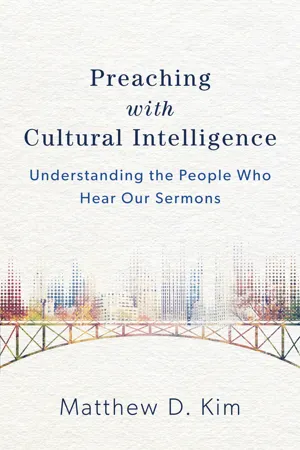
eBook - ePub
Preaching with Cultural Intelligence
Understanding the People Who Hear Our Sermons
- 288 pages
- English
- ePUB (mobile friendly)
- Available on iOS & Android
eBook - ePub
About this book
Information
Topic
Theologie & ReligionSubtopic
Christlicher DienstPart 1: Cultural Intelligence in Theory
1
Preaching and Cultural Intelligence
Blocks from where I live in Beverly, Massachusetts, lies the Kernwood Bridge, built in 1907 to connect Beverly, known for its scenic public parks and beaches, to the legendary town of Salem, famed for its late 1600s witch trials and modern witchcraft tourism.1 This bridge not only expedites approximately 7,700 drivers’ daily commutes when crossing the Danvers River into the other city; it also serves to bring together these two distinct expressions of New England culture.2 Just as physical bridges connect landmasses and town cultures separated by bodies of water, bridges are necessary connective instruments in homiletics. Preachers in the twenty-first century require, as John Stott puts it, the dexterities to stand “between two worlds”3 and engage the world of the Bible and the world of today.4 This book is an attempt to put additional flesh on Stott’s original skeleton for preaching as bridge-building. It is inadequate to study the Scriptures without marrying this biblical exegesis to the pressing cultural issues of our time and valuing the cultural groups embodied in our churches.
Like the sides of an incomplete Rubik’s Cube, preachers survey a checkerboard of eclectic people sitting in the pews, trying to make sense of how they can integrate the disparate pieces of their hearers’ lives into a clear, contextualized, and unified message. This bridge-building exercise in preaching warrants cultural intelligence. At the same time, the preacher who displays cultural intelligence when preaching is simultaneously and subconsciously building bridges between and among his congregants, who often come from very dissimilar cultural contexts. Congregational cultural intelligence is a trait that is sorely missing in many churches today. That is, people don’t have the requisite training to understand each other. In this opening chapter, I want to define culture through the eyes of a homiletician and explore how cultural intelligence conjoins the preaching process. The chapter concludes with a short description of the Homiletical Template that will augment our competence to preach with greater cultural understanding and sensitivity.
Culture and Homiletics
Culture is ubiquitous.5 Just open your ears to the cacophony of languages in the bustling grocery store aisles or glance at the latest fashion magazines vying for your consumption or absorb cultural sound bites by hearing late night talk-show hosts’ monologues on CBS, ABC, and NBC. Culture is life, and life is culture. Yet defining culture succinctly and cogently is quite tricky, is it not? The sheer murkiness of the term has led many in our society to dichotomize or parse out culture. Ask anyone on Main Street or in your church lobby what the term “culture” means today, and you will probably hear particularized aspects of culture named, including language, fashion, social media, trends, worldviews, musical tastes, news, values, politics, race, ethnicity, cuisine, beliefs, gender issues, mores, human sexuality, blue collar, white collar, religious preferences, the arts, sports, hip-hop, church traditions, evangelical, mainline, progressive, liberal, conservative, Baptist, Presbyterian, Anglican, Methodist, R-rated, PG-rated, and so on.
Not only have we compartmentalized culture but also culture is never stagnant. All cultures are fluid and ever evolving. New cultural trends are constantly being instated and reinstated by Hollywood, religious leaders, the media, politicians, marketers, designers, and others. How, then, might preachers define culture with regard to understanding the litany of cultures represented in our congregations? The apostle Paul provides this telos, or end goal, of preaching where he writes to the church of Colossae, “[Jesus Christ] is the one we proclaim, admonishing and teaching everyone with all wisdom, so that we may present everyone fully mature in Christ. To this end I strenuously contend with all the energy Christ so powerfully works in me” (Col. 1:28–29, emphasis added). In referring to this text, I am not contending that every single sermon must include Christ, as some propose from the historic-redemptive perspective on preaching.6 However, I am submitting that it is in the purview of every preacher to understand and appreciate everyone’s cultural nuances, to move them forward in their sanctification process in becoming more Christlike in their maturity.7
Take, for example, Philip’s encounter with the Ethiopian eunuch in Acts 8:26–40. The Holy Spirit prompts Philip to stop and inquire whether the Ethiopian understands what he is reading from the book of Isaiah. The Ethiopian eunuch responds in verse 31: “‘How can I,’ he said, ‘unless someone explains it to me?’ So he invited Philip to come up and sit with him.” At this point, the invitation toward cultural intelligence commences with an exchange of ideas, questions, and dialogue. Then, in verse 35, Philip explains the meaning of Isaiah 53:7–8 and continues to share with him the good news of Jesus Christ. It is not insignificant that Luke records the ethnicity of this Ethiopian eunuch. Here the ethnic moniker of Ethiopian does not refer to modern-day Ethiopia per se, but rather to the Nubian region between southern Egypt and northern Sudan.8 Through this cultural exchange, we observe that Philip’s presentation of the gospel for this Ethiopian government official required cultural intelligence.
As in Philip’s divine appointment with the Ethiopian eunuch, to be able to “present everyone fully mature in Christ” requires cultural intelligence. It does not happen without intentionality. It calls for extended labor “with all the energy Christ so powerfully works in me” to preach with cultural intelligence, by getting to know my congregants and their respective cultures. How, then, should preachers interpret the term “culture”? My definition of culture for preachers seeks to be holistic and intentionally broad in nature: culture is a group’s way of living, way of thinking, and way of behaving in the world, for which we need understanding and empathy to guide listeners toward Christian maturity.9 In a moment, we will explore what this means in greater detail.
The Genesis of Cultural Intelligence
People working in the business world—what Christians call the marketplace—have acutely felt the pressure to interact effectively with persons who are culturally different from them. A lack of cultural understanding and sensitivity has palpable consequences: a company’s loss of revenue. For this reason, business professors P. Christopher Earley and Soon Ang wrote a trendsetting book called Cultural Intelligence: Individual Interactions across Cultures, to assist businesspeople in understanding and working with people from different cultures and backgrounds.10 In this book the authors established a business concept called the cultural quotient theory (CQ), also known as cultural intelligence. They define cultural intelligence as “the capability to deal effectively with other people with whom the person does not share a common cultural background and understanding.”11
Cultural intelligence (CQ) resembles emotional intelligence (EQ), which measures one’s capacity for relational and interpersonal skills.12 David Livermore has popularized Earley and Ang’s concept and provided a concrete framework to achieve cultural intelligence in the midst of often complex and varied congregations.13 Borrowing CQ as a conceptual framework to guide this book, my goal is to employ cultural intelligence in our significant calling as preachers. Below is a quick overview of Livermore’s four stages of cultural intelligence, which we will adapt for homiletical purposes.
The Four Stages of Cultural Intelligence
As culturally intelligent preachers, we want to familiarize ourselves with and develop in all four stages of cultural intelligence.14 While each of the four stages is significant to understanding different cultural contexts, the loci of this book will be centered on CQ knowledge and CQ action. CQ drive will be the primary subject of chapter 4, and CQ strategy will be considered more implicitly as we attempt to put cultural intelligence into action via the Homiletical Template.
CQ Drive
First, Livermore articulates CQ drive as “the motivational dimension of CQ, [which] is the leader’s level of interest, drive, and energy to adapt cross-culturally.”15 CQ drive reflects an inner longing to better understand similar and dissimilar congregants. Loving our sheep requires getting to know them beyond simply their names and professions. Who are they? What cultures and subcultures do they most identify with? What dreams do they have, and what are their fears? What beliefs do they hold closely? What causes them pain?
Livermore indicates that CQ drive is the most crucial of the four stages.16 Here it gauges the preacher’s motivation level in seeking to understand one’s listeners. For example, someone with low CQ may quickly pigeonhole others without taking any time to consider where such thinking, living, and behaving derives from and the reasons why. They think to themselves, “That’s the way those people are.” Yet those who possess a high degree of CQ drive enjoy learning about other cultures. They do not consider cultural intelligence as a burden or a chore. No matter where you find yourselves on the CQ drive spectrum, my intention is not for you to feel overwhelmed. Rather, the hope is that cultural intelligence becomes an extension of our everyday lives as we grow to know our congregants over time.
How can we determine our CQ drive? Imagine this scenario at your church. A new couple who are recent immigrants from Senegal (ethnicity), transplants from Grand Rapids (location), or Methodists (denomination) visit your church for the very first time. Is your natural inclination to greet them and inquire about their cultural backgrounds, or would you dart toward church members with whom you already share a strong camaraderie? (If you are introverted like me, your immediate response may be driven by your introvertedness and may not necessarily be an indication of your level of CQ drive.) Are you willing to pronounce and remember unfamiliar or “foreign” names? Or do you have the patience to watch movies in a different language, reading the English subtitles? My assumption is that you inherently possess at least a moderate desire for cultural intelligence or else you would have avoided this book. Wherever we fall on the CQ drive spectrum, the goal is that God will increase our inquisitiveness and love for Others in our congregations and communities. A more detailed consideration of CQ drive will be taken up in chapter 4.
CQ Knowledge
The second stage toward cultural intelligence is CQ knowledge, which represents “the cognitive dimension of the CQ research, [and] refers to the leader’s knowledge about culture and its role in shaping how business [in our case, preaching] is done.”17 The key elements in CQ knowledge are assessing our current knowledge of how cultures are similar and different and “the way culture shapes thinking and behavior.”18 What knowledge do we currently possess about various listeners as we prepare to preach to them? For instance, what beliefs or values influence their daily decisions?19 Are they individualistic (making decisions based on individual preferences) or collectivistic (making decisions according to what’s best for a group)? Would they rather spend time with you (as a being-oriented culture) or accomplish something with you (as a doing-oriented culture)? On what do they spend their time and resources? What types of food do your listeners eat, and what do they decline? What cultural values are most highly esteemed in their culture: honesty, hard work, success, age, education, profession, salary, position, or status? What cultural idols obstruct the gospel from taking root in their lives, and more?
CQ Strategy
Third, “CQ strategy, also known as metacognitive CQ, is the leader’s ability to strategize when crossing cultures.”20 Put differently, it is our plan of attack when interacting with those who are culturally different from us. As we strategize, we are engaging in three important tasks. First, we consider our own level of awareness regarding “what’s going on in ourselves and others.”21 Second, we plan, thus “taking time to prepare for a cross-cultural encounter—anticipating how to approach the people, topic, and situation.”22 Last, we exercise CQ strategy by “monitoring our interactions to see if our plans and expectations were appropriate.”23 CQ strategy represents the process of creating a viable roadmap to help us become more culturally aware and culturally conversant. Our CQ strategy will be teased out through the Homiletical Template in chapter 2.
CQ Action
Last, in Stage 4, we want to develop CQ action, which is “the behavioral dimension of CQ . . . [and] the leader’s ability to act appropriately in a range of cross-cultural situations. . . . ...
Table of contents
- Cover
- Title Page
- Copyright Page
- Endorsements
- Dedication
- Contents
- Acknowledgments
- Introduction
- Part 1: Cultural Intelligence in Theory
- Part 2: Cultural Intelligence in Practice
- Conclusion
- Appendix 1: The Homiletical Template
- Appendix 2: Worksheet for Understanding Culture
- Appendix 3: Sample Sermon
- Notes
- Index
- Back Cover
Trusted by 375,005 students
Access to over 1.5 million titles for a fair monthly price.
Study more efficiently using our study tools.
Frequently asked questions
Yes, you can cancel anytime from the Subscription tab in your account settings on the Perlego website. Your subscription will stay active until the end of your current billing period. Learn how to cancel your subscription
No, books cannot be downloaded as external files, such as PDFs, for use outside of Perlego. However, you can download books within the Perlego app for offline reading on mobile or tablet. Learn how to download books offline
Perlego offers two plans: Essential and Complete
- Essential is ideal for learners and professionals who enjoy exploring a wide range of subjects. Access the Essential Library with 800,000+ trusted titles and best-sellers across business, personal growth, and the humanities. Includes unlimited reading time and Standard Read Aloud voice.
- Complete: Perfect for advanced learners and researchers needing full, unrestricted access. Unlock 1.5M+ books across hundreds of subjects, including academic and specialized titles. The Complete Plan also includes advanced features like Premium Read Aloud and Research Assistant.
We are an online textbook subscription service, where you can get access to an entire online library for less than the price of a single book per month. With over 1.5 million books across 990+ topics, we’ve got you covered! Learn about our mission
Look out for the read-aloud symbol on your next book to see if you can listen to it. The read-aloud tool reads text aloud for you, highlighting the text as it is being read. You can pause it, speed it up and slow it down. Learn more about Read Aloud
Yes! You can use the Perlego app on both iOS and Android devices to read anytime, anywhere — even offline. Perfect for commutes or when you’re on the go.
Please note we cannot support devices running on iOS 13 and Android 7 or earlier. Learn more about using the app
Please note we cannot support devices running on iOS 13 and Android 7 or earlier. Learn more about using the app
Yes, you can access Preaching with Cultural Intelligence by Matthew D. Kim in PDF and/or ePUB format, as well as other popular books in Theologie & Religion & Christlicher Dienst. We have over 1.5 million books available in our catalogue for you to explore.