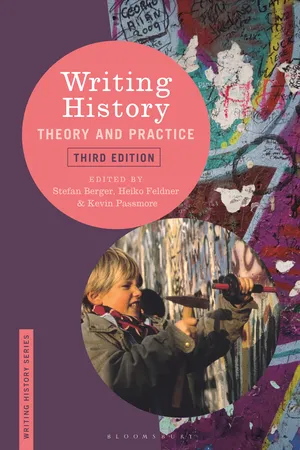
The third edition of Writing History provides students and teachers with a comprehensive overview of how the study of history is informed by a broader intellectual and analytical framework, exploring the emergence and development of history as a discipline and the major theoretical developments that have informed historical writing. Instead of focusing on theory, this book offers succinct explanations of key concepts that illuminate the study of history and practical writing, and demonstrates the ways they have informed practical work. This fully revised new edition comprehensively rewrites and updates original chapters but also includes new features such as: - new chapters on postcolonial, environmental and transnational history;
- chapter introductions setting them within the context of historiography;
- a new substantive introduction from the editors, providing a useful road-map for students;
- an expanded glossary. In its new incarnation Writing History is, more than ever, an invaluable introduction to the central debates that have shaped history.
eBook - ePub
Writing History
Theory and Practice
- 464 pages
- English
- ePUB (mobile friendly)
- Available on iOS & Android
eBook - ePub
Writing History
Theory and Practice
About this book
Information
Part One
Rankeanism and the professionalization of history
This part begins with the intellectual context in which professional historical writing emerged, along with its assumption of the primacy of politics. Heiko Feldner shows that a crucial development – at least in Germany and France – was the new conception of history as a science, even if there was much uncertainty about what ‘scientific’ meant.1 Prior to Ranke, history was excluded from the realm of the sciences, for following the principles of Aristotle, science meant establishing universal certainties, and history could not do that because it relied on unpredictable human choice. At the end of the eighteenth century, that changed. The Aristotelian concept of science declined, and the industrial and French revolutions presented new ideas about knowledge. No longer was science simply the pursuit of abstract knowledge – it had to serve useful ends. As the supposed repository of lessons from the past, history became essential to good government and productive industry. At the same time, science came to be conceived differently. Society was increasingly conceived of as a machine, a clock, and therefore as knowable scientifically because constructed by humans. Equally importantly, knowledge was to be made through experiment, meaning that it was accessible to the human senses, so long as the proper rules of method were observed. Experimentalism also dictated that, if possible, one should search for the original document and that reading them required training in methods – principally the cultivation of neutrality and the use of footnotes so that others could verify interpretations. The basis of professionalism was thus established half a century before Ranke, even if he was in large measure responsible for institutionalization of history as a discipline – Peter Lambert’s chapter confirms this point. The chapter ends with the contention that Rankeanism did not necessarily triumph because its methods were superior, for it was based on an impossible ideal of neutrality. As John Warren’s discussion of the Lipstadt–Irving case in the next chapter shows, this misconception nevertheless persists outside the universities.
John Warren’s chapter begins by recalling Ranke’s dictum that facts were primary – a view that implied the rejection of overarching theories such as Hegel’s view of progress in favour of the study of individual periods. He also points out that despite Ranke’s appeal for neutrality, the influences of Lutheranism, romanticism and idealization of the Prussian monarchy are all detectable in his work. The chapter then turns to its principal concern, the reception of Rankean methods in Britain (largely England). He shows the diversity of historical methods prior to the 1870s. He singles out at one extreme Thomas Carlyle’s history as poetry and highlights his careless approach to sources and attacks on ‘dryasdust’ history. At the other extreme of amateur history, Warren placed Henry Buckle, who, like Auguste Comte in France, thought it possible to establish historical laws. Rankean principles were first employed by William Stubbs at Oxford as an antidote to Carlyle and Buckle. Yet English historians struggled to abandon the moralism and partiality of their precursors. John Acton, for instance, thought that once the facts were established it was quite acceptable to apply moral judgement to people in the past – a stance which implied that there were timeless moral standards and that he, a liberal Catholic, was qualified to apply them. Acton was no exception, and Warren shows that Rankeanism was only selectively assimilated by some of those who called themselves Rankeans, notably, Williams Stubbs and Robert Seeley, both of whom saw history in terms of the development of the Anglo-British state. Rankeanism – at least Rankeanism’s stated principles – were more fully realized in the work of Hubert Butterfield and Lewis Namier, though idealization of Anglo-British history is absent from neither historian.
Peter Lambert’s chapter explains the establishment of history as a profession. While historians, unlike lawyers and doctors, never achieved a monopoly over their field, they did enforce professional standards as criteria for entry to university departments – footnoting and peer review, participation in seminars, doctoral theses, etc. Lambert moves on to explore the development and spread of professional history departments, which he shows was related to the existence of a middle-class civil society and the willingness of states to invest in universities and history. There was therefore a tension between states’ desire for historians to legitimate their power and historians’ tendency to forge cross-frontier links. In France and the United States, the architects of professional history advocated importing ‘German methods’ while contributing in practice to national projects, and writing political history. At the same time, importing seminars and source criticism permitted scholars to escape the confines of nationalism. In Britain, the seminar system took off only in the relatively new Manchester University. Oxford and Cambridge resisted, for they had a well-established individual tutorial system. At the London School of Economics, the weakness of disciplinary boundaries encouraged a more innovative history. After the war, three developments encouraged the formation of history departments in colonized countries. Focusing primarily on British colonies in Africa, Lambert highlights colonial governments’ attempt to reinvent colonialism as ‘preparation for independence’. European historians were employed in new universities, and often they innovated in applying Rankean methods of source criticism to oral sources that missionaries had collected. Secondly, newly independent states sought legitimation in history, just as Europeans had. In this respect they shared the Rankean preoccupation with the state. Thirdly, a more radical social history emerged in opposition to the two previous strands. In the 1980s, preoccupation with economic development rather than the humanities, coupled with economic crisis, undermined role of history in African universities. In India, in contrast, history flourished; a radical critique of elitist colonial and nationalist – implicitly Rankean – histories developed, in the form of subaltern studies, which has had a global impact. Yet some argue that the very concept of professional history is colonialist, while others retort that such denunciations depend on evidence gathered by historians.
Note
1 He does not enter the debate about whether history actually was a science, but the question does appear elsewhere in this book.
1
The new scientificity in historical writing around 1800
Heiko Feldner
Schorske is not so foolish as to declare the death of history,’ Steven Beller concedes in his review of Carl E. Schorske’s Thinking with History:
but Clio has certainly, in his view, fallen on hard times. The queen of the sciences in the mid-19th century, she is now in much straitened circumstances, reduced, in Schorske’s phrase, to going on ‘dates’ with any discipline that will have her. This sense of history having suffered a fall from grace is overly pessimistic. History never had quite the pre-eminence Schorske ascribes to it, except perhaps in Germany.1
Beller’s critique refers to a number of issues that form the backdrop of the following chapter. To begin with, there is the idea that history is a science and, subsequently, the uncertainty as to what exactly that means; second, the assumption that there was a golden age of history which, if it ever existed, was in nineteenth-century Germany; and finally, the endeavour to endow the academic discipline of history, in one way or another, with a distinctive biography. Underlying these issues is the question of what constitutes historical science (French science historique, German Geschichtswissenschaft) and its claims to objectivity, validity and truth – a recurrent theme that gives rise to controversial debates, particularly in times of paradigm shift.2
Part and parcel of these debates is the discussion about the emergence of scientific order in historical writing.3 It is obvious that historiography as a cultural practice and true representation of the past is much older than the academic discipline of history. Even so, until the eighteenth century no serious attempt was made to claim for historical writing a scientific code of practice. In fact, within the pre-modern order of knowledge, historia and scientia were mutually exclusive. However, what had seemed a contradiction in terms to the English philosopher Thomas Hobbes (1651), the German scholar Christian Wolff (1712) and, as late as 1751, the French editors of the Encyclopédie, d’Alembert and Diderot – namely that historiography could be viewed in science-like terms – was to be the point of departure for Johann Gustav Droysen’s theory of historical science (Historik) only some hundred years later, in 1857.4 Were nineteenth-century scholars, like the historian and Hegel-pupil Droysen, more astute than their seventeenth- and eighteenth-century counterparts? Did they detect some untapped potential in the writing of history that their predecessors had overlooked?
There is no such thing as historical science, and this is a chapter about its beginnings. Asking how it became possible to conceive of history as a science, it explores the rise of the new scientificity claimed, discussed and practised in historical writing around 1800. Since, we are usually told, it was at German universities that modern historical science took off, the German case looms large in this chapter, although this will not prevent us from reflecting on developments elsewhere and drawing some broader conclusions about history writing as a whole.
1.1 Experientia aliena
In Leviathan (1651) Hobbes introduces his system of knowledge by declaring emphatically that ‘[t]here are of knowledge two kinds, whereof one is knowledge of fact: the other knowledge of the consequence of one affirmation to another. … The later is called Science. … The register of knowledge of fact is called History.’ Whereas science relates to ‘reasoning’ and ‘contain[s] the demonstrations of consequences of one affirmation, to another’, history represents ‘nothing else but sense and memory’, that is ‘the knowledge required in a witnesse’. History consequently does not appear in Hobbes’s table of sciences.5
A lot of time has passed since Hobbes wrote these lines. And yet, even to the present day it is almost impossible for a historian to speak of history as a science without provoking a smile, since whenever the topic under discussion is philosophy of science, history of science or quite simply science, historians are very likely to be the only ones to assume that their discipline belongs there too. Worse still, historians themselves have made heavy weather of this and have been at issue over whether to treat history as soft science, quasi-science, science sui generis (of its own kind) or even not as a science at all but as an art.6
While this line of questioning has its merits, it is not going to concern us here. I do not want to explore whether scientificity (acting along the lines of scientific rationality) is an attainable goal for historical practitioners. Nor do I intend to ask whether scientificity and its attendant categories of objectivity and truth really exist, and if they do, whether that is something desirable. This chapter is not concerned with problems of existence and legitimacy but with those of history. In fact, what it means ‘to do things scientifically’ has changed quite dramatically over the past three centuries. The traces of this change can still be seen in our current usage of the word scientific. We glide, for example, with ease from ontological assertions about the ultimate structure of historical reality (the objective truth of a scientific claim) to statements about the procedures that ensure the validity of our empirical findings (scientific methods) and to claims about the scientific ethos of a true scholar (self-distancing, detachment, impartiality, self-effacement or, simply, objectivity). Our notion of scientificity, a blend of essentially different meanings, points to differing and often conflicting histories, which in turn refer to different intellectual traditions, cultural practices and social contexts of origin in which the various images and ideals of scientificity acquired their respective meanings. What I want to do here is to trace some ...
Table of contents
- Cover
- Half-Title
- Series
- Title
- Contents
- List of Figures
- Notes on contributors
- Introduction to the third edition
- Part One Rankeanism and the professionalization of history
- Part Two The social turn
- Part Three The cultural turn
- Part Four The eclecticism of contemporary historical writing
- Part Five Some case studies
- Glossary
- Index
- Copyright
Trusted by 375,005 students
Access to over 1.5 million titles for a fair monthly price.
Study more efficiently using our study tools.
Frequently asked questions
Yes, you can cancel anytime from the Subscription tab in your account settings on the Perlego website. Your subscription will stay active until the end of your current billing period. Learn how to cancel your subscription
No, books cannot be downloaded as external files, such as PDFs, for use outside of Perlego. However, you can download books within the Perlego app for offline reading on mobile or tablet. Learn how to download books offline
Perlego offers two plans: Essential and Complete
- Essential is ideal for learners and professionals who enjoy exploring a wide range of subjects. Access the Essential Library with 800,000+ trusted titles and best-sellers across business, personal growth, and the humanities. Includes unlimited reading time and Standard Read Aloud voice.
- Complete: Perfect for advanced learners and researchers needing full, unrestricted access. Unlock 1.5M+ books across hundreds of subjects, including academic and specialized titles. The Complete Plan also includes advanced features like Premium Read Aloud and Research Assistant.
We are an online textbook subscription service, where you can get access to an entire online library for less than the price of a single book per month. With over 1.5 million books across 990+ topics, we’ve got you covered! Learn about our mission
Look out for the read-aloud symbol on your next book to see if you can listen to it. The read-aloud tool reads text aloud for you, highlighting the text as it is being read. You can pause it, speed it up and slow it down. Learn more about Read Aloud
Yes! You can use the Perlego app on both iOS and Android devices to read anytime, anywhere — even offline. Perfect for commutes or when you’re on the go.
Please note we cannot support devices running on iOS 13 and Android 7 or earlier. Learn more about using the app
Please note we cannot support devices running on iOS 13 and Android 7 or earlier. Learn more about using the app
Yes, you can access Writing History by Stefan Berger, Heiko Feldner, Kevin Passmore, Stefan Berger,Heiko Feldner,Kevin Passmore in PDF and/or ePUB format, as well as other popular books in History & Teaching History. We have over 1.5 million books available in our catalogue for you to explore.