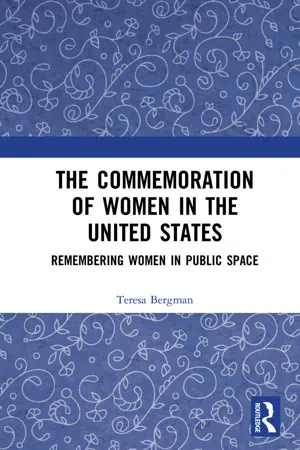
The Commemoration of Women in the United States examines the public memorialization of women in the US over the past century, with a particular focus on the late twentieth century and early twenty first. The analysis centers on six case examples of memorialization, and explores broad themes of cultural representation.
Bergman argues that the construction, or relocation, of a series of prominent national memorials together form a significant moment of change in the ways in which women are commemorated in the US. The historic and present-day challenges facing such commemoration are examined, with reference to broader political debates. The case examples explored are the Women in the Military Service for America Memorial; the Women's Rights National Historic Park; the Vietnam Veterans Women's Memorial; the Rosie the Riveter WWII Home Front National Historical Park; the Eleanor Roosevelt Statue in the Franklin Delano Roosevelt Memorial; and the Portrait Monument of Susan B. Anthony, Lucretia Mott, and Elizabeth Cady Stanton.
Providing insightful and grounded analysis of the history and practice of the commemoration of women in the US, this book makes useful reading for a range of scholars and students in subjects including heritage studies, communication studies, and history.
The Eleanor Roosevelt statue in the Franklin Delano Roosevelt (FDR) Memorial on the National Mall provides an important starting point for discussing the considerable changes that have taken place in commemoration of U.S. women’s patriotism and nationalism. Of the six sites chosen for this study, the Eleanor Roosevelt statue is the single memorial that falls into the compensatory category of representing women’s history. The Eleanor Roosevelt statue in the FDR Memorial is unlike the other five case studies in this book because the main focus of the other sites, from their inception, was the representation of women. Even though Eleanor Roosevelt “is the only first lady to be so honored in a presidential memorial,”1 deliberations surrounding the creation of the FDR Memorial did not include her representation until 1990. In fact, Lawrence Halprin, the FDR Memorial designer, wrote that the “FDR Memorial Commission had been negative about including Mrs. Roosevelt” because “Franklin Delano Roosevelt was elected president … not his wife.”2
Although the FDR Memorial was initially conceived to commemorate her husband and not Eleanor Roosevelt, her appearance in this memorial is significant for several reasons. Her statue is part of the paltry representation of women in general on the National Mall. A 2012 comprehensive inventory of the commemorative works on National Park Service land in Washington, DC, found that of the “113 completed memorials … only 6% prominently feature women.”3 Her statue is also significant because of the conditions that enabled its presence, which included the adoption of a new commemorative design approach that also ushered in her inclusion. Even with such a small number of memorials to women, and the radical design of the FDR Memorial, the response to the Eleanor Roosevelt statue in the FDR Memorial was decidedly mixed, reflecting larger ideological disagreements on women’s representation.
The FDR Memorial is located along the Potomac River Tidal Basin, between the Martin Luther King and Thomas Jefferson Memorials, and at 800 feet in length it is one of the largest memorials in the National Mall.4 The Eleanor Roosevelt statue, located toward the end of the sprawling FDR Memorial, is a larger-than-life representation of an older Eleanor Roosevelt, wearing a cloth overcoat, with a mid-calf-length dress showing beneath, and Oxford-type shoes with a small heel (see Figure 1.1). Her statue stands in a niche with the United Nations emblem behind her, and the etched words below the emblem read: “Eleanor Roosevelt First United States Delegate to the United Nations.” History professor Allida Black described the statue as a “resigned, world-weary woman, hands demurely clasped in front, leaving the United Nations,” and “safely relegated to a position in FDR’s shadow.”5 Sue Stovall, writing for the Sculpture Review, described the statue as “an appropriate reference to the work Eleanor Roosevelt did with the United Nations after the president’s death.”6 This dissensus, ranging from discontent for being located within FDR’s shadow to welcoming the statue as an appropriate depiction, indicates one of the challenges of women’s commemoration when their inclusion is not considered initially. In order to understand the historical moment that enabled the Eleanor Roosevelt statue, this chapter examines the evolution of the rhetorical situation surrounding the creation of the FDR Memorial, and how the addition of Eleanor Roosevelt and the memorial’s design both challenged commemorative decorum. The discussion begins with an examination of the key rhetorical events involved in the creation of the FDR Memorial, followed by an analysis of the changing rhetorical situation that enabled Eleanor Roosevelt’s addition, and concludes with an analysis of the ideological implications of the compensatory depiction of her public service and as First Lady.
Figure 1.1Image of Eleanor Roosevelt in the Franklin Delano Roosevelt Memorial in Washington, DC (courtesy of the U.S. Library of Congress, Prints and Photographs Division, Washington, DC).
Initial Rhetorical Situation
Initial plans for the FDR Memorial began on August 11, 1955, when President Dwight D. Eisenhower signed S.J. Resolution 73 establishing the Franklin Delano Roosevelt Memorial Commission, and this resolution contained no mention of including Eleanor Roosevelt (see Figure 1.2).7 It was one of the longest running memorial commissions, and its long tenure is explained by ongoing discord on topics ranging from how to commemorate FDR, to design disagreement, to whether to add Eleanor Roosevelt to the memorial.8 Public Law 86-214 reserved the site in West Potomac Park for the FDR Memorial in 1959, and by 1960 the commission began a design competition for the memorial, which received 547 submissions.9 The FDR Memorial Commission approved the design by Pedersen & Tilney in 1964, but this design was abandoned the following year because of criticism of the design, which included dubbing it as an “instant Stonehenge.”10 The drawings of this proposed memorial were on such a massive scale that the critique appeared fitting. The next designer, Marcel Breuer, chosen in 1966, attempted to scale down the immense size of the Pedersen & Tilney proposal. His version included “seven imposing rough granite ‘darts,’ sixty feet at their highest, radiating outward from a 32-foot cube of polished granite bearing an incised photograph portrait of Roosevelt on its surfaces.”11 This truly odd design was rejected in 1967, and the FDR Memorial Commission continued for the next several decades trying to find a balance between a Stonehenge or a rose garden type of design. The FDR Memorial Commission could not agree upon a plan, and when Ronald Reagan was elected president in 1980, one element of his platform was to cut the size of federal government. With his mandate, two members of Congress, “Reps. Dan Glickman, D-Kan., and Bill Dannemeyer, R-Calif., … tried to save the government a little money by abolishing the FDR Memorial Commission.” Their amendment was defeated in the House of Representatives by a vote of 216 to 201.12 These congressmen depicted the FDR Memorial Commission as government bloat; however, the contentious design issues were the cause of the stalemate rather than government bureaucracy.
Figure 1.2Image of workers installing the Franklin Delano Roosevelt Memorial in Washington, DC (courtesy of the U.S. Library of Congress, Prints and Photographs Division, Washington, DC).
Design Stalemate
The National Mall developed considerably during this time period, and each new memorial was accompanied by dissensus about the new memorial landscape. Before his death, FDR communicated how he wanted to be commemorated, and stated that he preferred an extremely simple commemorative plaque on a small stone, and his desire was fulfilled (see Figure 1.3). On April 12, 1965, a small marble stone was placed next to the National Archives on Pennsylvania Avenue, engraved with the words “In Memory of Franklin Delano Roosevelt 1882–1945.” (see Figure 1.4) Next to this diminutive and unassuming block of marble is a plaque that reads:
In September 1941 President Franklin Delano Roosevelt called his friend, Supreme Court Justice Frankfurter, to the White House and asked the justice to remember the wish he then expressed: “If any memorial is erected to me, I know exactly what I should like it to be. I should like it to consist of a block about the size of this (putting his hand on his desk) and placed in the center of that green plot in front of the archives building. I don’t care what it is made of, whether limestone or granite or whatnot, but I want it plain without any ornamentation, with the simple carving, ‘In Memory of ________________.’” On April 12, 1965, the twentieth anniversary of FDR’s death, a small group of living associates of the President fulfilled his wish by providing and dedicating this modest memorial.13
Despite his explicit statement concerning his commemoration, the FDR Memorial Commission continued to meet until it found another design they could agree upon. The sustained disagreement on how to commemorate FDR was not resolved until the commission viewed a new commemorative design approach that challenged commemorative design decorum.
Figure 1.3Image of the Franklin Delano Roosevelt engraved stone located next to the National Archives and Records Administration in Washington, DC (photograph by the author, 2015).
Figure 1.4Image of the Franklin Delano Roosevelt plaque located next to the National Archives and Records Administration in Washington, DC (photograph courtesy of Roger Aden, 2017).
Traditional Commemoration No Longer Appropriate
The FDR Memorial Commission held two more design competitions, and in March 1978 they accepted the design of Lawrence Halprin from San Francisco (see Figure 1.5).14 The FDR Memorial Commission’s choice of Lawrence Halprin to design the FDR Memorial signaled an important change of direction in U.S. commemoration on the National Mall, and it was one that embraced the new directions in landscape architecture. Halprin’s approach to landscape architecture incorporated urbanist and activist Jane Jacobs’ concerns by attempting “to make cities safer, livelier, and more diverse, filled with a variety of experiences and places.”15 Landscape architect Ann Komara characterizes Halprin as “one of the most substantive and influential practitioners of the second half of the twentieth century,” who is highly regarded for “his sensitivity to human factors in design and his investigation of movement and the experience of place,” and points ou...
Table of contents
Cover
Half Title
Title Page
Copyright Page
Dedication
Contents
Figures
Acknowledgments
Introduction: Beyond Allegory
1 Eleanor Roosevelt as Coda
2 The Portrait Monument’s Radical Message
3 The Politics of Optimism at the Women’s Rights National Historical Park
4 Women’s Patriotism in War: Vietnam Women’s and Women in Military Service for America Memorials
5 Rosie the Riveter WWII Home Front National Historical Park and the Social Construction of Power
Conclusion: After Absence, the Complications of Presence
Bibliography
Index
Trusted by 375,005 students
Access to over 1.5 million titles for a fair monthly price.
Study more efficiently using our study tools.
Frequently asked questions
Yes, you can cancel anytime from the Subscription tab in your account settings on the Perlego website. Your subscription will stay active until the end of your current billing period. Learn how to cancel your subscription
No, books cannot be downloaded as external files, such as PDFs, for use outside of Perlego. However, you can download books within the Perlego app for offline reading on mobile or tablet. Learn how to download books offline
Perlego offers two plans: Essential and Complete
Essential is ideal for learners and professionals who enjoy exploring a wide range of subjects. Access the Essential Library with 800,000+ trusted titles and best-sellers across business, personal growth, and the humanities. Includes unlimited reading time and Standard Read Aloud voice.
Complete: Perfect for advanced learners and researchers needing full, unrestricted access. Unlock 1.5M+ books across hundreds of subjects, including academic and specialized titles. The Complete Plan also includes advanced features like Premium Read Aloud and Research Assistant.
Both plans are available with monthly, semester, or annual billing cycles.
We are an online textbook subscription service, where you can get access to an entire online library for less than the price of a single book per month. With over 1.5 million books across 990+ topics, we’ve got you covered! Learn about our mission
Look out for the read-aloud symbol on your next book to see if you can listen to it. The read-aloud tool reads text aloud for you, highlighting the text as it is being read. You can pause it, speed it up and slow it down. Learn more about Read Aloud
Yes! You can use the Perlego app on both iOS and Android devices to read anytime, anywhere — even offline. Perfect for commutes or when you’re on the go. Please note we cannot support devices running on iOS 13 and Android 7 or earlier. Learn more about using the app
Yes, you can access The Commemoration of Women in the United States by Teresa Bergman in PDF and/or ePUB format, as well as other popular books in Social Sciences & Archaeology. We have over 1.5 million books available in our catalogue for you to explore.