The Russian Far East was a remarkably fluid region in the period leading up to, during, and after the Russian Revolution. The different contenders in play in the region, imagining and working toward alternative futures, comprised different national groups, including Russians, Buryat-Mongols, Koreans, and Ukrainians; different imperialist projects, including Japanese and American attempts to integrate the region into their political and economic spheres of influence as well as the legacies of Russian expansionism and Bolshevik efforts to export the revolution to Mongolia, Korea, China, and Japan; and various local regionalists, who aimed for independence or strong regional autonomy for distinct Siberian and Far Eastern communities and whose efforts culminated in the short-lived Far Eastern Republic of 1920–1922. The Rise and Fall of Russia's Far Eastern Republic, 1905–1922 charts developments in the region, examines the interplay of the various forces, and explains how a Bolshevik version of state-centered nationalism prevailed.
eBook - ePub
The Rise and Fall of Russia's Far Eastern Republic, 1905–1922
Nationalisms, Imperialisms, and Regionalisms in and after the Russian Empire
- 300 pages
- English
- ePUB (mobile friendly)
- Available on iOS & Android
eBook - ePub
The Rise and Fall of Russia's Far Eastern Republic, 1905–1922
Nationalisms, Imperialisms, and Regionalisms in and after the Russian Empire
About this book
Information
1 Left-liberal nationalism and self-organization east of Baikal, 1905–1916
During the first phase of the imperial transformation, between the First Russian Revolution (1905–1907) and the collapse of the Tsarist government in February–March 1917, left-liberal nationalism came to dominate the empire’s political debates, extending to broader public circles, although still mainly confined to urban areas. Oppositional public rallied around the idea of the self-organized imperial nation. Although left-liberal nationalism was inclusive, declaring equality of the empire’s diverse ethnic, religious, regional, and other social groups, some of the imperial hierarchies remained in place and there was no consensus on how exactly the distribution of universal and special rights should work. Buryat-Mongol, Korean, Ukrainian, Jewish, and other minority nationalists, regionalists, and advocates of other particularistic ideas were able to join the debates, yet the issues of autonomy and political representation remained undecided. Furthermore, despite its strong civic and progressive connotations, left-liberal nationalism remained state-centered, since the good of the Russian state was among its ideals. The two major modern wars – the Russo-Japanese War (1904–1905) and World War I (1914–1918) – which had proved the Tsarist government ineffective in defending the Russian state – consolidated left-liberal nationalism as a heterogeneous oppositional and patriotic discourse and as a program of imperial self-organization. It was in this context when the Russian Far East consolidated as a new imperial region. Far Eastern interests did not contradict the unity of the Russian imperial nation. Following the left-liberal nationalist mainstream, Far Eastern regionalists viewed self-organization as the solution to regional problems which stemmed from the inefficiency of the centralized Tsarist government.
For many Russian and international observers, the Russo-Japanese War marked the crisis of the autocratic political system and proved the efficacy of the reformed Japanese Empire.1 Coupled with social inequality, oppression of ethnic and religious minorities, and excessive centralization, the misfortunes of the war fueled the idea that only bottom-up self-organization of the Russian imperial nation can make the state efficient. The empire’s educated strata advocated self-organization but offered different approaches to it. Liberals, who united around the Union of Zemstvo Constitutionalists and the Union of Liberation, viewed parliamentarism and democracy (in the political sense) as a way of reassembling the Russian state. Having initially united for war relief, zemstvo (rural) representatives demanded a constitution, civil liberties, and a parliament from the Tsar at the first legal Zemstvo Congress (Saint Petersburg, November 6–9, 1904) (General Committee of the Russian Union of Zemstvos 1917, 4). This was the second time after 1895 when local leaders had voiced such demands. Unlike nine years before, on December 12, 1904, Tsar Nicholas II expressed his interest in reforming the state by extending self-government rights, improving workers’ conditions, increasing religious tolerance, empowering ethnic minorities, and relaxing censorship and political persecution. Yet the events turned violent, and the shooting of a peaceful demonstration in Saint Petersburg on January 9, 1905, the Bloody Sunday, marked the symbolic beginning of the First Russian Revolution.2
Unionism which began with the zemstvo movement became the prime form of political self-organization throughout 1905. Although riots and civil unrests were suppressed in 1906–1907, the revolution triggered a series of reforms which made Russia a constitutional monarchy. The October Manifesto (October 17, 1905) granted Russian subjects civil liberties. The Fundamental Laws of the Russian Empire (April 23, 1906) served as the constitution. The State Duma – which was introduced in August 1905, was turned into a legislative, albeit non-universally elected assembly by the October Manifesto, and convened on April 27, 1906 – and the State Council formed the empire’s legislative parliament. The First Duma became a major forum for oppositional politicians but proved short-lived. Responding to the outspoken criticism of its left-liberal (liberal and moderate socialist) majority, the Tsar dissolved the Duma on July 6, 1906. Yet the Second Duma, which convened on February 20, 1907, proved no less radical. Continued criticism of the government and draft legislation on civil rights (Gosudarstvennaia duma, vtoroi sozyv 1907) led to a new conflict, and on June 3, 1907, the Tsar again dissolved the lower chamber. The second dissolution was accompanied by the adoption of a restrictive electoral law, which became known as the Coup of June 3 and marked the revolution’s symbolic end (Obninskii 1906, 1: vii, 1–4, 176–180; Fedyashin 2012).
Civil liberties continued to be violated, the majority of the population was barred from the elections, and the parliament had little to no influence on the cabinet, all of which contributed to further protest and was reflected in political satire (Figure 1.1). Yet the revolution and the Duma, which featured minority and peasant deputies, reshaped imperial politics by opening up the discussions which previously had been confined to a handful of illegal and semi-legal organizations, many of them emigrant (Semyonov 2009). In these discussions, socialists, liberals, and non-partisan progressive intellectuals agreed that democracy was the preferred method of reassembling the empire. Although democracy had a variety of meanings, ranging from civil liberties and representative government to social justice, and from decentralization to national self-determination, the idea of agency and self-organization (samodeiatel’nost’) of an individual or a group was at its core. Societal self-organization was contrasted with the government’s tutelage.3
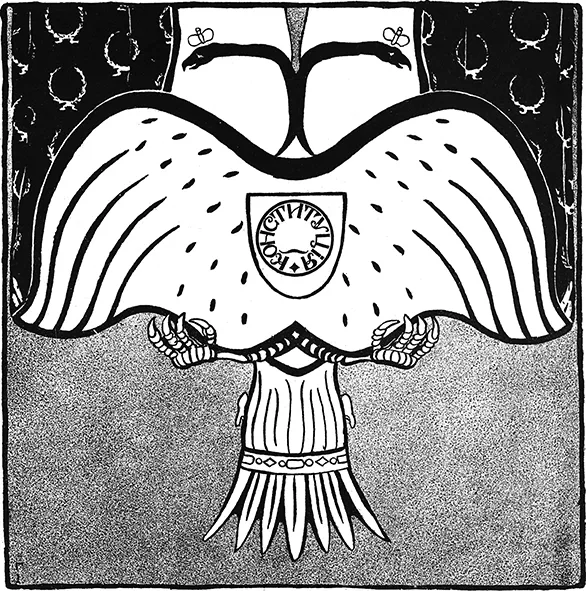
Figure 1.1 The eagle-shapeshifter or foreign and domestic policy, 1905. The word reads “Constitution.”
Source: Grzhebin 1926.
The revolution brought these discussions to the Priamur General Governorship, still considered part of Siberia at large, similar to many other imperial peripheries. Despite the differences and rising competition between the three main oppositional parties – the liberal Constitutional Democratic Party (KDs), the Russian Social Democratic Labor Party (the RSDLP or SDs), and the Party of Socialist Revolutionaries (SRs) – east of Baikal, the broad consensus on democratic self-organization included urban intellectuals, as well as worker, minority, and even peasant activists. With the exception of military riots in Vladivostok and Harbin and minor clashes, the revolution east of Baikal was largely non-violent; there were no pogroms or agricultural riots. Furthermore, most regional officials did not suppress local movements, and the Tsar and Prime Minister Sergei Iul’evich Witte (Vitte) had to dispatch special punitive expeditions.
Siberian Regionalism, Buryat-Mongol nationalism, and other particularistic projects seemed to fit well into the revolutionary self-organization scheme, in which autonomous units were to become the building blocks of a reformed imperial polity. The First and Second Duma facilitated an exchange between the empire’s diverse regional, social, religious, and ethnic groups. The formation of Cossack, Siberian, Muslim, and other caucuses and the programs of the three main oppositional parties helped outline the forms of self-organization (Semyonov 2009; Tsiunchuk 2007). Although the Priamur General Governorship (see Figure I.1) did not send its representatives to the first two parliaments, its representatives and those of the Transbaikal Region4 in the Third (1907–1912) and Fourth (1912–1917) Duma quickly adopted the language of self-organization, occasionally referring to themselves as the Far Easterners. Despite only the propertied class having the right to vote, all nine Far Eastern deputies (Transbaikal, Amur, and Maritime) were part of the left-liberal opposition siding with the KDs, the Labor Faction (Trudoviki), and the SDs.
The Duma did not turn into a functioning parliament, with the Tsar and the cabinet ruling unilaterally. Parliamentary discussions nevertheless helped define the Russian Far East of the Transbaikal, Amur, and Maritime Regions as a territory united by shared problems and interests. The Kamchatka and Sakhalin Regions, which were detached from the Maritime Region in 1909 and had no representatives in the parliament, were also considered part of the region. The CER Zone (also not represented in the parliament) was, however, excluded from the self-organized imperial region. Not only did the Far Eastern deputies defy the official position on the region, which united the Priamur Governor Generalship and the Manchurian possessions into the Viceroyalty of the Far East in 1903–1905, but also explicitly portrayed Manchuria as the “significant other” for the Russian Far East. Manchuria was a competitor of Primor’e and Priamur’e and a symbol of autocratic mismanagement. Before the Russo-Japanese War, the government developed the CER and the Manchurian ports of Port Arthur and Dalny (Dalian or Dairen), both lost in 1905, instead of building the Amur Railway and investing in the mainland Russian ports. Saint Petersburg’s ill-thought foreign policy challenged the security of settlers. The abolition of duty-free trade (porto franco) in the Russian Far East became a further blow to regional interests, lowering the competitiveness of Vladivostok against the Manchurian ports. Far Eastern interests nevertheless did not contradict those of Siberia, and all regional deputies joined the Siberian caucus and campaigned for zemstvo self-government in the whole of North Asia, thereby backing the main Siberian Regionalist cause (Iadrintsev 1892).
The suppression of the First Russian Revolution and the failure of the Duma to become a vehicle for reform did not put an end to political activism locally. Civil society across the empire survived the “Years of Reaction” (1907–1917) (Smith 2017, 10). The crackdown on opposition increased the number of exiles in North Asia, many of whom supported radical socialist groups. Operating locally and until 1910 from Japan, the SRs established party cells across the region. The SDs also set up a regional network with a center in Chita. The moderate orientation of many Siberian Regionalists resulted in tensions with radical exiles (Chuzhak 1927, 1:84). Yet the ideas of Grigorii Nikolaevich Potanin and others remained popular, attracting new backers, including former supporters of the SDs. Besides, the new crackdown on socialist organizations in 1910 effectively barred them from public discussions giving moderates a further advantage.
The agrarian reforms of 1906–1911 increased the number of settlers. Between 1908 and 1917, some 300,000 settlers (predominantly poor peasants from the European part of the empire) moved to the Priamur General Governorship. Following the Japanese occupation and annexation of Korea in 1905–1910, Korean settlement and political immigration increased as well. Their estimated numbers in Primor’e increased from 24,000 in 1900 to 64,000 in 1914 (Stephan 1994, 66–67, 75–76). In 1914, the total population of the Transbaikal (945,700), Amur (250,400), Maritime (606,600), Kamchatka (40,500), and Sakhalin (33,500) Regions reached 1,802,700, almost doubling, compared to 1,043,792 on the same territory in 1897.5 Mass settlement violated the land-use interests of the indigenous peoples and old settlers (including the Cossacks). The incursions into Buryat-Mongol lands became the key factor in the continued development of their national movement.
Buryat-Mongol and other minority nationalisms, which developed in 1905–1917, followed the larger imperial trend launched by the First Russian Revolution and the exchanges in the First and Second Duma. Students of the Vladivostok Oriental Institute and other intellectuals set up the first Ukrainian organizations in the Russian Far East in 1907–1911 (Chernomaz 2009, 60, 85–90). Korean, Chinese, and Japanese societies connected self-organization in the Russian Empire to that in the Japanese and Qing Empires. Korean guerillas and political activists used the Russian Far East as a base for operations against Japan, connecting the region to the larger Korean national movement. In a similar manner, those Buryat-Mongol intellectuals, who cooperated with the government of autonomous Outer Mongolia, after the collapse of the Qing Empire, contributed to the making of a broader Mongol political community. Elbek-Dorzhi Rinchino and other Buryat-Mongols also participated in the Siberian Regionalist movement (Rinchino 1994b, 34).
The inflow of settlers from European provinces dropped during World War I. Many Russian subjects, including Buryat-Mongols and naturalized Koreans, were mobilized for service at the front or the rear of the army. The large share of conscripts from the Transbaikal (13 percent of the total population in 1917), Maritime (10.8 percent), and Amur (12.5 percent) Regions led to labor shortages.6 Yet the demand increased, as Vladivostok remained Russia’s only major seaport receiving military goods and other commodities after the Central Powers effectively blocked the Baltic and Black Seas. Apart from transportation, the war also boosted military industries and coal mining.7 New Korean and Chinese migrants were supposed to meet the labor demand. With some 50,000 Chinese entering the Priamur General Governorship in 1916, the official number of foreign subjects there increased to 150,000. The war economy also reshaped the social structure of the population. Although the total population of the Priamur General Governorship grew only 1 percent in 1914–1916, the share of urban dwellers increased, reaching 32 percent in 1917.8 Unlike elsewhere in the empire, the large share of foreigners in labor and the predominance of temporal wage work did not translate the dissatisfaction with the rising prices and insufficient commodity supplies in the region into an organized movement. Still, the number of strikes increased from six in July 1914–late 1915 to 20 in 1916 (Galliamova 2014; Ikonnikova 1999).
During World War I, many zemstvo and municipal liberals across the empire opted for cooperation with moderate socialists and became increasingly interested in extra-parliamentary democracy in view of the Duma’s weakness. Self-organization through zemstvos, municipalities, war industries committees, cooperatives (diverse credit, consumer, and producer societies), associations of peasants, workers, traders, and minority nationalists mirrored the unionism of the First Russian Revolution and was supposed to strengthen the Russian imperial nation for the sake of winning the war. The proposed assemblage resonated with anarchist and socialist ideas on bottom-up societal organization. Yet unlike the radicals, many Russian liberals supported a system of unequal representation, with disproportional influence by the propertied class on decision-making (Bakunin 1972; Mill 1861, 175–76; Resnick 1973). During the last years of the empire, this and other differences between and among liberals and socialists did not prevent a broader left-liberal national consensus, which was directed against autocracy, and turned into political fragmentation only during the Revolution of 1917.
The First Russian Revolution, 1905–19079
In North Asia, the First Russian Revolution was predominantly confined to urban areas and those close to the railway line. Due to the relative abundance of arable land, no legacies of serfdom, and no large-scale private land ownership, there was no sizeable agrarian movement as in the European regions of the empire. Yet the revolution demonstrated that there was broad dissatisfaction with centralism and aspirations for economic and political reform. Rai...
Table of contents
- Cover
- Half Title
- Title Page
- Copyright page
- Table of Contents
- List of figures
- Introduction to the series
- Acknowledgments
- Note on the text
- List of abbreviations
- Introduction
- 1 Left-liberal nationalism and self-organization east of Baikal, 1905–1916
- 2 Post-imperial particularisms in the Russian Far East, 1917–1919
- 3 Nationalisms and the making of the Far Eastern Republic, 1920
- 4 The Far Eastern Republic and the Priamur State Formation, 1921
- 5 Competing nationalisms and Sovietization in the Russian Far East, 1922
- Conclusion
- Index
Trusted by 375,005 students
Access to over 1.5 million titles for a fair monthly price.
Study more efficiently using our study tools.
Frequently asked questions
Yes, you can cancel anytime from the Subscription tab in your account settings on the Perlego website. Your subscription will stay active until the end of your current billing period. Learn how to cancel your subscription
No, books cannot be downloaded as external files, such as PDFs, for use outside of Perlego. However, you can download books within the Perlego app for offline reading on mobile or tablet. Learn how to download books offline
Perlego offers two plans: Essential and Complete
- Essential is ideal for learners and professionals who enjoy exploring a wide range of subjects. Access the Essential Library with 800,000+ trusted titles and best-sellers across business, personal growth, and the humanities. Includes unlimited reading time and Standard Read Aloud voice.
- Complete: Perfect for advanced learners and researchers needing full, unrestricted access. Unlock 1.5M+ books across hundreds of subjects, including academic and specialized titles. The Complete Plan also includes advanced features like Premium Read Aloud and Research Assistant.
We are an online textbook subscription service, where you can get access to an entire online library for less than the price of a single book per month. With over 1.5 million books across 990+ topics, we’ve got you covered! Learn about our mission
Look out for the read-aloud symbol on your next book to see if you can listen to it. The read-aloud tool reads text aloud for you, highlighting the text as it is being read. You can pause it, speed it up and slow it down. Learn more about Read Aloud
Yes! You can use the Perlego app on both iOS and Android devices to read anytime, anywhere — even offline. Perfect for commutes or when you’re on the go.
Please note we cannot support devices running on iOS 13 and Android 7 or earlier. Learn more about using the app
Please note we cannot support devices running on iOS 13 and Android 7 or earlier. Learn more about using the app
Yes, you can access The Rise and Fall of Russia's Far Eastern Republic, 1905–1922 by Ivan Sablin in PDF and/or ePUB format, as well as other popular books in Social Sciences & Ethnic Studies. We have over 1.5 million books available in our catalogue for you to explore.