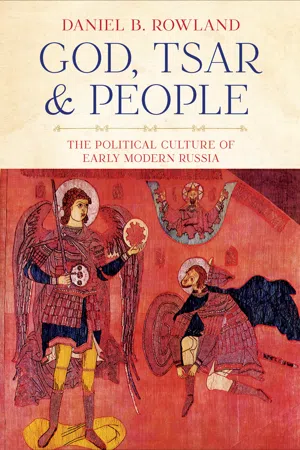
God, Tsar, and People brings together in one volume essays written over a period of fifty years, using a wide variety of evidence—texts, icons, architecture, and ritual—to reveal how early modern Russians (1450–1700) imagined their rapidly changing political world.
This volume presents a more nuanced picture of Russian political thought during the two centuries before Peter the Great came to power than is typically available. The state was expanding at a dizzying rate, and atop Russia's traditional political structure sat a ruler who supposedly reflected God's will. The problem facing Russians was that actual rulers seldom—or never—exhibited the required perfection. Daniel Rowland argues that this contradictory set of ideas was far less autocratic in both theory and practice than modern stereotypes would have us believe. In comparing and contrasting Russian history with that of Western European states, Rowland is also questioning the notion that Russia has always been, and always viewed itself as, an authoritarian country. God, Tsar, and People explores how the Russian state in this period kept its vast lands and diverse subjects united in a common view of a Christian polity, defending its long frontier against powerful enemies from the East and from the West.
Biblical Military Imagery in the Political Culture of Early Modern Russia
The Blessed Host of the Heavenly Tsar
“He deemed us soldiers of the Christian Faith
Willing to die for God. The hour of proof
Is come. The foes of Charles and God are here
Before you. Now confess your sins, and pray
God’s bounteous mercy. Then shall I absolve you,
And if you die, the crown of martyrdom
Is yours, and yours great Paradise.” He spoke,
And so the Franks, dismounting, knelt them down,
And Turpin signed them with the cross of God,
And for a penance bade them deal stout blows.
—Archbishop Turpin’s sermon, The Song of Roland
But the fight for our planet, physical and spiritual, a fight of cosmic proportions, is not a vague matter of the future; it has already started. The forces of Evil have begun their decisive offensive.
—Aleksandr Solzhenitsyn, Harvard speech, 1978
What a foolish notion
That killing is devotion
—Holly Near
In a recent review in The Atlantic, Neil Postman described the importance of mutually shared stories in the lives of nations, disciplines, and people:
Human beings require stories to give meaning to the facts of their existence. I am not talking here about those specialized stories that we call novels, plays, and epic poems. I am talking about the more profound stories that people, nations, religions, and disciplines unfold in order to make sense out of the world. For example, ever since we can remember all of us have been telling ourselves stories about ourselves, composing life-giving autobiographies in which we are the heroes and heroines.1
What stories did early modern Russians tell themselves about their state, why it existed and why it deserved their allegiance? What image or images did Muscovites have of themselves as a political entity? What story did they see in history, and what role did they envision for themselves? These are some questions to which I hope this essay will provide a partial answer by briefly examining one set of overlapping biblical images. These images depicted the Muscovite state as a re-embodiment of the ancient Israelite army and simultaneously as what the Israelites themselves thought their own army to have been—an earthly representation of the forces of God engaged in a cosmic struggle against the forces of evil.
In states as diverse as medieval Java, Elizabethan England, and nineteenth-century Morocco, commonly believed stories about the state were of enormous political importance because they helped to generate a consensus that made government possible.2 In Muscovy, the need for such a consensus was particularly urgent because the government, like that of an early medieval Western European state, was relatively weak. In 1450, 1500, or even 1600, Muscovy was economically poorer than most other contemporary European states, had a more rudimentary bureaucratic system, and yet succeeded remarkably well in expanding both its borders and its influence. Faced with relatively slender economic resources and an inability to compel obedience through brute force alone (though brute force was relied upon often enough), Muscovite rulers were of necessity dependent on shared stories, on the “symbolics of power,” in Clifford Geertz’s phrase, to maintain and expand their power. The idea of heavenly host was, at least potentially, an important source of Russian political loyalty because it was framed in military images that would have been immediately accessible to the most powerful group outside of the tsar himself—the military elite who formed the core of both the court and the army. It also gave this class a divinely sanctioned role to play in world history and God’s invincible protection while they were playing it.
Most of the abundant evidence I discuss is located in the Moscow Kremlin, the social, political, and symbolic center of the Muscovite state. The Kremlin seems to fit perfectly Geertz’s definition of a “glowing center.” Such centers are “essentially concentrated loci of serious acts; they consist in the point or points in a society where its leading ideas come together with its leading institutions to create an arena in which the events that most vitally affect its members’ lives take place.”3 Such centers convey particular importance to the symbolic events that occur in them and charisma to the people who frequent them. The placement in the Kremlin of multiple images depicting the theme of the host of the heavenly tsar suggests that this idea was of exceptional importance.
The very abundance of evidence on this theme presents a methodological problem: Space limitations here require me to deal briefly with a large number of works on a general level. The biggest danger inherent in this approach is that future research may (and probably will) result in the redating of some of the works I describe. Although many of the works themselves were painted in the seventeenth century, they seem to have been carefully based on earlier paintings that had deteriorated or been destroyed. The date and nature of the earliest iconographical programs and their relationship to what we now see or what was described in the 1670s may never be known with certainty. In theory, all general overviews should await the completion of careful and skeptical investigations into the authenticity and dating of each of the monuments concerned. Since in the case of biblical military imagery in Muscovy, this point will probably never be reached to everyone’s satisfaction, I have decided simply to proceed on the basis of present knowledge and to warn my readers of the danger that some pieces of evidence could turn out to come from the seventeenth rather than from the sixteenth century. I hope that this analysis demonstrates that the main ingredients of the idea of the Muscovite army as the “host of the Heavenly Tsar” were already present in Moscow by 1500. The dating of the murals in the Archangel Michael Cathedral remains uncertain, for example, but most of the scenes from the “life” of Michael, discussed below, can already be found in the same church’s Saint Michael icon that scholars believe was painted around 1400. These scenes were described in the twelfth century by a Byzantine writer, as we will discuss below.
Limitations of both space and knowledge prevent me from following the traditional path of explaining this theme by tracing in detail the origins of each of its constituent parts. This traditional method would set Muscovite works of art produced at a given moment against earlier examples of the same tradition, and, by throwing into relief what was new, would show the intention of the painter or program designer. Earlier developments are important to show that the basic ingredients of the theme of the blessed host of the Heavenly Tsar had been around for some time, that they were commonplaces in the Orthodox world, both within the cultural sphere of Rus´ and outside of it, and that these ideas would have therefore been easily accessible to most people, lay as well as clerical. By design as well as necessity, therefore, I have concentrated below on establishing a plausible reading of several visual texts in the light of Muscovite cultural ideas of the period roughly from 1550 to 1630. In spite of uncertainties of dating, I believe that this reading provides evidence of an important and powerful idea, of a story that, although it has been relatively ignored in recent times, may have given meaning to the lives of many Muscovites.
An emphasis on audience leads to a study of visual rather than textual evidence. In a society that was overwhelmingly illiterate, images were accessible to many more people than written texts were, and there were many more of them. As objects, they were also more powerful. M. T. Clanchy tells the fascinating story of an oral tradition from the reign of Edward I of England in which the Earl of Warenne shows a rusty sword in court to demonstrate the feudal rights acquired by his ancestors at the Norman Conquest. For the earl, the sword was worth much more than words on a paper. Painted or embroidered images were narrative objects whose meaning did not depend on literacy. On a wall they were passive, but as battle standards like the sword of the Earl of Warenne, they became active symbols.4
Historians have paid remarkably little attention to this visual evidence. Although both Michael Cherniavsky and David Miller, among American historians, have pointed to a virtual explosion of building and decorating in early modern Russia, conclusions drawn from this material have yet to enter the mainstream of our conceptions about Muscovy.5 There are other reasons more compelling than the possibly provincial American views of Muscovy. One of the striking features of Muscovite literary life is that much more energy was spent on editing and compiling previously existing works than was expended on the composition of original works.6 Original texts on general or abstract political subjects are particularly hard to find. Under these circumstances, the mural cycles in the Kremlin and the increasingly complex and didactic icons that were closely related to them may represent the best evidence we have of Muscovy’s historical imagination and her political image of herself. Further, it was far harder to copy a mural cycle from another time and place than it was to copy a text, which could be easily transported.
FIGURE6.1.Blessed Is the Host of the Heavenly Tsar[The Church Militant], 1550s, Tretiakov Gallery. Source: Wikimedia Commons.
Three sixteenth-century visual works serve admirably to illustrate the range of meanings conveyed in the theme of the blessed host of the Heavenly Tsar and provide evidence for the particular reading of other works that forms the basis of this essay. The most fully investigated is the Church Militant icon (figure 6.1), which provides the title for this essay. This icon, measuring seven feet in length, was given its current name, the Church Militant, only in the eighteenth century. It was painted apparently to commemorate Ivan IV’s victory over Kazan´ in 1552 and to memorialize the holy martyrs who fell during the victorious campaign. Thereafter it was placed prominently near the tsar’s place in the Kremlin’s Dormition Cathedral, and was listed in an early seventeenth-century description under the title Blessed Is the Host of the Heavenly Tsar.
V. I. Antonova made the important discovery that this title comes from a liturgical text commemorating holy martyrs (a point to which we will return), but the icon is also closely linked to two biblical chapters, Daniel 12 and Revelation 19.7 In Daniel’s vision, the Archangel Michael leads the heavenly host against an unnamed northern king in the last days:
And at that time shall Michael stand up, the great prince [kniaz´velikii in the Ostrih Bible] who standeth for the children of thy people, and there shall be a time of trouble such as never was since there was a nation even to that...
Table of contents
Acknowledgments
A Brief Note on Transliteration and Our Editorial Policy
Foreword
The Textual
Adding the Visual
Summing Up
Index
Trusted by 375,005 students
Access to over 1.5 million titles for a fair monthly price.
Study more efficiently using our study tools.
Frequently asked questions
Yes, you can cancel anytime from the Subscription tab in your account settings on the Perlego website. Your subscription will stay active until the end of your current billing period. Learn how to cancel your subscription
No, books cannot be downloaded as external files, such as PDFs, for use outside of Perlego. However, you can download books within the Perlego app for offline reading on mobile or tablet. Learn how to download books offline
Perlego offers two plans: Essential and Complete
Essential is ideal for learners and professionals who enjoy exploring a wide range of subjects. Access the Essential Library with 800,000+ trusted titles and best-sellers across business, personal growth, and the humanities. Includes unlimited reading time and Standard Read Aloud voice.
Complete: Perfect for advanced learners and researchers needing full, unrestricted access. Unlock 1.5M+ books across hundreds of subjects, including academic and specialized titles. The Complete Plan also includes advanced features like Premium Read Aloud and Research Assistant.
Both plans are available with monthly, semester, or annual billing cycles.
We are an online textbook subscription service, where you can get access to an entire online library for less than the price of a single book per month. With over 1.5 million books across 990+ topics, we’ve got you covered! Learn about our mission
Look out for the read-aloud symbol on your next book to see if you can listen to it. The read-aloud tool reads text aloud for you, highlighting the text as it is being read. You can pause it, speed it up and slow it down. Learn more about Read Aloud
Yes! You can use the Perlego app on both iOS and Android devices to read anytime, anywhere — even offline. Perfect for commutes or when you’re on the go. Please note we cannot support devices running on iOS 13 and Android 7 or earlier. Learn more about using the app
Yes, you can access God, Tsar, and People by Daniel B. Rowland in PDF and/or ePUB format, as well as other popular books in History & European Medieval History. We have over 1.5 million books available in our catalogue for you to explore.