Millions of tourists visit Washington, D.C., every year, but for some the experience is about much more than sightseeing. Lauren R. Kerby’s lively book takes readers onto tour buses and explores the world of Christian heritage tourism. These expeditions visit the same attractions as their secular counterparts—Capitol Hill, the Washington Monument, the war memorials, and much more—but the white evangelicals who flock to the tours are searching for evidence that America was founded as a Christian nation.
The tours preach a historical jeremiad that resonates far beyond Washington. White evangelicals across the United States tell stories of the nation’s Christian origins, its subsequent fall into moral and spiritual corruption, and its need for repentance and return to founding principles. This vision of American history, Kerby finds, is white evangelicals’ most powerful political resource—it allows them to shapeshift between the roles of faithful patriots and persecuted outsiders. In an era when white evangelicals’ political commitments baffle many observers, this book offers a key for understanding how they continually reimagine the American story and their own place in it.
eBook - ePub
Saving History
How White Evangelicals Tour the Nation's Capital and Redeem a Christian America
- 208 pages
- English
- ePUB (mobile friendly)
- Available on iOS & Android
eBook - ePub
Saving History
How White Evangelicals Tour the Nation's Capital and Redeem a Christian America
About this book
Information
Topic
Theology & ReligionSubtopic
Conservatism & LiberalismChapter 1 Founders
Just south of Constitution Avenue on the western edge of the National Mall sits a memorial that is often overlooked. Signers Island occupies the middle of Constitution Pond, a free-form body of water that meanders between the memorials to World War II and Vietnam veterans. The island is linked to the mainland with a simple wooden bridge. On its mainland end, the bridge is inscribed with a dedication from the 1976 American Revolution Bicentennial Administration, the organization that paid for the memorial. On the other end, the bridge features the final lines of the Declaration of Independence: “And for the support of this Declaration, with a firm reliance on the protection of Divine Providence, we mutually pledge to each other our Lives, our Fortunes, and our sacred Honor.”
As a group of tourists crosses the bridge, many of them pause to take a picture of this second inscription, momentarily halting traffic. Eventually, all twenty-five of them make it onto the island, urged gently onward by their guide, Jonathan. A few steps from the bridge, they find themselves in the middle of a semicircle of short stone pillars that opens onto the pond, with views of the Washington Monument across the water. Each of the fifty-six pillars bears the signature of one of the signers of the Declaration of Independence, accompanied by his printed name, occupation, and county. Some of the names are easily recognized: John Hancock, Thomas Jefferson, Benjamin Franklin. Others are less familiar: Edward Rutledge, Button Gwinnett, Charles Carroll of Carrollton. If there is any ambient Christianity here, it remains quiet in the background. Tourists browse the pillars casually, photographing the names they know. Soon their eyes (and cameras) drift away from this memorial to the Washington Monument and its picturesque reflection in the pond. There is little shade and nowhere to sit, so they are reluctant to linger.

Square stone pillars honoring the signers of the Declaration of Independence on Signers Island, July 2016. Photo by the author.
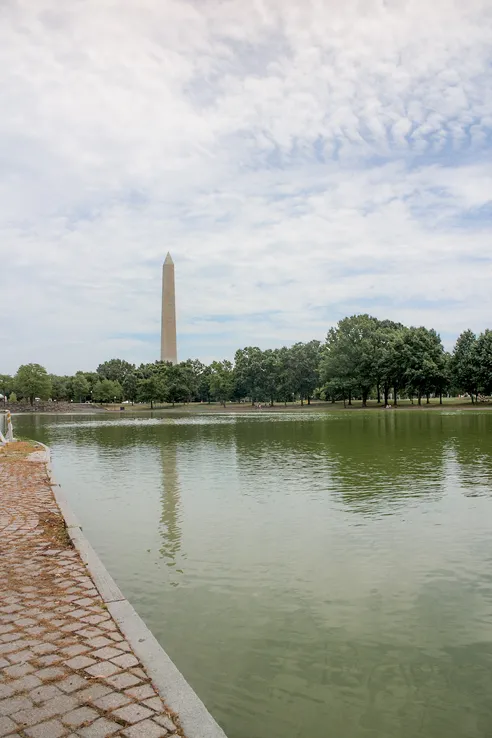
View of the Washington Monument from Signers Island, July 2016. Photo by the author.
As if their restlessness is his cue, Jonathan begins to tell stories about the men this memorial honors, the fifty-six signers of the Declaration of Independence. He starts with Samuel Adams of Massachusetts, who reportedly asked for a prayer to open the Constitutional Convention. In Jonathan’s telling, the delegates initially could not agree on a prayer, largely due to objections from the Quaker contingent. They settled on a reading of Psalm 35: “Plead my cause, O Lord, with them that strive with me: fight against them that fight against me.” As some tourists murmur appreciatively, he moves on to talk about Benjamin Rush, the founder of the Sunday School movement and another signer of the Declaration who was “a strong believer.” Jonathan also draws his tourists’ attention to John Witherspoon, who was the president of the College of New Jersey (now Princeton University), a Presbyterian minister. He was the “grandfather of the nation,” Jonathan says, because he taught so many of the future leaders of the new United States. He continues through the list, identifying the many signers who were ordained as ministers and in some cases reciting key lines from their writings about their faith. By doing so, he activates these pillars as Christian objects with significance for Christian heritage seekers. As he speaks, tourists who had wandered to the water’s edge come back to take a second look at the pillars, examining the professions of the signers more carefully. Jonathan wraps up his talk by exhorting his audience to remember that these men were “strong Christians” willing to sacrifice everything—“their lives, their fortunes, and their sacred honor”—for the cause of liberty.
Signers Island is not one of D.C.’s marquee attractions, but it nevertheless played an important role in the Christian heritage tours I observed. Tourists visited it only if time permitted—for those on a tight schedule, the modest memorial could not compete with the allure of Capitol Hill, the war memorials, and Arlington National Cemetery. But even if a group did not have time to stop, the guides still pointed it out from the bus, and tourists dutifully took photos as the bus crawled past in the heavy traffic on Constitution Avenue. The island itself was significant in these tours only insofar as it prompted a discussion of the signers of the Declaration of Independence and their “strong Christian faith.”
These visits and drive-bys to Signers Island offer a snapshot of the kind of stories featured on Christian heritage tours. These stories echo the Christian Right’s revisionist history of the United States, in which the founders were proto-evangelicals who intended Christianity to occupy a privileged place in the nation, and white evangelicals today are responsible for ensuring that the nation fulfills their intentions. This history is, in a sense, not history at all. Rather, it is heritage. According to historian David Lowenthal, “While it borrows from an enlivens historical study, heritage is not an inquiry into the past but a celebration of it, not an effort to know what actually happened but a profession of faith in a past tailored to present-day purposes.”1 Like other heritage makers, the Christian Right’s purpose was to use a particular narrative of the past to build a communal identity around an inheritance, in this case, of the nation.2 This narrative has some flexibility, particularly in the choice of heroes to feature and evidence to marshal. It does not, however, leave room for error.3 Its characters cannot be doubters, and its evidence cannot be ambiguous. This story must be uncompromising, for any compromise would leave it vulnerable to its many detractors. If this history is to be the blueprint for saving the nation, it must not waver in its claims about the Christianity of the founders and their prescriptions for American public and political life.
Academic historians greet Christian heritage history with skepticism (and often derision), largely because it rests on two claims that are antithetical to the academy. First, Christian heritage history uncritically accepts that the founders and other American heroes are utterly sincere in any word or action that references Christianity.4 Actions that academic historians might understand as expressions of civil religion, political expediency, or social control are understood by Christian heritage proponents to be sincere acts of devotion. This approach flattens the complexity of human behavior and ignores historical context. Second, Christian heritage history views the Christian God as a historical actor. Past events can be explained in terms of divine intervention. Academic historians reject this approach as part of their broader rejection of supernaturalism. Academic explanations of the American Revolution or the Great Depression can begin with politics or economics, but not divine providence. As a result of these two fundamental points of disagreement, Christian heritage proponents routinely clash with academic historians in a battle for the “real” history of the United States.
Christian heritage tours intervened in this debate by promising material evidence for their side of the story. D.C.’s many Christian statues, objects, and inscriptions can act as proof that, at some point in the past, Christians did occupy the privileged place that Christian heritage proponents say they did. Christian tourists understood these material objects, like the words and actions of the founders, to be sincere expressions of faith. In their view, the materiality of the objects made them incontrovertible proof of the Christian heritage story. Here, too, an academic perspective would be more critical in considering the intent of an object’s creators and its shift in meaning over time. But Christian heritage tours presented D.C. as their trump card in the debate over the historical relationship between Christianity and the nation. At least in this regard, Christian tourists’ experience in D.C. confirmed their belief that the founders were Christian and that they are the heirs to the founders.
FOUNDING FAITH
D.C. is full of memorials to great white men. Christian heritage tour guides took full advantage of these memorials as backdrops for the stories they wanted to tell, and they pointed out the features of the memorials that corroborated those stories. Three men dominated the tours’ stories just as their memorials dominate the landscape: George Washington, Thomas Jefferson, and Abraham Lincoln. At the Washington Monument and Mount Vernon, the Jefferson Memorial, and the Lincoln Memorial, as well as at other stops and on the bus, tour guides told stories about the “strong Christian faith” of these men. They were particularly concerned with defending each great American from accusations of deism or “lukewarm” Christianity and with showing that each man participated in public displays of religion that would be criticized today for blurring the line between church and state. In these stories, Washington, Jefferson, and Lincoln were exemplars of the kind of Christian leadership that the Christian Right seeks to promote today.
When Christian heritage guides talked about George Washington, they turned him into something of a saint. In addition to being a “strong Christian,” he is also said to have been specially chosen by God to lead the nation.5 At the Washington Monument, guides had two starting points for these stories. One was the inscription at the apex of the monument: Laus Deo, or “Praise Be to God.” Guides emphasized that this inscription is in recognition of Washington’s “strong Christian faith,” as are the Christian inscriptions on the interior of the monument.6 As they made these claims, guides acknowledged that tourists may have heard conflicting stories: as one guide put it, Washington was “a Christian man, despite what secular historians say today.” Another guide complained about the “denigration” of Washington, meaning historians’ arguments that he was a deist or nominal Christian at best, based on his irregular church attendance and abstract language for the divine.7 Christian heritage guides assured their tourists that these stories are secularist lies. As proof, they quote Washington’s Farewell Address and his Thanksgiving Proclamation. In the former, he calls “religion and morality … indispensable supports” to “political prosperity.” In the latter, he declares that it is “the duty of all Nations to acknowledge the providence of Almighty God, to obey his will, to be grateful for his benefits, and humbly to implore his protection and favor.” He then declares a day of prayer and thanksgiving for the entire nation.8 To many academic historians, these are instances of “civil religion,” intended more to sacralize the political process rather than to express personal piety.9 In the hands of Christian tour guides, these quotations are proof that Washington was a devout Christian and that he saw Christianity and government as naturally intertwined.
Christian guides also found evidence of Washington’s Christianity in accounts of his life in which he seemed to be divinely protected. At Mount Vernon every guide told the story of the Battle of Monongahela, which is also featured in a film at the visitors’ center.10 According to Mount Vernon’s interpretation, a young George Washington was serving as an aide-de-camp to the British general Edward Braddock during the French and Indian War in 1755. When Braddock was injured in the battle, Washington took command, coordinating the retreat of the few remaining British troops and earning a reputation as a war hero. However, Christian heritage guides tell this story very differently. To them, it was a miracle that Washington survived the battle. According to Mark, “Four bullets passed through his coat, and two horses were shot out from under him, but God preserved him. … God had a plan for him not to be killed in battle.” Stacy, a longtime guide for a large for-profit tour company, said much the same thing. But she also added to it, saying, “That was just one of many times when God’s hand was miraculously upon this man and caused him to be spared.” She told her group of forty people that God’s protection and plan went all the way back to when Washington contracted smallpox as a young man in Barbados. As a result, when the disease swept through the American army during the Revolution, Washington was immune. From a Christian heritage perspective, God orchestrated these events in Washington’s life so that he would survive to lead the nation first as general and then as president. He was divinely chosen and protected, which implied both that he was himself a Christian and that God had a hand in the creation of the new nation.
Like Washington, Jefferson also received outsize attention on Christian heritage tours, but for a different reason. Jefferson’s faith has long been called into question: he was called an atheist by his opponents in the election of 1800, and that accusation has followed him into the twenty-first century.11 However, the insider narrative demands that the founders be devout Christians, so tour guides summarily dismissed the idea that Jefferson was an atheist. As evidence, they pointed to his famous line in the Declaration of Independence: “The Laws of Nature and Nature’s God.” No atheist would write such a phrase, they concluded, since it grounds the whole project of American independence in an appeal to the divine. Even if he was a skeptic at one point, some guides added, struggling with faith does not make anyone less of a Christian, especially if they overcome their doubts. At the Jefferson Memorial, Mark admitted to one group that, yes, Jefferson did “question the deity of Christ.” Some of his tourists sighed, disappointed. But, he went on, the only reason Jefferson doubted was because of the rise of Unitarianism.12 At the time, he said, “Unitarians just wanted to get back to first-century Christianity.” His audience was relieved to hear this. They were mostly Protestants, and the desire for reformation was an impulse they could forgive, no matter how misguided.
For further proof of Jefferson’s Christian credentials, Christian guides pointed to Jefferson’s support of taxpayer-funded displays of religion during his presidency. During his monologue at Signers Island, Jonathan told us that church services were held in the Capitol during Jefferson’s presidency. “It was the first megachurch in the country,” he said. Jefferson attended services there, Jonathan said, but that was not all. He pretended to be scandalized as he confided that Jefferson used tax money to pay the Marine Corps Band to play during services.13 And, can you believe it, he even used tax money to send missionaries to the Indians. “I guess he wasn’t such a believer in separation of church and state!” Jonathan quipped. Most of his tourists laughed out loud. Other Christian guides made a similar argument. From their point of view, Jefferson’s own actions contravene the way his iconic phrase, “separation of church and state,” has been interpreted by those who would use it to exclude religion from public life altogether.
Christian guides also took time to explain the famous “Jefferson Bible,” which came up on every tour. In the last decade of his life, Jefferson extracted the teachings of Jesus from the New Testament, leaving out any references to miracles and the supernatural, and pasted them into a new volume he titled “The Life and Morals of Jesus of Nazareth.”14 Secularists and atheists like to hold up this text as an example of Jefferson’s atheism, and many tourists had heard about it in this context. Christian guides, however, argued that it was proof of Jefferson’s desire to distill the essence of Christianity. And where better to focus than on the words of Jesus? Jefferson was only doing what generations of Protestants have done in trying to extricate the truth from the accretions of tradition. In Mark’s view, the Jefferson Bible was merely “a red-letter edition before its time.” In other words, Jefferson was not really an atheist or even a skeptic; he was a proto-evangelical Christian who has been willfully misunderstood by historians. This rendering maintains the narrative that the founders were uniformly sincere Christians whose faith galvanized their work to build the nation.
Though he is not a Founding Father, Abraham Lincoln is also the subject of much discussion on Christian heritage tours. From an academic perspective, Lincoln’s faith is ambiguous at best. Despite his frequent and compelling use of the Bible in his speeches and writings, he never joined a church or clearly professed anything resembling orthodox Chri...
Table of contents
- Cover Page
- Title Page
- Copyright Page
- Dedication
- Contents
- Illustrations
- Acknowledgments
- Introduction: Searching for Christian America
- 1. Founders
- 2. Exiles
- 3. Victims
- 4. Saviors
- Conclusion: Invisible Grace
- Notes
- Bibliography
- Index
Trusted by 375,005 students
Access to over 1.5 million titles for a fair monthly price.
Study more efficiently using our study tools.
Frequently asked questions
Yes, you can cancel anytime from the Subscription tab in your account settings on the Perlego website. Your subscription will stay active until the end of your current billing period. Learn how to cancel your subscription
No, books cannot be downloaded as external files, such as PDFs, for use outside of Perlego. However, you can download books within the Perlego app for offline reading on mobile or tablet. Learn how to download books offline
Perlego offers two plans: Essential and Complete
- Essential is ideal for learners and professionals who enjoy exploring a wide range of subjects. Access the Essential Library with 800,000+ trusted titles and best-sellers across business, personal growth, and the humanities. Includes unlimited reading time and Standard Read Aloud voice.
- Complete: Perfect for advanced learners and researchers needing full, unrestricted access. Unlock 1.5M+ books across hundreds of subjects, including academic and specialized titles. The Complete Plan also includes advanced features like Premium Read Aloud and Research Assistant.
We are an online textbook subscription service, where you can get access to an entire online library for less than the price of a single book per month. With over 1.5 million books across 990+ topics, we’ve got you covered! Learn about our mission
Look out for the read-aloud symbol on your next book to see if you can listen to it. The read-aloud tool reads text aloud for you, highlighting the text as it is being read. You can pause it, speed it up and slow it down. Learn more about Read Aloud
Yes! You can use the Perlego app on both iOS and Android devices to read anytime, anywhere — even offline. Perfect for commutes or when you’re on the go.
Please note we cannot support devices running on iOS 13 and Android 7 or earlier. Learn more about using the app
Please note we cannot support devices running on iOS 13 and Android 7 or earlier. Learn more about using the app
Yes, you can access Saving History by Lauren R. Kerby in PDF and/or ePUB format, as well as other popular books in Theology & Religion & Conservatism & Liberalism. We have over 1.5 million books available in our catalogue for you to explore.