Introduces major catalytic processes including products from the petroleum, chemical, environmental and alternative energy industries
Provides an easy to read description of the fundamentals of catalysis and some of the major catalytic industrial processes used today
Offers a rationale for process designs based on kinetics and thermodynamics
Alternative energy topics include the hydrogen economy, fuels cells, bio catalytic (enzymes) production of ethanol fuel from corn and biodiesel from vegetable oils
Problem sets of included with answers available to faculty who use the book
Review: "In less than 300 pages, it serves as an excellent introduction to these subjects whether for advanced students or those seeking to learn more about these subjects on their own time...Particularly useful are the succinct summaries throughout the book...excellent detail in the table of contents, a detailed index, key references at the end of each chapter, and challenging classroom questions..." (GlobalCatalysis.com, May 2016)
Frequently asked questions
Yes, you can cancel anytime from the Subscription tab in your account settings on the Perlego website. Your subscription will stay active until the end of your current billing period. Learn how to cancel your subscription.
At the moment all of our mobile-responsive ePub books are available to download via the app. Most of our PDFs are also available to download and we're working on making the final remaining ones downloadable now. Learn more here.
Perlego offers two plans: Essential and Complete
Essential is ideal for learners and professionals who enjoy exploring a wide range of subjects. Access the Essential Library with 800,000+ trusted titles and best-sellers across business, personal growth, and the humanities. Includes unlimited reading time and Standard Read Aloud voice.
Complete: Perfect for advanced learners and researchers needing full, unrestricted access. Unlock 1.4M+ books across hundreds of subjects, including academic and specialized titles. The Complete Plan also includes advanced features like Premium Read Aloud and Research Assistant.
Both plans are available with monthly, semester, or annual billing cycles.
We are an online textbook subscription service, where you can get access to an entire online library for less than the price of a single book per month. With over 1 million books across 1000+ topics, weâve got you covered! Learn more here.
Look out for the read-aloud symbol on your next book to see if you can listen to it. The read-aloud tool reads text aloud for you, highlighting the text as it is being read. You can pause it, speed it up and slow it down. Learn more here.
Yes! You can use the Perlego app on both iOS or Android devices to read anytime, anywhere â even offline. Perfect for commutes or when youâre on the go. Please note we cannot support devices running on iOS 13 and Android 7 or earlier. Learn more about using the app.
Yes, you can access Introduction to Catalysis and Industrial Catalytic Processes by Robert J. Farrauto,Lucas Dorazio,C. H. Bartholomew in PDF and/or ePUB format, as well as other popular books in Technology & Engineering & Chemical & Biochemical Engineering. We have over one million books available in our catalogue for you to explore.
CHAPTER 1 CATALYST FUNDAMENTALS OF INDUSTRIAL CATALYSIS
1.1 INTRODUCTION
Chemical reactions occur by breaking the bonds of reactants and forming new bonds and new compounds. Breaking stable bonds requires the absorption of energy, while making new bonds results in the liberation of energy. The combination of these energies results in either an exothermic reaction in which the conversion of reactants to products liberates energy or an endothermic process in which the conversion process requires energy. In the former case, the energy of the product is lower than that of the reactants with the difference being the heat liberated. In the latter case, the product energy is greater by the amount that must be added to conserve the total energy of the system. Under the same reaction conditions, the heat of reaction (ÎH) being a thermodynamic function does not depend on the path or rate by which reactants are converted to products. Similarly, ÎG of the reaction is not dependent on the reaction path since it too is a thermodynamic state function. This will be emphasized once we discuss catalytic reactions. The rate of reaction is determined by the slowest step in a conversion process independent of the energy content of the reactants or products.
1.2 CATALYZED VERSUS NONCATALYZED REACTIONS
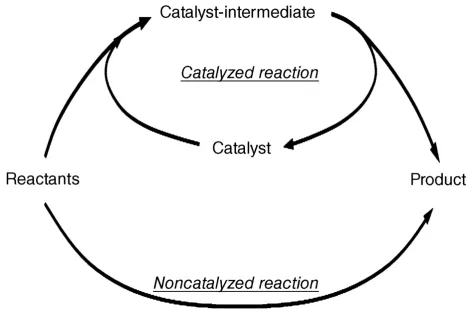
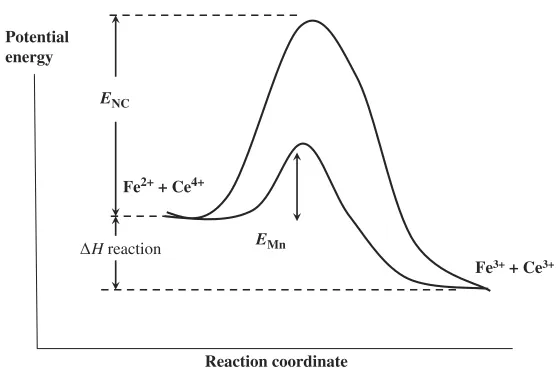
In the most basic sense, the purpose of the catalyst is to provide a reaction pathway or mechanism that has a lower activation barrier compared to the noncatalyzed (Enc) pathway, as illustrated in Figure 1.1. Also shown is the catalyzed barrier (EMn). In any reaction, catalyzed or noncatalyzed, the reaction sequence occurs through a series of elementary steps. In a noncatalyzed reaction, the species that participate in the reaction sequence are derived solely from the reactants. In a catalyzed reaction, the catalyst is simply an additional species that participates in the reaction sequence by lowering the activation energy and hence enhances the kinetics of the reaction. Finally, during the catalyzed reaction sequence, the catalyst species returns to its original state. It is the regeneration of the catalyst species to its original state that makes a catalyst a âcatalystâ and not a âreactant.â Thus, a catalyst is a species that participates in the reaction sequenceâit interacts with the âreactantsâ to form an intermediate species that undergoes further reaction to form the âproductâ with the catalyst returning to its original state. This basic sequence of events is illustrated in Figure 1.2.
Figure 1.1 Catalyzed and uncatalyzed reaction energy paths illustrating the lower energy barrier (activation energy) associated with the catalytic reaction compared with the noncatalytic reaction. (Reproduced from Chapter 1 of Heck, R.M., Farrauto, R.J., and Gulati, S.T. (2009) Catalytic Air Pollution Control: Commercial Technology, 3rd edn, John Wiley & Sons, Inc., New York.)
Figure 1.2 Illustration of catalyzed versus noncatalyzed reactions.
1.2.1 Example Reaction: Liquid-Phase Redox Reaction
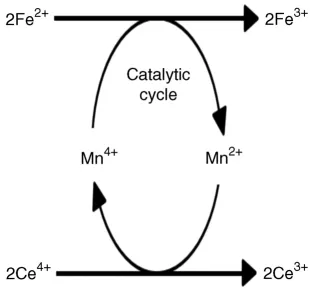
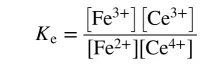
Let us consider the simple redox reaction between Fe2+ and Ce4+ in aqueous solution. The reaction below excludes the H2O present in the coordination sphere for each species since it does not directly participate in the reaction.
Figure 1.3 Catalytic FeâCe redox reaction catalyzed by Mn.
(1.1a)
(1.1b)
This reaction involves a direct electron transfer from the Fe2+ to the Ce4+ and by itself occurs very slowly because the electron transfer process occurs slowly. However, in the presence of Mn4+ species, the rate dramatically increases because the electron transfer is now facilitated through the Mn4+/Mn2+ couple. The Mn4+ species is a catalyst, not a reactant. While it does directly participate in the reaction, the reaction pathway results in no overall change in the chemical state of the Mn ion (Figure 1.3).
The reaction profile of both the catalyzed and noncatalyzed reactions can be described kinetically by the Arrhenius profile in which reactants convert to products by surmounting the energy barrier called the activation energy. According to the Arrhenius expression (Equation 1.2), the rate of reaction is proportional to the exponential of absolute temperature (T) and inversely proportional to the exponential of the activation energy (E)....
Table of contents
Cover
Table of Contents
PREFACE
ACKNOWLEDGMENTS
LIST OF FIGURES
NOMENCLATURE
CHAPTER 1: CATALYST FUNDAMENTALS OF INDUSTRIAL CATALYSIS
CHAPTER 2: THE PREPARATION OF CATALYTIC MATERIALS
CHAPTER 3: CATALYST CHARACTERIZATION
CHAPTER 4: REACTION RATE IN CATALYTIC REACTORS
CHAPTER 5: CATALYST DEACTIVATION
CHAPTER 6: GENERATING HYDROGEN AND SYNTHESIS GAS BY CATALYTIC HYDROCARBON STEAM REFORMING
CHAPTER 7: AMMONIA, METHANOL, FISCHERâTROPSCH PRODUCTION
CHAPTER 8: SELECTIVE OXIDATIONS
CHAPTER 9: HYDROGENATION, DEHYDROGENATION, AND ALKYLATION
CHAPTER 10: PETROLEUM PROCESSING
CHAPTER 11: HOMOGENEOUS CATALYSIS AND POLYMERIZATION CATALYSTS
CHAPTER 12: CATALYTIC TREATMENT FROM STATIONARY SOURCES: HC, CO, NOX, AND O3
CHAPTER 13: CATALYTIC ABATEMENT OF GASOLINE ENGINE EMISSIONS
CHAPTER 14: DIESEL ENGINE EMISSION ABATEMENT
CHAPTER 15: ALTERNATIVE ENERGY SOURCES USING CATALYSIS: BIOETHANOL BY FERMENTATION, BIODIESEL BY TRANSESTERIFICATION, AND H2-BASED FUEL CELLS