- English
- ePUB (mobile friendly)
- Available on iOS & Android
About this book
Much of chemistry is motivated by asking 'How'? How do I make a primary alcohol? React a Grignard reagent with formaldehyde. Physical chemistry is motivated by asking 'Why'? The Grignard reagent and formaldehyde follow a molecular dance known as a reaction mechanism in which stronger bonds are made at the expense of weaker bonds. If you are interested in asking 'why' and not just 'how', then you need to understand physical chemistry.
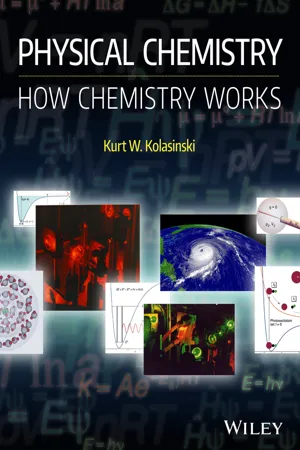
Physical Chemistry: How Chemistry Works takes a fresh approach to teaching in physical chemistry. This modern textbook is designed to excite and engage undergraduate chemistry students and prepare them for how they will employ physical chemistry in real life. The student-friendly approach and practical, contemporary examples facilitate an understanding of the physical chemical aspects of any system, allowing students of inorganic chemistry, organic chemistry, analytical chemistry and biochemistry to be fluent in the essentials of physical chemistry in order to understand synthesis, intermolecular interactions and materials properties. For students who are deeply interested in the subject of physical chemistry, the textbook facilitates further study by connecting them to the frontiers of research.
- Provides students with the physical and mathematical machinery to understand the physical chemical aspects of any system.
- Integrates regular examples drawn from the literature, from contemporary issues and research, to engage students with relevant and illustrative details.
- Important topics are introduced and returned to in later chapters: key concepts are reinforced and discussed in more depth as students acquire more tools.
- Chapters begin with a preview of important concepts and conclude with a summary of important equations.
- Each chapter includes worked examples and exercises: discussion questions, simple equation manipulation questions, and problem-solving exercises.
- Accompanied by supplementary online material: worked examples for students and a solutions manual for instructors.
- Fifteen supporting videos from the author presenting such topics as Entropy & Direction of Change; Rate Laws; Sequestration; Electrochemistry; etc.
- Written by an experienced instructor, researcher and author in physical chemistry, with a voice and perspective that is pedagogical and engaging.
Frequently asked questions
- Essential is ideal for learners and professionals who enjoy exploring a wide range of subjects. Access the Essential Library with 800,000+ trusted titles and best-sellers across business, personal growth, and the humanities. Includes unlimited reading time and Standard Read Aloud voice.
- Complete: Perfect for advanced learners and researchers needing full, unrestricted access. Unlock 1.4M+ books across hundreds of subjects, including academic and specialized titles. The Complete Plan also includes advanced features like Premium Read Aloud and Research Assistant.
Please note we cannot support devices running on iOS 13 and Android 7 or earlier. Learn more about using the app.
Information
Table of contents
- Cover
- Title Page
- Copyright
- Dedication
- Preface
- About the companion website
- 1 Introduction
- 2 Ideal gases
- 3 Non-ideal gases and intermolecular interactions
- 4 Liquids, liquid crystals, and ionic liquids
- 5 Solids, nanoparticles, and interfaces
- 6 Statistical mechanics
- 7 First law of thermodynamics
- 8 Second law of thermodynamics
- 9 Third law of thermodynamics and temperature dependence of heat capacity, enthalpy and entropy
- 10 Thermochemistry: The role of heat in chemical and physical changes
- 11 Chemical equilibrium
- 12 Phase stability and phase transitions
- 13 Solutions and mixtures: Nonelectrolytes
- 14 Solutions of electrolytes
- 15 Electrochemistry: The chemistry of free charge exchange
- 16 Empirical chemical kinetics
- 17 Reaction dynamics I: Mechanisms and rates
- 18 Reaction dynamics II: Catalysis, photochemistry and charge transfer
- 19 Developing quantum mechanical intuition
- 20 The quantum mechanical description of nature
- 21 Model quantum systems
- 22 Atomic structure
- 23 Introduction to spectroscopy and atomic spectroscopy
- 24 Molecular bonding and structure
- 25 Molecular spectroscopy and excited-state dynamics: Diatomics
- 26 Polyatomic molecules and group theory
- 27 Light–matter interactions: Lasers, laser spectroscopy, and photodynamics
- Appendix 1 Basic calculus and trigonometry
- Appendix 2 The method of undetermined multipliers
- Appendix 3 Stirling's theorem
- Appendix 4 Density of states of a particle in a box
- Appendix 5 Black-body radiation: Treating radiation as a photon gas
- Appendix 6 Definitions of symbols used in quantum mechanics and quantum chemistry
- Appendix 7 Character tables
- Appendix 8 Periodic behavior
- Appendix 9 Thermodynamic parameters
- Index
- Backcover1
- Backcover2
- EULA