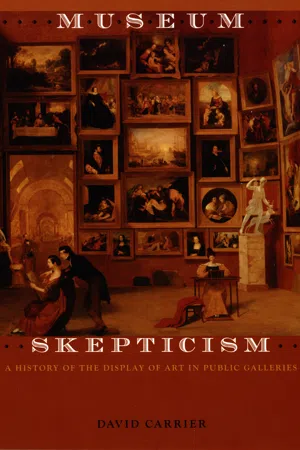
Carrier illuminates the public role of art museums by describing the ways they influence how art is seen: through their architecture, their collections, the narratives they offer museum visitors. He insists that an understanding of the art museum must take into account the roles of collectors, curators, and museum architects. Toward that end, he offers a series of case studies, showing how particular museums and their collections evolved. Among those who figure prominently are Baron Dominique Vivant Denon, the first director of the Louvre; Bernard Berenson, whose connoisseurship helped Isabella Stewart Gardner found her museum in Boston; Ernest Fenollosa, who assembled much of the Asian art collection now in the Museum of Fine Arts, Boston; Albert Barnes, the distinguished collector of modernist painting; and Richard Meier, architect of the J. Paul Getty Center in Los Angeles. Carrier's learned consideration of what the art museum is and has been provides the basis for understanding the radical transformation of its public role now under way.
- 329 pages
- English
- PDF
- Available on iOS & Android
eBook - PDF
About this book
In Museum Skepticism, art historian David Carrier traces the birth, evolution, and decline of the public art museum as an institution meant to spark democratic debate and discussion. Carrier contends that since the inception of the public art museum during the French Revolution, its development has depended on growth: on the expansion of collections, particularly to include works representing non-European cultures, and on the proliferation of art museums around the globe. Arguing that this expansionist project has peaked, he asserts that art museums must now find new ways of making high art relevant to contemporary lives. Ideas and inspiration may be found, he suggests, in mass entertainment such as popular music and movies.
Information
Publisher
Duke University Press BooksYear
2006Print ISBN
9780822336945
9780822336822
eBook ISBN
9780822387572
Topic
ArteSubtopic
Arte generaleTable of contents
- Contents
- Acknowledgments
- Overture
- "Beauty and Art, History and Fame and Power": On Entering the Louvre
- Art and Power: Time Travel in the Museum
- Museum Skeptics
- Picturing Museum Skepticism
- Art Museum Narratives
- Isabella Stewart Gardner’s Museum
- Ernest Fenollosa’s History of Asian Art
- Albert Barnes’s Foundation and the Place of Modernist Art within the Art Museum
- The Display of Absolutely Contemporary Art in the J. Paul Getty Museum
- The End of the Modern Public Art Museum: A Tale of Two Cities
- Conclusion: What the Public Art Museum Might Become
- Notes
- Bibliography
- Index
Trusted by 375,005 students
Access to over 1.5 million titles for a fair monthly price.
Study more efficiently using our study tools.
Frequently asked questions
Yes, you can cancel anytime from the Subscription tab in your account settings on the Perlego website. Your subscription will stay active until the end of your current billing period. Learn how to cancel your subscription
No, books cannot be downloaded as external files, such as PDFs, for use outside of Perlego. However, you can download books within the Perlego app for offline reading on mobile or tablet. Learn how to download books offline
Perlego offers two plans: Essential and Complete
- Essential is ideal for learners and professionals who enjoy exploring a wide range of subjects. Access the Essential Library with 800,000+ trusted titles and best-sellers across business, personal growth, and the humanities. Includes unlimited reading time and Standard Read Aloud voice.
- Complete: Perfect for advanced learners and researchers needing full, unrestricted access. Unlock 1.5M+ books across hundreds of subjects, including academic and specialized titles. The Complete Plan also includes advanced features like Premium Read Aloud and Research Assistant.
We are an online textbook subscription service, where you can get access to an entire online library for less than the price of a single book per month. With over 1.5 million books across 990+ topics, we’ve got you covered! Learn about our mission
Look out for the read-aloud symbol on your next book to see if you can listen to it. The read-aloud tool reads text aloud for you, highlighting the text as it is being read. You can pause it, speed it up and slow it down. Learn more about Read Aloud
Yes! You can use the Perlego app on both iOS and Android devices to read anytime, anywhere — even offline. Perfect for commutes or when you’re on the go.
Please note we cannot support devices running on iOS 13 and Android 7 or earlier. Learn more about using the app
Please note we cannot support devices running on iOS 13 and Android 7 or earlier. Learn more about using the app
Yes, you can access Museum Skepticism by David Carrier in PDF and/or ePUB format, as well as other popular books in Arte & Arte generale. We have over 1.5 million books available in our catalogue for you to explore.