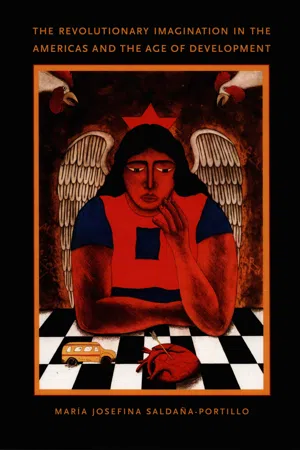
Reading governmental reports, memos, and policies, Saldaña-Portillo traces the arc of development narratives from its beginnings in the 1944 Bretton Woods conference through its apex during Robert S. McNamara's reign at the World Bank (1968–1981). She compares these narratives with models of subjectivity and agency embedded in the autobiographical texts of three revolutionary icons of the 1960s and 1970s—those of Che Guevara, Guatemalan insurgent Mario Payeras, and Malcolm X—and the agricultural policy of the Sandinista National Liberation Front (FSLN). Saldaña-Portillo highlights a shared paradigm of a masculinist transformation of the individual requiring the "transcendence" of ethnic particularity for the good of the nation. While she argues that this model of progress often alienated the very communities targeted by the revolutionaries, she shows how contemporary insurgents such as Rigoberta Menchú, the Zapatista movement, and queer Aztlán have taken up the radicalism of their predecessors to retheorize revolutionary subjectivity for the twenty-first century.
eBook - PDF
The Revolutionary Imagination in the Americas and the Age of Development
- 382 pages
- English
- PDF
- Available on iOS & Android
eBook - PDF
The Revolutionary Imagination in the Americas and the Age of Development
About this book
In The Revolutionary Imagination in the Americas and the Age of Development, María Josefina Saldaña-Portillo boldly argues that crucial twentieth-century revolutionary challenges to colonialism and capitalism in the Americas have failed to resist—and in fact have been constitutively related to—the very developmentalist narratives that have justified and naturalized postwar capitalism. Saldaña-Portillo brings the critique of development discourse to bear on such exemplars of revolutionary and resistant political thought and practice as Ernesto "Che" Guevara, Malcolm X, the Sandinista government of Nicaragua, and the Guatemalan guerrilla resistance. She suggests that for each of these, developmentalist constructions frame the struggle as a heroic movement from unconsciousness to consciousness, from a childlike backwardness toward a disciplined and self-aware maturity.
Information
Publisher
Duke University Press BooksYear
2003Print ISBN
9780822331667
9780822331780
eBook ISBN
9780822385240
Table of contents
- Contents
- About the Series
- Acknowledgments
- Part I
- Part II
- Part III
- Notes
- Works Cited
- Index
Trusted by 375,005 students
Access to over 1.5 million titles for a fair monthly price.
Study more efficiently using our study tools.
Frequently asked questions
Yes, you can cancel anytime from the Subscription tab in your account settings on the Perlego website. Your subscription will stay active until the end of your current billing period. Learn how to cancel your subscription
No, books cannot be downloaded as external files, such as PDFs, for use outside of Perlego. However, you can download books within the Perlego app for offline reading on mobile or tablet. Learn how to download books offline
Perlego offers two plans: Essential and Complete
- Essential is ideal for learners and professionals who enjoy exploring a wide range of subjects. Access the Essential Library with 800,000+ trusted titles and best-sellers across business, personal growth, and the humanities. Includes unlimited reading time and Standard Read Aloud voice.
- Complete: Perfect for advanced learners and researchers needing full, unrestricted access. Unlock 1.5M+ books across hundreds of subjects, including academic and specialized titles. The Complete Plan also includes advanced features like Premium Read Aloud and Research Assistant.
We are an online textbook subscription service, where you can get access to an entire online library for less than the price of a single book per month. With over 1.5 million books across 990+ topics, we’ve got you covered! Learn about our mission
Look out for the read-aloud symbol on your next book to see if you can listen to it. The read-aloud tool reads text aloud for you, highlighting the text as it is being read. You can pause it, speed it up and slow it down. Learn more about Read Aloud
Yes! You can use the Perlego app on both iOS and Android devices to read anytime, anywhere — even offline. Perfect for commutes or when you’re on the go.
Please note we cannot support devices running on iOS 13 and Android 7 or earlier. Learn more about using the app
Please note we cannot support devices running on iOS 13 and Android 7 or earlier. Learn more about using the app
Yes, you can access The Revolutionary Imagination in the Americas and the Age of Development by María Josefina Saldaña-Portillo, Walter D. Mignolo, Irene Silverblatt, Sonia Saldívar-Hull, Walter D. Mignolo,Irene Silverblatt,Sonia Saldívar-Hull in PDF and/or ePUB format, as well as other popular books in Economics & Development Economics. We have over 1.5 million books available in our catalogue for you to explore.