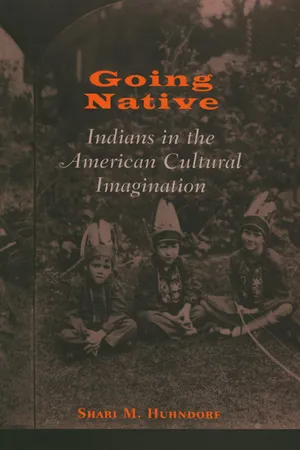
Since the 1800's, many European Americans have relied on Native Americans as models for their own national, racial, and gender identities. Displays of this impulse include world's fairs, fraternal organizations, and films such as Dances with Wolves. Shari M. Huhndorf uses cultural artifacts such as these to examine the phenomenon of "going native," showing its complex relations to social crises in the broader American society—including those posed by the rise of industrial capitalism, the completion of the military conquest of Native America, and feminist and civil rights activism.Huhndorf looks at several modern cultural manifestations of the desire of European Americans to emulate Native Americans. Some are quite pervasive, as is clear from the continuing, if controversial, existence of fraternal organizations for young and old which rely upon "Indian" costumes and rituals. Another fascinating example is the process by which Arctic travelers "went Eskimo," as Huhndorf describes in her readings of Robert Flaherty's travel narrative, My Eskimo Friends, and his documentary film, Nanook of the North. Huhndorf asserts that European Americans' appropriation of Native identities is not a thing of the past, and she takes a skeptical look at the "tribes" beloved of New Age devotees.Going Native shows how even seemingly harmless images of Native Americans can articulate and reinforce a range of power relations including slavery, patriarchy, and the continued oppression of Native Americans. Huhndorf reconsiders the cultural importance and political implications of the history of the impersonation of Indian identity in light of continuing debates over race, gender, and colonialism in American culture.
- English
- ePUB (mobile friendly)
- Available on iOS & Android
eBook - ePub
About this book
Information
CHAPTER ONE
Imagining America: Race, Nation, and Imperialism at the Turn of the Century
IN 1907, J. W. SCHULTZ published My Life as an Indian, a story that anticipates the one told by Kevin Costner in Dances with Wolves decades later and marks a transition in the representation of Native peoples in American culture. Set in the mid-nineteenth century, just before European-American invasions into the region reached their highest point, Schultz’s book celebrates his years on the frontier living as a member of the Blackfoot tribe. Inspired by the painter George Catlin’s romantic depictions of vanishing Indian life and by Lewis and Clark’s accounts of their transcontinental explorations, Schultz was drawn to the Plains by his “love of wild life and adventure.” “I hated the conventions of society,” he wrote, referring to life in his native New England town. “[I] thought so much of the Indians, and wanted to live with them.”1 When he reached adulthood, he fled his New England home and the confinement of “civilized occupations” to travel West. Eventually, he settled with the Blackfoot Indians, grew his hair long, donned buckskin clothing, married a Native woman, and lived in every way “as an Indian.” With evident nostalgia, My Life as an Indian describes the time its author spent learning from medicine men and warriors, hunting buffalo, and going on the warpath against the tribe’s enemies. These days of freedom and adventure were not to last, however. Schultz lived on the Plains during the final years before the successful military conquest of North America reached the lands of the Blackfoot and neighboring tribes. The closing pages of the book narrate the annihilation of the buffalo herds, the confinement of the Indians on reservations, and their cruel fate at the hands of corrupt government agents. Sadly, by the turn of the century, the romantic Plains Indian life depicted by Schultz (as well as by Catlin and others before him) was a mere memory, a casualty of the forward march of history.
By the early twentieth century, such idealized portraits of bygone Plains Indian life as well as stories of white men “gone native” were increasingly common. When Schultz penned My Life as an Indian, however, they had only recently become popular. Indeed, a few decades earlier, the thought of living with Indians would have inspired most European Americans with unspeakable terror and disdain. Although some settlers had idealized Native peoples from the earliest days of contact, they comprised a distinct minority.2 Throughout the era of conquest, as Roy Harvey Pearce has argued, most colonists imagined the Native inhabitants of North America as “the worst of Satan’s creatures,” obstacles to “civilized progress westward,” or as savages, living antitheses of civilization.3 “The Indian, in his savage nature,” Pearce writes, “stood everywhere as a challenge to order and reason and civilization.”4 Literature provided one (but certainly not the only) medium for articulating these sentiments. Until the mid-nineteenth century, captivity narratives describing the horrifying fates of noble settlers, often women, at the hands of violent savages typified accounts of European-American interactions with Natives. Later, dime novels adapted these conventions, titillating vast audiences with stories of Indian brutality inflicted upon hapless settlers. Beginning around the turn of the century, Western novels and films—the self-aggrandizing tales that mainstream Americans told themselves about the nation’s origins—supplied further opportunities for Indian-hating, justifying Europe’s bloody conquest of the Americas with fictions of Native peoples’ aggression and inherent malevolence.
As the nineteenth century progressed, however, the conquering culture began to reimagine the objects of its conquest. Popular images of Native peoples, though never monolithic, grew increasingly ambivalent. Indians continued to serve as civilized society’s inferior “other,” but more and more often European Americans looked to Native America to define themselves and their nation. The reasons were partly historical. During this period the military conquest of Native America drew to a close. Lured by the prospect of gold and free land, white settlers arrived in the West en masse during the middle years of the century with the U.S. military in tow. The relentless conquest, begun with Columbus’s arrival, thus commenced in earnest in the West. The Indians’ days of independence were numbered. The Battle of the Little Bighorn on 25 June 1876 marked the last Indian military triumph, a victory over Custer’s Seventh Cavalry which soon cost the Sioux and Cheyenne dearly. Although the bloody U.S.-Indian wars in the West wound down in the 1870s, the Wounded Knee massacre of 1890 usually signals the end of the military conquest of Native America. At Wounded Knee, a reconstituted Seventh Cavalry avenged Custer’s 1876 defeat by slaughtering around three hundred unarmed Lakota Sioux, mostly women, children, and old people.5 With them died any serious threat Native peoples posed to the consolidation of colonial power on the continent. No longer a challenge to white civilization, Native peoples thus began to play a more ambivalent role in the American cultural imagination. Going native, as the following analyses show, expresses European America’s anxiety about the conquest and serves in part to recast this terrible history by creating the illusion of white society’s innocence. At the same time, these events also assert white dominance. In this regard, Schultz’s story is symptomatic. By identifying with the Blackfoot, who conveniently “vanish” at the end of the narrative, Schultz concealed his complicity in the conquest. And his use of Native America as a playground or tourist destination of sorts, a means of escaping confining “civilized occupations,” betrays a privilege predicated on white dominance.
The military conquest of Native America was not the only historical factor that reshaped popular images of Native peoples, however. Key conflicts within the dominant society also contributed to these changes. Vast territorial expansion throughout the century had brought together not only diverse geographical regions but culturally and linguistically different populations as well, a fact that complicated the question of “Americanness.” For this reason and others, by the latter half of the nineteenth century European America found itself in a period of rapid social change. The divisiveness of the Civil War shattered the fragile political unity of Europe’s more established settlements in the eastern part of the country. In the decades that followed, urbanization, political turmoil, and industrial progress further transformed the postbellum landscape. Strikes and violent class conflicts, fed in part by a series of crippling economic depressions, began to plague urban centers. Meanwhile, massive immigrations from Asia as well as from Eastern and Southern Europe threatened Anglo-American hegemony. In all these conflicts, race loomed large. By the end of the century, mainstream America thus confronted critical problems: What was the nature of American national identity? How could the Anglo-American middle classes retain power in this rapidly changing society? And was it possible to reconcile a history marred by slavery and colonial violence, not to mention the advent of imperialism abroad in the 1890s, with the quintessentially “American” ideals of freedom, equality, and democracy?
Mounting social change led many European Americans to “remember” Native American life with nostalgia. Indians, now safely “vanishing,” began to provide the symbols and myths upon which white Americans created a sense of historical authenticity, a “real” national identity which had been lacking in the adolescent colonial culture. This new model of Americanness, curiously based on a mythic version of a conquered people, related in complex ways to the power structures within the nation as well as to its imperial debut overseas. In this first chapter I ask a series of interrelated questions: How did middle-class white America define itself during these tumultuous years? How did the stories Americans told themselves about the nation’s origins relate to U.S. domestic crises and the nascent controversies surrounding imperialism abroad? How do race and nation intertwine in these stories? How did popular images of Native peoples change during this period? Finally, what do these stories reveal—or conceal—about America’s bloody colonial past, a past built upon the conquest of Native America?
Inevitably, popular culture became a critical site for staging debates surrounding what—and, perhaps more important, whose—experiences constituted the nation’s history and identity. Two emblematic events, the 1876 Philadelphia Centennial Exposition and the 1893 World’s Columbian Exposition, manifested particularly clearly the complicated intersections of race, nationalism, and imperialism during this transitional moment in American history. These two world’s fairs provided opportunities for the dominant American culture to tell stories of its own origins to vast audiences, through both visual displays and performances like Frederick Jackson Turner’s famed frontier thesis speech, delivered at the World’s Columbian Exposition. Marking a key historical transition from the last Indian military victory in 1876 to the end of the conquest in 1890, these events expressed critical changes in the place Native peoples occupied in the American cultural imagination. By siting Native America in European America’s past, they show white America going native in part to conceal its violent history. After the conquest, representations of this troubling history reflected on other conflicts and power relations within the broader American society. Visions of Native America, now identified with European America, both articulated and reinforced white dominance at home and abroad, frequently in contradictory ways, during this period of rapid social change. Later, going native in turn-of-the-century fraternal organizations (including the Boy Scouts) would employ and refigure these changing representations of Native peoples, relating them specifically to America’s nascent imperial ventures overseas. As the following chapters show, these images and the emergent phenomenon of going native have shaped popular understandings of Native America throughout the twentieth century.
TELLING STORIES: VISIONS OF AMERICA AT THE 1876 AND 1893 WORLD’S FAIRS
Toward the end of the nineteenth century, Michael Kammen writes, “American memory began to take form as a self-conscious phenomenon.”6 The production of memory and the creation of tradition during this era, prompted in part by the dislocations and losses of the Civil War, showed the dominant American culture struggling to define itself as a unified entity. Questions of national identity focused primarily on unresolved issues that had preoccupied European Americans since the Revolutionary era: Was colonial American culture merely an extension of its European (particularly Anglo) roots? If not, what made America unique? But it was not only the nation’s relationship to Europe that posed a problem. The history of America, a nation born from the genocide of Native peoples and built on slave labor, undermined the values of liberty and equality the nation claimed to hold dear. A presence that haunted (and continues to haunt) the American cultural imagination, Native America challenged Europeans’ occupancy of the continent and, thus, threatened the legitimacy of the nation itself. In telling the nation’s story, then, European Americans had to explain this part of their past. What, exactly, was the relationship between European America and Native America? And how could white Americans tell the story of a bloody conquest in a way that justified their presence as well as their privileges?
To answer these questions, the dominant culture first had to recognize that European America had a particular history. In 1895, a government report urging the protection of antiquities, titled “What the United States Government Has Done for History,” began by lamenting that “it was not till about 1875 that the Government and people of the United States seemed to realize that our country has a history.”7 The manifestations of this new realization included increasing numbers of public historical displays as well as large-scale commemorations of the white nation’s foundational events. These were accompanied by a renaissance of patriotism and a growing interest in American music, folk art, and colonial architecture. In the latter part of the nineteenth century, world’s fairs also provided key opportunities for the dominant culture to tell stories about the nation and its origins to large audiences. These fairs showcased what their organizers (all leaders in industry, academia, and government who thus represented the white middle classes) defin...
Table of contents
- LIST OF ILLUSTRATIONS
- ACKNOWLEDGMENTS
- INTRODUCTION “If Only I Were an Indian”
- CHAPTER ONE Imagining America: Race, Nation, and Imperialism at the Turn of the Century
- CHAPTER TWO Nanook and His Contemporaries: Traveling with the Eskimos, 1897–1941
- CHAPTER THREE The Making of an Indian: “Forrest” Carter’s Literary Inventions
- CHAPTER FOUR Rites of Conquest: Indian Captivities in the New Age
- CONCLUSION Rituals of Citizenship: Going Native and Contemporary American Identity
- BIBLIOGRAPHY
Trusted by 375,005 students
Access to over 1.5 million titles for a fair monthly price.
Study more efficiently using our study tools.
Frequently asked questions
Yes, you can cancel anytime from the Subscription tab in your account settings on the Perlego website. Your subscription will stay active until the end of your current billing period. Learn how to cancel your subscription
No, books cannot be downloaded as external files, such as PDFs, for use outside of Perlego. However, you can download books within the Perlego app for offline reading on mobile or tablet. Learn how to download books offline
Perlego offers two plans: Essential and Complete
- Essential is ideal for learners and professionals who enjoy exploring a wide range of subjects. Access the Essential Library with 800,000+ trusted titles and best-sellers across business, personal growth, and the humanities. Includes unlimited reading time and Standard Read Aloud voice.
- Complete: Perfect for advanced learners and researchers needing full, unrestricted access. Unlock 1.5M+ books across hundreds of subjects, including academic and specialized titles. The Complete Plan also includes advanced features like Premium Read Aloud and Research Assistant.
We are an online textbook subscription service, where you can get access to an entire online library for less than the price of a single book per month. With over 1.5 million books across 990+ topics, we’ve got you covered! Learn about our mission
Look out for the read-aloud symbol on your next book to see if you can listen to it. The read-aloud tool reads text aloud for you, highlighting the text as it is being read. You can pause it, speed it up and slow it down. Learn more about Read Aloud
Yes! You can use the Perlego app on both iOS and Android devices to read anytime, anywhere — even offline. Perfect for commutes or when you’re on the go.
Please note we cannot support devices running on iOS 13 and Android 7 or earlier. Learn more about using the app
Please note we cannot support devices running on iOS 13 and Android 7 or earlier. Learn more about using the app
Yes, you can access Going Native by Shari M. Huhndorf in PDF and/or ePUB format, as well as other popular books in Literature & North American History. We have over 1.5 million books available in our catalogue for you to explore.