Drawing on interviews, observations of sets and workplaces, and analyses of TV shows, industry documents, economic data, and promotional materials, Caldwell shows how film and video workers function in a transformed, post-network industry. He chronicles how workers have responded to changes including media convergence, labor outsourcing, increasingly unstable labor and business relations, new production technologies, corporate conglomeration, and the proliferation of user-generated content. He explores new struggles over "authorship" within collective creative endeavors, the way that branding and syndication have become central business strategies for networks, and the "viral" use of industrial self-reflexivity to motivate consumers through DVD bonus tracks, behind-the-scenes documentaries, and "making-ofs." A significant, on-the-ground analysis of an industry in flux, Production Culture offers new ways of thinking about media production as a cultural activity.
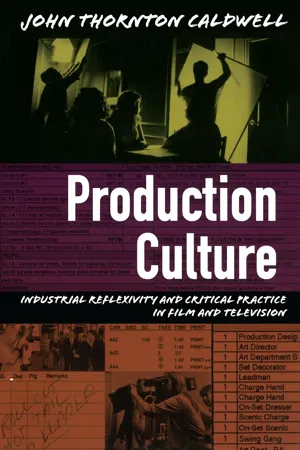
eBook - PDF
Production Culture
Industrial Reflexivity and Critical Practice in Film and Television
- 463 pages
- English
- PDF
- Available on iOS & Android
eBook - PDF
Production Culture
Industrial Reflexivity and Critical Practice in Film and Television
About this book
In Production Culture, John Thornton Caldwell investigates the cultural practices and belief systems of Los Angeles–based film and video production workers: not only those in prestigious positions such as producers and directors but also many "below-the-line" laborers, including gaffers, editors, and camera operators. Caldwell analyzes the narratives and rituals through which workers make sense of their labor and critique the film and TV industry as well as the culture writ large. As a self-reflexive industry, Hollywood constantly exposes itself and its production processes to the public; workers' ideas about the industry are embedded in their daily practices and the media they create. Caldwell suggests ways that scholars might learn from the industry's habitual self-scrutiny.
Information
Publisher
Duke University Press BooksYear
2008Print ISBN
9780822341116
9780822340928
eBook ISBN
9780822388968
Subtopic
Film History & CriticismChapter
1
46
Desperation
at
work,
in
outsourced
contract
labor,
stimulates
‘‘against-all-odds’’
trade
stories
in
‘‘digital
sweatshops’’
just
as
in
below-the-line
field
production
work.
Here
icons
for
DVD
authoring
software
and
Silicon
Graphics
digital
graphics
software.
Composite
photos
of
promotional
posters
by
J.
Caldwell.
Murphy
Brown
producer
Bob
Je√ords,
author
of
Je√ords’s
Rules
and
Regula-
tions,
a
widely
used
compendium
of
union
rules,
feared
that
producers
might
resist
working
shorter
days,
but
only
initially:
‘‘[Shorter
days]
removes
some
of
the
creative
flexibility
in
their
minds.
But
we
know
from
aesthetics
philos-
ophers
that
limitation
is
a
great
impetus
for
the
creation
of
art.
So
if
we
give
them
good
guidelines,
the
quality
of
the
product
might
very
well
improve.’’
∞∑
Je√ords’s
theory
invokes
and
underscores
the
paradigm
that
physical
limitations
create
the
very
conditions
for
innovation,
even
as
it
enhances
corporate
profits
for
producers
as
well.
Ironically,
this
business
theory
(i.e.,
that
hardships
create
e≈ciencies
and
profits)
proves
to
be
very
congruent
with
the
war
story
and
against-all-odds
practitioner
genres.
Unfortunately,
the
complaints
coded
into
below-the-line
trade
narratives—about
harsh
working
conditions,
worker
character,
and
creative
triumphs
of
the
will—
Table of contents
- Contents
- Acknowledgments
- Introduction - Industrial Reflexivity and Common Sense
- Chapter 1 - Trade Stories and Career Capital
- Chapter 2 - Trade Rituals and Turf Marking
- Chapter 3 - Trade Images and Imagined Communities (Below the Line)
- Chapter 4 - Trade Machines and Manufactured Identities (Below the Line)
- Chapter 5 - Industrial Auteur Theory (Above the Line/Creative)
- Chapter 6 - Industrial Identity Theory (Above the Line/Business)
- Chapter 7 - Industrial Reflexivity as Viral Marketing
- Conclusion - Shoot-Outs, Bake-Offs, and Speed Dating (Manic Disclosure/Non-Disclosure)
- Appendix 1 - Method: Artifacts and Cultural Practices in Production Studies
- Appendix 2 - A Taxonomy of DVD Bonus Track Strategies and Functions
- Appendix 3 - Practitioner Avowal/Disavowal (Industrial Doublespeak)
- Appendix 4 - Corporate Reflexivity vs. Worker Reflexivity (The Two Warring Flipsides of Industrial Self-Disclosure)
- Notes
- Works Cited
- Index
Trusted by 375,005 students
Access to over 1.5 million titles for a fair monthly price.
Study more efficiently using our study tools.
Frequently asked questions
Yes, you can cancel anytime from the Subscription tab in your account settings on the Perlego website. Your subscription will stay active until the end of your current billing period. Learn how to cancel your subscription
No, books cannot be downloaded as external files, such as PDFs, for use outside of Perlego. However, you can download books within the Perlego app for offline reading on mobile or tablet. Learn how to download books offline
Perlego offers two plans: Essential and Complete
- Essential is ideal for learners and professionals who enjoy exploring a wide range of subjects. Access the Essential Library with 800,000+ trusted titles and best-sellers across business, personal growth, and the humanities. Includes unlimited reading time and Standard Read Aloud voice.
- Complete: Perfect for advanced learners and researchers needing full, unrestricted access. Unlock 1.5M+ books across hundreds of subjects, including academic and specialized titles. The Complete Plan also includes advanced features like Premium Read Aloud and Research Assistant.
We are an online textbook subscription service, where you can get access to an entire online library for less than the price of a single book per month. With over 1.5 million books across 990+ topics, we’ve got you covered! Learn about our mission
Look out for the read-aloud symbol on your next book to see if you can listen to it. The read-aloud tool reads text aloud for you, highlighting the text as it is being read. You can pause it, speed it up and slow it down. Learn more about Read Aloud
Yes! You can use the Perlego app on both iOS and Android devices to read anytime, anywhere — even offline. Perfect for commutes or when you’re on the go.
Please note we cannot support devices running on iOS 13 and Android 7 or earlier. Learn more about using the app
Please note we cannot support devices running on iOS 13 and Android 7 or earlier. Learn more about using the app
Yes, you can access Production Culture by John Thornton Caldwell, Lynn Spigel in PDF and/or ePUB format, as well as other popular books in Media & Performing Arts & Film History & Criticism. We have over 1.5 million books available in our catalogue for you to explore.