![]()
1
Facilitating the Professional Development of Others
The Role of Action Research and Professional Learning Communities
Nothing within a school has more impact upon students in terms of skills development, self-confidence, or classroom behavior than the personal and professional growth of their teachers. When teachers examine, question, reflect on their ideas and develop new practices that lead towards their ideals, students are alive. When teachers stop growing, so do their students.1 (Barth, 1981, p. 145)
In the position of district or school-based staff developer, coach, principal, mentor, or teacher-leader, you have been charged with the awesome responsibility of facilitating the learning and professional growth of the teachers in your school and/or district. The job of keeping teachers alive and growing throughout their careers is more important than ever! Given the pressures of high-stakes testing and national, state, and district mandates, coupled with the charge to meet the endless list of student needs, teachers are leaving the profession in record numbers (Luekens, Lyter, Fox, & Chandler, 2004). Those that remain are hungry for support as they strive to meet the endless challenges of teaching in today’s schools. In your role of staff developer, coach, principal, or teacher-leader, you are uniquely positioned to fulfill the professional development appetites of teachers in your building, keeping them in the profession, and most importantly, keeping them vibrant and alive in their work. Staff developers who keep teachers vibrant and alive in their work also keep learning vibrant and alive for students each school day.
WHAT CONSTITUTES POWERFUL PROFESSIONAL DEVELOPMENT?
So what is the best way to nourish the professional development of teachers? In the past fifty years, we have learned a great deal about what powerful professional development does and does not look like. Historically, the most prominent model of professional development has taken the form of workshops delivered on in-service days when teachers work, but students have a holiday (Cochran-Smith & Lytle, 1999a). In these workshops, sometimes referred to as “sit and get” professional development, teachers often learn about a new pedagogy from an outside expert, and then go back to their classrooms the next school day to implement the new knowledge that was handed down from the expert. This type of training emphasizes developing a certain type of knowledge, referred to by Cochran-Smith and Lytle (1999a) as knowledge for practice.
Knowledge for practice is often reflected in traditional professional development efforts when a trainer shares with teachers information produced by educational researchers. This knowledge presumes a level of correctness about specific teaching practices based on conventional scientific methods that “yields a commonly accepted degree of significance, validity, generalizability, and intersubjectivity” (Cochran-Smith & Lytle, 1999a, p. 255, referencing Fenstermacher, 1994, p. 8). Given that research can wisely inform teaching practice, this knowledge for practice, often generated and shared by an outside source, is useful to teacher growth but not sufficient. Knowledge for practice may suggest a potential solution for a generic learning dilemma but offers little insight into how to implement that solution within the teacher’s specific classroom context. In most cases, teachers need support as they transfer that newly acquired knowledge to the learning process within their classrooms. The problem with relying solely on professional development focused on knowledge for practice is that these researched-based practices are not necessarily easily transferable to a specific classroom context.
Therefore, experienced educators know that knowledge for practice as the sole focus of professional development may be an efficient method of disseminating information, but often does not satisfy teachers’ yearning for meaningful professional development or result in real and meaningful change in the classroom. After a workshop, teachers often return to their classrooms without support to implement the new knowledge they gained as a result of workshop participation, and anything that may have been good or useful about the workshop often gets lost in the already established daily routines, pressures, and isolation of teaching. In addition, this model of professional development relies solely on the expertise of educators outside of the school and/or district. In many cases, the expertise of a district’s own teaching force is never acknowledged or shared. Finally, this model of professional development does not acknowledge the tremendous complexities inherent in teaching.
Translating new strategies, approaches, and pedagogy from theory to practice within individual classrooms is rarely a simple task for teachers, and it is natural for dilemmas to emerge when implementing an innovation. The traditional model of professional development offers no mechanism to help teachers understand and address these dilemmas that emerge as they implement new practices within their classrooms. Thus, educators involved with the professional development of teachers must also cultivate knowledge in practice.
Knowledge in practice recognizes the importance of teacher practical knowledge and its role in improving teaching practice. Often this type of knowledge is generated as teachers begin testing out their new knowledge for practice gained from traditional professional development training. As teachers apply this new knowledge, they construct knowledge in practice by engaging in their daily work within their classroom and school. Knowledge in practice is strengthened as teachers deliberatively reflect about specific teaching episodes and articulate the tacit knowledge embedded in their experiences. Knowledge in practice is strengthened through collaboration with peers. Professional development vehicles, including mentoring and peer coaching, rely on collaboration and dialogue that can generate reflection as well as make public the new knowledge being created.
A third type of knowledge that is gaining attention from professional developers today is knowledge of practice. Knowledge of practice stresses that through systematic inquiry “teachers make problematic their own knowledge and practice as well as the knowledge and practice of others” (Cochran-Smith & Lytle, 1999a, p. 273). Teachers create this kind of knowledge as they focus on raising questions about and systematically studying their own classroom teaching. Cochran-Smith and Lytle suggest that “what goes on inside the classroom is profoundly altered and ultimately transformed when teachers’ frameworks for practice foreground the intellectual, social, and cultural contexts of teaching” (p. 276). What this means is that as teachers engage in this type of knowledge construction, they move beyond the “nuts and bolts” of classroom practice to examine how these “nuts and bolts” might reflect larger social structures and roles that could potentially inhibit student learning. Teachers interested in constructing knowledge of practice receive support as they collaboratively inquire with colleagues about how their own teaching practices might inhibit the learning that takes place in their schools and classrooms. For example, teachers might work in study groups to uncover hidden agendas and explore issues of race, class, gender, culture, language, or ability that might influence the learning within their school and classrooms.
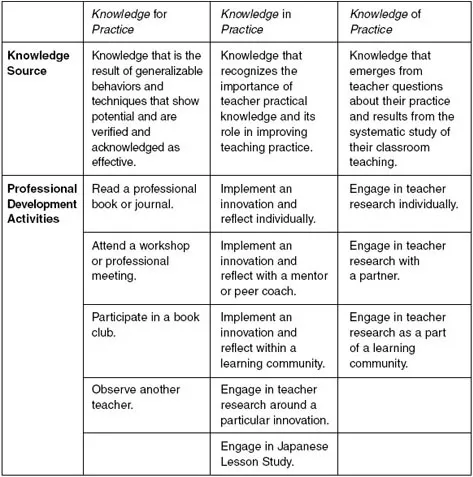
Dissatisfied with the traditional “sit and get” model of professional development, scholars throughout the past several decades have suggested the need for new approaches to professional development that acknowledge all three types of teacher knowledge. By attending to developing knowledge for, in, and of practice, we can enhance professional growth that leads to real change. Figure 1.1 outlines the three different types of teacher knowledge that we have shared as important to those striving to support teacher learning, as well as some of the professional development activities that can cultivate that type of knowledge.
Borne out of the dialogue focused on developing all three types of teacher knowledge and moving away from relying on the traditional “sit and get” professional development model, two driving forces for meaningful, powerful professional development have gained momentum in schools throughout the nation: action research and PLCs.
WHAT IS ACTION RESEARCH?
Action research, also referred to as teacher research, teacher inquiry, or practitioner inquiry, is defined as systematic, intentional study by teachers of their own classroom practice (Cochran-Smith & Lytle, 1993). Action researchers seek out change and reflect on their practice by posing questions or “wonderings,” collecting data to gain insights into their wonderings, analyzing the data along with reading relevant literature, making changes in practice based on new understandings developed during inquiry, and sharing findings with others (Dana & Yendol-Silva, 2003).
Example: A Fourth Grade Teacher Researches Reading Fluency
To illustrate the process of action research, we turn to teacher-researcher Debbi Hubbell. Debbi teaches fourth grade in a rural elementary school located in North Florida. Intrigued when her principal offered the opportunity to engage in teacher research as a part of staff development at her building, Debbi decided to look closely at one of her teaching passions—reading. Debbi knew that one of the best predictors of performance on Florida’s yearly standardized test, the FCAT (Florida Comprehensive Assessment Test), was reading fluency, and that research has shown a direct correlation between fluency and comprehension. She wanted to help her students become more successful readers, and she believed that if they became more fluent they would develop their reading comprehension. In the end, this would also allow them to perform better on the FCAT.
Figure 1.1 Types of Teacher Knowledge and Professional Development
Worried about seven students she felt were at risk and less fluent than others in her class, she decided to explore in more detail the research related to developing fluency in elementary readers. She attended numerous workshops and read a variety of research-based articles that developed her knowledge of fluency. As a result of this knowledge development, Debbie introduced the rereading of fractured fairy tale plays to these seven learners to see if this activity might increase reading fluency. The fractured fairy tales differed from the more traditional skill-and-drill activity these students often encountered in daily reading instruction.
To gain insights into her wondering, “What is the relationship between my fourth graders’ fluency development and the reading of fractured fairy tale plays?” Debbi collected three forms of data. First, Debbi administered Dynamic Indicators of Basic Early Literacy Skills (DIBELS) at different times throughout her research. The DIBELS are a set of standardized, individually administered measures of early literacy development. They are designed to be short, one-minute fluency measures used to regularly monitor the development of prereading and early reading skills.
In addition, Debbi took anecdotal notes each time she utilized fractured fairy tale plays with these fourth grade students, documenting their reactions, engagement, and Debbi’s assessment of their fluency development with each rereading of a play. Finally, Debbi relied on student work or artifacts as a third data source. At the end of the fractured fairy tale series, Debbi asked her students to write “Dear Mrs. Hubbell” letters, telling her about their perceptions and experiences with the fractured fairy tale unit of study.
Debbi analyzed her data by charting student DIBELS scores over time, as well as organizing and reading through her anecdotal notes and student-produced artifacts. Based on her data, Debbi could make three statements that characterized the knowledge in practice that she learned as a result of her research. First, all students’ DIBELS scores improved over time. Second, the reading of fractured fairy tale plays generated enthusiasm for school and learning. A student who had hated school and was failing actually said later he enjoyed reading fractured fairy tales and producing them as a play. This student improved at least by a grade or more in each subject. Third, positive social interactions occurred between students who previously had difficulty communicating in a positive way. Students enjoyed helping each other when someone made a mistake in word recognition, stress, pitch, or phrasing, and tolerance, as well as admiration, replaced existing adversarial student-to-student relationships.
As her action research progressed, Debbi’s data indicated the academic, social, and emotional value of fractured fairy tales. As a result, Debbi decided to move beyond the seven initial learners in her study to implement fractured fairy tales with her entire class. At the close of the school year, Debbi shared what she learned about the relationship between the reading of fractured fairy tale plays and the fluency development of her struggling fourth grade readers at a local action research conference. During the presentation she shared the academic, social, and emotional value of this strategy, as well as how her teaching changed as a result of this inquiry. She also received solid feedback on her inquiry from other teachers (Hubbell, 2005). Next, Debbie shared her research at a faculty meeting in her school. Her inquiry served as the impetus for her school to develop schoolwide fluency objectives and engage in dialogue to assess existing reading practices in her school and district.
WHAT ARE PLCs?
PLCs serve to connect and network groups of professionals to do just what their name entails—learn from practice. PLCs meet on a regular basis and their time together is often structured by the use of protocols to ensure focused, deliberate conversation and dialogue by teachers about student work and student learning. Joseph McDonald and his colleagues explain the importance of using protocols:
In diplomacy, protocol governs who greets whom first when the President and Prime Minister meet, and other such matters. In technology, protocols enable machines to “talk” with one another by precisely defining the language they use. In science and medicine, protocols are regimens that ensure faithful replication of an experiment or treatment; they tell the scientist or doctor to do this first, then that, and so on. And in social science, they are the scripted questions that an interviewer covers, or the template for an observation. But in the professional education of educators? One could argue that elaborate etiquette, communicative precision, faithful replication, and scripts would prove counterproductive here. Don’t we best learn from each other by just talking with each other? No, we claim. Among educators especially, just talking may not be enough. The kind of talking needed to educate ourselves cannot rise spontaneously and unaided from just talking. It needs to be carefully planned and scaffolded. (J. P. McDonald et al., 2003, p. 4)
Protocols for educators provide a script or series of timed steps for how a conversation among teachers on a chosen topic will develop.
A variety of different protocols have been developed for use in PLCs by a number of noteworthy organizations such as the National Staff Development Council (see, for example, Lois Brown Easton’s Powerful Designs for Professional Learning) and the National School Reform Faculty (NSRF), who developed one version of a PLC called Critical Friends Groups (CFGs; NSRF, 2007). In its work conceptualizing CFGs, the NSRF laid much of the ground work for shifting the nature of the dialogue that occurs between and among teachers about their practice in schools, and is responsible for training thousands of teachers to focus on developing collegial relationships, encouraging reflective practice, and rethinking leadership in restructuring schools. Because of the intense focus and scope of the NSRF’s work, in this book we rely most heavily on resources developed by the NSRF. Further information about NSRF and access to their protocols can be found at http://www.nsrfharmony.org.
The CFGs provide deliberate time and structures dedicated to promoting adult professional growth that is directly linked to student learning. When used within a PLC, protocols ensure planned, intentional conversation by teachers about student work, a teacher’s dilemma, a lesson to be taught, or other aspects of practice. Different protocols are selected for use depending on the topic for discussion that day.
Example: An Elementary School PLC Focuses on Inclusion
To illustrate the process of PLCs, we turn to the teachers in an elementary school in south Florida who were collectively struggling with how to survive the pressures of high-stakes testing and accountability. The teachers at Everglades Elementary School met for one or two hours at least twice a month during a designated shared planning time. A facilitator, who was the school’s reading coach, led the group, which typically consisted of ten to t...