- 350 pages
- English
- ePUB (mobile friendly)
- Available on iOS & Android
eBook - ePub
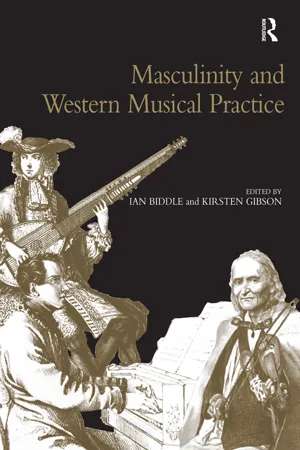
Masculinity and Western Musical Practice
About this book
How have men used art music? How have they listened to and brandished the musical forms of the Western classical tradition and how has music intervened in their identity formations? This collection of essays addresses these questions by examining some of the ways in which men, music and masculinity have been implicated with each other since the Middle Ages. Feminist musicologies have already dealt extensively with music and gender, from the 'phallocentric' tendencies of the Western tradition, to the explicit marginalization of women from that tradition. This book builds on that work by turning feminist critical approaches towards the production, rhetorical engagement and subversion of masculinities in twelve different musical case studies. In other disciplines within the arts and humanities, 'men's studies' is a well-established field. Musicology has only recently begun to address critically music's engagement with masculinity and as a result has sometimes thereby failed to recognize its own discursive misogyny. This book does not seek to cover the field comprehensively but, rather, to explore in detail some of the ways in which musical practices do the cultural work of masculinity. The book is structured into three thematic sections: effeminate and virile musics and masculinities; national masculinities, national musics; and identities, voices, discourses. Within these themes, the book ranges across a number of specific topics: late medieval masculinities; early modern discourses of music, masculinity and medicine; Renaissance Italian masculinities; eighteenth-, nineteenth- and early twentieth-century ideas of creativity, gender and canonicity; masculinity, imperialist and nationalist ideologies in the nineteenth century, and constructions of the masculine voice in late nineteenth- and twentieth-century opera and song. While the case studies are methodologically disparate and located in different historical and geographical locations, they all share a common conc
Information
Section One
Effeminate and Virile Musics and Masculinities
Section One
Introduction
The virility/effeminacy dichotomy lies at the heart of debates about the nature of masculinity and the gendering of musical discourses and practices over the longue durée of modernity. Since at least Antiquity, the virility/effeminacy dichotomy has provided a conceptual pairing onto which a whole range of asymmetrical binarisms might be projected or substituted: man/woman; masculine/feminine; manly/womanish; reason/madness; moderation/excess; virtue/sin; intellectual/sensual; strong/weak; active/passive; speech/song; culture/nature; mind/body; perfect/imperfect; whole/lacking; positive/negative. And, since at least Antiquity, these gender-inflected pairs have been projected, in different formulations at different times and in different places, onto an array of musical pairings: durus/mollis; natural/chromatic; unadorned/adorned; homophonic/polyphonic; first subject/second subject; perfect/imperfect; structural/lyrical; strong/weak; symphonic/miniaturist; dominant/mediant; composer/listener. The transition from philosophical ideal to musical sound and reception has been made easily and frequently over the course of at least almost one thousand years of Western musical history. Those elements of the musical pair regarded by detractors as negative, weak, derogatory, imperfect, undesirable or even dangerous were frequently figured as ‘effeminate’ or ‘feminine’.1 And yet, although the tendency to pair off conceptual terms in this manner has remained stubbornly persistent in the Western mindset, those elements of music or musical practice deemed ‘effeminate’ or ‘feminine’ are not immutable but have shown themselves to be susceptible to radical transformation and re-appropriation. In short, then, there is a structural tension in gender-interested histories of music between, on the one hand, the tendency to reproduce gender binarisms and, on the other, the historical, geographical and cultural malleability of those binarisms. There is, in other words, always a structural tension at work between the longue durée and the local mentalité: gender-coded musical elements demonstrate both continuity and rupture; they alter according to changing musical styles, social and musical values and gender constructions and yet can also be seen to adhere to a strikingly consistent and persistent patriarchal gender matrix.
According to the Oxford English Dictionary the term ‘effeminate’ denotes a person who ‘has become like a woman’, displaying the possible characteristics of being ‘Womanish, unmanly, enervated, feeble; self-indulgent, voluptuous; unbecomingly delicate or over-refined’.2 It is noteworthy that definition 1d of ‘effeminate’ relates the term specifically to descriptions of music. ‘Virile’, based on the Latin root vir (man), encompasses, conversely, the ‘characteristic[s] of a man; manly, masculine; marked by strength or force’.3 It is, specifically, the polar opposite of effeminate: ‘Full of masculine energy or strength; not weak or effeminate.’4 Other words derived from vir likewise serve to reinforce the historically-valued qualities frequently associated with masculinity. ‘Virtue’, for instance, can be defined as referring to the ‘possession or display of manly qualities; manly excellence, manliness, courage, valour’,5 again a definition that functions in direct opposition to the ‘Womanish, unmanly, enervated, feeble’ connotations of the ‘effeminate’. The long-held associations of ‘virtue’ with ‘the power or operative influence inherent in a supernatural or divine being’, acts ‘of superhuman or divine power’, ‘particular moral excellence’ and ‘superiority or excellence’ all implicitly reflect the gender-based root of the term and reinforce cultural, philosophical and historical alignments of notions of divinity, power, morality and superiority with notions of masculinity.6
Yet, as we have already intimated above, while the use of ‘effeminate’ and ‘virile’ in musical discourses during the long span of modernity is clearly traceable and connected, the exact meanings, subtleties and significance of these terms also undergo radical changes over that same long span. It is notable, for instance, that ‘effeminate’, though thought generally to imply a ‘womanish’ state or behaviour, held a specifically different meaning and association for early modern subjects than for those of the late nineteenth and twentieth centuries. ‘Whereas nowadays describing a man as “effeminate” might imply homosexual leanings,’ observes Roger Freitas, ‘a womanish demeanor in the 17th century was considered rather a sign of too great a taste for women.’7 Such differences inevitably impact on our readings of the uses of these terms in music-related discourses from different historical periods, especially for historicist-minded scholars for whom the notions of historical specificity and locality ground their work. Yet, the persistence of these terms over the longue durée also requires us to look at articulations and manifestations of this dichotomy in a range of historical contexts in order to view the lineage of this dichotomy in Western musical practices and to get a sense of the texture of its appropriations across that durée. The five chapters in this section thus traverse the longest historical duration in this volume – from the Middle Ages to the twentieth century – and all deal with the circulation and appropriation of the virility/effeminacy dichotomy in a range of musical contexts, discourses and materials. It should therefore come as no surprise, given the above, that they collectively show that the shape and texture of these debates are both historically contingent – in that they change radically from one time and place to another – and also remarkably consistent across the longue durée of modernity. Since this binary is central to the working through of questions of masculinity in Western musical practices more generally, the chapters in this section also establish and explore many of the intellectual foundations upon which the subsequent sections in this volume are built.
Chapter 1, by Elizabeth Eva Leach, explores music and masculinity in the Middle Ages. Building upon Ruth Mazo Karras’s work on medieval masculinities,8 Leach considers the pedagogical role of music in inculcating, constructing and imagining idealized masculinities in two distinct contexts: the homosocial domain of the monastery; and the mixed-sex, urban, political context of the court. Through a comprehensive consideration of medieval music theory, Leach examines the ways in which the virile/effeminate pairing impinged upon actual musical practices for men in these two contexts in the Middles Ages. In so doing, Leach not only provides a detailed introduction to music and masculinity in these two particular contexts in the Middle Ages, but also, tracing the ancient philosophical foundations on which medieval music theory was based and from which these binarisms were appropriated, introduces the historical roots of the virile/effeminate pairing in Western musical discourses that, as the ensuing chapters demonstrate, would continue, in a variety of manifestations, to haunt music theory, practice and reception for centuries to come.
In Chapter 2, Kirsten Gibson considers the perception of music as an effeminizing agent, especially as it is mediated through the discourse of melancholy, in early modern England. Gibson draws on scholarship from a range of disciplines, adopting a variety of methodological approaches to explore the processes of somatization that were embedded in medical and lay discourses on melancholy, music and masculinity: Thomas Laqueur’s foundational work on the history of the body, sex and gender; the work of literary scholars concerned with the cultural implications of early modern understandings of the body and medicine; and Linda Phyllis Austern’s seminal work on music and gender in the sixteenth and seventeenth centuries, especially that pertaining to theories of listening.9 Considering the interweaving strands of these three discourses – melancholy, music, masculinity – and specific points of intersection between them in sixteenth- and seventeenth-century England, Gibson examines the role of music in the workings of the early modern patriarchal imagination, and, especially, its place in discourses about the threat of effeminacy to the moral and physiological order.
There follows an exploration by Richard Wistreich, in Chapter 3, of Claudio Monteverdi’s Eighth Book of Madrigals (Madrigali guerrieri ed amorosi, 1638), in the preface of which Monteverdi claims to have entered a new era of musical completeness due to his ‘rediscovery’ of a musical style that would enable him to voice in music the highest and most active human state: that of the warrior; the man engaged in warfare. Grounding his exploration in the context of late Renaissance discourses about male identity – especially that pertaining to the figure of the warrior – and singing, Wistreich negotiates questions of voicing virility in song through musical and textual analyses; through a consideration of the semiotics and technical aspects of voice type, specifically that of the bass voice; and through considerations of late Renaissance mediations of ancient musical and rhetorical writings. At the heart of Wistreich’s chapter is the issue of the double-bind of the virility/effeminacy dichotomy as it is worked through in late Renaissance Italian discourses of representing masculinity in music: how, asks Wistreich, was a soldier to present himself in song (an apparently effeminate activity) without compromising his masculine identity or status?
The final two chapters in this section deal with uncovering, and making explicit, the previously little explored, or acknowledged, centrality of the virility/effeminacy dichotomy in the reception of two canonical composers – Joseph Haydn and Hector Berlioz. Howard Irving deals, in Chapter 4, with the ways in which disco...
Table of contents
- Cover
- Half Title
- Dedication
- Title Page
- Copyright Page
- Table of Contents
- List of Illustrations
- List of Musical Examples
- Notes on Contributors
- Acknowledgements
- Introduction
- Section One: Effeminate and Virile Musics and Masculinities
- Section Two: National Masculinities, National Musics
- Section Three: Identities, Voices, Discourses
- Select Bibliography
- Index
Trusted by 375,005 students
Access to over 1.5 million titles for a fair monthly price.
Study more efficiently using our study tools.
Frequently asked questions
Yes, you can cancel anytime from the Subscription tab in your account settings on the Perlego website. Your subscription will stay active until the end of your current billing period. Learn how to cancel your subscription
No, books cannot be downloaded as external files, such as PDFs, for use outside of Perlego. However, you can download books within the Perlego app for offline reading on mobile or tablet. Learn how to download books offline
Perlego offers two plans: Essential and Complete
- Essential is ideal for learners and professionals who enjoy exploring a wide range of subjects. Access the Essential Library with 800,000+ trusted titles and best-sellers across business, personal growth, and the humanities. Includes unlimited reading time and Standard Read Aloud voice.
- Complete: Perfect for advanced learners and researchers needing full, unrestricted access. Unlock 1.5M+ books across hundreds of subjects, including academic and specialized titles. The Complete Plan also includes advanced features like Premium Read Aloud and Research Assistant.
We are an online textbook subscription service, where you can get access to an entire online library for less than the price of a single book per month. With over 1.5 million books across 990+ topics, we’ve got you covered! Learn about our mission
Look out for the read-aloud symbol on your next book to see if you can listen to it. The read-aloud tool reads text aloud for you, highlighting the text as it is being read. You can pause it, speed it up and slow it down. Learn more about Read Aloud
Yes! You can use the Perlego app on both iOS and Android devices to read anytime, anywhere — even offline. Perfect for commutes or when you’re on the go.
Please note we cannot support devices running on iOS 13 and Android 7 or earlier. Learn more about using the app
Please note we cannot support devices running on iOS 13 and Android 7 or earlier. Learn more about using the app
Yes, you can access Masculinity and Western Musical Practice by Kirsten Gibson, Ian Biddle in PDF and/or ePUB format, as well as other popular books in Media & Performing Arts & Music. We have over 1.5 million books available in our catalogue for you to explore.