- 320 pages
- English
- ePUB (mobile friendly)
- Available on iOS & Android
eBook - ePub
Sex Work Now
About this book
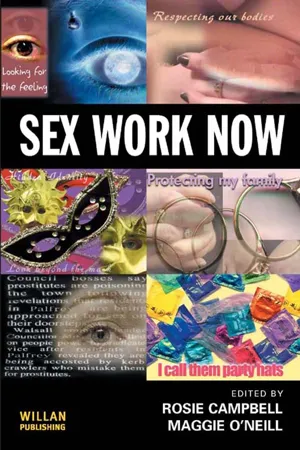
Sex Work Now provides an authoritative overview of female sex work and policy in the UK, and addresses a number of key contemporary issues and debates. These include sex worker unionization, migrant sex work and trafficking, communities and sex work, male clients of sex workers, the policing of prostitution, zoning of street sex work, young people and sexual exploitation, drug use and sex work, exiting, violence and sex work. Throughout the book is shaped by the lives and experiences of sex workers themselves drawing on applied, policy or participatory action research. This book approaches the subject from an interdisciplinary perspective, cutting across conventional boundaries of sociology, criminology, politics and social policy. Contributors to the book include academics, researchers, practitioners and activists who are among the leading commentators on prostitution in the UK. provides overview of sex work in UK considers impact of recent legislation and policy, especially Sex Offences Act 2003 focus on lives and experiences of sex workers themselves
Information
Chapter 1
Out of touch and out of time? The contemporary policing of sex work
Phil Hubbard
Introduction
Although sex work essentially involves a private contract negotiated between two consenting individuals, in Britain this contractual interpretation of sex work has traditionally been rejected by the state and the law in favour of legislation designed to express moral condemnation of sex work as well as to protect ‘respectable’ populations from the sight and sounds of those engaged in sex work. In addition, British ‘vice law’ has generally sought to offer some level of protection to sex workers by punishing those who seek to control or exploit them. Yet, as has been the case in other nations (Symanski 1981; Lowman 1992), the interpretation and enactment of British prostitution laws has been somewhat inconsistent and uneven, and it is clear that the police have not enforced all vice laws with the same vigour and vigilance. Rather, there has been a sense in which the police have treated the law as a resource which they are able to deploy as and when particular issues or problems arise. Vice law, in this sense, needs to be understood not as an instrumental force, but as produced in and productive of the social world (Blomley 2005). Hence, while it is instructive to analyse the laws surrounding sex work as abstract legal discourses, it is more meaningful to explore the way that legal relations of power are constructed and reproduced through police practices that code, exclude, enable, locate and repress particular forms of sex work in particular places at specific times. Above all else, it is clear that the policing of sex work produces a differential and striated landscape of sex work, evident in the contrast between ‘red-light’ (inner-city) districts where street sex work has traditionally been tolerated by the state and law and those wealthier, whiter and more politically articulate residential neighbourhoods, where any manifestation of sex work is routinely repressed and removed (Hubbard 1999).
Recently, however, dominant modes of regulation have been inexorably unravelling in the face of critiques of British vice laws and policing strategies. specifically, vice legislation has been repeatedly exposed as of dubious value in offering a meaningful, long-term solution to the ‘problem’ of prostitution and publicly criticised by many senior police Officers as entailing a huge outlay of resources for little demonstrable return (Sharpe 1998). Moreover, vice laws have also been opposed on broadly humanitarian and libertarian grounds by a growing number of campaigners – including sex worker unions, legal experts and feminist groups – who argue for the liberalisation of prostitution laws. Recognising that some women and men will always want to work in the sex industry – albeit not always under circumstances of their own choosing – advocates of liberalisation suggest it offers a more pragmatic way of dealing with the problems associated with sex work and would offer more protection to sex workers, clients and those living in the vicinity of sites of sex work. In effect, some have gone so far as to suggest that the modern forms of policing have actually exacerbated the problems associated with street sex work by attempting to contain prostitution in specific areas and applying the law in uneven and contradictory ways. Latterly, the fact that the police have adopted a more repressive and draconian mode of enforcement in particular locales has further highlighted the uneven and iniquitous impacts of vice laws – and the need for reform of those laws.
The fact that there has been no radical overhaul of vice laws for nearly fifty years in the UK means that dominant modes and practices of policing now seem badly out of touch with the needs of sex workers, communities and even the police themselves. In this chapter, I want to scrutinise this argument, detailing the way that the police deploy the law in different contexts and situations, and noting the gendered injustices wrought by this process. The chapter hence begins by detailing the current legislative situation in the UK, describing the way that the dominant logic of common and statute law in the UK has remained essentially unaltered since the deliberations of the Wolfenden Committee in the 1950s. It then turns to explore the enactment of these laws at ‘street level’ through a scrutiny of the way that the police seek to control or intervene in specific sex work markets. The fact that this mode of intervention is seen to be breaking down and that there is a need for a new form of policing is then highlighted. Accordingly, significant attention is devoted to the rhetoric and practices of zero tolerance which are beginning to impact on the policing of sex work in many areas of the UK. The chapter concludes by outlining the possible consequences of going down this more repressive route, contrasting this with possible modes of regulating sex work that might involve the police working collaboratively alongside a wide range of agencies.
The criminalising of sex work
Currently, prostitution itself is not criminalised in Britain, and is legally regarded as a private transaction conducted between two consenting adults. However, there are many pieces of legislation that still seek to regulate and punish a wide variety of acts associated with sex work. In general, these laws focus on those aspects of the sex industry which impinge on the ‘wider public’ and, as such, may be considered as public order offences. Under the terms of the Street Offences Act 1959 and the Sexual Offences Act 1985, such offences may include soliciting in public or quasi-public spaces, kerb-crawling, advertising sexual services or conducting sexual practices in public view (with the Criminal Justice and Police Act 2001 adding new powers to arrest those who place advertisements for sex work in a public place – see Hubbard 2002).
Simultaneously, the Sexual Offences Acts 1956 and 2003 allow for the prosecution of those who are seen to beneft from other people's prostitution, such as pimps, procurers and the owners of brothels. As such, British vice laws (which differ slightly between Scotland and England and Wales) have the twin aims of preventing ‘the serious nuisance to the public caused when prostitutes ply their trade in the street’ while simultaneously penalising the ‘pimps, brothel keepers and others who seek to encourage, control and exploit the prostitution of others’ (cited in Edwards 1997: 928). In practice, this creates a paradoxical situation where, although prostitution may not be illegal, it is impossible for female sex workers to work without breaking a number of laws in the performance of their work. Moreover, as soon as any third party becomes involved in any transaction between sex worker and clients (whether as owner of the premises where sex is being sold, a pimp or agent) they are immediately subject to arrest on the basis that they must be exploiting the sex worker. The Sexual Offences Act 1956 thus penalises ‘the procurer’ – any pimp who knowingly lives wholly or in part off the earnings of prostitution (Edwards 1997: 63). However, this defnition has been taken to include the partners or boyfriends of sex workers, and has sometimes led to a situation where the sex worker is both isolated or criminalised (the penalty for pimping is up to seven years in prison). Equally, section 33 of the same act makes it illegal to run a disorderly house, defined as a house used by more than one woman for the purposes of prostitution (Sharpe 1998), again encouraging women to work alone.
Yet if British vice laws often proclaim a concern for the working conditions and safety of sex workers, the low number of prosecutions for living off immoral earnings or encouraging women into prostitution suggests that such concerns are currently given a low police priority: for instance, in 2002 there were 2,678 women found guilty of soliciting compared to just 31 incited for procurement offences (Home Office 2004b). Hence, it has been suggested that the police are most concerned with responding to pressure from residents and politicians who wish to reduce the ‘nuisance’ experienced by people living in areas of street prostitution (rather than intervening in off-street sex markets). According to the Wolfenden Report (1957: 23), which preceded the introduction of the 1959 Street Offences Act, the main justification for intervening in sex work markets was to maintain ‘the right of the normal decent citizen to go about the streets without affront to their sense of decency’. Hence, while many of the attitudes underpinning contemporary British vice laws can be traced back to the 1824 Vagrancy Act, which instigated the power of arrest for women behaving in a ‘riotous and indecent manner’, it is the Wolfenden Report that provides the moral justification for current laws. significantly, the Wolfenden Committee was established at a time when street prostitution, while largely contained in deprived inner-city districts, was implicated in a wider process of postwar moral decline that was leading to family breakdown and social disintegration. With the ascent of the new queen to the throne, an attempt was made to redefine women's and men's role as homemakers, with support for family values often made with reference to the Christian values of the British monarchy (Self 2003).
Outwardly, the attitude of the Wolfenden Committee was dogmatically moralistic, claiming that ‘prostitution is an evil of which any society that claims to be civilised should seek to rid itself of’. Referring to 6,829 arrests for street soliciting in 1953, the committee further suggested that London's prostitution population was ‘without parallel in the capital cities of other civilised countries’ (cited in Matthews 1997: 1). Such claims were informed by a detailed mapping of the capital's sexual topography, a strategic mapping that isolated some of Soho's notorious streets and landmarks as belonging to London's more recalcitrant citizens, a sexually immoral population that was seen in need of isolation and re-education (Mort 1998). However, alongside this desire for order was a concern that it was not the law's role to interfere in the private lives of citizens or to seek to enforce any particular pattern of behaviour:
If it were the law's intention to punish prostitution per se, on the grounds that it is immoral conduct, then it would be right that it should provide for the punishment of all the men (clients) as well as women (prostitutes). But that is not the function of the law. It should confine itself to those activities which offend against public order and decency or expose the ordinary citizen to what is offensive and injurious, and the fact is that prostitutes do parade themselves more habitually and openly than their prospective clients, and do by their continual presence affront the sense of decency of the ordinary citizen. (Wolfenden Report 1957: 14)
This judgment may well have been informed by the fact that many of those among London's elite continued to be dependent on prostitution, either fnancially or as a sexual outlet. Nonetheless, this distinction between prostitution as a public offence and prostitution as a private consensual transaction was important in subsequent British legal debates which demonstrated the law's ostensible acceptance of sexual liberation while simultaneously actually strengthening the legislation which could be enacted against sex workers.
For example, by recommending the national introduction of a cautioning system first employed in Edinburgh and Glasgow, whereby the police were merely empowered to caution women who they considered to be soliciting on the first and second occasion, the Wolfenden Report appeared to express a concern that female sex workers should not be punished without being given the chance of ‘redeeming’ themselves. Once charged in court as a common prostitute though, the new legislation stipulated that prostitute women need not be cautioned again, and, under section 1 of the 1959 Street Offences Act, could be charged with loitering or soliciting in a street or a public place for the purpose of prostitution without caution. Lopez-Jones (1990) points out the absurdity of this position by stressing that the guilt of the prostitute is assumed once she has been labelled as a common prostitute, with the purpose of her presence in public space presumed on the basis of her previous conviction. Nonetheless, if a woman is charged with an offence she may incur fines and court costs which may simply force her to work extra hours to pay off, instigating a vicious cycle of arrest–fine–arrest. In this context, it has been suggested that the role of intermediaries becomes more important too, and some prostitute women may look to their pimps to pay off the fine or pay bail costs as appropriate (Edwards 1987).
Moreover, although the Wolfenden Report made reference to the nuisance of kerb-crawling, it was not until the (hastily drawn-up) 1985 Sexual Offences Act that British law sought to criminalise those men who solicited women in addition to those women who solicited men. Under the provisions of this act, a man commits an offence if he solicits a woman for the purpose of prostitution from a motor vehicle while it is in a street or public place or in a street or place while in the immediate vicinity of a motor vehicle he has just got out of (Edwards 1987). Those convicted of kerb-crawling are normally subject to a fine which varies from around £50 to £300 depending on local court procedures (Benson and Matthews 1995). However, the criteria for prosecution normally requires proof that the kerb-crawlers acted persistently or in a manner likely to cause annoyance to the solicited woman or to other persons in the neighbourhood. This need for proof of persistence places a burden on the police which they are often unable to meet, and instead they may prefer to adopt methods where warning letters are sent out to the kerb-crawler's address (presumably in the hope of ‘shaming’ him). In cases where such cases proceed to court, names (and sometimes photographs) of kerb-crawlers are published in the media to try to deter further offences. Kerb-crawling legislation has consequently been the source of much controversy and while it was designed to bring equality in terms of how women soliciting men and men soliciting women are treated, in 2002, the number of men found guilty of kerb-crawling was 993 against 2,678 for soliciting. Here, it should be noted that these figures refer to a period when kerb-crawling was a cautionable and not an arrestable offence, with the 2003 Sexual Offences Act also allowing judges to demand the confscation of persistent offenders' cars. Enactment of the law has been described as a ‘fasco’ by some commentators (Lopez-Jones 1990).
Avowedly created to both protect sex workers and the public at large, it has therefore been suggested that British laws effectively serve to criminalise all sex workers. The way in which such legal discourses contribute to this stigmatising process is particularly pronounced in that women convicted of soliciting are labelled as a ‘common prostitute’, a term that dates back to the Contagious Diseases Acts. Through this label, Lopez-Jones (1990) contends that the current prostitution laws effectively distinguish between the civil rights afforded to sex workers and those offered to other women (once labelled as a ‘common prostitute’, the guilt of sex worker is assumed in eyes of the law, with any legal protection sought by the prostitute with respect of violence or exploitation undermined by the court's awareness of her status as common prostitute). In this sense, the dominant discourses encoded in prostitution laws appear to combine with political, medical and religious narratives to construct the sex worker as separate from ‘decent’ women. As such, it has also been suggested that prostitution laws reproduce certain assumptions about sexual power, and thus reproduce dominant male discourses:
The law creates potential offences in every aspect of the prostitute's life, raising the spectre of an offence for everyone she comes in contact with, constituting her as a pariah … Beyond the surface of order and innocence, prostitution laws create and extend the power which underpins male sexuality by facilitating the buying of women on their own terms. (Duncan 1994: 25)
The English Collective of Prostitutes (1997: 93) sums the position up by suggesting that the prostitution laws continue to divide women between the good/moral and bad/immoral, signalling to men that female sex workers are criminals. In turn, they argue that this has major implications for sex worker's safety, with men thinking that violence against prostitute women will be dealt with more leniently by the law. In sum, this type of reading backs up Duncan's claim that there is no legal approach to prostitution that is not abusive and does not exploit women, stressing that ‘all legal approaches to prostitution are masculinist systems that yield to the market de...
Table of contents
- Cover
- Half Title
- Copyright
- Contents
- Notes on the contributors
- Introduction
- 1 Out of touch and out of time? The contemporary policing of sex work
- 2 Street sex work and local communities: creating discursive spaces for genuine consultation and inclusion
- 3 ‘Zoning’ street sex work: the way forward?
- 4 Behind the personal ads: the indoor sex markets in Britain
- 5 The conundrum of women’s agency: migration and the sex industry
- 6 Murder made easy: the final solution to prostitution?
- 7 Sex work and problem drug use in the UK: the links, problems and possible solutions
- 8 Finding the ‘I’ in sexual exploitation: young people’s voices within policy and practice
- 9 Clients of female sex workers: men or monsters?
- 10 Support services for women working in the sex industry
- 11 Sex workers in the Labour Movement
- Index
Trusted by 375,005 students
Access to over 1.5 million titles for a fair monthly price.
Study more efficiently using our study tools.
Frequently asked questions
Yes, you can cancel anytime from the Subscription tab in your account settings on the Perlego website. Your subscription will stay active until the end of your current billing period. Learn how to cancel your subscription
No, books cannot be downloaded as external files, such as PDFs, for use outside of Perlego. However, you can download books within the Perlego app for offline reading on mobile or tablet. Learn how to download books offline
Perlego offers two plans: Essential and Complete
- Essential is ideal for learners and professionals who enjoy exploring a wide range of subjects. Access the Essential Library with 800,000+ trusted titles and best-sellers across business, personal growth, and the humanities. Includes unlimited reading time and Standard Read Aloud voice.
- Complete: Perfect for advanced learners and researchers needing full, unrestricted access. Unlock 1.5M+ books across hundreds of subjects, including academic and specialized titles. The Complete Plan also includes advanced features like Premium Read Aloud and Research Assistant.
We are an online textbook subscription service, where you can get access to an entire online library for less than the price of a single book per month. With over 1.5 million books across 990+ topics, we’ve got you covered! Learn about our mission
Look out for the read-aloud symbol on your next book to see if you can listen to it. The read-aloud tool reads text aloud for you, highlighting the text as it is being read. You can pause it, speed it up and slow it down. Learn more about Read Aloud
Yes! You can use the Perlego app on both iOS and Android devices to read anytime, anywhere — even offline. Perfect for commutes or when you’re on the go.
Please note we cannot support devices running on iOS 13 and Android 7 or earlier. Learn more about using the app
Please note we cannot support devices running on iOS 13 and Android 7 or earlier. Learn more about using the app
Yes, you can access Sex Work Now by Rosie Campbell, Maggie O'Neill, Rosie Campbell,Maggie O'Neill in PDF and/or ePUB format, as well as other popular books in Social Sciences & Social Policy. We have over 1.5 million books available in our catalogue for you to explore.