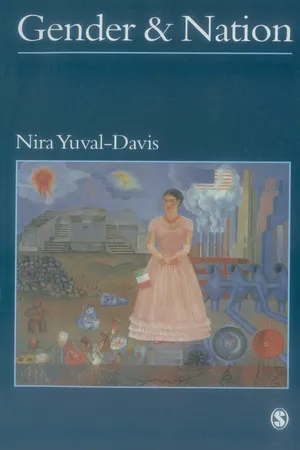
Gender and Nation is an important contribution to the debates on citizenship, gender and nationhood. It will be essential reading for academics and students of women?s studies, race and ethnic studies, sociology and political science.
- 168 pages
- English
- ePUB (mobile friendly)
- Available on iOS & Android
eBook - ePub
About this book
Nira Yuval-Davis provides an authoritative overview and critique of writings on gender and nationhood, presenting an original analysis of the ways gender relations affect and are affected by national projects and processes. In Gender and Nation Yuval-Davis argues that the construction of nationhood involves specific notions of both `manhood? and `womanhood?. She examines the contribution of gender relations to key dimensions of nationalist projects - the nation?s reproduction, its culture and citizenship - as well as to national conflicts and wars, exploring the contesting relations between feminism and nationalism.
Information
Publisher
SAGE Publications LtdYear
1997Print ISBN
9780803986640
9780803986633
Edition
1eBook ISBN
9781446240779
1
THEORIZING GENDER AND NATION
If the Woman does not want to be Mother, Nation is on its way to die.1
The mothers of the nation, the womenfolk as a whole, are the titans of our struggle.2
This book is about gender relations and the ways they affect and are affected by national projects and processes. The main focus of the book is on the positions and positionings of women, but men and masculinity are correspondingly central to the book’s focus. As one of my sociology teachers at the Hebrew University, Eric Cohen, used to say, ‘Talking about women without talking about men, is like clapping hands with one hand only.’ Although I have come to reject much of what I was taught during my studies there all those years ago, I still agree with the sentiment of this statement. ‘Womanhood’ is a relational category and has to be understood and analysed as such. Moreover, one of the main arguments of the book is that constructions of nationhood usually involve specific notions of both ‘manhood’ and ‘womanhood’.
The epistemological framework of the book is based on the recognition that knowledge is situated (Haraway, 1990), and that knowledge emanating from one standpoint cannot be ‘finished’ (Hill-Collins, 1990). Although I have read – before and during the writing of this book – many books and articles written by scholars and activists from different standpoints, I am aware, of course, that the perspective of the book is unavoidably affected by my own specific positioning, and that a high percentage of the concrete examples with which I have chosen to illustrate many of the theoretical points are based on events which took place in the societies in which I have lived (mainly Israel and Britain) or in those of my close colleagues and friends (mentioned in the preface). I do believe, however, that ‘unfinished’ is not the same as ‘invalid’, and this has given me the courage to actually write this book.
Most of the hegemonic theorizations about nations and nationalism (for example, Gellner, 1983; Hobsbawm, 1990; Kedourie, 1993; Smith, 1986; 1995), even including, sometimes, those written by women (for example, Greenfeld, 1992), have ignored gender relations as irrelevant. This is most remarkable because a major school of nationalism scholars, the ‘primordialists’ (Geertz, 1963; Shils, 1957; van den Berghe, 1979), have seen in nations a natural and universal phenomenon which is an ‘automatic’ extension of kinship relations.
And yet, when discussing issues of national ‘production’ or ‘reproduction’, the literature on nationalism does not usually relate to women. Instead, it relates to state bureaucrats or intellectuals. Materialist analyses, such as those by Amin (1978) and Zubaida (1989), have given primary importance to state bureaucracy and other state apparatuses in establishing and reproducing national (as well as ethnic) ideologies and boundaries. Although national and ethnic divisions also operate within the civil society, it is the differential access of different collectivities to the state which dictates the nature of the hegemonic national ethos in the society.
Other theorists of nationalism and the sociology of knowledge, such as Gellner (1983) and Smith (1986), have stressed the particular importance intellectuals have had in the creation and reproduction of nationalist ideologies, especially those of oppressed collectivities. Being excluded from the hegemonic intelligentsia and from open access to the state apparatus, these intellectuals ‘rediscover’ ‘collective memories’, transform popular oral traditions and languages into written ones, and portray a ‘national golden age’ in the distant mythical or historical past, whose reconstitution becomes the basis for nationalist aspirations.
However, as this book elaborates, it is women – and not (just?) the bureaucracy and the intelligentsia – who reproduce nations, biologically, culturally and symbolically. Why, then, are women usually ‘hidden’ in the various theorizations of the nationalist phenomena?
Pateman (1988) and Grant (1991) offer explanations which might be relevant here. Carole Pateman studied the classical theories of ‘the social contract’ which are widely influential and have laid the foundation for common sense understanding of western social and political order. These theories divide the sphere of civil society into the public and private domains. Women (and the family) are located in the private domain, which is not seen as politically relevant. Pateman and other feminists have challenged the validity of this model and the public/private divide even within its own assumptions, and Pateman claims that
the public realm cannot be fully understood in the absence of the private sphere, and, similarly, the meaning of the original contract is misinterpreted without both, mutually dependent halves of the story. Civil freedom depends on patriarchal right. (1988: 4)
As nationalism and nations have usually been discussed as part of the public political sphere, the exclusion of women from that arena has affected their exclusion from that discourse as well.
Following Pateman, Rebecca Grant (1991) has an interesting explanation of why women were located outside the relevant political domain. She claims that the foundation theories of both Hobbes and Rousseau portray the transition from the imagined state of nature into orderly society exclusively in terms of what they both assume to be natural male characteristics – the aggressive nature of men (in Hobbes) and the capacity for reason in men (in Rousseau). Women are not part of this process and are therefore excluded from the social and remain close to ‘nature’. Later theories followed these assumptions as given.
Some notable exceptions to the gender-blind theorizations of nationalism have been Balibar (1990a), Chatterjee (1990) and Mosse (1985). Their insights were influenced and nurtured by a small but growing group of feminist scholars who have been working in this area (for example, Enloe, 1989; Jayawardena, 1986; Kandiyoti, 1991a; Parker et al., 1992; Pateman, 1988; Yuval-Davis, 1980; 1993; Yuval-Davis and Anthias, 1989). Nevertheless I think it is indicative that in the Oxford University Press reader Nationalism (edited by John Hutchinson and Anthony D. Smith, 1994), the editors placed the only extract in the book which relates to nationalism and gender relations in the last section, ‘Beyond Nationalism’. They introduced that extract (which was taken from the introduction to the book Woman-Nation-State: Yuval-Davis and Anthias, 1989) in the following words:
The entry of women into the national arena, as cultural and biological reproducers of the nation and as transmitters of its values, has also redefined the content and boundaries of ethnicity and the nation. (1994: 287)
But, of course, women did not just ‘enter’ the national arena: they were always there, and central to its constructions and reproductions! However, it is true that including women explicitly in the analytical discourse around nations and nationalisms is only a very recent and partial endeavour.
The aim of this book is to promote this analytical project of a gendered understanding of nations and nationalisms, by examining systematically the crucial contribution of gender relations into several major dimensions of nationalist projects: national reproduction, national culture and national citizenship, as well as national conflicts and wars.
Nationalist projects are sharply differentiated in the book from ‘nationstates’, and it is emphasized that membership of ‘nations’ can be sub-, superand cross-states, as the boundaries of nations virtually never coincide with those of the so-called ‘nation-states’. As becomes clear when reading the book, my analysis is deconstructionist. At the same time, however, I reject the extreme postmodernist construction of contemporary citizens as disembedded ‘free floating signifiers’ (Wexler, 1990). On the contrary, I highlight the crucial importance of social and economic power relations and the crosscutting social divisions in which any concrete historical social categorization is enmeshed. These social divisions have organizational, experiential and representational forms, which can have implications for the ways they are linked to other social relations and actions (Anthias, 1991; Brah, 1992). They are not reducible to each other and have different ontological bases (Anthias and Yuval-Davis, 1983; 1992).
Nor do 1 accept unproblematically that we are all indeed in the ‘postmodern era’. Postmodernism includes the uncritical assumption that we have all gone through the ‘modern’ era. In spite of the acceleration of the processes of globalization, this is a very westocentric3 assumption (see more discussion of this in Chapter 3). Moreover, as Rattansi admits – while at the same time promoting ‘the postmodern frame’ (1994: 16–17) – various features which have been promoted by him and others as characteristic of the postmodern era have been features of other forms of society. His insistence on the need ‘to decentre and de-essentialize both “subjects” and “the social”’, to analyse temporality and spatiality as ‘constitutive features of the social, of subjectivity and of processes of identification’ and – what would be a cornerstone of any feminist analysis of any society at any time – to seek ‘an engagement with questions of sexuality and sexual difference’, are all part of, as I and many others would argue, what good sociological analysis should always be. Moreover, at a time when religious fundamentalist movements are growing in all religions, in the North as well as in the South, to describe contemporary society as one in which the grand narratives have ended is absurd. On the other hand, even the most hegemonic naturalized grand narratives in historical societies have never had homogeneous unified control over the differentially positioned members of those societies.
Given these observations, the project of the book is to introduce a framework for discussing and analysing the different ways in which the discourse on gender and that on nation tend to intersect and to be constructed by each other. Before embarking on this, however, there is a need to look at each discourse separately; this will be done in the next two sections of this chapter. The focus of the discussion on ‘gender’ is on the theoretical debates around the category of ‘woman’ as well as on the relationship between the notions of ‘sex’ and ‘gender’. Understanding these debates is crucial to any attempt to analyse the ways the relations between women and men affect and are affected by various nationalist projects and processes, as well as the ways notions of femininity and masculinity are constructed within nationalist discourses.
The notion of ‘the nation’ has to be analysed and related to nationalist ideologies and movements on the one hand and the institutions of the state on the other. Nations are situated in specific historical moments and are constructed by shifting nationalist discourses promoted by different groupings competing for hegemony. Their gendered character should be understood only within such a contextualization.
Following these two sections, the last section of this chapter outlines the main dimensions of the intersections between gender and nation which are examined in the following chapters of the book, moving from the more ‘naturalized’ roles of women as biological reproducers of the nation, through their roles in the cultural constructions of nations, to the ways civil constructions of nationhood, via rights and duties of citizenship, are gendered. The penultimate chapter looks at the gendered nature of militaries and wars. The book concludes with an examination of the complex relationship between feminism and nationalism and points towards transversal politics as a model of feminist politics, which takes account of national as well as other forms of difference among women, without falling into the trap of identity politics.
Analysing Women and Gender Relations
In spite of their great quantity and variety, one may crudely reduce the preoccupations of feminist literature into three major questions. The first question was an attempt to analyse the causes of a common concern of feminists: why/how are women oppressed? There has been a search for the organizing principles which determine the power differences between men and women. Theories concerning ‘patriarchy’ (Eisenstein, 1979; Walby, 1990), or – as others prefer to call it – the sex/gender system (Rubin, 1975) or ‘gender regimes’ (Connell, 1987), have been at the centre of feminist theory since its inception. Dichotomous constructions of social spheres such as the public/private domains or nature/civilization have been central to these analyses.
The second question relates to the ontological basis of the differences between men and women: are these differences determined biologically, socially, or by a combination of the two? The discussion about this issue is generally known as ‘the sex and gender debate’ (Assiter, 1996; Butler, 1990; Delphy, 1993; Hood-Williams, 1996; Oakley, 1985). Enquiries about the basis and the boundaries of the categories ‘woman’ and ‘man’ became more problematic with the rise of poststructuralist and postmodernist frameworks of analysis (Barrett and Phillips, 1992).
The third question arose to a large extent as a reaction to some of the more simplistic – as well as ethnocentric and westocentric – perspectives of early feminist literature. It concerns the differences among women and among men and their effects upon generalized notions of gender relations. This question was first pursued by mostly black and ethnic minority women (hooks, 1981) and then became incorporated into feminist deconstructive postmodernist analyses (Barrett, 1987).
Given the limitations of space and scope of this chapter, I cannot even attempt to give a systematic review of all the debates on these three questions, However. any discussion on the issues raised in this book implies and is informed by certain positions on these questions which thus need to be referred to here, even briefly.
Much of the explanation of women’s oppression has been related to their location in a different social sphere from that of men. Two such binary divides have been the public/private and the natural/civilized domains. Much of the feminist literature, while pointing out and objecting to the fact that women have been ‘hidden from history’ (Rowbotham, 1973), accepts the naturalized locations of men in the public sphere and women in the private sphere.
In the chapter on citizenship (Chapter 4), some of the problems of the dichotomy of the private/public domains and the ways these relate to the positioning of women as citizens will be discussed. It will be argued that this division is fictional to a great extent as well as both gender and ethnic specific, and that often this division has been used to exclude women from freedom and rights (Phillips, 1993: 63). Moreover, there have been claims (Chatterjee, 1990) that the line between the public and the private is a completely inadequate tool for analysing constructions of civil societies in post-colonial nations and that a non-westocentric analysis of gender relations cannot assume the boundary between the public and the private as a given.
The private/public dichotomy, however, is only one of the dichotomies in which women have been positioned at an opposite pole to that of men in the social sciences literature, including the feminist one. Another is that of the nature/civilization divide. The identification of women with ‘nature’ has been seen not only as the cause for their exclusion from the ‘civilized’ public political domain (Grant, 1991), but also as the explanation of the fact that in all cultures women are less valued socially than men. Simone de Beauvoir argued that
It is not in giving life but in risking life that man is raised above the animal: that is why superiority has been accorded in humanity not to the sex that brings forth but to that which kills, (quoted in Harding, 1986: 148)
Sherry Ortner (1974) has argued more generally that women tend to be identified with ‘nature’ while men tend to be identified with ‘culture’. This is so because in bearing children women create new ‘things’ naturally, while men are free/forced to create culturally. Women are also, as a result, more confined to the domestic sphere and rear children who are ‘pre-social’ beings. Since human beings everywhere rank their own cultural products above the realm of the physical world, as every culture is aimed at controlling and/or transcending nature, women end up with an inferior symbolic position. Henrietta Moore (1988) adds, after Goodale (1980), the concept of pollution as reinforcing women’s symbolic devaluation and their connection to ‘nature’, as women are often constructed as ‘polluting’ when they are bleeding during menstruation or after child-birth. However, she also points out some of the problems that such generalized notions about women’s position can raise. Such generalizations homogenize and discard the diversity of the different societies. They also assume specific western cultural values of ‘nature’ as inferior to ‘culture’ to be universal and shared by all societies. Last but not least, they assume that there is no difference among different members of the society, including between men and women, as to how they value themselves and the other gender. In this way, notions of social conflict, domination, resistance and, most importantly, of ...
Table of contents
- Cover Page
- Politics and Culture
- Dedication
- Title
- Copyright
- Contents
- Preface
- 1 Theorizing Gender and Nation
- 2 Women and the Biological Reproduction of the Nation
- 3 Cultural Reproduction and Gender Relations
- 4 Citizenship and Difference
- 5 Gendered Militaries, Gendered Wars
- 6 Women, Ethnicity and Empowerment: Towards Transversal Politics
- References
- Index
Trusted by 375,005 students
Access to over 1.5 million titles for a fair monthly price.
Study more efficiently using our study tools.
Frequently asked questions
Yes, you can cancel anytime from the Subscription tab in your account settings on the Perlego website. Your subscription will stay active until the end of your current billing period. Learn how to cancel your subscription
No, books cannot be downloaded as external files, such as PDFs, for use outside of Perlego. However, you can download books within the Perlego app for offline reading on mobile or tablet. Learn how to download books offline
Perlego offers two plans: Essential and Complete
- Essential is ideal for learners and professionals who enjoy exploring a wide range of subjects. Access the Essential Library with 800,000+ trusted titles and best-sellers across business, personal growth, and the humanities. Includes unlimited reading time and Standard Read Aloud voice.
- Complete: Perfect for advanced learners and researchers needing full, unrestricted access. Unlock 1.5M+ books across hundreds of subjects, including academic and specialized titles. The Complete Plan also includes advanced features like Premium Read Aloud and Research Assistant.
We are an online textbook subscription service, where you can get access to an entire online library for less than the price of a single book per month. With over 1.5 million books across 990+ topics, we’ve got you covered! Learn about our mission
Look out for the read-aloud symbol on your next book to see if you can listen to it. The read-aloud tool reads text aloud for you, highlighting the text as it is being read. You can pause it, speed it up and slow it down. Learn more about Read Aloud
Yes! You can use the Perlego app on both iOS and Android devices to read anytime, anywhere — even offline. Perfect for commutes or when you’re on the go.
Please note we cannot support devices running on iOS 13 and Android 7 or earlier. Learn more about using the app
Please note we cannot support devices running on iOS 13 and Android 7 or earlier. Learn more about using the app
Yes, you can access Gender and Nation by Nira Yuval-Davis in PDF and/or ePUB format, as well as other popular books in Social Sciences & Sociology. We have over 1.5 million books available in our catalogue for you to explore.