This book provides a comprehensive overview of the professional development of counselors and therapists over the career lifespan. Drawing on their own extensive experience as psychotherapists, supervisors, teachers, and researchers, as well as from their own extensive study of the topic, previously published in their 1992 book The Evolving Professional Self, the authors aim to provide an update of their work that all counselors and psychotherapists will find valuable and useful. Readers are provided with empirically based conceptual knowledge that can increase their awareness of the central issues in professional development, allowing them to monitor their own development. The authors discuss the concept of development and review the research literature on practitioner development, and then provide detailed descriptions of its six phases. Aspects of each phase addressed include the developmental tasks unique to that phase; the sources of influence and the learning process which impacts therapeutic work and a sense of development; the perception of the professional role and working style; and therapists' measures of effectiveness and satisfaction. All of this is augmented with quotes and illustrative examples from participants in the authors' research studies. The book includes knowledge generated from research on master therapists and from the Society for Psychotherapy Research/Collaborative Research Network. The book also considers themes of professional development; struggles faced by novice practitioners; patterns of practitioner resiliency; and ways to improve training, supervision, and practice.
eBook - ePub
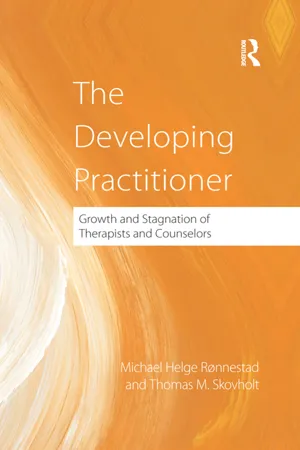
The Developing Practitioner
Growth and Stagnation of Therapists and Counselors
- 392 pages
- English
- ePUB (mobile friendly)
- Available on iOS & Android
eBook - ePub
The Developing Practitioner
Growth and Stagnation of Therapists and Counselors
About this book
Information
Part I
THEORETICAL AND EMPIRICAL FOUNDATIONS FOR THE STUDY OF PRACTITIONER DEVELOPMENT
1
PERSPECTIVES ON PRACTITIONERS’ PROFESSIONAL DEVELOPMENT1
Introduction
During the last decades of the 20th century and into the 21st century, the fields of psychotherapy and counseling have been progressively valued as important contributors to human well-being. These fields are increasingly commanding a central position in the solutions of many of the complex and important concerns that are faced by numerous people. Mental health services are steadily expanding and continued growth is expected over the decades ahead. Central to this rise in popularity are the positive responses from individuals who are receiving counseling or therapy. People usually value the professional help that they receive from therapists and counselors in such diverse areas as anxiety reduction, managing depression, coping with loss, resolving relationship conflicts, developing positive organizations, finding satisfying work, learning new interpersonal skills, stopping addictive behaviors, struggling with meaning and purpose in life, and addressing family problems.
Within the fields of psychotherapy and counseling, there is an ongoing debate regarding definition of the knowledge-base for practitioners. The policy statement of the American Psychological Association on Evidence-Based Treatment (2006) is one expression of necessary sources of knowledge for professional practice. As many will already know, the definition is as follows: “Evidence-based practice in psychology (EBPP) is the integration of the best available research with clinical expertise in the context of patient characteristics, culture, and preferences” (APA, 2006, p. 273). One of the components of clinical expertise in this definition is continual self-reflection and acquisition of skills. One rationale for the work we are presenting in the book is the “know thyself credo” of the therapy/counseling culture. We hope that this book will stimulate readers to explore broadly and deeply the different aspects of their professional and personal selves, their motivations for entering and staying in the profession, their assets and limitations in professional functioning, and how to ensure continued professional growth. For those who may feel that they are stagnating or experiencing a sense of decline, we hope that this book will provide a stimulus toward regaining a sense of vitality and enthusiasm for their professional work.
We feel that the knowledge reported in this book, knowledge generated from in-depth interviews, survey data, and from reflections and dialogues with colleagues, has a potential to enhance the professional development of therapists and counselors. When we add to this the recent summaries of psychotherapy research that have convincingly documented the impact of therapist/counselor effects on the outcome of therapy and counseling (Norcross, 2011; Wampold, 2011), we feel that we have compelling arguments for the continued study of therapists and counselors. The focus of our research is on the professional development of practitioners throughout their professional lifespan.
Many models of therapist and counselor development were formulated during the 1970s and 1980s. Following publication of our initial work on professional development (Rønnestad & Skovholt, 1991; Skovholt & Rønnestad, 1991, 1992), few studies have emerged that have provided empirically based models for professional development with the focus on the entire professional life cycle of the practitioner. Exceptions are our follow-up study of therapists/counselors (Rønnestad & Skovholt, 2001), reanalyses of our material (e.g., Rønnestad & Skovholt, 2003); the largescale survey conducted by the Society for Psychotherapy Research Collaborative Research Network (e.g., Orlinsky & Rønnestad, 2005), and studies in related fields of expertise (Chi, Glaser, & Farr, 1988; Feltovitch, Prietula, & Ericsson, 2006). There are, of course, large bodies of knowledge within established areas of inquiry that are highly relevant for understanding professional development, like therapist/counselor training (both basic and continuing education), supervision, personal therapy, and motivation for becoming a professional helper. Typically, this research does not attempt to describe professional development over the course of the entire professional lifespan.
In this chapter, we present first some reflections on topics which converge in a need to combine the study of therapist effects with the study of practitioner development in order to better understand the contribution of the therapist to the therapy/counseling outcome. This is followed by a discussion of the concept of development, and a historical review of the professional development literature.
The Profound Importance of the Therapist’s Contribution to Successful Outcome
The person of the psychotherapist is increasingly attracting the attention of those interested in understanding the processes and dynamics of changes in therapy and counseling. Over the years, we have come to appreciate the deeply personal nature of being a practitioner. The work by Skovholt and McCarthy (1988) documented the personal nature of therapeutic work in their investigation of critical incidents in the development of counselors and therapists. Also, the book edited by Goldfried (2001) offers a highly engaging series of 15 first-person accounts by seasoned practitioners of their own professional lives. Another recent contribution to this literature is Voices from the Field: Defining Moments in Counselor and Therapist Development, (Trotter-Mathison, Koch, Sanger, & Skovholt, 2010), a book also filled with deeply meaningful and engaging stories by 87 practitioners who share the defining moments that shaped their own professional lives.
Another recent and convincing contribution to the perspective of the person of the therapist/counselor is the formulation of the real relationship in therapy (e.g., Gelso, 2002, 2009). Gelso suggests not only that the real relationship is a viable and useful construct in the study of therapy/counseling process, but also that the personal qualities of psychotherapists contribute to the formation of the professional relationship. This is how Gelso (2009) defines the real relationship:
In sum, we define the real relationship as the personal relationship existing between two or more people as reflected in the degree to which each is genuine with the other, and perceives and experiences the other in ways that befit the other.
(pp. 254–255)
Carl Rogers’s seminal contributions to the conceptualization of psychotherapy, and his emphasis on therapist genuineness (Rogers, 1957), is a testimony to how important therapists’ personal qualities are for optimal professional functioning. Gelso brings genuineness and the real relationship together by stating that the two concepts are interrelated. He writes: “It is difficult for me to think of a real relationship in the absence of these two elements, realism and genuineness” (p. 255). Another professional who describes the personal aspect of professional practice is David Orlinsky, who on his home page states:
Orlinsky views psychotherapy also as essentially [a] “personal relationship,” but one that is offered professionally as a corrective or remedial experience for persons in modern societies whose subjective distress or behavioral problems are rooted in impaired, incomplete, or deviant development in “natural” personal relationships.
There is an ongoing debate in psychotherapy research about the relative contribution of the therapeutic relationship versus the technical factors for therapy outcome (see Duncan, Miller, Wampold, & Hubble, 2010; Norcross, 2011; Norcross & Lambert, 2011 for contributions to this debate). We will address this briefly, as the empirical results that contribute to this discussion are arguments for focusing more intensely on the study of therapists. While some argue that it is the quality of the therapeutic relationship that is of most importance for client change, others contend that it is the therapeutic methods or techniques that are of greatest significance. This debate is often framed within a related discussion; namely, that regarding common versus specific factors of psychotherapy. Those who have most confidence in the common factors perspective believe that elements that are most effective in therapy are shared by the majority of forms of psychotherapy; the researchers with this perspective, typically will not investigate in their research what differentiates one therapy from another, but will explore those characteristics that they share. In contrast, those who deem that it is the technical aspects that are most important for therapy outcome, will typically look for differences between treatment forms in their research, and they are likely to do so by studying those therapies that are manualized.
The debate about the relative contributions of common and specific factors is far from settled, and it may also be argued that the distinction is artificial, as we illustrate below. Possibly overstating the change in the editors’ position in the revision of The Heart and Soul of Change (Duncan et al., 2010), Orlinsky (2010) writes:
Implicit recognition of this new paradigm is reflected in the fact that the architects of this new edition have abandoned the traditional distinction between common factors and specific factors as an organizing framework (in which specific factors refers primarily to differences in therapists’ procedures or techniques) and have replaced that with a simpler, more inclusive emphasis on therapeutic factors.
(p. xxii)
More than 30 years ago, Goldfried (1980) proposed a strategy to arrive at a rapprochement between different schools of therapy through identifying common clinical strategies. He suggested conceptualizing the therapeutic enterprise at various levels of abstraction. Theoretical frameworks or accompanying theoretical stances were at the highest level of abstraction. According to Goldfried, focusing the discussion at that level provides little chance for agreement. Therapeutic techniques or clinical procedures were at the lowest level of abstraction. Some agreement might be found at this level, but likely not beyond trivial points of similarity. There was more promise at the midlevel. He wrote:
I would suggest, however, that the possibility of finding meaningful consensus exists at a level of abstraction somewhere between theory and technique which, for want of a better term, we might call clinical strategies. Were these strategies to have a clear empirical foundation, it might be more appropriate to call them principles of change.
(p. 994)
And indeed, in a special issue of Applied and Preventive Psychology (Volume 13, 2009) devoted to a discussion of Goldfried’s seminal article, it is documented that principles of change have an empirical foundation (e.g., Castonguay & Beutler, 2006). Goldfried highlights the following: (a) client’s initial expectations that therapy can be helpful and client motivation, (b) the therapeutic alliance, (c) having clients become aware of what contributes to their current life problems, (d) client engagement in corrective experiences.
Increasingly, prominent psychotherapy researchers question the validity and usefulness of arguing for either the treatment method or the relationship having most impact for therapy/counseling outcome. Norcross and Lambert (2011) write: “But perhaps the most pernicious and insidious consequence of the false dichotomy of treatment versus relationship has been its polarizing effect on the discipline” (p. 4). With their overview of the field, we are wise to listen to their advice to study the patient, the therapist, their relationship, the treatment method, and the context if we want to improve psychotherapy outcome.
Although we are mindful of the complexity and interrelationship of “what works,” our focus is on the therapists’ perceptions of their work and development. It is reasonably certain that therapist effects contribute substantially to variations in therapy/counseling outcome (Lutz, Leon, Martinovitch, Lyons, & Stiles, 2007; Wampold, 2010; Wampold & Brown, 2005). Even though it is conceptually questionable to single out different “effects,” the empirical findings on the topic cannot be ignored. Indeed, “therapist effects” are much more important than “methods effects,” and therefore who the therapist is, is much more important than the therapeutic method used. While there may be some exceptions to this description, this is the general picture. However, we caution against the misunderstanding that methods and techniques are not important; it can certainly be argued that it is through the use of different techniques and methods that relationships are formed. Orlinsky (2010) expresses this point of view: “The therapist’s procedures are important but become effective largely by contributing to the formation and development of this relationship in the patient’s perspective” (p. xxi). Nevertheless, the bulk of the empirical findings indicate that the relative importance favors the relationship effects and therapist effects. Indeed, one recent finding is that it is the therapist’s variability in alliance scores that predict outcome, rather than client’s variability (Baldwin, Wampold, & Imel, 2007). The findings above provide a compelling argument for focusing more research on the therapist’s contribution to the alliance, and also, by implication, on the study of therapist/counselor development.
If you assume an instrumental/rational view of science, in which the therapist is merely a vehicle by which the treatment is delivered, you may be disturbed by the findings outlined above. But, if you are a clinician or a counselor, and consider who you would refer your close friends and family to for counseling or therapy then you are likely to find such findings not only quite agreeable, but obvious. They simply make sense.
By combining two major conclusions from psychotherapy and counseling research: (a) that the therapeutic relationship is highly important for outcome, and (b) that therapist effects are substantial, it follows that it is wise to study the entire person of the therapist/counselor, including personal aspects, if one is to grasp important aspects of practitioner functioning and therapist/counselor development.
Although the psychotherapist is no longer a neglected variable in psychotherapy research, as Garfield (1997) stated, there is still a need to combine traditional research on psychotherapy with research on psychotherapists and counselors. Studying change and stability in practitioners across their professional lifespan provides one avenue for increasing our knowledge on therapist functioning. Through the lens provided by such a perspective, we have the potential to view possible constructive and nonconstructive movements within and among practitioners, and may be able to identify those processes that impact on therapist/counselor development.
The Knowledge-Base for This Book
The main source of knowledge for this book is our own work, over many years, on therapist/counselor development, from which we have been fortunate enough to accrue extensive in-depth data from interviews that we have analyzed qualitatively. However, we have also drawn from other sources. In particular, we have consulted results from The Society for Psychotherapy Research-Collaborative Research Network (SPR-CRN) and results from studies on master therapists by Skovholt and Jennings (2004) and colleagues. In addition, we have compared our information with that from other research perspectives, and this has assisted in focusing our views on the nature of professional development. Lastly, our findings and perspectives have been both presented to, and discussed with, large numbers of students and colleagues from various professions over many years. Interacting with others, and obtaining reactions to our work during classes, seminars, workshops, conferences, and informal discussions has provided valuable feedback. These responses have assisted us in reconceptualizing our findings, in bringing some material to the forefront, leaving some on the back burner, even dropping some material that seemed less meaningful. This has been an ongoing process.
The SPR-CRN study is a research network that was initiated by David Orlinsky in 1989 and which has collected survey data from almost 11,000 psychotherapists from more than 30 countries. The major results from this study are presented in the book How Psychotherapists Develop: A Study of Therapeutic Work and Professional Growth (Orlinsky & Rønnestad, 2005a), while a summary of major concepts and results, including theoretical models from this large research study, is described in chapter 14 in this book...
Table of contents
- Cover Page
- Half Title page
- Title Page
- Copyright Page
- Dedication
- Contents
- List of Figures and Tables
- About the Authors
- Acknowledgments
- Preface
- Part I Theoretical and Empirical Foundations for the Study of Practitioner Development
- Part II A Qualitative Study of Therapist and Counselor Development
- Part III Expanding Views
- Part IV Appendices
- References
- Index
Trusted by 375,005 students
Access to over 1.5 million titles for a fair monthly price.
Study more efficiently using our study tools.
Frequently asked questions
Yes, you can cancel anytime from the Subscription tab in your account settings on the Perlego website. Your subscription will stay active until the end of your current billing period. Learn how to cancel your subscription
No, books cannot be downloaded as external files, such as PDFs, for use outside of Perlego. However, you can download books within the Perlego app for offline reading on mobile or tablet. Learn how to download books offline
Perlego offers two plans: Essential and Complete
- Essential is ideal for learners and professionals who enjoy exploring a wide range of subjects. Access the Essential Library with 800,000+ trusted titles and best-sellers across business, personal growth, and the humanities. Includes unlimited reading time and Standard Read Aloud voice.
- Complete: Perfect for advanced learners and researchers needing full, unrestricted access. Unlock 1.5M+ books across hundreds of subjects, including academic and specialized titles. The Complete Plan also includes advanced features like Premium Read Aloud and Research Assistant.
We are an online textbook subscription service, where you can get access to an entire online library for less than the price of a single book per month. With over 1.5 million books across 990+ topics, we’ve got you covered! Learn about our mission
Look out for the read-aloud symbol on your next book to see if you can listen to it. The read-aloud tool reads text aloud for you, highlighting the text as it is being read. You can pause it, speed it up and slow it down. Learn more about Read Aloud
Yes! You can use the Perlego app on both iOS and Android devices to read anytime, anywhere — even offline. Perfect for commutes or when you’re on the go.
Please note we cannot support devices running on iOS 13 and Android 7 or earlier. Learn more about using the app
Please note we cannot support devices running on iOS 13 and Android 7 or earlier. Learn more about using the app
Yes, you can access The Developing Practitioner by Michael Helge Ronnestad,Thomas Skovholt in PDF and/or ePUB format, as well as other popular books in Psicologia & Didattica in psicologia. We have over 1.5 million books available in our catalogue for you to explore.