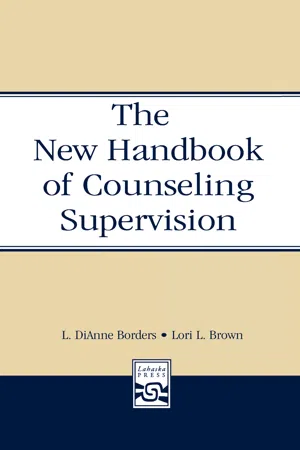
The second edition of this ground-breaking book continues the mission of its predecessor: to provide a "best principles" and "best practices" overview of the counseling supervision process, one that is firmly rooted in the recent explosion of empirical research in this field. Sponsored by the Association for Counselor Education and Supervision (ACES), the presentation is targeted primarily at master's-level practitioners who want "how-to" applications of the research literature (with examples) rather than a comprehensive review of the supervision literature. Like the first edition, this revised book is also a useful supplement for more academic texts used for doctoral-level instruction in counseling supervision.
Key changes in this new edition include greater attention to multicultural and diversity issues and new chapters on group supervision and on technology. Also new are discussion questions and vignettes meant to enhance application of key concepts in each chapter as well as more sample materials and forms for practice.
- 166 pages
- English
- ePUB (mobile friendly)
- Available on iOS & Android
eBook - ePub
The New Handbook of Counseling Supervision
About this book
Information
1
Supervision Models and Principles
All readers, regardless of their experience as a supervisor, come to the New Handbook of Counseling Supervision with a good bit of knowledge about the supervision process. Those of you who have been in the role of supervisee only still have ideas and opinions regarding what works and how you would “do supervision.” Chances are likely that you are right about many of your ideas. Those of you who have extensive supervision experience, whether trained as a supervisor or not, at the least have some practice-based observations and conclusions that probably can be found in the supervision literature. Quite simply, even untrained supervisors arrive at their first supervision session with a good bit of relevant training and experience. Certainly, all arrive with extensive training as a counselor, and everything learned in one’s master’s or doctoral program in counseling is relevant to supervision. Every Council for Accreditation of Counseling and Related Education Programs (CACREP) area addressed in our counselor education accreditation standards (CACREP, 2001)—counseling theories, assessment devices, helping and consulting skills, change interventions, ethical and legal guidelines, lifespan development and career development theories, family and group dynamics, social and cultural foundations, research and evaluation—has obvious application to helping a supervisee better understand and work with a client. Less obvious is the application of one’s counseling background for better understanding of and working with a supervisee. However, as a trained counselor, you know how to establish rapport and create a working relationship with your supervisee, you understand the implications of a supervisee’s life stage to his or her approach to clients, and you are aware of the varied influences (e.g., family history, ethnicity, and gender) on your supervisee’s behavior. Your knowledge of change mechanisms, including motivations toward and resistance to change, also are rele vant to a supervisee’s growth as a professional counselor. Both your empathic and your confrontive skills will be needed.
Those of you who have some teaching experience bring other relevant knowledge and skills to the supervision context, including your background in learning theories and instructional strategies. You know how to establish both short-term lesson plan objectives (a supervision session) and long-term unit plan goals (semester), and have experience in designing evaluations of progress. You understand the importance of flexibility in teaching strategies to address a variety of learning styles as well as the use of complementary strategies (e.g., didactic and experiential) and active learning approaches to consolidate learning. You have practice breaking down feedback into manageable chunks, concrete suggestions, and sequential steps.
Other professional backgrounds also have relevance for your work as a counseling supervisor. From consultation training, one has additional assessment and facilitation skills. From research courses, one understands the importance of ongoing evaluation of one’s work, as well as the skills for stating testable hypotheses, gathering relevant data from multiple sources, maintaining objectivity, and appropriately limiting the generalizability of your results to other supervisees. In fact, we have seen supervisors draw from their experiences in a wide array of professional experiences, including business (e.g., establishing a contract), computer and information systems (e.g., comfort using technology), dance (e.g., a fine sensitivity to body movements), engineering (e.g., ordering all the parts into a system), and theology (e.g., the relevance of grace and deep understanding of moral values underlying ethical decision making).
Clearly, the point here is that all new supervisors already have knowledge and skills highly applicable to their work as a supervisor. Why, then, is supervisor training needed? First, knowledge and skills from other professional areas are used in new and unique ways in supervision. You will use your counseling skills, but you will not be a counselor for your supervisee. You will use your teaching skills but will apply them in a specialized, nonclassroom setting, within an ongoing relationship. Part of supervision training, then, is learning how to apply existing skills appropriately in supervision. Second, it is quite important to have a framework for conducting supervision, a schema for organizing one’s knowledge and skills and deciding when and how to use them. Third, there are some interventions, learning processes, and ethical and legal considerations unique to supervision, and these need to be learned during supervisor training. Supervision, then, truly is a unique, separate profession (Dye & Borders, 1990).
As an initial step in your supervisor training, then, we suggest you first take an inventory of the relevant knowledge and skills you bring to your new role as a supervisor. There are several tools for doing this, including a self-assessment resumé in Borders and Leddick (1987), reprinted here (see Tables 1.1, 1.2, and 1.3). Similarly, the Association for Counselor Education and Supervision (ACES) Standards for Counseling Supervisors (Dye & Borders, 1990) provide an overview of 11 core areas of knowledge, competence, and personal traits that can be used as a self-assessment checklist (see Appendix A). These standards are operationalized in the ACES Curriculum Guide for Training Counseling Supervisors (Borders et al., 1991; see Appendix B). These tools will help you get a quick overview of what you need to know to be an effective supervisor, as well as what you already know, and which areas require focused work.
TABLE 1.1 Resumé Format for a Self-Assessment of Knowledge and Skills Developed in Previous Supervision-Related Roles and Experiences
TABLE 1.2 Self-Assessment of Supervision-Related Knowledge and Skills
As part of your self-inventory, give particular emphasis to feedback you have received about your work as a counselor, teacher, consultant, and other positions. If you are reluctant to use confrontation skills in counseling, this likely will be true of you in supervision also. If you used experiential activities effectively in the classroom, this will be a strength you can draw on during supervision. Review of feedback about your previous work provides a solid foundation for creating individual goals for your supervisor training experience.
TABLE 1.3 Self-Assessment of Supervision-Related Abilities Developed as a Supervisee
We do offer one word of caution about drawing from your previous experiences, particularly as a supervisee. What worked for you within any particular supervisory relationship should not be overgeneralized as “the right way.” What worked in that supervision context was influenced by the personalities of the supervisor and supervisee as well as their race and gender, the supervisee’s developmental level, the culture of the setting, types of client issues, and many other variables. Indeed, although we present a number of principles and dynamics underlying the supervision process, these principles and dynamics play out in unique ways within each supervision experience. These individual variations underlie both the challenge and the joy of conducting supervision.
SUPERVISION FRAMEWORKS
We begin with supervision models because they provide frameworks for organizing knowledge and skills for conducting supervision. Much like counseling theories, supervision models serve as a guide for choosing an interv...
Table of contents
- Cover Page
- Title Page
- Copyright Page
- List of Tables
- List of Appendices
- Preface
- Acknowledgments
- 1: Supervision Models and Principles
- 2: Initial Supervisory Sessions
- 3: Supervision Interventions
- 4: Group Supervision
- 5: Supervisory Relationship and Process Issues
- 6: Ethical Issues in Supervision
- 7: Evaluation of the Supervisee
- 8: Technology in Supervision
- Appendix A: Standards for Counseling Supervisors
- Appendix B: Curriculum Guide for Training Counseling Supervisors
- Appendix C: Ethical Guidelines for Counseling Supervisors
- References
Trusted by 375,005 students
Access to over 1.5 million titles for a fair monthly price.
Study more efficiently using our study tools.
Frequently asked questions
Yes, you can cancel anytime from the Subscription tab in your account settings on the Perlego website. Your subscription will stay active until the end of your current billing period. Learn how to cancel your subscription
No, books cannot be downloaded as external files, such as PDFs, for use outside of Perlego. However, you can download books within the Perlego app for offline reading on mobile or tablet. Learn how to download books offline
Perlego offers two plans: Essential and Complete
- Essential is ideal for learners and professionals who enjoy exploring a wide range of subjects. Access the Essential Library with 800,000+ trusted titles and best-sellers across business, personal growth, and the humanities. Includes unlimited reading time and Standard Read Aloud voice.
- Complete: Perfect for advanced learners and researchers needing full, unrestricted access. Unlock 1.5M+ books across hundreds of subjects, including academic and specialized titles. The Complete Plan also includes advanced features like Premium Read Aloud and Research Assistant.
We are an online textbook subscription service, where you can get access to an entire online library for less than the price of a single book per month. With over 1.5 million books across 990+ topics, we’ve got you covered! Learn about our mission
Look out for the read-aloud symbol on your next book to see if you can listen to it. The read-aloud tool reads text aloud for you, highlighting the text as it is being read. You can pause it, speed it up and slow it down. Learn more about Read Aloud
Yes! You can use the Perlego app on both iOS and Android devices to read anytime, anywhere — even offline. Perfect for commutes or when you’re on the go.
Please note we cannot support devices running on iOS 13 and Android 7 or earlier. Learn more about using the app
Please note we cannot support devices running on iOS 13 and Android 7 or earlier. Learn more about using the app
Yes, you can access The New Handbook of Counseling Supervision by L. DiAnne Borders,Lori L. Brown in PDF and/or ePUB format, as well as other popular books in Education & Education Counseling. We have over 1.5 million books available in our catalogue for you to explore.