- 226 pages
- English
- ePUB (mobile friendly)
- Available on iOS & Android
eBook - ePub
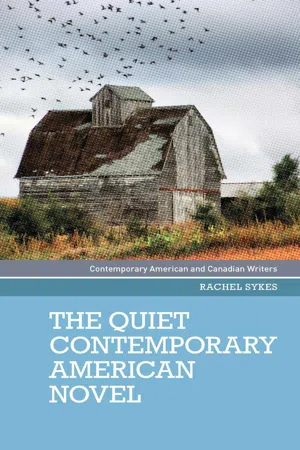
The quiet contemporary American novel
About this book
This book explores the concept of 'quiet' – an aesthetic of narrative driven by reflective principles – and argues for the term's application to the study of contemporary American fiction. In doing so, it makes two critical interventions. Firstly, it maps the neglected history of quiet fictions, arguing that from Hester Prynne to Clarissa Dalloway, from Bartleby to William Stoner, the Western tradition is filled with quiet characters. Secondly, it asks what it means for a novel to be quiet and how we might read for quiet in an American literary tradition that critics so often describe as noisy. Examining recent works by Marilynne Robinson, Teju Cole and Ben Lerner, among others, the book argues that quiet can be a multi-faceted state of existence, one that is communicative and expressive in as many ways as noise but filled with potential for radical discourse by its marginalisation as a mode of expression.
Information
Publisher
Manchester University PressYear
2017Print ISBN
9781526163615
9781526108876
eBook ISBN
9781526108890
1
The quiet novel
Quiet is a dynamic term. Whether constructed as a noun, adjective, adverb or verb, the word is older and more diverse than quietness or quietude and miscellaneous enough to remain applicable to many situations, states and, as this study argues, fictions. The third edition of the OED notes that the earliest use of ‘quiet’ as a noun appears in 1330, followed by ‘quietness’ in 1425, ‘quietude’ in 1598 and ‘quietism’ in 1687. ‘Loud’ is older and dates back to 800 with fewer listed meanings; ‘noise’ is only a century older than quiet and defined as an aggregate of sounds that somehow creates a ‘disturbance’. The reason I focus on ‘the quiet novel’ rather than literary quietness, quietude or quietism is because of the relative instability embodied in the term. While quietness and quietude are often defined very simply as states or conditions of being quiet, quietism is primarily conceived as a form of religious mysticism that embraces internal contemplation and, in its contemporary form, has become an accusation of political inaction.1
To describe a novel as quiet, however, is first to personify it: to be quiet is to be calm, private or peaceful and to speak quietly is to be measured, patient and unobtrusive. Quiet has also been associated with a mode and method of being since antiquity. In the Bible, Jacob is described as a ‘quiet man dwelling in tents’ who makes little external noise, rarely raises his voice and is fond of quiet activities.2 Compared with his brother, Esau, who is a man of action, ‘a skilful hunter’ and ‘man of the field’, Jacob creates little outward disturbance and leaves the world around him largely unchanged. Important to this study and the aesthetic of fiction it proposes, Jacob seems quieter when compared with the noise that Esau creates; in Genesis, he is praised for questioning the role that action plays in the outward expression of personality. When Jacob is renamed ‘Israel’, meaning one who wrestles inwardly with God, his renaming confirms that the essential and, indeed, worthy action of Jacob’s life is and will be internal.
Quiet novels privilege the experience of men like Jacob and examine the relative value and variety of quiet states that philosophy has valued for centuries. In Ancient Greece, for example, quiet was famously associated with inner tranquillity, characterised as an idyllic condition, free from mental or emotional agitation and undisturbed by external influence, action or event. Plato described the Greek concept of sophrosyne, denoting soundness of character and mind, as ‘a certain quietness’; Aristotle believed the quiet life to be a necessary condition for independent thought and the creation of art; Euripides proclaimed that only ‘the genial, quiet life, / Ruddered by right-thinking, / Knows calm security’.3 For Euripides, in particular, society’s activity and noise seemed distracting to the individual but personal quietude restores composure by reclaiming the mental space that reflection requires in the present. To be quiet is to be private and peaceful but most importantly quiet can be a philosophically active state, an ‘energy and essence’ as Aristotle suggests in Metaphysics (350 BC) that strengthens the individual’s ability to exist and participate in society.4
Historically, reviewers have used the term similarly, yet when references to ‘the quiet novel’ first appeared in the book review sections of British and American newspapers and periodicals in the 1860s, these early reviews contained little precision as to what ‘the quiet novel’ might be and shared no common authors. In 1868, the periodical London Society compared the quiet novel to ‘the very fast novel’ and described the experience of reading the two ‘like turning aside from the heat and glare and dust of a crowded street into some chapel, very still and quiet’.5 Notably, the unnamed reviewer hints that reading a quiet novel both requires and encourages a different faculty of mind, comparing the experience with that of entering a sacred space in search of tranquillity.6 A year later, in 1869, another unnamed reviewer described the quiet novel as any ‘successful attempt at characterisation’ in which incidents are ‘neither extravagant nor slow’.7 This reviewer emphasised how a lack of narrative action facilitates quiet prose, an association that trails ‘the quiet novel’ throughout its history. In 1884, Henry Mills Alden took up this idea in his review of Dinah Mulock’s Miss Tommy for Harper’s Monthly Magazine:
A much rarer gift – indeed, a most rare one – is the faculty of writing a quiet novel, whose interest does not depend upon these highly spiced and stimulating excitements. To write such a novel without lapsing into insipidity and tameness is one of the most difficult tests to which a writer of romance can be subjected, and to write one that will be successful with the public is a genuine triumph of art.8
Here, Alden refers to the quiet novel as the marginalia of a noisy culture and defines its quietness only by the absence of action: a lack of ‘highly spiced and stimulating excitements’.9 He claims that it is wildly popular for authors to write ‘dramatic scenes and incidents’ but uncommon for them to write quietly. Its implied rarity therefore leads Alden to praise the form as a ‘genuine triumph of art’ without further definition of its formal properties. Similarly, although The New York Times did not refer to ‘the quiet novel’ until 1929, its writers used ‘quiet’ as a description of the novel’s aesthetics as early as 1898 when an unnamed reviewer described Ada Cambridge’s Materfamilias (1898) as a novel with ‘no plot’ and a ‘quiet and unassuming’ style.10 To write quietly, these nineteenth-century reviewers suggest, is a worthy enterprise that requires the reader to reflect more slowly on the text and the ideas it introduces. However, the same reviewers also acknowledge that the quiet novel could be dismissed as trivial when it is not seen to compete with the overwhelming noise of the surrounding culture and that it risks going unheard when competing authors depict ‘stimulating excitements’ that could lure the reader’s attention elsewhere.
Throughout the phrase’s 150-year history, and as this chapter demonstrates, one idea is common to all discussions of quiet fiction: if society is noisy, then quiet becomes a much rarer commodity. Indeed, although quiet remains a necessary state for both reading and writing, many critics suggest that quiet prose risks going ‘unheard’ because quiet states seem so antithetical to the perceived noise of civilisation. The study of the quiet novel therefore has something important to say about the production and distribution of literary fiction. As Amelia DeFalco suggests, ‘[i]nterpreting contemplation, being, even resting or sleeping as meaningful, morally valuable states goes against the grain of teleological, capitalist-inflected discourses of activation that associate inactivity with weakness and diminished work.’11 The life of ‘quiet observation’ that DeFalco attributes to Ames in Marilynne Robinson’s Gilead lacks drama, excitement and event in the same way that Henry Mills Alden observes of the quiet novel in 1884.12 That is, without ‘dramatic scenes and incidents’, both Robinson and Dinah Mulock represent an existence in which action is not the primary experiential framework and ideas are encountered within the text at a rate of ‘extreme deceleration’ that is out of step with the accelerated pace of a capitalist society.13
It is this feature of narrative that I believe reviewers refer to when they describe a novel as quiet; a slow, contemplative prose style that denies the teleological drive to conclusion by largely eschewing narrative event. It is also in this way that I argue the four conditions for quiet outlined in my Introduction, from the depiction of quiet people and locations, to a focus on interior life and the absence of narrative event, facilitate an aesthetic of narrative that has not yet been defined despite consistent references throughout twentieth- and twenty-first-century literary criticism.
The quiet American novel
A major contention of The quiet contemporary American novel is that the quiet novel has a long history in Anglophone literature and is often positioned against an opposing norm of loudness and noise. The quiet contemporary American novel therefore joins a centuries-old tradition. Still, there is something peculiarly un-American about the idea of a quiet novel, which often focuses on the depiction of bookish, antisocial, solitary protagonists who set out to achieve ‘nothing’. In thinking about the relationship between quiet and the American nation-state, Graham Greene’s The Quiet American (1955) most immediately comes to mind. Greene’s anti-war novel is not a quiet novel, per se, nor is it written by an American author. However, it does imagine the implications of describing an American citizen as quiet. Alden Pyle, a CIA agent working undercover in Vietnam, is the quiet American of the title and Greene describes his quiet as antithetical to his nationality: ‘“He’s a good chap in his way. Serious. Not one of those noisy bastards at the Continental. A quiet American.”’14 Greene’s narrator, a British foreign correspondent called Thomas Fowler, intends his description to be an insult, not only against Pyle but also against all Americans; he compares the phenomenon of a ‘quiet American’ to ‘“a blue lizard […] a white elephant”’, animals of equal unlikeliness. As the novel develops, the significance of Pyle’s quiet changes from a calm enigmatic façade into a wider failure to speak against an American government that charges him with increasingly dubious tasks.15 He is a quiet American, then, because his demeanour hides even quieter, morally questionable actions, which ultimately lead to Pyle’s death.
Notably, Fowler finds the idea of a ‘quiet American’ ironic because he believes Americans and, by extension, America to be noisy. Part of America’s perceived loudness comes from its association with action, read historically in everything from the nation’s violent inception and aggressive foreign policies to the wide-reaching noise of US consumerism and media cultures, symbolised by the cacophonous Hollywood blockbuster.16 Colloquially, Americans are also often referred to as ‘noisy people’ who assert their needs and desires above those of others, prioritising sounds necessary to the completion of their own aims that are more likely to be deemed unwanted by non-American citizens. For instance, in a 1957 article for Life magazine, called ‘How We Appear to Others’, journalist Robert Coughlan notes that fundamentally:
[T]he American is noisy. In a public place his talk and his laughter are too loud and draw attention. He drinks too much, and when he drinks he becomes louder. A Turkish girl touches several sore points: ‘The Turk admires and yearns for the freedom of America, but he hates the way the Americans come here and act as if this country were a dominion of America.’17
Articles like this, playing off several xenophobic stereotypes, illustrate how popular perception of American noise exceeds the mere production of sound. Indeed, accusations of American loudness seem more related to the kinds of noise associated with the country and its citizens rather than a specific volume. When viewed from abroad, the noise of America seems like confidence granted by at least a century of relative prosperity and security, which attracts negative attention when that noise appears to claim what Coughlan calls ‘dominion’ over quieter nations.
Among American writers, a mixture of pride and frustration has also marked cultural responses to noise. Historian Emily Thompson notes that earlier twentieth-century Americans, like F. Scott Fitzgerald, saw the ‘pervasive din’ of the American city as ‘the keynote of modern civilization’.18 While some, like Fitzgerald, celebrated noise, others campaigned to eliminate it. However, as Thompson argues, ‘[a]ll perceived that they lived in an era uniquely and unprecedentedly loud’.19 This attitude persists in contemporary American writing. Tired of what he perceives to be an increasingly noisy New York, George Prochnik’s In Pursuit of Silence: Listening for Meaning in a Wor...
Table of contents
- Cover
- Half Title
- Title Page
- Copyright
- Contents
- Series editors’ foreword
- Acknowledgements
- Introduction
- 1 The quiet novel
- 2 ‘9/11’ and the noise of contemporary fiction
- 3 Quiet in time and narrative
- 4 The quiet novel of cognition
- 5 The novel of ‘(dis)quiet’
- Conclusion
- Bibliography
- Index
Trusted by 375,005 students
Access to over 1.5 million titles for a fair monthly price.
Study more efficiently using our study tools.
Frequently asked questions
Yes, you can cancel anytime from the Subscription tab in your account settings on the Perlego website. Your subscription will stay active until the end of your current billing period. Learn how to cancel your subscription
No, books cannot be downloaded as external files, such as PDFs, for use outside of Perlego. However, you can download books within the Perlego app for offline reading on mobile or tablet. Learn how to download books offline
We are an online textbook subscription service, where you can get access to an entire online library for less than the price of a single book per month. With over 1.5 million books across 990+ topics, we’ve got you covered! Learn about our mission
Look out for the read-aloud symbol on your next book to see if you can listen to it. The read-aloud tool reads text aloud for you, highlighting the text as it is being read. You can pause it, speed it up and slow it down. Learn more about Read Aloud
Yes! You can use the Perlego app on both iOS and Android devices to read anytime, anywhere — even offline. Perfect for commutes or when you’re on the go.
Please note we cannot support devices running on iOS 13 and Android 7 or earlier. Learn more about using the app
Please note we cannot support devices running on iOS 13 and Android 7 or earlier. Learn more about using the app
Yes, you can access The quiet contemporary American novel by Rachel Sykes in PDF and/or ePUB format, as well as other popular books in Literature & Drama. We have over 1.5 million books available in our catalogue for you to explore.