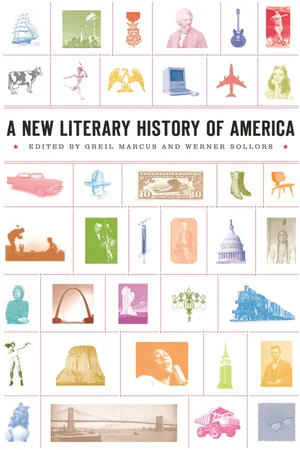
America is a nation making itself up as it goes along—a story of discovery and invention unfolding in speeches and images, letters and poetry, unprecedented feats of scholarship and imagination. In these myriad, multiform, endlessly changing expressions of the American experience, the authors and editors of this volume find a new American history.
In more than two hundred original essays, A New Literary History of America brings together the nation's many voices. From the first conception of a New World in the sixteenth century to the latest re-envisioning of that world in cartoons, television, science fiction, and hip hop, the book gives us a new, kaleidoscopic view of what "Made in America" means. Literature, music, film, art, history, science, philosophy, political rhetoric—cultural creations of every kind appear in relation to each other, and to the time and place that give them shape.
The meeting of minds is extraordinary as T. J. Clark writes on Jackson Pollock, Paul Muldoon on Carl Sandburg, Camille Paglia on Tennessee Williams, Sarah Vowell on Grant Wood's American Gothic, Walter Mosley on hard-boiled detective fiction, Jonathan Lethem on Thomas Edison, Gerald Early on Tarzan, Bharati Mukherjee on The Scarlet Letter, Gish Jen on Catcher in the Rye, and Ishmael Reed on Huckleberry Finn. From Anne Bradstreet and John Winthrop to Philip Roth and Toni Morrison, from Alexander Graham Bell and Stephen Foster to Alcoholics Anonymous, Life, Chuck Berry, Alfred Hitchcock, and Ronald Reagan, this is America singing, celebrating itself, and becoming something altogether different, plural, singular, new.
eBook - PDF
A New Literary History of America
- 1,129 pages
- English
- PDF
- Available on iOS & Android
eBook - PDF
A New Literary History of America
About this book
Information
1982
M
AYA
L
I
N
’
S
WA
L
L
1009
The
Vietnam
Veterans
Memorial,
Washington,
D.C.
Photograph
by
James
P.
Blair,
National
Geographic
(Getty
Images)
Table of contents
- Cover
- Title Page
- Copyright
- Contents
- Introduction
- 1507 The name “America” appears on a map
- 1521, August 13 Mexico in America
- 1536, July 24 Alvar Núñez Cabeza de Vaca
- 1585 “Counterfeited according to the truth”
- 1607 Fear and love in the Virginia colony
- 1630 A city upon a hill
- 1643 A nearer neighbor to the Indians
- 1666, July 10 Anne Bradstreet
- 1670 The American jeremiad
- 1670 The stamp of God’s image
- 1673 The Jesuit relations
- 1683 Francis Daniel Pastorius
- 1692 The Salem witchcraft trials
- 1693–1694, March 4 Edward Taylor
- 1700 Samuel Sewall, The Selling of Joseph
- 1722 Benjamin Franklin, The Silence Dogood Letters
- 1740 The Great Awakening
- Late 1740s; 1814, September 13–14 Two national anthems
- 1765, December 23 Michel-Guillaume Jean de Crèvecoeur
- 1773, September Phillis Wheatley
- 1776 The Declaration of Independence
- 1784, June Charles Willson Peale
- 1787 James Madison, Notes of the Debates in the Federal Convention
- 1787–1790 John Adams, Discourses on Davila
- 1791 Philip Freneau and The National Gazette
- 1796 Washington’s farewell address
- 1798 Mary Rowlandson and the Alien and Sedition Acts
- 1798 American gothic
- 1801, March 4 Jefferson’s first inaugural address
- 1804, January The matter of Haiti
- 1809 Cupola of the world
- 1819, February The Missouri crisis
- 1820, November 27 Landscape with birds
- 1821 Sequoyah, the Cherokee syllabary
- 1821, June 30 Junius Brutus Booth
- 1822 Henry Rowe Schoolcraft, the Ojibwe firefly, and Longfellow’s Hiawatha
- 1825, November Thomas Cole and the Hudson River school
- 1826, July 4 Songs of the republic
- 1826 Cooper’s Leatherstocking tales
- 1826; 1927 Transnational poetry
- 1827 Joseph Smith and the Book of Mormon
- 1828 David Walker, Appeal, in Four Articles
- 1830, May 21 Jump Jim Crow
- 1831, March 5 The Cherokee Nation decision
- 1832, July 10 President Jackson’s bank veto
- 1835, January Democracy in America
- 1835 William Gilmore Simms, The Yemassee
- 1835 The Sacred Harp
- 1836, February 23–March 6 The Alamo and Texas border writing
- 1836, February 28 Richard Henry Dana, Jr.
- 1837, August 15 Ralph Waldo Emerson, “The American Scholar”
- 1838, July 15 “The Divinity School Address”
- 1838, September 3 The slave narrative
- 1841 “The Murders in the Rue Morgue”
- 1846, June James Russell Lowell’s Biglow Papers
- 1846, late July Henry David Thoreau
- 1850 The Scarlet Letter
- 1850, July 19 Margaret Fuller and the Transcendentalist Movement
- 1850, August 5 Nathaniel Hawthorne and Herman Melville
- 1851 Moby-Dick
- 1851 Uncle Tom’s Cabin
- 1852 Hawthorne’s Blithedale Romance and utopian communities
- 1852, July 5 Frederick Douglass, “What to the slave is the Fourth of July?”
- 1854 Maria Cummins and sentimental fiction
- 1855 Walt Whitman, Leaves of Grass
- 1858 The Lincoln-Douglas debates
- 1859 The science of the Indian
- 1861 Emily Dickinson
- 1862, December 13 The journeys of Little Women
- 1865, March 4 Lincoln’s second inaugural address
- 1865 “Conditions of repose”
- 1869, March 4 Carl Schurz
- 1872, November 5 All men and women are created equal
- 1875 The Winchester Rifle
- 1876, January 6 Melville in the dark
- 1876, March 10 The art of telephony
- 1878 “How to Make Our Ideas Clear”
- 1879 John Muir and nature writing
- 1881, January 24 Henry James, Portrait of a Lady
- 1884 Mark Twain’s hairball
- 1884, July The Linotype machine
- 1884, November The Southwest imagined
- 1885 The problem of error
- 1885, July Limits to violence
- 1885, October Writing New Orleans
- 1888 The introduction of motion pictures
- 1889, August 28 A Connecticut Yankee in King Arthur’s Court
- 1893 Chief Simon Pokagon and Native American literature
- 1895 Ida B. Wells, A Red Record
- 1896 Paul Laurence Dunbar, Lyrics of Lowly Life
- 1896, September 6 Queen Lili‘uokalani
- 1897, Memorial Day The Robert Gould Shaw and 54th Regiment Monument
- 1898, June 22 Literature and imperialism
- 1899; 1924 McTeague and Greed
- 1900 Henry Adams
- 1900 The Wizard of Oz
- 1900; 1905 Sister Carrie and The House of Mirth
- 1901 Charles W. Chesnutt, The Marrow of Tradition
- 1901; 1903 The problem of the color line
- 1903, May 5 “The real American has not yet arrived”
- 1903 The invention of the blues
- 1903 One sees what one sees
- 1904, August 30 Henry James in America
- 1905, October 15 Little Nemo in Slumberland
- 1906, April 9 The Azusa Street revival
- 1906, April 18, 5:14 a.m. The San Francisco Earthquake
- 1911 “Alexander’s Ragtime Band”
- 1912, April 15 Lifeboats cut adrift
- 1912 The lure of impossible things
- 1912 Tarzan begins his reign
- 1913 A modernist moment
- 1915 D. W. Griffith, The Birth of a Nation
- 1915 Robert Frost
- 1917 The philosopher and the millionaire
- 1920, August 10 Mamie Smith’s “Crazy Blues”
- 1921 Jean Toomer
- 1922 T. S. Eliot and D. H. Lawrence
- 1923, October Chaplinesque
- 1924 F. O. Matthiessen meets Russell Cheney
- 1924, May 26 The Johnson-Reed Act and ethnic literature
- 1925 The Great Gatsby
- 1925, June Sinclair Lewis
- 1925, July The Scopes trial
- 1925, August 16 Dorothy Parker
- 1926 Fire!!
- 1926 Hardboiled
- 1926 The Book-of-the-Month Club
- 1927 Carl Sandburg and The American Songbag
- 1927, May 16 “Free to develop their faculties”
- 1928, April 8, Easter Sunday Dilsey Gibson goes to church
- 1928, Summer John Dos Passos
- 1928, November 18 The mouse that whistled
- 1930 “You’re swell!”
- 1930, March The Silent Enemy
- 1930, October Grant Wood’s American Gothic
- 1931, March 19 Nevada legalizes gambling
- 1932 Edmund Wilson, The American Jitters
- 1932 Arthur Miller
- 1932, April or May The River Rouge plant and industrial beauty
- 1932, Christmas Ned Cobb
- 1933 Baby Face is censored
- 1933, March FDR’s first Fireside Chat
- 1934, September Robert Penn Warren
- 1935 The Popular Front
- 1935 The skyscraper
- 1935, June 10 Alcoholics Anonymous
- 1935, October 10 Porgy and Bess
- 1936 Gone with the Wind and Absalom, Absalom!
- 1936, July 5 Two days in Harlem
- 1936, November 23 Life begins
- 1938 Superman
- 1938, May Jelly Roll Morton speaks
- 1939 Billie Holiday, “Strange Fruit”
- 1939; 1981 Up from invisibility
- 1940 “No way like the American way”
- 1940–1944 Preston Sturges
- 1941 An insolent style
- 1941 Citizen Kane
- 1941 The word “multicultural”
- 1943 Hemingway’s paradise, Hemingway’s prose
- 1944 The second Bill of Rights
- 1945, February Bebop
- 1945, April 11 Thomas Pynchon and modern war
- 1945, August 6, 10:45 a.m. The atom bomb
- 1946, December 5 Integrating the military
- 1947, December 3 Tennessee Williams
- 1948 Norbert Wiener, Cybernetics
- 1948 Saul Bellow
- 1949–1950 “The Birth of the Cool”
- 1950, November 28 “Damned busy painting”
- 1951 A poet among painters
- 1951 The Catcher in the Rye
- 1951 James Jones, From Here to Eternity
- 1951 A soft voice
- 1952, April 12 Elia Kazan and the blacklist in Hollywood
- 1952, June 10 C. L. R. James
- 1953, January 1 The song in country music
- 1954 Wallace Stevens, Collected Poems
- 1955, August 11 “The self-respect of my people”
- 1955, September 21 A. J. Liebling and the Marciano-Moore fight
- 1955, October 7 A generation in miniature
- 1955, December Nabokov’s Lolita
- 1956, April 16 “Roll Over Beethoven”
- 1957 Dr. Seuss
- 1959 “Nobody’s perfect”
- 1960 Psycho
- 1960, January More than a game
- 1961, January 20 JFK’s inaugural address and Catch-22
- 1961, July 2 The author as advertisement
- 1962 Bob Dylan writes “Song to Woody”
- 1962 “White Elephant Art vs. Termite Art”
- 1963, April “Letter from Birmingham Jail”
- 1964 Robert Lowell, “For the Union Dead”
- 1964, October 27 “The last stand on Earth”
- 1965, September 11 The Council on Interracial Books for Children
- 1965, October The Autobiography of Malcolm X
- 1968 Norman Mailer
- 1968, March The illusory babels of language
- 1968, August 28 The plight of conservative literature
- 1969 Elizabeth Bishop, Complete Poems
- 1969, January 11 The first Asian Americans
- 1969, November 12 The eye of Vietnam
- 1970 Maya Angelou, Toni Morrison, Alice Walker
- 1970; 1972 Linda Lovelace
- 1973 Loisaida literature
- 1973 Adrienne Rich, Diving into the Wreck
- 1975 Gayl Jones
- 1981, March 31 Toni Morrison
- 1982 Edmund White, A Boy’s Own Story
- 1982 Wild Style
- 1982 Maya Lin’s wall
- 1982, November 8 Harriet Wilson
- 1985, April 24 Henry Roth
- 1987 Maxine Hong Kingston, Tripmaster Monkey
- 1995 Philip Roth
- 2001 Twenty-first-century free verse
- 2003 Richard Powers, The Time of Our Singing
- 2005, August 29 Hurricane Katrina
- 2008, November 4 Barack Obama
- Contributors
- Index
Trusted by 375,005 students
Access to over 1.5 million titles for a fair monthly price.
Study more efficiently using our study tools.
Frequently asked questions
Yes, you can cancel anytime from the Subscription tab in your account settings on the Perlego website. Your subscription will stay active until the end of your current billing period. Learn how to cancel your subscription
No, books cannot be downloaded as external files, such as PDFs, for use outside of Perlego. However, you can download books within the Perlego app for offline reading on mobile or tablet. Learn how to download books offline
Perlego offers two plans: Essential and Complete
- Essential is ideal for learners and professionals who enjoy exploring a wide range of subjects. Access the Essential Library with 800,000+ trusted titles and best-sellers across business, personal growth, and the humanities. Includes unlimited reading time and Standard Read Aloud voice.
- Complete: Perfect for advanced learners and researchers needing full, unrestricted access. Unlock 1.5M+ books across hundreds of subjects, including academic and specialized titles. The Complete Plan also includes advanced features like Premium Read Aloud and Research Assistant.
We are an online textbook subscription service, where you can get access to an entire online library for less than the price of a single book per month. With over 1.5 million books across 990+ topics, we’ve got you covered! Learn about our mission
Look out for the read-aloud symbol on your next book to see if you can listen to it. The read-aloud tool reads text aloud for you, highlighting the text as it is being read. You can pause it, speed it up and slow it down. Learn more about Read Aloud
Yes! You can use the Perlego app on both iOS and Android devices to read anytime, anywhere — even offline. Perfect for commutes or when you’re on the go.
Please note we cannot support devices running on iOS 13 and Android 7 or earlier. Learn more about using the app
Please note we cannot support devices running on iOS 13 and Android 7 or earlier. Learn more about using the app
Yes, you can access A New Literary History of America by Greil Marcus, Werner Sollors, Greil Marcus,Werner Sollors in PDF and/or ePUB format, as well as other popular books in Literature & North American History. We have over 1.5 million books available in our catalogue for you to explore.