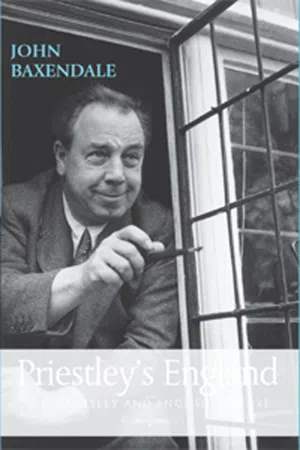
Priestley's England is the first full-length academic study of J B Priestley – novelist, playwright, screen-writer, journalist and broadcaster, political activist, public intellectual and popular entertainer, one of the makers of twentieth-century Britain, and one of its sharpest critics.
The book explores the cultural, literary and political history of twentieth-century Britain through the themes which preoccupied Priestley throughout his life: competing versions of Englishness; tradition, modernity, and the decline of industrial England; 'Americanisation', mass culture and 'Admass'; cultural values and 'broadbrow' culture; consumerism and the decay of the public sphere; the loss of spirituality and community in 'the nervous excitement, the frenzy, the underlying despair of our century'. It argues that Priestley has been unjustly neglected for too long: we have a great deal to learn both from this extraordinary, multi-faceted man, and from the English radical tradition he represented.
This book will appeal to all those interested in the culture and politics of twentieth-century Britain, in the continuing debates over 'Englishness' to which Priestley made such a key contribution, and in the life and work of one of the most remarkable and popular writers of the past century.
- 213 pages
- English
- ePUB (mobile friendly)
- Available on iOS & Android
eBook - ePub
About this book
Trusted by 375,005 students
Access to over 1.5 million titles for a fair monthly price.
Study more efficiently using our study tools.
Information
1
‘A serious writer with a message’
Others are proud of reading J. B. Priestley and writers such as him, because they are ‘serious writers with a message’. Others have learned that Mr Priestley is a ‘middlebrow’, and only mention him in terms of deprecation. They tend to read bitterly ironic or anguished literature – Waugh, Huxley, Kafka and Greene.1
Thus Richard Hoggart in The Uses of Literacy (1957) describes the predicament of a serious working-class reader, seeking the pathway to ‘the cultured life’, and finding it set about with unexpected dangers. It also encapsulates Priestley’s problematic reputation within twentieth-century literary culture. We can easily see why Hoggart’s reader takes Priestley for a ‘serious’ writer. He wrote properly crafted novels, not sensational adventure stories like Edgar Wallace or Mickey Spillane. Though his novels were not afraid to entertain, they were set in the real contemporary world, and they made you think about important issues. His books were reviewed in serious newspapers and magazines, where Priestley himself also wrote. He served his time alongside other famous writers in organisations such as PEN, and in due course was honoured by the state for his literary achievements. When he wrote in the newspaper, or appeared on the radio or the public platform, his authority to be there rested on his reputation as a writer worthy of respect: a serious writer, with a message, to whom serious people should listen.
Such, however, is not the received narrative of twentieth-century literary history – a narrative which Hoggart’s working-class reader in due course ‘learns’. According to this story, Priestley was out of date before he started, writing novels in an obsolete style which appealed only to readers who knew no better and who craved only the simple emotional comforts that an old-fashioned tale would provide. As there were rather a lot of these readers Priestley made plenty of money, but that should not blind us to the fact that the modernism which he and his readers spurned – Virginia Woolf, D. H. Lawrence, James Joyce, T. S. Eliot et al. – was the only contemporary literature worth considering. Mr Priestley, on the other hand, was a ‘middlebrow’.
The purpose of this chapter is to put forward a different view of things. Situating Priestley in the literary culture of his time, it will argue that far from being an old-fashioned writer he was in many ways a very modern one, and it was in his fame and popularity, and his omnipresence in the developing mass media, that much of this modernity lay. It will also investigate the idea of the ‘middlebrow’, its origins in the cultural warfare of the 1920s and 1930s, and its implications for literary and cultural values. It will argue that Priestley, like other so-called ‘middlebrows’, was pursuing one of the writer’s time-honoured duties: to provide a critical commentary on contemporary society for a wide audience. This multi-faceted democratic debate is the underlying theme of Priestley’s long writing career, and therefore of this book.
The changing literary field
Hoggart’s autodidact had stumbled over what Pierre Bourdieu described as a contest for cultural legitimacy – the ‘power to consecrate’, to determine what counts as ‘proper’ culture. According to Bourdieu, such contests are structured around the opposition within literary culture between two conflicting principles: on the one hand restricted production, ‘art for art’s sake’; and on the other large-scale production: the desire not just for commercial success but to communicate with the largest number of people. Bourdieu also argued that there is continual conflict between generations, orthodoxy versus heresy, establishment versus newcomers.2 Both these levels of conflict were hard at work in the literary world which Priestley entered in the 1920s. It was a world shaped by two concurrent, and related, developments in cultural history: the expansion of the cultural marketplace, and the rise of literary modernism.
Print culture is always, irretrievably, embroiled in commerce, and there have always been writers who find this troubling. In 1761 Oliver Goldsmith was railing against ‘that fatal revolution whereby writing is converted to a mechanic trade’.3 The new literary forms suited to mass reproduction and commercial sale – newspapers, magazines, novels – that came into their own in the eighteenth and nineteenth centuries, dependent on new technologies, economic expansion and a growing reading public, heralded the Victorian golden age of print. In the late nineteenth and early twentieth centuries commercialised culture entered a new phase. The grip of the circulating libraries on novel production was broken; book sales and titles published more than doubled between 1850 and 1901, and again by 1913; popular halfpenny newspapers, the Daily Mail and the Daily Express, arrived on the scene, along with new popular magazines such as the Strand (1891) and John Bull (1906), and cheap periodicals such as Tit-Bits (1881) and Answers (1888), bringing with them new popular styles of journalism, and often carrying syndicated fiction supplied by agencies – all this happening, it should be noted, before the arrival of broadcasting, and before cinema and recorded music had made their biggest impact.4
Out of this expansion came the new world of letters described (and deplored) by George Gissing in New Grub Street (1891). Publishers and writers experienced, says Peter Keating, ‘a new kind of individual freedom that would release authors from the compromises and concessions that had inhibited the mid-Victorians’, while a whole new set of economic relationships emerged, including payment by royalties dependent on sales rather than a lump sum, literary agents, the Society of Authors and new publishers geared up to the expanded fiction market – such as Heinemann, who were to publish almost all of Priestley’s books. Publicity and celebrity became central to the promotion of new books, supported by secondary discourses such as reviews and magazine interviews. The world of the best-seller was born.
Writers’ reactions to this process varied. While some, like Edmund Gosse, feared for cultural standards, and saw the prospect of ‘a revolt of the mob against our literary masters’, others, like Willkie Collins, Arnold Bennett and H. G. Wells, were exhilarated by the possibilities of a wider readership – not just for making money but for influencing the thinking of the new democracy.5 But even Priestley, who certainly liked to do both of these things, would later complain of the ‘bargain basement atmosphere about publishing … snap successes, the Book of the Month, the Smash Hit of the Season’.6 By 1927 J. M. Keynes was describing publishing as ‘a gambling business kept alive by occasional windfalls’ – a pattern also followed by the film and music industries. ‘Literature now is a trade’, Jasper Milvain in New Grub Street bluntly declares, echoing Goldsmith’s lament of 130 years earlier.7 The fact of the matter is, though, that since writers have to eat, literature has always been a trade, one way or another. What was changing was the way in which that trade was conducted.
Portrait of the artist as a young Bruddersfordian
Meanwhile, in Bradford, young Jack Priestley, a voracious reader, and as such a beneficiary of the expansion of literary production, but dimly aware if at all of the alarms and excursions of the London literary scene, was deciding to become a writer. In his memoir Margin Released (1962), he would construct a vivid and affectionate account of this crucial phase of his life, from leaving school at sixteen in 1910 to work in a Bradford wool-merchant’s office to joining the army in 1914. The older Priestley evokes for us a young Priestley firmly situated ‘outside the fashionable literary movement’ by virtue of geography, class and a secure upbringing, but determined to be something – an actor, a musician, a writer.8 A bright pupil, but bored with school (and perhaps reacting against his schoolmaster father), he saw no connection between ‘certificates and degrees’ and a future artistic career; none of the authors he admired had been to Oxford or Cambridge, and it certainly never occurred to him that he would need higher education to become a more accomplished writer, let alone reader.9 Edwardian Bradford, as Priestley was to frequently remind his readers, provided not only the material for writerly observation and speculation but a thriving cultural life: musical, theatrical, artistic and literary.10 Most crucially, it was independent of London: London, says Priestley, never crossed his mind in those days except as a collection of editors’ addresses for the reception of manuscripts and the dispatch of rejection slips. His idea of a literary career was to sell enough pieces to those editors to raise a pound a week, on which he could easily keep himself in a cottage on the edge of the moors, a tuppenny tram-ride and a sharp walk from the centre of town: ‘writing for money’, if you like, but in a very modest way.11
To this end, after work in the wool-office, the teenaged Priestley lived the literary life in the attic of his parents’ terraced house, scribbling profusely in pencil in his notebooks in front of the gas fire, turning out prose sketches, short stories and blank-verse narratives about Sir Lancelot and Atlantis, one of which, a short piece of doom-laden free verse entitled ‘The song of a mood’, he sent to the Irish poet George Russell, receiving a detailed and encouraging response.12 At sixteen, having already accumulated many rejections, he finally sold a short piece – a mock interview entitled ‘Secrets of the rag-time king’ – to the weekly magazine London Opinion, for a guinea.13 Shortly afterwards he began a weekly (unpaid) column for the local socialist paper, the Bradford Pioneer, in which he wrote, as he later put it, ‘on everything – books, plays, music, this world and the next – with all the gusto and dogmatism of a precocious boy of 17 or 18’.14
Bradford was no Bloomsbury, but it provided ample sustenance for the budding author. Although there were few writers in the town worthy of the name, there were plenty of ‘people who read a great deal’. There were three local daily papers, including the estimable Yorkshire Observer, for which Priestley was to write a weekly column in 1919–21, and so there were sophisticated young journalists around (including, though Priestley never mentions him, the young Howard Spring), who ‘could take the city to pieces over a coffee and a roll-and-butter at Lyons’s’; but that cynical newspaper world was not for him.15 There were even one or two proper, published wri...
Table of contents
- Front Cover
- Title Page
- Copyright Page
- Contents
- Acknowledgements
- Introduction
- 1 ‘A serious writer with a message’
- 2 Bruddersford and beyond
- 3 Englands and Englishness
- 4 This new England
- 5 Priestley’s war
- 6 ‘Now we must live up to ourselves’: New Jerusalem and beyond
- Bibliography
- Index
Frequently asked questions
Yes, you can cancel anytime from the Subscription tab in your account settings on the Perlego website. Your subscription will stay active until the end of your current billing period. Learn how to cancel your subscription
No, books cannot be downloaded as external files, such as PDFs, for use outside of Perlego. However, you can download books within the Perlego app for offline reading on mobile or tablet. Learn how to download books offline
We are an online textbook subscription service, where you can get access to an entire online library for less than the price of a single book per month. With over 1.5 million books across 990+ topics, we’ve got you covered! Learn about our mission
Look out for the read-aloud symbol on your next book to see if you can listen to it. The read-aloud tool reads text aloud for you, highlighting the text as it is being read. You can pause it, speed it up and slow it down. Learn more about Read Aloud
Yes! You can use the Perlego app on both iOS and Android devices to read anytime, anywhere — even offline. Perfect for commutes or when you’re on the go.
Please note we cannot support devices running on iOS 13 and Android 7 or earlier. Learn more about using the app
Please note we cannot support devices running on iOS 13 and Android 7 or earlier. Learn more about using the app
Yes, you can access Priestley’s England by John Baxendale in PDF and/or ePUB format, as well as other popular books in History & Art & Politics. We have over 1.5 million books available in our catalogue for you to explore.