How do leading Conservative politicians strive to communicate with and influence the electorate? Why have some been more effective than others in advancing their personal positions and ideological agendas? How do they seek to connect with their audience in different settings, such as the party conference, House of Commons, and through the media?
This book draws analytical inspiration from the Aristotelian modes of persuasion to shine new and insightful light upon the articulation of British conservatism, examining the oratory and rhetoric of twelve key figures from Conservative Party politics. Each chapter is written by an expert in the field and explores how its subject attempted to use oratory to advance their agenda within the party and beyond.
This is the first book to analyse Conservative Party politics in this way, and marks an important new departure in the analysis of British politics.
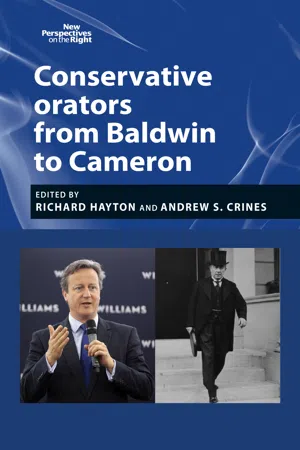
eBook - ePub
Conservative orators
From Baldwin to Cameron
- 232 pages
- English
- ePUB (mobile friendly)
- Available on iOS & Android
eBook - ePub
Conservative orators
From Baldwin to Cameron
About this book
Information
1
The oratory of Stanley Baldwin
Andrew Taylor
Introduction
Stanley Baldwin (1867–1947) was MP for Bewdley (1908–37), leader of the Conservative Party (1923–37) and prime minister three times (May 1923–January 1924; November 1924–June 1929; June 1935–May 1937). He was at the apex of British politics in a tempestuous and formative period making his oratory an important aspect of modern politics. Baldwin spoke frequently, formally and informally, on a vast range of political and non-political topics, and to a diverse range of audiences (Williamson, 1999: 153–4). The scale and scope of this oratorical and rhetorical effort can be sensed from the 137 examples in four (well selling) volumes of speeches: On England (1926), Our Inheritance (1928), Torch of Freedom (1935) and Service of Our Lives (1937). Baldwin refused to retreat into the ritual pessimism of democracy’s critics (although he was critical) who argued that more voters meant an inevitably worse politics. Rather, he believed a fractious democracy could be educated and that its diversity disguised deep strength and resilience. ‘By the outbreak of the Second World War’, LeMahieu argues, ‘Britain was still a nation profoundly divided by class. Yet an emerging common culture provided shared frame of reference among widely divergent groups. Individuals … could find common ground’ (1988: 4). This chapter explores Baldwin’s contribution to creating that common ground.
Rather than focusing on a single arena such as the House of Commons, or even a particular speech this chapter focuses on the mid-1920s which is, I believe, a critical period in the formation of modern British politics (Taylor, 2005). Permeating Baldwin’s speeches is disquiet at the consequences of the First World War and its disruption of economic, social and political patterns of behaviour. In 1928 J. C. C. Davidson, Baldwin’s confidant and party chairman, told Baldwin:
Before the War it was possible with a limited and highly expert electorate to put forward Party programmes of a restricted & well defined character, but nowadays I am quite sure that while not departing from the principles of our Party we must endeavour to gain the confidence not only of our own supporters but of the mugwump vote. (HLRO, 1928)
Dislocation created and stimulated new forces – an enlarged electorate, an assertive trade union movement, and an electorally expanding Labour Party – and after 1918 politicians experimented with responses such as coalition, fusion and repression. All failed.
Rhetoric and Conservative strategy
Conservative dominance was not pre-ordained; class was now the dominant political cleavage but how Conservatives responded was yet to be finalised. Political space was not yet fixed so it could be manipulated and constructed. In the 1920s the Conservatives were potential losers, possible futures included a multi-party system, coalition politics, perhaps even a majority Labour government and Baldwin’s first response, protection in 1923, cost the Conservatives the election, reunited the Liberals, and put Labour in office. Labour’s rise and industrial militancy was paralleled by the rise of a suburban, lower-middle-class conservatism, fuelled by a deep post-war crisis that was profoundly hostile to the working class, and especially the organised working class, which saw the Conservatives as their sole defence (McKibbin, 1998: 50–62). The danger of the country pulling apart into antagonistic social groups was real and posed a possibly fatal strategic problem for the Conservatives who had to retain their core vote and attract large numbers of new voters and ex-Liberals. If anti-socialism, detestation of trade unions, anti- communism and so on, were reasons for not voting Labour, what were the reasons for voting Conservative? Baldwin was convinced an anti-Labour/anti-socialist majority existed; his task was to make it a Conservative majority.
Stimulated by defeat in 1923 Baldwin announced in February 1924 a re-think of organisation, policy and propaganda aimed squarely at the new democracy, especially the working-class and women. The rhetoric was central (Cowling, 1971: 407). The result was a re-cast One Nation appeal expressed in the Aims and Principles (May 1924) statement and published in June as Looking Ahead. The difference between the 1923 and 1924 manifestos shows the extent of the repositioning on anti-socialism and moderate social reform with the intention of the Conservative Party becoming a mass national party (Ramsden, 1978: 188–215). This was the fundamental objective of Baldwin’s rhetoric.
This chapter is based on nine speeches by Baldwin. These speeches were delivered in a three-year period critical for the modern Conservative Party and they cover elements central to Baldwin’s thinking and the scale of the problems – mass democracy, the rise of the Labour Party and industrial militancy – are reflected in the range of audiences addressed. Some of the speeches (notably ‘England’ and ‘Peace in Industry’) are often cited as quintessential statements of Baldwinism, others (for example, ‘Service’ and ‘Freedom’) address norms Baldwin considered fundamental, whilst others (for example, ‘Political Education’ and ‘Democracy and its Task’) articulate aspects of Conservative strategy. Baldwin’s rhetoric is frequently presented as a panegyric to a lost, rural, socially cohesive world; although this rural myth declined in significance in Baldwin’s oratory it played an important role in pathos and ethos, defining Baldwin’s image and cross-class appeal. Baldwin held ideas in his mind for long periods and frequently tried them out on different audiences to judge their effects (Barnes and Nicholson, 1988: 398). Table 1 gives the speeches by date and the audience to which it was addressed.
Table 1 The speeches
| Source | Date | Audience |
| England | 6 May 1924 | Royal Society of St. George |
| Peace in Industry | 6 March 1925 | House of Commons |
| Service | 13 March 1925 | Leeds Luncheon Club |
| Truth and Politics | 6 November 1925 | Edinburgh University |
| The Citizen and the General Strike | 12 June 1926 | Chippenham public meeting |
| Freedom | 16 June 1926 | Junior Imperial League |
| Political Education | 27 September 1926 | Philip Stott College |
| Democracy and its Task | 4 March 1927 | Cambridge University Conservative Association |
| The Industrial Situation in England | 3 August 1927 | Canadian Club, Ottawa |
To analyse the speeches I employed NVivo, a computer software program designed for quantitative research. Reading Baldwin’s speeches in this period one quickly becomes aware of repeated themes and ideas irrespective of the specific audience which suggests an underlying structure and purpose. This opens the possibility of a more systematic analysis that can explore the ideational and conceptual structure of the speeches (data, or in NVivo, sources) and model how these ideas and concepts interrelate. Coding is the basis of the analysis (Bazeley, 2007: 66), reducing data (the speeches) to codes that represent general categories as well as overarching themes that produce patterns of association. Coding takes the form of nodes (see Appendix for the definition of the nodes) that cover nineteen concepts, themes and attributes present in the nine speeches. Thus, ‘Englishness’ is present in all nine and with thirty-four references/uses. Each node represents a theme in Baldwin’s speeches. Table 2 shows the nodes used and number of references. NVivo does not substitute for interpretation and analysis. The coding and their application to the speeches are my own; NVivo is used to ‘unpick’ Baldwin’s rhetorical strategy.
Table 2 The coding
| Source | Nodes used | References made |
| Peace in Industry | 12 | 63 |
| The Industrial Situation in England | 10 | 41 |
| Service | 10 | 10 |
| The Citizen and the General Strike | 9 | 30 |
| England | 9 | 29 |
| Democracy and its Task | 8 | 26 |
| Freedom | 9 | 19 |
| Political Education | 8 | 15 |
| Truth and Politics | 5 | 12 |
Rhetorically Baldwin had two objectives: first, to offer a diagnosis of the current instability; and second, offer a solution that was intelligible, plausible and grounded in a narrative that was recognised by, and acceptable to, his audiences. He sought to mobilise public sentiment to create a public opinion that saw the Conservative Party as the best and only guarantor of good governance. Baldwin was a late-Victorian, entering politics when ‘public opinion’ meant that of the middle- and upper-classes but after 1906, and especially after 1914, public opinion broadened. Creating a public opinion required Baldwin to articulate sentiments identified as common to all classes and then construct an image and appeal around which a cross-class integrative political strategy intended to preserve the existing distribution of wealth and power with as few concessions as possible, could be mobilised. The real test of rhetoric is its persuasiveness which depended, in turn, on its plausibility and the perceived trustworthiness, or propriety, of the rhetorician. The ‘New Conservatism’ was a public doctrine appropriate to the new matrix of political forces and utilised a rhetorical strategy that relied on the repeated articulation of core themes expressing immutable national values that connected democracy to conservatism and vice versa. This rhetorical effort was all the more difficult because Baldwin was ‘a Tory PM, surrounded with a Tory Cabinet, moving in Tory circles’ (Jones, 1969a: 167).
Studies of rhetoric, classical or contemporary, often focus on the single speech (for example, Wills, 1992 and Pauley, 2007) but a campaign of persuasion (or political education) rests on a clear and believable definition of the problem, the articulation of a persuasive solution and repetition of a few core themes. The foundation is defining the problem. Baldwin’s definition went something like this. The pre-1914 world had gone, democracy could not be rolled-back and the Conservative Party was the only viable defence of the status quo. To tame mass democracy the party itself had to be tamed. This pointed to a rhetoric using language, imagery and sentiments that evoked a...
Table of contents
- Cover
- Half Title
- Title Page
- Copyright Page
- Table of Contents
- Notes on contributors
- Acknowledgements
- List of abbreviations
- Introduction: analysing oratory in Conservative Party politics
- 1 The oratory of Stanley Baldwin
- 2 The oratory of Winston Churchill
- 3 The oratory of Harold Macmillan
- 4 The oratory of Iain Macleod
- 5 The oratory of Enoch Powell
- 6 The oratory of Keith Joseph
- 7 The oratory of Margaret Thatcher
- 8 The oratory of Michael Heseltine
- 9 The oratory of John Major
- 10 The oratory of William Hague
- 11 The oratory of Boris Johnson
- 12 The oratory of David Cameron
- Conclusion: oratory and rhetoric in Conservative Party politics
- Appendix
- Bibliography
- Index
Trusted by 375,005 students
Access to over 1.5 million titles for a fair monthly price.
Study more efficiently using our study tools.
Frequently asked questions
Yes, you can cancel anytime from the Subscription tab in your account settings on the Perlego website. Your subscription will stay active until the end of your current billing period. Learn how to cancel your subscription
No, books cannot be downloaded as external files, such as PDFs, for use outside of Perlego. However, you can download books within the Perlego app for offline reading on mobile or tablet. Learn how to download books offline
Perlego offers two plans: Essential and Complete
- Essential is ideal for learners and professionals who enjoy exploring a wide range of subjects. Access the Essential Library with 800,000+ trusted titles and best-sellers across business, personal growth, and the humanities. Includes unlimited reading time and Standard Read Aloud voice.
- Complete: Perfect for advanced learners and researchers needing full, unrestricted access. Unlock 1.5M+ books across hundreds of subjects, including academic and specialized titles. The Complete Plan also includes advanced features like Premium Read Aloud and Research Assistant.
We are an online textbook subscription service, where you can get access to an entire online library for less than the price of a single book per month. With over 1.5 million books across 990+ topics, we’ve got you covered! Learn about our mission
Look out for the read-aloud symbol on your next book to see if you can listen to it. The read-aloud tool reads text aloud for you, highlighting the text as it is being read. You can pause it, speed it up and slow it down. Learn more about Read Aloud
Yes! You can use the Perlego app on both iOS and Android devices to read anytime, anywhere — even offline. Perfect for commutes or when you’re on the go.
Please note we cannot support devices running on iOS 13 and Android 7 or earlier. Learn more about using the app
Please note we cannot support devices running on iOS 13 and Android 7 or earlier. Learn more about using the app
Yes, you can access Conservative orators by Hayton Richard,Andrew S. Crines,Richard Hayton,Andrew S. Roe-Crines, Hayton Richard, Andrew S. Crines in PDF and/or ePUB format, as well as other popular books in Politics & International Relations & Conservatism & Liberalism. We have over 1.5 million books available in our catalogue for you to explore.