- 246 pages
- English
- ePUB (mobile friendly)
- Available on iOS & Android
eBook - ePub
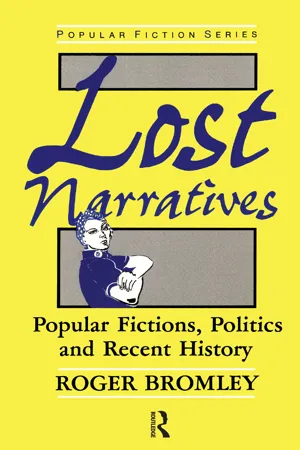
Lost Narratives
About this book
Roger Bromley deals with the ways in which certain popular forms contribute to the social production of memories. The texts he examines include the fictions of R. F. Delderfield and Lena Kennedy. This book should be of interest to students of cultural studies and popular fiction.
Trusted by 375,005 students
Access to over 1.5 million titles for a fair monthly price.
Study more efficiently using our study tools.
Information
Topic
LiteraturSubtopic
Literaturkritik1
In those days
This chapter is concerned with the commercial popularization of particular forms of autobiography, based on working-class experience. I hope to show that their circulation within a market economy has the effect of explaining the current crisis as the result of a lengthy diversion from past values. How that past is mediated cannot simply be determined by examining political speeches or ‘serious’ news analysis. It is also necessary to trace the active role of cultural practices and processes in constituting the ways in which we come to understand the ‘popular’ and ‘social reality’.
It is difficult to place a precise date on the origins of the commercial interest in publishing the autobiographies of working-class people, but the republication in 1973 of Flora Thompson’s Lark Rise to Candleford by Penguin undoubtedly helped to establish this mode of writing as a popular genre. Lark Rise was first published by Oxford University Press in 1939, Over to Candleford in 1941, and Candleford Green in 1943. All three were published under the current title in 1945. At another level, and addressing another range of experience, the re-issue of Vera Brittain’s Testament of Youth (1933) and subsequent television version also contributed to the same effect. The extensive marketing of The Country Diary of an Edwardian Lady (1977) is another such example.
The reasons for this growth of activity cannot be seen simply as a quest for origins, or as an indulgence of an uncomplicated ‘nostalgia’. Although the different discourses may share common forms and refer to similar periods, they address very different experiences and articulate a complex, varied, and contradictory range of positions and attitudes. They have also been actively recruited and co-opted for radically different purposes.
Some of the texts most readily associated with the renewal of, and definition of, nostalgia in recent times have also become part of the profitable exploitation of what Fraser Harrison calls ‘corrupt grief’.1 A classic instance is Edith Holden’s The Country Diary of an Edwardian Lady, (1977), published in fourteen countries, selling more than three million copies in hardback, and marketed in the form of over 900 products in Britain and the USA. A televised version in twelve half-hour episodes appeared in 1984. Fraser Harrison’s excellent analysis in Strange Land makes a key point about the illustrations. The plants sketched are shown with, ‘their roots … excised, their original earthiness has been scrubbed away and only their formal, abstract qualities are shown. These sketches have the lifeless, eerie look of pressed flowers, whose flesh withers to paper, but whose colours remain vibrant.’2 Each page of The Illustrated Lark Rise, in similar vein, is decorated with a pressed flower.
It is this ‘pressed flower’ approach to the past which characterizes many recent television versions of the interwar period. The ‘original’ colours are lovingly restored, while the ‘flesh’ is stylized in its formal, abstract qualities. These versions are active agencies of symbolization through style.
Selectivity, conscious or unconscious, repression, interference, decay of memory and distortions, all form part of the limitations of recollection. The time of remembering (personal, cultural, social, political) is a crucial part of the process. In other words, there may well be current a number of explanatory frames which condition how and what is remembered. This applies equally to forgetting, which may also be cultural in some cases. Remembering is quite obviously an interpretive process. Bartlett showed that remembering is a reconstructive activity, and that the moment of remembering is as important as the time being remembered.3 However suppressed, or excised, from the discursive representation, the present always intervenes significantly on constructions of the past. If the ‘past’ is widely thought of in abstract terms, and the present is dehistoricized, then the past could be liable to a ‘remembering’ of it in ‘pressed flower’ terms – torn from its roots and simply invoked as a witness for contemporary, dominant values. Bartlett also used the concept of conventionalization in his discussions of memory, by which he meant that people express their recall in terms of particular conventions. From this the question arises as to how and where these conventions are formed, and to whether it is possible to talk of dominant cultural conventions for recall. The currency and circulation of particular ideological assumptions and beliefs at the time of remembering may well have a critical role to play in the shaping of the past in the autobiographical mode. The fact also that many of the writers were living, at the time of writing, completely different lives (in terms of class position, status, and location) from those evoked and recalled, is a significant determination on the selective perceptions and evaluations, and the appropriation of the genre as part of the creating of ideology.
In other words, what is marketed and made available as the representation of popular experience is the result of a complex process of selection, appropriation, and cultural negotiation which has gone on in contemporary political processes even if, as is so often the case, no space is found within the specific published representations for those processes, except in attentuated, personalized, and dispersed forms.
Unsurprisingly, working-class autobiographies which focus on the inter-war period are dominated by references to poverty and deprivation. Interestingly enough, although I use the term ‘working class’, many of the autobiographies which have found commercial outlets concentrate upon ‘lumpenproletarian’ experiences, which perhaps helps to marginalize the specific details of the ‘memory’, while prioritizing the resourcefulness of the survivors. I will offer some specific analysis of particular texts in order to demonstrate the different ways in which these conditions are described. My broader concern, however, is with the generic characteristics of these writings, in particular their tendency to sideline the political, distance the poverty by means of discursive filters (linguistic, cultural), and their use as a distillation, or displacement of, memory. This is not to condemn any particular work as ‘reactionary’, or merely ‘ideological’, but to indicate the instability of any text and its potential cultural-political use. The intention of the individual writer is not in question, nor the integrity of the ‘memory’. It is a matter of the proliferation of a particular genre of writing at a critical conjuncture (the past decade), and the possible use of this genre (with its potential for commercial ‘spin-offs’) as an instrument for foregrounding ‘preferred’ images of the past in a struggle over political memories.
By stressing the physical conditions of poverty – debt, overcrowding, hunger, raggedness – the genre produces an effect of exaggeration, of extremity, given that it is circulated in a political context of ‘the invisibility of structural poverty.’ Golding and Middleton analyse this context in which poverty is ‘an enemy who has vanished into the footnotes’, quoting a Conservative politician speaking in the 1950s:
For primary poverty has now almost disappeared. … The Beveridge assumptions have governed our national outlook for a decade and a half. But there is nothing sacred or immutable about them. They postulate a Britain in which the great majority of citizens are too poor to provide for themselves. It is the business of Toryism to thrust that Britain into the history books, and to thrust the politics of poverty into the dustbin.4
What I am arguing is that in order to demonstrate, in absolute terms, that there is no poverty now and therefore no need for such a vast welfare apparatus, an ideology is being generated which seeks to recall ‘that Britain’ from the history books and to exhibit the ‘refuse’ of ‘real’ poverty rescued from the dustbin. The stress is on past/present disjunction, the need to conduct discussions about the past which emphasize its absolute discontinuities at the level of current ‘comfort’ and ‘security’. Some need for welfare is acknowledged, but on a scale fitted to those ‘really in need’, whereas the inter-war period is consigned to oblivion as past/completed ‘facts’, if not as ‘value’. If anything, the period is used as an ‘evolutionary’ referent.
Unwittingly, therefore, such autobiographies are vulnerable to stylization, to what appears, in a relative perspective, to be excessive quantification. It is a mode which, in its commercial forms (the stories of ‘winners’ in Benjamin’s terms referred to in the introduction), is predicated upon contrast because, invariably, it is torn out of its explicit political and historical contradictions. Ironically, it is the very detailing, the insistent and repeated images of deprivation which, in a context of ‘welfarism’ that has in terms of consistent popular mediation eliminated poverty, makes these treatments of the past seem to emphasize their pastness, almost (because so distanced) their ‘quaintness’ – poverty as landscape. The popularized cultural narrative concedes that there was poverty, appalling housing, and hunger once upon a time, but in the post-war period no such conditions remain save in pockets of local difficulty. A general welfare structure is no longer needed and people can assume full responsibility for their own lives without State interference. The figures for homelessness, unemployment, and welfare dependency since the early 1970s which contest these views are successfully ignored by means of a narrative about welfare abuse, ‘scroungerphobia’, and ‘unwillingness to work’ and an accompanying stress on individualism, thrift, self-discipline, and enterprise.5 Such re-writing of the last decade incorporates, assimilates, and transforms elements of that earlier history.
The revisionist process involves a conscious, preemptive strike against contending versions of British history, so that the primary site chosen for the wresting of ‘meanings’ away from a potential opposition has been the inter-war period, with its own version of ‘Victorian values’, and the Depression (with its psychological overtones) becomes a ‘slump’, a temporary postural collapse, a mere interlude among chapters of ‘progress’. In this way it becomes possible to extrapolate from certain autobiographies carefully quantified images of hopelessness (seven in one room, no shoes, twopence to last the week) and yet from within the same text or range of texts, to mobilize a differing set of abstracted, qualitative images representing ‘the human spirit’ – tireless mums, resourceful kids, community feeling. The dominant image is that of the survivor – figures who ‘made it’ despite demoralizing conditions, and have lived to ‘write’ the tale. ‘Spirit’ is privileged as timeless and eternal, and the physical conditions relegated to the background as timed, period-specific, politically localized. The past becomes a sort of archaeological site which throws up relics, icons of deprivation as of a ‘savage’ tribe – where otherness, not nowness, is what matters. There is a stress on past ‘ways’, ‘structures’, and ‘forms’ of ‘how we used to live’, ‘in those days’. The ‘days of hope’ are, in the process, made part of a diachronic, moving theme; the ‘hard times’ are part of a synchronic grasp only. The reclamation is complete.
Differential reception of texts depends very much upon the dominant explanations and mediations of social relations. It is not suggested that reception is an uncomplicated, unilateral process. We know that people assimilate, reconstruct, resist and negotiate cultural mediations in a variety of ways. Ideology and ‘social’ education, however influential, have quite definite limits. However, a mode of writing (or re-writing?) which is structured around individual experience, excludes the rhetoric and arguments of class, and basing itself on psychological, rather than social or historical, explanations has already built into it a potential for a commonsensical/consensual appropriation, because it is a mode which derives its authenticating forms (e.g. the ‘I’ narrative) from particular notions of personality, speech, and social relations. Its commercial forms have tended to produce a narrowing, channelling mode. In the absence of substantial research on the readership, or reception, of these autobiographies, any assumptions about their cultural use is bound to be speculative. Broadcast radio and television versions, large paperback sales, and extensive library borrowing indicate, at a very crude level admittedly, a considerable popularity. Most of the texts I have selected for later close analysis are, by no means, passive or uncritical reflections of ‘how it was’, or mere nostalgic excursions. Each has carved out considerable space for alternative and oppositional readings of the ‘past’, yet each is also subject to the effects of their positioning within the market economies of commercial publishing. Writing is always inscribed in a network of relays and differential traces which can never be simply ‘expressed’ by the author, or unproblematically decoded by individual readers. The processes of encoding (every text is traversed by numerous contradictory features) and the social relations of reception both guarantee that no mode of writing can ever be recuperated ‘once and for all time’ to any single position.
Working-class autobiographies can be appropriated for both consensual and oppositional purposes, but for the latter to be successful these have to be part of a wider political struggle; they cannot simply be celebrated as individual instances – ‘gems’. The more effective appropriation is likely to be the one which is keyed in with prevailing codes, frames, and explanations of the events described. In the situation I am discussing, this ‘keying in’ depends upon the muting of continuity and upon ways of decoding the items of discourse as ‘museum exhibits’. In this process, priority is given to those cues which relate to the dominant cultural schemata – the structures of commonsensical knowledge.6 This ‘knowledge’ functions like a cultural/ideological script, an integrated package of information brought to bear on the interpretation of a situation, or event. For example, it is possible to think of a ‘hard times’ or a ‘world we have lost’ script (these may, in fact, co-exist contradictorily in the same ‘script’). If such scripts are thought of as a complex mix of memory, anecdote, and mental map, then the circulation of texts which consistently exclude the political and anything beyond the immediate and the local will key in most closely with ‘popular inference systems’.
Evidence of such co-option can be drawn from the introductions to a number of examples of the genre. In the foreword to Winifred Foley’s No Pipe Dreams for Father (1978), Humphrey Phelps writes:
A Child in the Forest brought fame and success to Winifred Foley, but she is still shy and modest; in essence, she is still a child of the Forest. In these tales about the Forest she writes with a touching simplicity and a childlike honesty that is altogether charming.All of these tales are apparently slight, but they have the power to move the reader to an occasional chuckle and, more often, to the verge of tears. Older readers will remember that dread phrase which occurs in one story – ‘’im ’ave got it.’ It is a mark of real progress that younger readers are not familiar with it. If this book does nothing else it should at least make us pause and count our blessings. But it also exemplifies – and Winifred herself is a good example – that even hardships and grinding poverty could not quench the human spirit; kindliness, comradeship, hope and joy still come bubbling out. (my italics)7
The text is being used for exemplificatory purposes – it is being recuperated for an ideology of ‘the human spirit’. In fact, Winifred Foley’s writings are radical, irreverent, ‘coarse’, memorably written, and full of what Gramsci called, ‘that feeling-passion [which] becomes understanding’, but the discursive terms and tones of the foreword – dated and platitudinous – have the effect of ‘infantilizing’ the writing, sanitizing it, and securing it for the rhetoric of progress. The familiar, and recurring, words ‘even’ and ‘count our blessings’ are part of this technique of abstraction. The tone diminishes the text, tames, deflects, and domesticates its radical elements, and pulls them inside the framework, or script, of a ‘period’ genre. It is the verbal equivalent of the sepia photograph. Not that the ‘hope and joy’ are not in the text, but the syntactic ordering of the foreword ensures that the hardships and poverty are displaced by the rhetorical emphasis given to the metonyms of ‘the human spirit’. Some continuities are highlighted, others toned down. There is, in other words, a selective, or preferred, continuity. The hardship, poverty, and ‘it’ are all associated as signifiers of the period being recalle...
Table of contents
- Cover
- Half Title
- Series Page
- Title Page
- Copyright Page
- Dedication
- Series editors’ preface
- Table of Contents
- Bibliographical note
- Acknowledgments
- Preface
- Introduction: organized forgetting?
- 1 In those days
- 2 A temporary thing
- 3 People like us
- 4 Everything British
- Conclusion: beginning again
- Notes
- Bibliography
- Index
Frequently asked questions
Yes, you can cancel anytime from the Subscription tab in your account settings on the Perlego website. Your subscription will stay active until the end of your current billing period. Learn how to cancel your subscription
No, books cannot be downloaded as external files, such as PDFs, for use outside of Perlego. However, you can download books within the Perlego app for offline reading on mobile or tablet. Learn how to download books offline
We are an online textbook subscription service, where you can get access to an entire online library for less than the price of a single book per month. With over 1.5 million books across 990+ topics, we’ve got you covered! Learn about our mission
Look out for the read-aloud symbol on your next book to see if you can listen to it. The read-aloud tool reads text aloud for you, highlighting the text as it is being read. You can pause it, speed it up and slow it down. Learn more about Read Aloud
Yes! You can use the Perlego app on both iOS and Android devices to read anytime, anywhere — even offline. Perfect for commutes or when you’re on the go.
Please note we cannot support devices running on iOS 13 and Android 7 or earlier. Learn more about using the app
Please note we cannot support devices running on iOS 13 and Android 7 or earlier. Learn more about using the app
Yes, you can access Lost Narratives by Roger Bromley,Roger Bromely in PDF and/or ePUB format, as well as other popular books in Literatur & Literaturkritik. We have over 1.5 million books available in our catalogue for you to explore.