Today, more than at any other point in history, we are aware of the cultural impact of global processes. This has created new possibilities for the development of a cosmopolitan culture but, at the same time, it has created new risks and anxieties linked to immigration and the accommodation of strangers.
This book examines how the images of the terrorist and the refugee, by being dispersed across almost all aspects of social life, have resulted in the production of 'ambient fears', and it explores the role of artists in reclaiming the conditions of hospitality. Since 9/11 contemporary artists have confronted the issues of globalization by creating situations in which strangers can enter into dialogue with each other, collaborating with diverse networks to forms new platforms for global knowledge. Such knowledge does not depend upon the old model of establishing a supposedly objective and therefore universal framework, but on the capacity to recognize, and mutually negotiate, situated differences. From artworks that incorporate new media techniques to collective activism Papastergiadis claims that there is a new cosmopolitan imaginary that challenges the conventional divide between art and politics. Through the analysis of artistic practices across the globe this book extends the debates on culture and cosmopolitanism from the ethics of living with strangers to the aesthetics of imagining alternative visions of the world.
Timely and wide-ranging, this book will be essential reading for students and scholars in sociology and cultural studies and will be of interest to anyone concerned with the changing forms of art and culture in our contemporary global age.
- English
- ePUB (mobile friendly)
- Available on iOS & Android
eBook - ePub
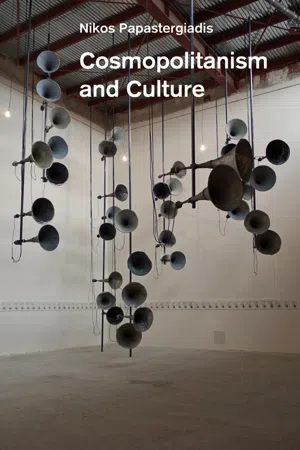
Cosmopolitanism and Culture
About this book
Information
Part I
The Aestheticization of Politics
1
Ambient Fears
At the precise midpoint of Gillo Pontecorvo’s The Battle of Algiers (1966), a scene of colonial revenge is exacted at a cafeteria on rue Michelet. It is late afternoon, and the French colonial middle class has gathered to relax. Couples are having coffee, children are enjoying ice creams and hopeful men are hanging at the bar. A young woman in a white dress enters and approaches the bar. A man moves to the side, offers his seat and smiles. She orders a coke, places a bag beneath her feet. She is sexy and cool. Midway through her drink she gets up. ‘Leaving?’ he inquires. ‘Yes’, she replies. ‘Pity’, he adds. No sooner has she crossed the road than the bar explodes. Within minutes two other bombs are detonated.
Who can you trust? The enemy could be anyone or anywhere. Prior to the explosions, three women met. They removed their veils and burkas. They dyed their hair, dressed like Europeans, assumed an aloof sense of entitlement and subsequently passed every security checkpoint, pausing only either to take nervous breath or to flirt with the soldiers. These scenes play out the colonizer’s greatest fear: the invisibility of the intimate enemy. This kind of fear was not immediately apparent after 9/11, but it has come to dominate our political imaginary.
What Changed After 9/11?
In his first public address to the American people after the attacks on 9/11, George Bush declared that these were ‘acts of terror’. The following day he added: ‘The deliberate and deadly attacks which were carried out yesterday against our country were more than acts of terror. They were acts of war.’ In the weeks after 9/11, almost all the world leaders spoke in calm voices but were quick to adopt the new catachrestic phrase: ‘war on terror’. Their initial response was couched in a discourse that switched between the apocalyptic and an epiphany. For George Bush it was ‘civilization’s war against barbarism’, and for Tony Blair a ‘wake-up call’. The events of September 11 were immediately taken as symbols of the end of a previous world and the beginning of a new and as yet unknown and unnamed world. The headline in the Washington Post demanded that Congress should immediately declare war: ‘It does not have to name a country.’ The New York Post followed with equal bloodlust: ‘Kill the bastards … As for cities or countries that host these worms, bomb them into basketball courts.’ The US administration decided that this was the moment to implement in full its foreign policy of unilateralism, while on the domestic front it went into overdrive to redefine the sphere of liberties under the new banner of homeland security, as well as outsourcing fear management to private agencies and ‘fear experts’ (Lapham 2005; Meeropol 2005; Grey 2006).
In Bush’s words: ‘To those who scare peace-loving people with phantoms of lost liberty, my message is this: your tactics only aid terrorists, for they erode our national unity and diminish our resolve; they give ammunition to America’s enemies and pause to America’s friends.’ Concerned university professors and civil rights advocates were mocked as either juvenile idealists or anachronistic obscurants that were blind to the fact that the ‘world has changed’. By 10 November, Bush had informed the UN of its ultimatum: ‘either you are with us, or you are with the terrorists’. The ‘war on terror’ marked the point at which the Bush administration claimed that the USA was ‘compelled’ to act outside of the conventions of international rule, and that the urgency of the crisis demanded that there was no time to follow normal democratic procedures and the Geneva conventions.
If the ‘war on terror’ was the beginning of a new world, then what made that war different from other wars? For instance, Clausewitz’s description of war as a symmetrical conflict in an open field made perfect sense during the Napoleonic era. In this period the enemy was sighted and the aim was to destroy their vital organs. As strange as the Cold War was, the identity and location of the adversaries was also never in doubt. They were on the other side of the Iron Curtain. Until the Soviet bloc imploded, it was a war of containment. When Muhammad Ali refused to be drafted into the Vietnam War, he justified his stance by claiming: ‘No Vietcong ever called me nigger!’ Asked if he even knew where Vietnam was, he replied with quicksilver irony: ‘Yes, it’s on TV!’ In the scene from The Battle of Algiers with which I began this chapter, people have the knowledge that the enemy is already in their midst: ‘They are everywhere in the Casbah and in the European sectors.’ For the French commander, the problem is not where they are, but how to distinguish them. He concedes that their invisibility is a product of the method of parallel recruitment that isolates the different teams from each other. ‘The reason we do not know our enemy is because they do not know each other.’
Anonymity and mobility have formed the weapon of the weak throughout guerrilla warfare. However, in the contemporary context of a ‘war on terror’, the scene of battle and the identity of the enemy are even more complex and elusive. At one level, the origins of the war can be linked to Reagan’s policy of the ‘rollback’ of the ‘evil’ Soviet empire (McCoy 2003). Kissinger’s solution of outsourcing and privatizing the spread of violence – ‘Asian boys to fight Asian wars’ – seemed to be a convenient short-term solution. However, it also produced the nightmare scenario of training and arming a new transnational warrior elite that would eventually be recruited by Al Qaeda. These new ‘homeless’ militias that were instrumental in micro-wars became ‘blowback’ agents of a new kind of transnational war that spread out of control.
After 9/11 the Bush administration argued that ‘terrorist’ states such as Afghanistan under the Taliban and fanatical movements such as Al Quaeda had no regard for international law, and therefore it was pointless to pursue them within the established legal frameworks. Osama bin Laden had always justified 9/11 as a counter-attack against the invasion, occupation and humiliation of the Islamic holy lands. What one side called terrorist attacks, the other described as a continuation of a war that had begun long before. The violence of terrorism produced its violent responses, including a novel form of infinite retaliation and vigilance against anonymous enemies. Threat, we were warned, no longer takes the form of an invading army, but assumes a covert identity. The image of ‘sleepers’ in our midst, or an infinite network of terrorists, incites new levels of dread. Killing has become an invisible and irregular business (Mbembe 2003). This moral void, and in particular Bush’s moral absolutism and unilateralist stance, turned global public opinion against what was seen as a modern form of cowboy vigilantism (Micklethwait and Wooldridge 2005, p. 222).
The ‘war on terror’ is a misnomer because terror is not an object that can be attacked. However, what this phrase does signal is an expansion and blurring of the modes of military assault. It represents a departure from the classical warfare, in which the adversaries aimed at each other’s body, to a kind of struggle that seeks to violate the realm of the imaginary (Sloterdijk 2009, p. 25). I will argue that the interplay between the unilateralist stance by the Bush administration and the networked terrorism of Al Qaeda also generated an ambiguous and multifaceted form of fear, or what I call ambient fear. This form of fear manifests itself through the dissolution of the conventional means for identification, categorization and classification.
Finding Fear: Its Meaning and Dynamics
Ambient fear is a kind of dread that has become so widespread that its sources appear to be both unlocatable and ubiquitous (Bauman 2006a; see also Buchler and Papastergiadis 1996). It is a force that is experienced viscerally, framing our suspicious glances at our neigh-bours, and extending into the gleeful approval of the state’s use of violence. Cultural critics are quick to debunk the hysteria and prick the balloons of hyperbole that surrounded the political uses of fear, but in the process they overlook the way fear is entangled in a complex web of associations. When they do admit that fear has a social reality, the focus tends to be confined to its instrumental functions or related to specific struggles for power (Bourke 2006; Furedi 2005; Glassner 1999). A similar mode of explanation is also evident in political philosophy. Fear is interpreted as if it were a mechanism for sharpening loyalties and galvanizing collective bonds. Hence, Machiavelli and Hobbes are routinely cited as the philosophers who elevated fear into an instrument that the sovereign could wield in order to preserve both the social contract and power (Corey 2004). By contrast, when attention is turned to the more diffuse ways in which fear can shape the political environment, there is a tendency to adopt explanations that intertwine a subjective experience of doom with a collective wish for salvation by an external agent (Carroll 2002). Tocqueville saw anxiety as a formless state of nervousness that gripped the mass psyche, producing a state of paralysis that left people feeling vulnerable, while also stimulating an unspoken desire for salvation from an authoritarian figure. More nuanced conceptions of the relationship between fear and anxiety can be traced throughout the writings of Kant, Kierkegaard and Heidegger. The problem with fear and anxiety, states Heidegger, is not just that it ‘radiates harmfulness’, but that the person who is immersed in it ‘loses his head’ (Svendsen 2007, pp. 42–3).
Historians have also argued that fear played a central role in promoting hostility towards outsiders and stimulating integration into the modern nation-state. For instance, Eric Hobsbawm argued that, at a time when empires were struggling to manage competing forms of religious and cultural pluralism, the nation was ‘invented’ in order to create social cohesion (Hobsbawm 1994; Hobsbawm and Ranger 1983). Benedict Anderson (1983) also stressed that, as an ‘imagined community’, the nation promised a sense of fraternity and security to its members, by highlighting the barbarity and threat of the external other. It was postcolonial cultural theorists like Edward Said (1993) and Homi Bhabha (1990) who exposed the logic of this communion and noted that the fear of strangers served a double purpose: to externalize undesirable qualities while concentrating the permissible forms of national identity. This critical perspective paid particular attention to the way that nationalist discourses of belonging were dependent upon a definition of the other as an external and dreadful entity. However, to suggest that fear is merely a manifestation of a local form of insecurity arising from the fragmentation of social structures, or an instrument for mystification and exaggeration that is manipulated by political elites, is to limit its sources and scope to a specific psycho-geographic terrain. In this sense, it is reduced to an instrument that should, and can, be controlled. It is rarely seen as a constitutive force in social reality (Rumford 2008, p. 631).
Paolo Virno was among the first of the social theorists to grasp the centrality of fear and the ‘ambivalence of disenchantment’ in the transformation of contemporary culture and society. Fear, he argues, is not just the negative effect of experiencing threat, but also the motivating force that now drives contemporary politics and shapes the administrative criteria of everyday regulations. The restructuring of home and work is no longer defined simply by a break with the solidity of tradition but by an activation of the already fragmented state of traditions and an engagement with – a process of putting to work – sentiments, inclinations and states of mind that have been severed from any form of traditional foundation (Virno 1996, p. 15). The mobilization of fear is therefore not just a response but part of the precondition or mechanism for the advancement of specific socio-economic practices. The mutability of economic relations and the fragmentation of cultural values combine to create a mood of collective uncertainty, rather than simply a personal sense of insecurity (Nelson 2010). Or, put the other way, when the instances of a person experiencing insecurity are now commonplace, and the sources that stimulate this response are so widespread, then it is no longer sufficient to speak of fear as if it were a single entity that belonged within a person’s subjectivity.
The distinction between fear and anxiety can help sharpen our focus. Fears are, as Freud noted, usually linked to specific objects of dread, whereas anxiety is an uncomfortable state in which the origin or the object of threat cannot be specified. Fear usually emanates from an external source. It hovers above, like a tyrant, or approaches as an enemy from the outside. When we speak of our fears, we usually refer to our fear of something. The object of our fear has a definable outline. By contrast, anxiety is diffuse, without precise boundaries, and it appears to emerge from a twilight state – neither in full light nor in total darkness. Therefore, when we articulate this kind of mood, we say that we are anxious about the possibility of something happening. Anxiety may lack a clear source of threat, but it is related to what Freud (1948) calls an ‘expected situation of helplessness’. It lurks in the heart, it exists in rumour, and it spreads from below. Anxiety can provoke insecurity without sensory apprehension. It produces a far less certain sense of where danger lies, what is risky, and who is threatening. In his extensive survey of the role of fear in contemporary life, Zygmunt Bauman asserts that ‘fear is at its most fearsome’ when it remains an implicit menace that ‘can be glimpsed everywhere but is nowhere to be seen’ (2006a, p. 2). The inability to identify the origins or predict the consequences of our everyday fears has, according to Ulrich Beck, made people feel that fear is so widespread that it threatens to disrupt the crucial task of calculating risk. In a rather pessimistic response to the tension between difference and certainty, Beck goes so far as to suggest that the collapse of a risk regime – that is, the ability to measure and control threat – signals the end of modernity (1999, p. 5).
More recent uses of the psychoanalytic theories of projection and anxiety can also help unfurl the link between unconscious and public fears (Papastergiadis 2007d, 2006b). For instance, Julia Kristeva’s study of the presence of strangers in contemporary society provides a useful example of the adoption of psychoanalytic concepts of the uncanny, splitting and projection for an explanation of the way fear is mobilized in both the encounter with the other as a stranger and the process by which we become ‘strangers to ourselves’ (Kristeva 1991). John Cash (2004) has also argued that, in the more paranoid modes of neo-nationalist politics, or what he eloquently describes as the ‘haunting of security by the spectre of insecurity’, there is a struggle to preserve an idealized self by means of either expelling or suspending the other in a state of unplacement.
A critical feature of the psychoanalytic construction of identity is the deployment of mechanisms for resisting the incursion of foreign elements and for promoting boundary formations. Across this boundary, values are projected that define the characteristics of the self and the other; force, then, is mobilized to ensure that the boundary and the differentiated identities remain intact. Projective and defensive mechanisms also operate in contradictory ways: they tend to both exaggerate and trivialize the figure of the other, while also asserting the right to aggressiveness and minimizing the acknowledgement of violence in the self. For Lacan, projection is linked to anxiety. Anxiety emerges when the individual is caught in an ambivalent state: wanting the comfortable feeling of being human and whole, and yet also discovering the paralyzing and dreaded sense of lack (Salecl 2001, p. 92).
Psychoanalytic concepts can help differentiate between aggressive modes of dehumanization and more inclusive ways of living with difference. However, Freud’s psychoanalytic model of identity development, based on this familial triangulation of fears and desires, is not easily transposed to explain the collective formation of ambient fears in the global political imaginary (Stengers 1997, p. 106). Deleuze and Guattari’s vision of the social imaginary as a vast, shifting network of desire-producing machines, connecting with each other in multi-directional binary chains and in ever-mutating combinations, offers a more prescient framework for considering the turbulent patterns that are shaping contemporary political attitudes and cultural identities (Deleuze and Guattari 1983). From this perspective, the aim is not to isolate fear from hope, or to oppose repulsion and attraction, but to see how the two responses are inextricably tied in a common creative process. Both occur in the imaginary, and they proceed through an associative dynamic. In the experience of fear there is also a perverse feeling of wonder, just as the encounter with sublime beauty always sends a shiver through your body.
Ambient fear is therefore not just a political effect that is manipulated by a powerful elite. It is more like a collective creative process that spreads through the whole range of communicative devices, from the one-way channels of mass media to the multiple networks of the internet. Passing from one medium to the next, it gets implicated in a near infinite range of carriers. This process of connecting disparate entities in the imagination gives rise to a much more intimate sense of threat. Each new formulation of fear proves to be highly unstable and quickly overlaps with the residual sediments of archaic fears, as well as inserting itself into the as yet undefined fears of the future. Hence, this associative dynamic acquires a self-propelling capacity that is fuelled by both the multiplying effect of additional sources and the process of concatenation that occurs in the rebound between the external sites and the expanded field of fearful sensory apprehension. Rather than trying to disentangle this new emotional and social bundle, I propose to examine the tropes that bring together deep historical fears and wide-open anxieties. As these ‘vertical’ and ‘horizontal’ emotions mutually reinforce one another, they are internalized as social ‘facts’ that provide the spatial and psychic markers for the ‘ensemble of possibilities’ through which we relate to others, affirm our own idealized self-images, and define a sense of place in the world. Hence it is not just a matter of correcting the flawed and false images of fear, but a deeper challenge to understand how the dynamics of fear create a specific worldview.
I will now examine the broadening of fear by discussing the blurring of the boundaries for six fundamental tropes: spatial boundaries, recognizable faces, controlled order, stable media, central leadership and unified organization. Ambient fear arises, therefore, not just from the acts of violation but also from the perception that these tropes no longer operate in their normal way.
De-spatialization of fear
The shift in the form of fear since September 11 can be gauged by the perception that the spatial boundaries of conflict have collapsed. In conventional warfare the aim of conflict is to overpower or disarm one’s adversaries. This is usually achieved by superior force or cunning, and the battle usually occurs within the respective territories of the combatants. Even in the most paranoid accounts of war there was always an actual location from which the enemy would launch their invasion. For instance, shortly after President Ronald Reagan ‘warned’ America that the Sandanistas were closer to Texas than the Texans were to Washington, a cartoonist drew an ironic picture of the necessary watchfulness that war inspires. It showed, under moonlit skies, two men sitting on a veranda with shotguns on their laps. The son turns to his father and suggests: ‘It’s a bit quiet out there.’ Pa replies: ‘Yeah, a bit too quiet!’1
After September 11, the fear of the other could not be contained within a single territorial entity or confined to a given place of origin. The previous attacks on US embassies in Africa, as well as the subsequent bombings in Madrid and London, were seemingly connected as part of wide-open conflict, but they happened across a disjointed terrain and an asynchronous time frame. Hence the war was not waged against an enemy with a conventional army, but against the concept of terror and the euphemistic defence of virtues.2 The ensuing wars in Afghanistan and Iraq lacked the primary characteristics of conventional warfare because there was no front, no clear borderline to divide adversaries, and therefore no territory that had to be conquered and occupied. The enemy could not be pinned to a fixed place, nor did they gather for a once and for all battle over a particular territory. It suddenly became clear that the enemy could be on all sides of any given line. The de-spatialization of the arena for ‘war against terror’ not only meant that there was no bounded territory that could be monitored, it also created a boundless temporal horizon. Donald Rumsfeld was brazen enough to announce that the ‘war on terror’ had no endgame, and therefore...
Table of contents
- Cover
- Halftitle
- Dedication
- Title Page
- Copyright
- Contents
- Acknowledgements
- Introduction: Waiting for the Barbarians
- Part I The Aestheticization of Politics
- Part II The Politics of Art
- Epilogue: The Coming Cosmopolitans
- Notes
- References and Bibliography
- Index
Trusted by 375,005 students
Access to over 1.5 million titles for a fair monthly price.
Study more efficiently using our study tools.
Frequently asked questions
Yes, you can cancel anytime from the Subscription tab in your account settings on the Perlego website. Your subscription will stay active until the end of your current billing period. Learn how to cancel your subscription
No, books cannot be downloaded as external files, such as PDFs, for use outside of Perlego. However, you can download books within the Perlego app for offline reading on mobile or tablet. Learn how to download books offline
Perlego offers two plans: Essential and Complete
- Essential is ideal for learners and professionals who enjoy exploring a wide range of subjects. Access the Essential Library with 800,000+ trusted titles and best-sellers across business, personal growth, and the humanities. Includes unlimited reading time and Standard Read Aloud voice.
- Complete: Perfect for advanced learners and researchers needing full, unrestricted access. Unlock 1.5M+ books across hundreds of subjects, including academic and specialized titles. The Complete Plan also includes advanced features like Premium Read Aloud and Research Assistant.
We are an online textbook subscription service, where you can get access to an entire online library for less than the price of a single book per month. With over 1.5 million books across 990+ topics, we’ve got you covered! Learn about our mission
Look out for the read-aloud symbol on your next book to see if you can listen to it. The read-aloud tool reads text aloud for you, highlighting the text as it is being read. You can pause it, speed it up and slow it down. Learn more about Read Aloud
Yes! You can use the Perlego app on both iOS and Android devices to read anytime, anywhere — even offline. Perfect for commutes or when you’re on the go.
Please note we cannot support devices running on iOS 13 and Android 7 or earlier. Learn more about using the app
Please note we cannot support devices running on iOS 13 and Android 7 or earlier. Learn more about using the app
Yes, you can access Cosmopolitanism and Culture by Nikos Papastergiadis in PDF and/or ePUB format, as well as other popular books in Social Sciences & Sociology. We have over 1.5 million books available in our catalogue for you to explore.