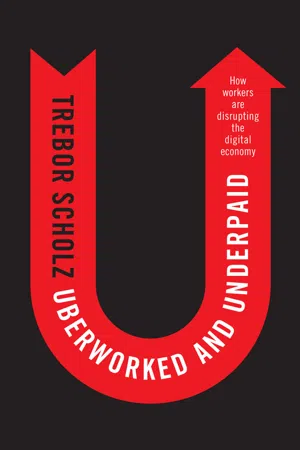
This book is about the rise of digital labor. Companies like Uber and Amazon Mechanical Turk promise autonomy, choice, and flexibility. One of network culture's toughest critics, Trebor Scholz chronicles the work of workers in the "sharing economy," and the free labor on sites like Facebook, to take these myths apart.
In this rich, accessible, and provocative book, Scholz exposes the uncaring reality of contingent digital work, which is thriving at the expense of employment and worker rights.
The book is meant to inspire readers to join the growing number of worker-owned "platform cooperatives," rethink unions, and build a better future of work. A call to action, loud and clear, Uberworked and Underpaid shows that it is time to stop wage theft and "crowd fleecing," rethink wealth distribution, and address the urgent question of how digital labor should be regulated and how workers from Berlin, Barcelona, Seattle, and São Paulo can act in solidarity to defend their rights.
- English
- ePUB (mobile friendly)
- Available on iOS & Android
eBook - ePub
About this book
Information
Part I
1
Waged Labor and the End of Employment
It seems inevitable, doesn't it? The traditional relationship of employer and employee stands like a lone tree, a relic of the past. In the twenty-first century, “flexible workers” – the Uber drivers, baristas, crowd workers, fast-food cooks, models, and adjunct professors – all supposedly carry the torch of choice and autonomy high above their heads, bringing light to the monotonous world of formal jobs. “Think Outside the Boss,” the slogan goes. Continued employment with social security and legally regulated norms is no longer the rule. Digitization is making work increasingly dense. Casual work, part-time or freelance, is the new normal. Full-time jobs are fragmented into freelance positions, turning workers into “micro-entrepreneurs” who are competing under conditions of infinite labor supply. Increasingly, companies retain a small number of core employees, making up the rest with temporary contract laborers. It echoes from all corners: don't romanticize employment. And it's true: employment is a relatively young and by all means flawed relationship but it would be a mistake to give up on the protections and benefits that come with employment. Digital labor is instrumental in the process of dissolving direct employment, thereby creating low-wage futures for millions of people. Just like the railroad industries of the past, “sharing economy” platforms are changing the world of work. As the horse is already out of the barn, proponents argue, we might as well embrace this new working world.
Ryan Bingham, the antihero and central character of the 2009 film Up in the Air makes this argument almost irresistibly. Ryan (played by George Clooney) is a hired gun, a corporate consultant whose sole job it is to tell people that they are being fired. In fact, this is his company's business: stepping in when corporations want to lay off their workers, telling them that they are being “let go.” Firing people for a living allows Ryan to enjoy a lifestyle of executive business class travel and luxurious hotels. Bingham's standard line when facing the soon-to-be-unemployed is “anybody who ever built an empire, or changed the world, sat where you are now. And it is because they sat there that they were able to do it.” Bingham's spiel about opportunity and innovation echoes the rhetoric of Silicon Valley; you might even say that it prepares the newly unemployed for the digital economy.
The rhetoric of the enterprising individual is meant to make people feel optimistic about a “liberation” from career and employment and a forced entry into the world of entrepreneurship. Just check in with your “inner entrepreneur” and “do what you love!” Reid Hoffman, cofounder of LinkedIn, begins his book The Start-Up of You by channeling Ryan Bingham: “All humans are entrepreneurs.” All jobs that are solid melt into freelance labor while Silicon Valley exports its playbook to the rest of the world. Hoffman points to “our ancestors in the caves” who invented their own rules for living:
They were founders of their own lives. In the centuries since then we forgot that we are entrepreneurs. We've been acting like labor.
On the other hand, the author Bob Black, the scholar Kathi Weeks, or the anarchist CrimethInc Ex-Workers' Collective, distance themselves from the obsession with work altogether. “The carrot is just a stick by other means,” as Black put it.1 Their stance does not stop at a rejection of employment; it is a rejection of the demeaning system of domination at work altogether; it's a call to slow down the engines of productivity.
The platform economy helps to facilitate an overall shift away from salaried employment. “Did anyone ever like having a boss, irritating colleagues, or long hours, anyway?,” supporters of the extractive economy ask. The spokespeople for the extractive “sharing economy,” on the other hand, glorify independent work, choice, opportunity, and autonomy. Burn the heavy briefcase, the two-bedroom house, the car payments; humans are meant to be lions. Bingham puts it so convincingly:
I see people who work at the same company for their entire lives. They clock in, they clock out, and they never have a moment of happiness. You have an opportunity here.
This dream of flexible work, of an opportunity for a better life, spurs many of the contemporary labor practices that I introduce in this chapter.
1) Toward a Typology of Digital Labor
As part of this typology of paid digital labor, I closely examine practices like crowdsourcing, paid in-game labor, and content farming. I ask which forms of paid digital labor shaped the terrain of unregulated digital work. I caution that the templates of work introduced by companies like Uber and Amazon Mechanical Turk can lead to a regime of work that is even worse than previous systems of labor.
Ultimately, this typology can lead to a broader understanding of the landscape of digital labor practices necessary for careful and network-savvy regulation. Such typology, read alongside chapter 7, can clarify which tendencies are worth advancing while at the same time calling out practices and companies that need regulatory attention and punishment for violations of the Fair Labor Standards Act. In the absence of worker protections for the most vulnerable workers, we face the threat of a crushing regime of digital work.
My perspective on digital work is informed by four conferences that I convened between 2009 and 2016. This research is grounded in the review of studies coming out of fields like sociology, political science, labor law, and media theory. The writing is informed by news accounts and interviews with workers, labor advocates, cooperativists, historians, venture capitalists, activists, artists, civic technologists, designers, and union representatives. While this chapter emphasizes the perils of digital labor, I conclude with a vision of decent digital work. In chapter 7, you'll find a proposal for what I call platform cooperativism.
Throughout this chapter, I show how digital labor platforms and “new vectors of the production of wealth,” as the French economist Yann Moulier Boutang put it,2 have made contemporary work more intensive (dense), while restructuring labor markets on a global scale. Time becomes even more central as an instrument of oppression.
One new quality of contemporary labor online is the vast scale of a global, on-demand labor force available in real time. The virtual hiring hall UpWork,3 for example, claims to have 10 million workers; the grand sum of real-time work hours ingested by this globally operating company is unprecedented. Netscape co-founder Marc Andreessen claimed that his software is eating the world and indeed, today, there is a pronounced power asymmetry between the class of platform owners, that holds all four aces and the workers who hold none, as David Graeber puts it.
What can this chapter accomplish and what are its limitutions? The examples offer a freeze-frame perspective haunted by technological obsolescence; think about the quick succession with which Google discontinued Google Wave, Google Knol, Google Reader, Google Glasses, and Google+. Amazon introduced HomeServices, Amazon Flex, and Handmade at Amazon, while oDesk acquired Elance and rebranded it as Upwork. TaskRabbit changed its modus operandi, its “pivot” in industry parlance, from one day to the next. Uber can alter its agreements with drivers with the click of a button. The constant reshuffling of labor markets makes it hard to offer a stable inventory of these practices.
What follows in the next two chapters, broken down into paid (chapter 1) and unpaid (chapter 2) digital work, is a proposal for a typology of digital work that is crucial for the discussion about the future of work. While such typology, grounded in historical and political observations, is necessary, it has also clear limitations. What I...
Table of contents
- Cover
- Table of Contents
- Epigraph
- Dedication
- Title page
- Copyright page
- Acknowledgments
- Introduction: Why Digital Labor Now?
- Part I
- Part II
- Index
- End User License Agreement
Trusted by 375,005 students
Access to over 1.5 million titles for a fair monthly price.
Study more efficiently using our study tools.
Frequently asked questions
Yes, you can cancel anytime from the Subscription tab in your account settings on the Perlego website. Your subscription will stay active until the end of your current billing period. Learn how to cancel your subscription
No, books cannot be downloaded as external files, such as PDFs, for use outside of Perlego. However, you can download books within the Perlego app for offline reading on mobile or tablet. Learn how to download books offline
Perlego offers two plans: Essential and Complete
- Essential is ideal for learners and professionals who enjoy exploring a wide range of subjects. Access the Essential Library with 800,000+ trusted titles and best-sellers across business, personal growth, and the humanities. Includes unlimited reading time and Standard Read Aloud voice.
- Complete: Perfect for advanced learners and researchers needing full, unrestricted access. Unlock 1.5M+ books across hundreds of subjects, including academic and specialized titles. The Complete Plan also includes advanced features like Premium Read Aloud and Research Assistant.
We are an online textbook subscription service, where you can get access to an entire online library for less than the price of a single book per month. With over 1.5 million books across 990+ topics, we’ve got you covered! Learn about our mission
Look out for the read-aloud symbol on your next book to see if you can listen to it. The read-aloud tool reads text aloud for you, highlighting the text as it is being read. You can pause it, speed it up and slow it down. Learn more about Read Aloud
Yes! You can use the Perlego app on both iOS and Android devices to read anytime, anywhere — even offline. Perfect for commutes or when you’re on the go.
Please note we cannot support devices running on iOS 13 and Android 7 or earlier. Learn more about using the app
Please note we cannot support devices running on iOS 13 and Android 7 or earlier. Learn more about using the app
Yes, you can access Uberworked and Underpaid by Trebor Scholz in PDF and/or ePUB format, as well as other popular books in Social Sciences & Media Studies. We have over 1.5 million books available in our catalogue for you to explore.