eBook - ePub
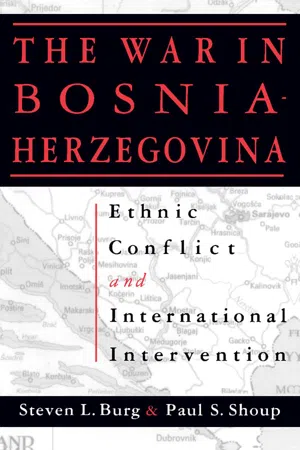
The War in Bosnia-Herzegovina
Ethnic Conflict and International Intervention
- 520 pages
- English
- ePUB (mobile friendly)
- Available on iOS & Android
eBook - ePub
The War in Bosnia-Herzegovina
Ethnic Conflict and International Intervention
About this book
This book examines the historical, cultural and political dimensions of the crisis in Bosnia and the international efforts to resolve it. It provides a detailed analysis of international proposals to end the fighting, from the Vance-Owen plan to the Dayton Accord, with special attention to the national and international politics that shaped them. It analyzes the motivations and actions of the warring parties, neighbouring states and international actors including the United States, the United Nations, the European powers, and others involved in the war and the diplomacy surrounding it. With guides to sources and documentation, abundant tabular data and over 30 maps, this should be a definitive volume on the most vexing conflict of the post-Soviet period.
Information
Subtopic
Social HistoryIndex
HistoryCHAPTER 1

Introduction
Bosnia, Ethnic Conflict, and International Intervention
In this volume, we examine the dynamics of ethnic conflict in Bosnia-Herzegovina, and the dilemmas surrounding international involvement in it. We analyze the causes and conduct of the war; why, for more than three years, international efforts to resolve the conflict in Bosnia failed; and why they finally succeeded in late 1995. We review the Dayton accord produced in 1995 and ask whether, after two years of experience with its implementation, we can expect it to lead to long-term peace in Bosnia. Our analyses are intended to help citizens interested in understanding and learning from the events in Bosnia-Herzegovina; scholars attempting to understand the dynamics of ethnic conflict and develop strategies for managing it; and policymakers intent on preventing ethnic conflicts from undermining international peace.
We focus on the actions of the major participants in the crisis, including actors in the former Yugoslavia and the international community. The first half of the study is devoted to an examination of Bosnia-Herzegovina before the war broke out (chapter 2); the origins of the conflict, including events in Croatia (chapter 3); and the major developments in the war between 1992 and 1994, including the role of the media, ethnic cleansing, and the question of genocide (chapter 4). The second half of the volume is devoted to a detailed description and analysis of the efforts of the international community to resolve the conflict (chapters 5, 6, and 7). The accounts of the war provided in chapter 4 provide essential background for these analyses. Our conclusions concerning the war, Western responses to it, and the lessons to be learned from it are presented in chapter 8.
Each of the authors has long experience in Yugoslavia, and is intimately acquainted with the history of ethnic conflict and controversy over the national question that marked the life of the country and finally led to its demise. We view the conflict in Bosnia in the same light. Having adopted this approach, however, we are sensitive to its dangers. To embrace a narrowly ethnic definition of the conflict in Bosnia-Herzegovina, or in the former Yugoslavia more broadly, is to be tempted to exclude economic, political, and especially moral issues from the analysis. We try not to succumb to this mistake. We attempt to keep the larger issues before the reader when appropriate, even as we explore the details of the conflict in Bosnia.
Understanding Ethnic Conflict in Bosnia
The essence of ethnic conflict is the struggle between mobilized identity groups for greater power—whether it be for equality within an existing state, or the establishment of a fully independent national state. The collapse of communism, and with it the collapse of the remaining multinational states of Europe, was not followed by the victory of liberal democracy and the legitimation of new civil states. Instead, older, historical identities—religion, ethnicity, national identity, and even region—reemerged as bases of political mobilization and claims to statehood, and clashed with the state in almost all those areas where the existing or emerging state did not correspond to the identities of mobilizing groups. This produced a conflict between international norms of state sovereignty and territorial integrity on the one hand, and the power and violence of appeals to ethnicity as a basis of state formation on the other. Much of the story of Bosnia is the story of how the international community attempted, but failed, to reconcile the conflict between these mutually exclusive principles of state formation.
Several factors seem to contribute to the emergence of ethnic conflict. These include a history of intergroup antagonism; a pattern of ethnic domination and/or inequality; the perception of contemporary intergroup competition as a zero-sum game; an electoral triumph or other change that brings nationalist forces to power, and the inadequacy of existing political arrangements for moderating or constraining their behaviors; the existence of competing, exclusivist claims to authority over territory; a pattern of settlement that lends itself only too easily to secession or partition; and the existence of outside sponsorship or support for extremist politics. Differing subsets of these factors may explain the dynamic of differing cases. But there is widespread agreement in the literature on the importance of each of them.1
The literature on ethnic conflict distinguishes, sometimes explicitly but most times implicitly, between conflicts occurring in the context of democratic states and those taking place in nondemocratic states. In democratic states the level of violence associated with secessionist/separatist conflicts tends to remain low. The institutionalized protection of civil liberties and respect for human rights characteristic of democracies permits ethnic, linguistic, or other identity groups to translate their demands into electoral power. But, at the same time, it constrains the ability of any ethnically defined government to oppress its ethnic opposition. The means for resolving conflicts peacefully are institutionalized, and enjoy widespread popular legitimacy. Thus, electoral accountability constrains elite behavior.2
Even in democratic states, however, conflicts over demands for self-determination and secession arouse passions. In Quebec, the failure of the most recent referendum on independence by a narrow margin led the secessionist party leader to lash out publicly against ethnic minorities in the province.3 In Switzerland, the 1975 vote on partition in Bern canton was accompanied by rioting and acts of intimidation that left one key town “intensely polarized.”4 Yet, analysts do not attempt to explain these cases (or the many other instances of ethnoregional autonomist or secessionist movements in democratic Europe) in terms of “age-old hatreds” or the nature of the cultures involved. They look instead to issues of power and interest, and to questions of institutions and decisionmaking processes to explain these conflicts and to find their solutions. We believe that to understand and explain the conflict in Bosnia-Herzegovina—despite the catastrophic violence it brought forth—requires a similar approach.
There were at least three major issues being contested in Bosnia as the nationalist leaderships mobilized their communities and the republic descended into war. The most basic contest was over defining the nature of rights in Bosnia; were they to be seen as residing in individuals, or in the ethnic communities as collective entities? Neither the distant Bosnian past, nor the immediate communist-era past, provided any clear answer to this question. The second major contest unleashed in Bosnia by the disintegration of Yugoslavia was over the “national question.” This term, as commonly used throughout Eastern Europe, applied to all aspects of interethnic relations. But its most important element concerned defining the right to claim titular, or state-constituting status (usually reserved for the majority ethnic group), and defining the rights that accrued to “others” (minority ethnic groups). To achieve state-constituting status conferred superior cultural and political rights on a group, including control over the state itself. The struggle over rights and the struggle over the national question were thus intertwined, in Bosnia as elsewhere throughout Eastern Europe. But they were of fateful significance for Bosnia: a multiethnic (or multinational) state in which no one group could claim titular status on the basis of numbers alone, and all three major groups thus vied for the status of a state-constituting nation.
Because Bosnia was surrounded by the more powerful national states of two of the groups contesting these issues—the Croats and the Serbs—the contests over rights and the national question inside Bosnia could not be resolved without the participation of Croatia and Serbia. With the disintegration of Yugoslavia and the emergence of nationalist states in Croatia and Serbia, the struggles in Bosnia-Herzegovina took on international dimensions, and raised a third contentious issue: how the international community should respond to the collapse of a multinational state and the onset of conflict among its peoples. Each of these three contested issues was viewed differently by the parties to the conflict. Each raised fundamental issues for the international community as it attempted to mediate the conflict. The contests in Bosnia over individual versus collective rights and over the competing claims of the Muslims, Serbs, and Croats as state-constituting nations were manifest first in a political struggle over the definition of decisionmaking principles and institutions. This quickly escalated to a contest over a constitutional definition of the state itself and, ultimately, to a war over whether that state should exist at all.
The academic approach to these issues is dominated by two competing formulas: the pluralist, or integrationist approach, and the power-sharing approach.5 The power-sharing approach can be boiled down to a few simple ideas: First, ethnic conflict is understood as originating in contact between groups holding incompatible, culturally rooted values. Hence, the power-sharing approach calls for the isolation of groups from one another at the mass level through entirely separate networks of social and political organizations. Second, in the apparent conviction that culturally distinct groups cannot reach compromise, each of the cultural segments or communities is to be granted a high degree of autonomy over its own affairs. Third, with respect to decisionmaking on issues of common interest to all groups, the power-sharing model calls for proportional systems of representation that ensure the participation of representatives of all such groups in the decisions that affect them. Fourth, each of the groups represented in authoritative decisionmaking processes is to be granted veto power when its “vital interests” are at stake. Because intergroup contact is restricted to elites, decisionmaking on issues of common interest, and the exercise of group vetoes on issues concerning “Vital interests,” are to be exercised by the leaderships of each group. Indeed, elites exercise a monopoly even over the definition of what constitute common interests, and what constitute the distinct “vital interests” of each group. Hence, the power-sharing approach lends itself to collectivist definitions of rights and group claims to state-constituting status. The obvious vulnerability of such a system to intransigent elite behavior is avoided by goodwill between elite representatives of the ethnic segments—a condition seen as essential for success.
The pluralist approach is based on a radically different understanding of the effects of intergroup contact. Stated most concisely, pluralists argue that, under critically important conditions of open communications and equality, contact between groups generates mutual understanding and cooperation, not conflict. While the advocates of power-sharing view institutions primarily as instruments of ethnic segmentation, pluralists view institutions as a means to transform intergroup relations. Contact in shared institutions is not seen as necessarily an agent of cultural assimilation. But sustained contact under conditions of open communications and equality is viewed as contributing to the emergence of a shared culture of interaction and cooperation, or what in the West has come to be called a “civic culture.” The pluralist approach is thus premised on a commitment to individual rights.
The pluralist approach calls for avoiding definition of the state or state institutions in ethnic terms. It thus leaves little room to recognize the claims of ethnic groups to state-constituting status. From a pluralist perspective, behaviors based on ethnic identities should be required to compete with behaviors based on nonethnic identities and interests on an equal, rather than a privileged basis. Where the politicization of ethnicity dominates other bases of political behavior, as in Bosnia, the challenge in pursuing a pluralist approach to the resolution of contests over rights and status consists of establishing a balance between the ethnic and the nonethnic in participation, representation, and decisionmaking. But, to pursue a power-sharing strategy under such circumstances institutionalizes ethnic cleavages, excludes other interests, and creates the structural foundations for intransigent use of the veto and, ultimately, secessionism.
In Bosnia, the international community was faced with the challenge of reconciling pluralist and power-sharing arguments, advanced by opposing nationalist leaders. The Bosnian government argued that its refusal to accept autonomy for the Croats and Serbs was based on its adherence to the pluralist principles of individual rights. Serb and Croat nationalists argued that their claims to autonomy, an ethnic veto, and ultimately, the right to form separate states of their own were based on their claim to status as state-constituting nations in Bosnia, and on the collective right of nations to self-determination. In the end, as our account will show, the international community tried to combine these two approaches, but this did nothing to end the controversy between the pluralist and collectivist approaches, which continued to divide analysts and experts involved in finding ways to facilitate implementation of the Dayton accords.
The third major issue in Bosnia, the appropriate international response to the collapse of the multinational Yugoslav state and the conflicting claims of successor states and ethnic groups, was contested by the Bosnian Muslims, Serbs, and Croats; by Croatia and Serbia; and by the outside actors and organizations that were drawn into the conflict. They were deeply divided over this issue. Historically in Eastern Europe, the disintegration of multinational states or empires was followed by the formation of national states. The process began in the early nineteenth century, and was not over until the breakup of Czechoslovakia and Yugoslavia, following the collapse of communism in 1989–90. The Bosnian conflict of 1992–95 raised nineteenth-century and Versailles-era questions about state formation and the definition of borders in the Balkans all over again. Notwithstanding all that had happened in the interim, it is possible to draw parallels between the efforts of the European powers to resolve the Bosnian question at the Congress of Berlin in 1878, and the negotiations over the future of Bosnia carried out at Dayton. In both cases the international community was attempting to maintain the fiction of a preexisting status quo while acknowledging the emergence of new political realities. In both cases Bosnia ended up in limbo; in 1878 the international community maintained the fiction that Bosnia remained within the Ottoman empire while allowing Austria to occupy it; in 1995 the international community preserved a largely fictional Bosnian state while allowing Serbia and Croatia to partition it.
The conflicts that follow disintegration of multinational states are driven by a mixture of ethnic, territorial, and of course, power-political motivations. In the absence of a prior agreement on how to go about dissolving the old state and constituting new ones, these conflicts can escalate rapidly, exacerbated on all sides by extremist elements pursuing maximalist agendas. Realist theorists of international conflict suggest that such conflicts can be averted by ensuring a balance of military capabilities among the successor states,6 ignoring the fact that the emotions aroused by ethnonational conflict may lead each side to use newly acquired capabilities in pursuit of maximalist agendas, rather than considering them instruments of deterrence.
For much of the literature on ethnic conflict, the path to peace lies through the electoral process. Proportionality systems recommended by the proponents of power-sharing ensure the representation of all groups, but also encourage ethnic bloc voting. Where ethnicity has been politicized, the result of proportionality rules is the conversion of electoral competition into an ethnic census. Donald Horowitz has argued that alternative rules may be devised that foster cooperation between groups in the electoral process, and produce representatives more inclined to intergroup cooperation than confrontation.7 Such prescriptions, however, imply a fairly strong commitment to democratic elections and to the continued existence of the common state. In Bosnia, the continued existence of the common state was the object of contention.
Partition is rarely acknowledged in the literature on ethnic conflict as a viable solution, given the near impossibility of creating ethnically homogeneous successor states. For most states, it is nearly impossible to draw clean dividing lines between ethnic groups. The partition of multinational states into ethnically defined successor states therefore tends to produce internal conflict between the “state-forming nation” in each successor state and its minorities; as well as between successor states over territories inhabited by their respective nations, but assigned to the “wrong” side of the border. Such irredenta may be eliminated through the transfer or expulsion of ethnic populations. But even then disputes over the rights of minorities, or even conflicts over borders, may continue indefinitely.
Ethnic Conflict and International Intervention
What distinguishes conflicts surrounding the disintegration of multinational states is not the overlap between ethnic violence and state-directed violence—that is, the employment of regular armies, police, or militia of the disintegrating state against civilians. It is the uncertain international response to state-directed violence. The use of violence against traditional secessionist movements arising in otherwise stable states—rebellions—tends to be accepted by the international community. In these cases, the use of force is largely shielded by principles of sovereignty and territorial integrity. In cases of disintegration, in contrast, the status of the state itself is in dispute. State-directed violence may be commanded by leaders whose loyalties are divided between the existing order and an emerging successor state, or wholly devoted to an emerging state. Some international actors may be sympathetic to the claims of the secessionist state(s) ...
Table of contents
- Cover
- Title Page
- Copyright Page
- Dedication
- Table of Contents
- List of Maps
- List of Tables
- List of Abbreviations
- Note on Translations, Place-names, and Diacritical Markings
- Chapter 1. Introduction: Bosnia, Ethnic Conflict, and International Intervention
- Chapter 2. Conflict and Accommodation in Bosnian Political History
- Chapter 3. The Descent into War
- Chapter 4. The War on the Ground, 1992–94
- Chapter 5. The International Community and the War: The Vance-Owen Plan
- Chapter 6. The International Community and the War: Negotiating Partition, 1993–94
- Chapter 7. Imposing the Dayton Agreement
- Chapter 8. Dilemmas of Intervention
- Notes
- Bibliography of Works Cited
- Index
Trusted by 375,005 students
Access to over 1.5 million titles for a fair monthly price.
Study more efficiently using our study tools.
Frequently asked questions
Yes, you can cancel anytime from the Subscription tab in your account settings on the Perlego website. Your subscription will stay active until the end of your current billing period. Learn how to cancel your subscription
No, books cannot be downloaded as external files, such as PDFs, for use outside of Perlego. However, you can download books within the Perlego app for offline reading on mobile or tablet. Learn how to download books offline
We are an online textbook subscription service, where you can get access to an entire online library for less than the price of a single book per month. With over 1.5 million books across 990+ topics, we’ve got you covered! Learn about our mission
Look out for the read-aloud symbol on your next book to see if you can listen to it. The read-aloud tool reads text aloud for you, highlighting the text as it is being read. You can pause it, speed it up and slow it down. Learn more about Read Aloud
Yes! You can use the Perlego app on both iOS and Android devices to read anytime, anywhere — even offline. Perfect for commutes or when you’re on the go.
Please note we cannot support devices running on iOS 13 and Android 7 or earlier. Learn more about using the app
Please note we cannot support devices running on iOS 13 and Android 7 or earlier. Learn more about using the app
Yes, you can access The War in Bosnia-Herzegovina by Steven L. Burg,Paul S. Shoup in PDF and/or ePUB format, as well as other popular books in History & Social History. We have over 1.5 million books available in our catalogue for you to explore.