Shift 1: Regular Practice With Complex Text and Academic Language
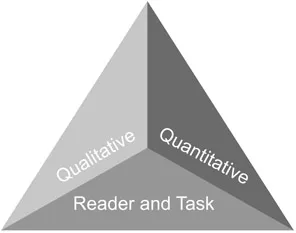
Exposure to complex text is critical in all grades, with each grade building upon the previous one. In every grade level, the CCSS call for students to be exposed to complex, grade-level text. But, what exactly does that mean? Determining text complexity is, for lack of a better word, complex. The standards describe three measures for determining complexity: qualitative, quantitative, and reader and task. All three must be taken into account when selecting texts.
Figure 1.1 The three measures of text complexity
Qualitative measures require looking at the text itself: what challenges does it present in terms of language, knowledge demands, structure, and levels of meaning? Quantitative measures, such as Lexile levels, assess a text’s readability and word count. Reader and task considerations include the reader’s motivation and experiences, as well as the purpose of reading the text and the challenges of the questions asked about the text or the work assigned to go along with it. In essence, this third portion of complexity calls for teachers to use sound judgement in matching texts to readers and the tasks they are asked to perform.
When it comes to academic language, students should gain exposure to vocabulary that appears across content areas, as well as to subject-specific vocabulary. The CCSS call upon students to broaden their vocabularies through close examination of text, paying particular attention to words that will appear in other grade-level texts students might encounter.
Implications for Planning
Text selection matters. So in planning ELA lessons, it is critical that careful attention is paid to the text students will read. As Liben and Liben (2014) write, Shift 1 “will be a departure from what many teachers are accustomed to, which is the practice of always giving students ‘just-right’ texts, or leveled readers, as the core of their instructed reading.”
When choosing texts in the planning stages, choosing grade-level complex text and giving all students access to it is imperative. This isn’t to say that your reading lessons shouldn’t be differentiated based upon students’ reading abilities. They absolutely should be. However, instead of differentiation via giving different students different texts, the differentiation should take the form of offering differing levels of scaffolding and support.
When planning a reading lesson, two key questions should be asked about the text students will be working with:
- What makes it challenging?
- What do I want them to get out of it?
These questions provide a starting point and a means of choosing text in an efficient and straightforward manner. We don’t always have time to do an in-depth qualitative evaluation of a text, or to look up its different quantitative scores. But with these two questions, we can begin to think about whether or not a text meets the grade-level demands of the standards, and make decisions accordingly.
A Note on “Letting Go”
I taught reading for a number of years. Anyone who does so develops a bank of “favorites,” books that they love to teach with. However, the shift toward text complexity calls for all of us to reevaluate every text we use, even our favorites. This might mean that book you’ve been teaching characterization with for years isn’t complex enough. For your students’ sake, you might have to let it go.
Shift 2: Reading, Writing, and Speaking Grounded in Evidence from the Text
The second shift calls for students to regularly answer questions that require a close reading of the text. These text-dependent questions should go beyond surface-level questions, questions with answers that are directly stated, and questions that can be answered using prior knowledge, opinion, or experiences, to questions that require conclusions and inferences supported by the text. The same is true when writing or speaking about a text—student answers should be rooted in evidence from the text. See Table 1.1 for some example questions.
Implications for Planning
The big takeaway from Shift 2 should be the importance of text-dependent questions and supporting answers to these questions with evidence from the text. Text-dependent questions are questions that require students to return to the text after reading it to determine an answer. When planning, careful attention should be paid to the types of questions you’ll be asking as well as the types of answers that will demonstrate mastery.
Table 1.1 Text dependent questions: Examples
| NOT Text Dependent | Text Dependent |
|
| In “Casey at the Bat,” Casey strikes out. Describe a time when you failed at something. | What makes Casey’s experiences at bat humorous? Provide specific evidence from the text that supports your answer. |
| In “Letter from a Birmingham Jail,” Dr. King discusses nonviolent protest. Discuss, in writing, a time when you wanted to fight against something that you felt was unfair. | What can you infer from Dr. King’s letter about the letter that he received? Justify your response with citations from the text. |
| In “The Gettysburg Address” Lincoln says the nation is dedicated to the proposition that all men are created equal. Why is equality an important value to promote? | “The Gettysburg Address” mentions the year 1776. According to Lincoln’s speech, why is this year significant to the events described in the speech? |
These two tips will help you ensure that your lessons meet the demands of Shift 2: read the text and write your questions in advance, and know Standard 1 for your grade level and the grades before and after. Let’s dig into each of these in more detail to provide more context.
Tip 1: Read the Text and Write Your Questions (and Exemplar Answers) in Advance
Not only will this give you an opportunity to double check the text’s complexity (see Shift 1), but it will help you ensure that you are asking students questions that will drive them toward mastery of the skills you are teaching. When writing questions it is important to consider Shift 2 and the push toward supporting answers with evidence from the text. It’s also important to think of your questions as a group, rather than each in isolation. This will ensure that your questions build upon one another, scaffolding student understanding across the lesson in such a way that students are eventually demonstrating mastery independently.
Furthermore, taking the time to write exemplar answers to the questions you want to ask can greatly improve your lessons. These exemplar answers should represent what you want and expect to hear from students when they answer your text-dependent questions. With top-quality answers to your questions in mind before you ask them, you will then know during your lesson if students are demonstrating the understanding that you are working toward.
How can you make sure your questions meet the demands of Shift 2? Table 1.2 can serve as a guide.
Table 1.2 Checklist for text-dependent questions
| Does the student have to read and return to the text to answer each question? |
| Is the student required to spend time lingering over a specific portion of the text? |
| Do the questions follow a coherent sequence, building toward deeper understanding? |
| Are the questions specific enough so they can be answered only by referencing the text? |
| For each question, does the student have to provide evidence from the text to support his or her answer? |
| Do questions focus on the most complex and challenging parts of the text? (These could be sections with difficult syntax, particularly dense information, and tricky transitions or places that off er a ... |