- 160 pages
- English
- ePUB (mobile friendly)
- Available on iOS & Android
eBook - ePub
About this book
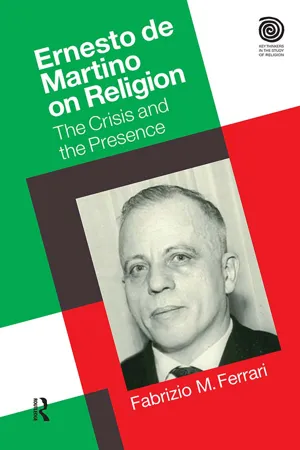
Ernesto de Martino was a major critical thinker in the study of vernacular religions, producing innovative analyses of key concepts such as 'folklore', 'magic' and 'ritual'. His methodology stemmed from his training under the philosopher Benedetto Croce whilst his philosophical approach to anthropology borrowed from Marx and Gramsci. Widely celebrated in continental Europe, de Martino's contribution to the study of religion has not been fully understood in the Anglophone world though some of his works - 'Primitive Magic: the Psychic Powers of Shamans and Sorcerers' and 'The Land of Remorse: a Study of Southern Italian Tarantism' - have been translated. This volume presents a comprehensive overview of de Martino's life and work, the thinkers and theories which informed his writings, his contribution to the study of religions and the potential of his methodology for contemporary scholarship.
Information
1
The life, works and influences of Ernesto de Martino
The life, works and influences of Ernesto de Martino
Overview
Ernesto de Martino was born in Naples on 1 December 1908 and died in Rome on 6 May 1965, aged only fifty-seven. Throughout a career that lasted some twenty-five years and spanned World War II, the following Italian civil war and the birth of the Italian republic1 and the economic miracle, de Martino pioneered different fields in both the humanities and social sciences. Although he obtained little, if any, international recognition – especially if compared with other continental European scholars (Mircea Eliade and Claude Lévi-Strauss, among others) – he became a major figure in the Italian intellectual landscape and, more recently, a widely appreciated anthropologist.2
The son of a railway engineer, Ernesto Sr, and Gina Jaquinangelo, the young Ernesto follows his family first to Florence, where he attends the local liceo (lyceum), and then to Turin, where he begins a university course in engineering (1928). After a few months, however, he decides to leave the programme to pursue his academic interests in the study of philosophy and religion. In 1930 he moves again with his family and settles in Naples. There he is enrolled in the faculty of humanities at the University of Naples, where he studies history of religion. His work at the university is supervised by Adolfo Omodeo (1889–1946),3 one of the foremost Italian intellectuals. Omodeo – who acknowledged the intellectual qualities and potentialities of his young student – introduces de Martino to some of the most important Italian scholars of the time. These include Vittorio Macchioro (1888–1958), a phenomenologist who specialized in the study of mysticism and esotericism in classic religions, Raffaele Pettazzoni (1883–1959), the founder of the Italian school of the history of religion – as well as being responsible for its disengagement from theology (cf. Capps 1995: 89–93) – and ultimately Benedetto Croce (1866–1952), the most prominent and authoritative Italian academic.
Benedetto Croce and the philosophy of the spirit
In 1932, under the guidance of Omodeo, and intellectually stimulated by the teachings of both Macchioro and Pettazzoni, de Martino obtains his Laurea degree with a dissertation on the Eleusinian gephyrisms (ritual jeers).4 In the years between 1933 and 1936, as we learn from an unpublished and unfinished article – ‘Sulla religione civile’ (‘On Civil Religion’) – de Martino is working on fascist mysticism. Apparently, he was planning to write a comparative study in which fascism was discussed as the third Italic religion after Roman paganism and Christianity.5 The work is left incomplete and the young de Martino – probably influenced by Macchioro – begins to work systematically on history, ethnology, magic and occult phenomena.
The life of Ernesto de Martino radically changes in 1935. He begins to teach history and philosophy in the Liceo Scientifico A. Scacchi in Bari and then marries Anna Macchioro (1911–72), his mentor’s daughter. Later on, he is admitted to the exclusive academic circle gravitating around the charismatic figure of Senator Benedetto Croce. He becomes a ‘student’ of the so-called ‘University of Palazzo Filomarino.’6 Fascinated by Croce and heavily influenced by the senator’s interpretation of idealism and historicism, de Martino starts to research on the applications of historicism to the study of religion and culture. At the same time he explores, and reformulates, some of the theses of the German school of the phenomenology of religion, and develops a strong dislike for such methodologies as comparativism, naturalism and evolutionism. These positions, which also benefited from Omodeo and Pettazzoni’s advice (Ginzburg 1991c: 39–41), would eventually lead him to a fatal ideological fracture with his father-in-law, Vittorio Macchioro, whose methodology was more centred on the phenomenology of religion and the study of spiritual experiences.7
The work and the thought of Benedetto Croce are of primary importance to understanding the development of de Martino as an independent scholar. Croce, a former minister of public education and a lifelong senator in both the Reign of Italy and the Italian Republic, distinguished himself for his liberal anti-fascism8 and for the rigour of his analytical thought. Croce is a pivotal figure in the fields of history, history of religion, philosophy and politics. Drawing his methodology from Italian philosopher Gianbattista Vico (1668–1744) and from German idealism (mainly Georg W.F. Hegel and Johann G. Fichte), he theorized the so-called ‘absolute historicism’ (also called ‘the philosophy of the spirit’ or ‘absolute idealism’), a methodology that locates itself between empiricism and rationalism. By insisting on the contemporariness of history, every history, Croce explains the intrinsic ‘immanency’ of history and focuses on the critical observation of experience: ‘Life and reality are history, and nothing else’ (Croce 2002: 57). This approach radically liberates human beings from history intended as a series of events progressing from past to present, hence the qualification of ‘absolute’ historicism. In a rather cathartic way, it transforms the past into consciousness, thus becoming a ‘philosophy of the spirit’.
Croce’s methodology – which rejected reductionist assumptions of contingent factuality – anticipated in many ways various aspects of the current critique to phenomenology.9 Notions like aesthetics and concrete experience are core to understanding Croce’s work. But what exactly is historicism? Bianchi says:
historicism, whether in its idealistic or materialistic form, must … be distinguished from the approach of a historian of religions. While religion is a decidedly historical phenomenon, it must not be reduced to history. Historicism makes religion a mere moment in a dialectic that essentially transcends it.(Bianchi 2005: 4061)
In one of the most influential books on historical theory and cultural studies, Provincializing Europe (2008), Dipesh Chakrabarty examines two ‘minimalist definitions of historicism’, by Ian Hacking:
[Historicism] is the theory that social and cultural phenomena are historically determined and that each other period in history has its own values that are not directly applicable to other epochs.
and by Maurice Mandelbaum:
Historicism is the belief that an adequate understanding of the nature of any phenomenon and an adequate assessment of its value are to be gained through considering it in terms of the place it occupied and the role which it played within a process of development.(Chakrabarty 2008: 22)
While one can appreciate a structural similarity between Hacking and Mandelbaum (who wrote in 1971 and 1995, respectively) and Bianchi, in Croce absolute historicism is discussed in a rather different fashion. Historicism is built on four main ‘categories’, or the four forms of the spirit, which are ‘eternal and immutable’. These are: (i) aesthetics, (ii) logics, (iii) economics and (iv) ethics. The categories – discussed as true agents of history – are supplemented by sub-categories such as beauty, truth, utility, goodness, etc. Croce borrows from Aristotelian logic and, in particular, the concept of hexis (Greek, ‘having’, ‘condition’). This is discussed as a fixed value contributing to the fulfilment of one’s own nature. Yet hexis also requires the participation of mutable concepts, or acquired dispositions (diathesis, or the Crocean sub-categories). But how is it possible for Croce to justify the universalism of absolute historicism and the fixity of eternal categories without considering their relation with acquired variable dispositions? Croce resolves the paradox by arguing that although the categories never change, the concepts through which they express themselves do. Croce’s historicism implies the problematic notion of a uniform development of time; that is to say, the idea that history is based on a universalist interpretation of human actions. Civilization results from collective historical experiences and is shaped by a leadership that immanently actualizes aesthetics, logics, economics and ethics, while the rest of society passively benefits from it. Although one may see some points of agreement with the historical theories of Hegel, John Locke, Ludwig Feuerbach and even Karl Marx, Croce strenuously defends the idea of the individual being at the centre of society. Therefore he is against the notion of ‘fixed legitimate power’ and communality. The struggle of the individual is what determines consciousness and, eventually, liberty. Freedom is an earned right qualified by the individual’s performance in history. As for religion (and theology), Croce denied the autonomous value of religion in society and was fiercely opposed to its independence in academia.
De Martino elaborates Croce’s theories, most notably the notion that history is ‘philosophy in motion’, lacking any greater design, and tries to apply them to ethnology and the study of religion. During his assiduous frequentations with Omodeo and Croce, he starts to engage critically with historians of religion, philosophers and sociologists such as Husserl, Heidegger, Marx, Branislaw Malinowski, Father Wilhelm Schmidt, Edward Burnett Tylor, Durkheim and Franz Boas. In 1941, de Martino publishes his first book, Naturalismo e storicismo nelletnologia (‘Naturalism and historicism in ethnology’), which is dedicated to his first mentor, Adolfo Omodeo. The book is well received overall, although some years later de Martino himself will admit his conclusions were hasty and somehow immature (2000b: 7).
The purpose of the book is ambitious. De Martino wants to rebuild ethnology, the interpretation of religious phenomena and the way they are studied and given meaning. Most notably, he affirms that nature is culturally conditioned. Accordingly, magic and religious rituals are true. If they are in their natural context, they actually work. De Martino agrees with Lévi-Strauss’s idea that the enquiring ‘I’ should not supersede the ‘Other’, and strongly rejects the theses perpetuated by naturalists and evolutionists. Furthermore, by arguing against the experiential approach of phenomenologists like Otto and emphasizing the active role of religious practice and magic as makers of culture,10 he wants ethnology to become de facto a historical science: ‘This collection of essays wishes to claim the historical character of ethnology and to limit the naturalistic method to philological research, or to the practical organization of facts while awaiting the historiography to come’ (de Martino 1997: 53). De Martino urges his colleagues to carefully listen to the discourses generated by ‘primitive thought’ (pensiero primitivo) and inaugurates a dialogical approach to the study of religion.11
For Croce this is unacceptable: the ‘primitives’ are part of the world of nature (just like plants and minerals) and it is not possible to make history with nature. More precisely, the primitives express themselves and their culture through magic, which is a ‘negative’. Omodeo too, with Croce, agrees that a history of magic is a contradiction in that magic is not determined by reason, the foundation of history (cf. de Martino 2000a: 162, fn. 133). Naturalismo e storicismo nelletnologia causes the first ideological break with Croce (and Croceans), a crisis that will appear more transparently in de Martino’s following book, Il mondo magico (1948).
As in many other instances, de Martino’s intellectual and ideological positions impact heavily on his career. Yet even more than academic diatribes, it is his overt political rejection of fascism that costs him his job. In 1942 the name of Ernesto de Martino appears on the blacklist signalling intellectuals potentially dangerous to the fascist regime. He is immediately removed from the education system. By then the Neapolitan scholar finds himself actively engaged in anti-fascist propaganda and organized resistance (Resistenza). He starts collaborating with the National Liberation Committee and contributes to the foundation of the Liberal-Socialist Party. Eventually he enters as a leftist delegate in the Partito d’Azione (Action Party, henceforth PdA).12 In 1943, soon after the fall of fascism, de Martino is forced to hide in Cotignola, in the countryside around Ravenna, to escape the raids of the German SS and the Gestapo, as well as the squads of the newborn Repubblica Sociale Italiana (Italian Social Republic).13 In this dramatic context, de Martino – following his encounters with Italian partisans – starts thinking about practical applications of the teachings of Omodeo and Croce. In other words, he begins to act as an ideologue. Increasingly closer to the PdA, he contributes to the establishment of a political agenda characterized by a socialist doctrine that rejects Marx’s economic determinism and emphasizes class struggle, respect of individual liberty and civil rights in cultural, political and economical terms. This experience will have a profound influence on de Martino and his intellectual development as an ethnologist concerned with the place of subaltern classes in history and culture.
In 1945, after a frenetic collaboration with the Partito Italiano del Lavoro (Italian Party of Labour), de Martino joins the Partito Socialista di Unità Proletaria (Socialist Party of Proletarian Unity), the largest Italian socialist party, and in 1947 he is appointed secretary of the sections of Bari and Molfetta in Apulia, southern Italy. While still actively politically engaged, his name begins to circulate in academic circles, and it will soon attract national and international interest (internationally, mainly from France). In 1948 he becomes co-editor – along with Cesare Pavese (1908–50), one of the major twentieth-century Italian poets, novelists and literary critics – of the Religious, Ethnological and Psychological Studies Series (the ‘Collana Viola’, or Purple Series) of the prestigious Einaudi publisher.14 In the same year he publishes Il mondo magico: Prolegomeni a una storia del magismo (translated into English as Primitive Magic: the Psychic Powers of Shamans and Sorcerers),15 a book he began to write as early as 1941 but publication of which was delayed due to the war and de Martino’s hiding and underground activity.
While the contents of Il mondo magico will be discussed in the following chapters, it is worth mentioning here that de Martino’s main output was to address in a systematic way strengths and weaknesses of contemporary sociological and naturalist theories, with particular reference to French sociologists Émile Durkheim and Lucien Levy-Brühl, and Austrian anthropologist Father Wilhelm Schmidt. In the last chapter of Il mondo magico, ‘The problem of magic powers in the history of ethnology’ (1988: 155–201), de Martino anticipates some of the themes that will be discussed in the years to follow. The evolutionism of Schmidt, Durkheim and Lévy-Brühl does not resolve satisfactorily the problems behind the study of ‘primitive societies’. Durkheim, in his The Elementary Forms of Religious Life ([1912] 2001), developed the theory that there are two mentalities, the primitive one and the adult one, which participate in the world through their discriminating – or qualifying – activity. Lévy-Brühl, in Primitive Mentality (1923), reinforces such an approach by formulating the notion of ‘prelogism’, a concept that applies to the collective logics of ‘inferior cultures’ and di...
Table of contents
- Cover
- Half Title
- Title Page
- Copyright Page
- Table of Contents
- Note on translation
- Preface
- Acknowledgements
- Introduction
- 1 The life, works and influences of Ernesto de Martino
- 2 Ernesto de Martino's writings on religion
- 3 From militant ethnology to critical ethnocentrism
- 4 Religion, magic and the crisis of presence
- 5 Using de Martino to interpret religion: applications and limitations
- Conclusion
- Notes
- Bibliography
- Index
Trusted by 375,005 students
Access to over 1.5 million titles for a fair monthly price.
Study more efficiently using our study tools.
Frequently asked questions
Yes, you can cancel anytime from the Subscription tab in your account settings on the Perlego website. Your subscription will stay active until the end of your current billing period. Learn how to cancel your subscription
No, books cannot be downloaded as external files, such as PDFs, for use outside of Perlego. However, you can download books within the Perlego app for offline reading on mobile or tablet. Learn how to download books offline
We are an online textbook subscription service, where you can get access to an entire online library for less than the price of a single book per month. With over 1.5 million books across 990+ topics, we’ve got you covered! Learn about our mission
Look out for the read-aloud symbol on your next book to see if you can listen to it. The read-aloud tool reads text aloud for you, highlighting the text as it is being read. You can pause it, speed it up and slow it down. Learn more about Read Aloud
Yes! You can use the Perlego app on both iOS and Android devices to read anytime, anywhere — even offline. Perfect for commutes or when you’re on the go.
Please note we cannot support devices running on iOS 13 and Android 7 or earlier. Learn more about using the app
Please note we cannot support devices running on iOS 13 and Android 7 or earlier. Learn more about using the app
Yes, you can access Ernesto De Martino on Religion by Dr. Fabrizio M. Ferrari in PDF and/or ePUB format, as well as other popular books in Theology & Religion & Ethnic & Tribal Religion. We have over 1.5 million books available in our catalogue for you to explore.