- 392 pages
- English
- ePUB (mobile friendly)
- Available on iOS & Android
eBook - ePub
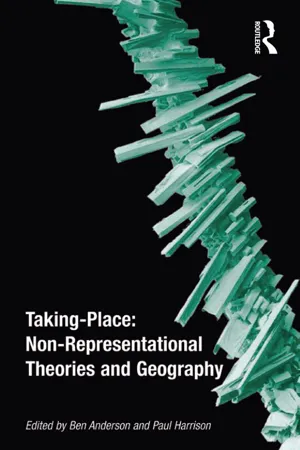
Taking-Place: Non-Representational Theories and Geography
About this book
Emerging over the past ten years from a set of post-structuralist theoretical lineages, non-representational theories are having a major impact within Human Geography. Non-representational theorisation and research has opened up new sets of problematics around the body, practice and performativity and inspired new ways of doing and writing human geography that aim to engage with the taking-place of everyday life. Drawing together a range of innovative contributions from leading writers, this is the first book to provide an extensive and in-depth overview of non-representational theories and human geography. The work addresses the core themes of this still-developing field, demonstrates the implications of non-representational theories for many aspects of human geographic thought and practice, and highlights areas of emergent critical debate. The collection is structured around four thematic sections - Life, Representation, Ethics and Politics - which explore the varied relations between non-representational theories and contemporary human geography.
Information
Chapter 1
The Promise of Non-Representational Theories
Ben Anderson and Paul Harrison
A Dream
I can’t help but dream of the kind of criticism that would try not to judge but to bring an oeuvre, a book, a sentence, an idea to life; it would light fires, watch grass grow, listen to the wind, and catch the sea foam in the breeze and scatter it. It would multiply not judgements but signs of existence; it would summon them, drag them from their sleep. Perhaps it would invent them sometimes – all the better. All the better. [...] It would not be sovereign or dressed in red. It would bear the lightening of possible storms (Michel Foucault 1997a, 323).
It’s the affirmation which gives the quote its force. The affirmation not just of one thing, one subject, one angle, but of many. And beyond this, an affirmation of life, of existence as such, as precarious, as active and as unforeseeable. We will move to a more traditional mode of introduction in a moment however for now let us stay with Foucault’s dream. What would ‘criticism’ have to be to be capable of all these things, of this affirmation and this potential? It seems to us that it would have to be itself multiple, itself composed out of many things. It would have to work out how to move differently, how to step from one topic to the next, one matter to the next, and initiate new ways of relating, walk new routes without tripping, (or at least not often). It would have to take risks, invent new terms, new tones, new objects. It would draw new maps. Perhaps most importantly, it would have to continue changing, not settle in the satisfaction of a judgment but keep experimenting. Further on in the interview from which the quote above comes, Foucault suggests that
What we are suffering from is not a void but inadequate means for thinking about everything that is happening. There is an overabundance of things to be known: fundamental, terrible, wonderful, insignificant, and crucial at the same time (1997a, 325).
It is our view that non-representational theories1 are best approached as a response to such a situation. If one single thing can be said to characterise nonrepresentational work in Human Geography over the past 15 years it is the attempt to invent new ways of addressing fundamental social scientific issues and, at the same time, displacing many of these issues into new areas and problems. In doing so we believe that it has multiplied ‘signs of existence’, helping to introduce all kinds of new actors, forces and entities into geographic accounts and, at the same time, aiding in the invention of new modes of writing and address and new styles of performing Geographic accounts. While the consistency of these attempts may sometimes be hard to see, an issue we will consider below, on a basic level what has linked this diverse body of work is a sense of affirmation and experimentation. In this we believe that they share the ethos of Foucault’s dream and, moreover, its invitation to do and think otherwise.
Of course non-representational theories have not done this alone. In the second section of this introduction ‘Context’ we shall offer a kind of origins myth for non-representational theory in geography, locating its emergence in and from social constructivism in the mid-1990s. However beyond this undoubtedly partial account the main aim of this introduction is to outline three shared commitments or problematics which we believe link together what is a diverse and still diversifying body of work. Our aim here is partly genealogical, taken sequentially one could read these three elements as stages of an evolution and in growing complexity. However the more important (and slightly less artificial) task is that they provide a kind of intellectual ‘primer’ for the rest of the volume; a chart onto which the reader may map the following chapters and so note their shared concerns and the different routes they plot across common problematics. Thus, following the ‘Context’, the first of the three substantive sections discusses ‘Practices’. Here we describe how and why non-representational theory has a practical and processual basis for its accounts of the social, the subject and the world, one focused on ‘backgrounds’, bodies and their performances. In particular this section is concerned with showing how non-representational approaches locate the making of meaning and signification in the ‘manifold of actions and interactions’ rather than in a supplementary dimension such as that of discourse, ideology or symbolic order. The next section ‘Life and the Social’ acts as an auto-critique and expansion on the issues just given, charting the movement in non-representational theory from practice based accounts to wider post-humanist accounts of life. Here the influences of Gilles Deleuze and Bruno Latour are most evident, as we attempt to describe the consequences of non-representational theory’s relational-materialism for thinking about the composition and nature of the social. Following on, ‘Event and Futurity’ gives the final shared commitment or problematic; here we focus on the ‘non’ of non-representational theory, and consider exactly how the work gathered by the name is orientated by and to an open-ended future, an orientation through which it attempts to ‘bear the lightening of possible storms’. The introduction closes with a brief reflection and a look at the structure of the volume which follows.
Context
Beginnings are always arbitrary, always imagined. One can always extend the genealogy and go back further, or move off sideways seeking the skeleton in the closet, and we will, to some extent. However in this section of the introduction we outline a specific intellectual problematic as the spur behind non-representational theories. In doing so we keep within the recognised genre requirements of an introduction to an edited academic book; ‘storying’ the emergence of nonrepresentational theories as a successor ‘paradigm’. The reasons for this choice are largely pedagogic and heuristic; feeling optimistic, we like to imagine this introduction’s primary audience as being composed of people who may not be so familiar with non-representational theories and so the onus is upon us to tell, reductive as it may be, a more or less believable intellectual narrative. However many other beginnings could be plausibly given, not least amongst them; the ongoing impact of post-structuralism on the discipline and, in particular, the avenues for thought opened by the translation of the work of Deleuze and Latour; an emergent concern for ‘everyday life’ and the forms of embodied practice therein; a specific confluence of energies, research interests and institutional setting focused on the School of Geographical Sciences in Bristol in the UK throughout the 1990s; the gathering together and elaboration of non-representational theories by Nigel Thrift; the crystallisation of desires to find new ways of engaging space, landscape, the social, the cultural and the political; the influence of the UK’s Research Assessment Exercise through which, in Human Geography at least, value was attached to single author papers and which promoted an academic climate wherein so called ‘theoretical’ interventions could be valued as highly as more ‘empirical’ studies; a simple generational shift between the New Cultural Geography and what would follow; an ever more extensive engagement by geographers with other social science and humanities disciplines; a cynical careerist fabulation. As with the account which follows, none of these beginnings are determinate, however all and more probably played a role. We could then classify the emergence of non-representational theories in the discipline as an ‘event’, (see below), one which, as with all events, arrives somewhat unexpectedly, whose outcome is never guaranteed in advance, and which is composed across but irreducible to a multiplicity of sites, desires, fears, contingencies and tendencies, an event housed within the term ‘non-representational theory’.
Still, for now, let’s imagine a beginning. It’s 1993:
When it was enthusiastically pointed out within the memory of our Academy that race or gender or nation ... were so many social constructions, inventions, representations, a window was opened, an invitation to begin the critical project of analysis and cultural reconstruction was offered. And one still feels its power even though what was nothing more than an invitation, a preamble to investigation has, by and large, been converted into a conclusion – e.g. ‘sex is a social construction’, ‘race is a social construction’, ‘the nation is an invention’, and so forth, the tradition was an invention. The brilliance of the pronouncement was blinding. Nobody was asking what’s the next step? What do we do with this old insight? If life is constructed, how come it appears so immutable? How come culture appears so natural? If things coarse and subtle are constructed, then surely they can be reconstructed as well? (Taussig 1993, xvi).
There can be little doubt that throughout the 1980s and the 1990s social constructivism was the dominant mode of social and cultural analysis, within Human Geography and beyond. ‘Social constructivism’ is, of course, a convenient shortcut; what is named with this term is less a specific body of work and more a general ontological and epistemological stance, a certain way of delimiting and apprehending ‘the social’. In this origins myth, social constructivism plays the somewhat thankless role of context and matrix for the emergence of nonrepresentational theories. So, what traits distinguish social constructivism as an approach and for this dubious honour?
First and foremost social constructivism is distinguished by a preoccupation with representation; specifically, by a focus on the structure of symbolic meaning (or cultural representation). Social constructivism looks to how the symbolic orders of the social (or the cultural) realise themselves in the distribution of meaning and value, and thereby reinforce, legitimate and facilitate unequal distributions of goods, opportunities and power. Thus the primary ontological object for social constructivism is the collective symbolic order understood to be, as the anthropologist Clifford Geertz has it, ‘a set of control mechanisms – plans, recipes, rules, instructions (what computer programmers call “programmes”) – for governing behaviour’ (1973, 44). Or as geographers David Ley and Marwyn Samuels put it five years after Geertz; ‘All social constructions, be they cities or geographic knowledge, reflect the values of a society and an epoch’ (1978, 21 emphasis added). The collective symbolic order is that by which its members make sense of the world, within which they organise their experience and justify their actions. Hence James S. Duncan’s characterisation (after Raymond Williams (1981)) of landscape as ‘a signifying system through which a social system is communicated, reproduced, experienced, and explored’ (1990, 17).2 An important point here, one with extensive epistemological (and methodological) implications, is the separation made between the symbolic order and the particular situations within which that order is realised. As Tim Ingold writes; ‘Starting from the premise that culture consists of a corpus of inter-generationally transmissible knowledge, as distinct from the ways in which it is put to use in practical contexts of perception and action, the objective is to discover how this knowledge is organised’ (2000, 161). Epistemologically, this means that the ‘action’ is not in the bodies, habits, practices of the individual or the collective (and even less in their surroundings), but rather in the ideas and meanings cited by and projected onto those bodies, habits, practices and behaviours (and surroundings). Indeed the decisive analytic gesture of social constructivism is to make the latter an expression of the former. To critically depart, for example, from being ‘narrowly focused on physical artifacts (log cabins, fences, and field boundaries)’ and move towards an understanding of ‘the symbolic qualities of landscape, those which produce and sustain social meaning’ (Cosgrove and Jackson 1987, 96). A departure through which the objects of investigation – landscape, city space, place – become apprehended as ‘texts’, where ‘the text is seen in terms of the self-realisation or contestation of [ideas, ideologies and] identities, understood as part of the impulse to the self-realisation of the group, class or nation’ (Clark 2005, 17).
To sum up, social constructivism’s initial impetus and its considerable critical purchase in the 1980s and 1990s lay, in Human Geography at least, in two linked insights. First, in the recognition of the arbitrary nature of symbolic orders, in recognising the fact that they are ‘invented’ and not ‘natural’. Second, in the emphasis placed on the plural and contested (or at least contestable) nature of symbolic orders and the sites at which this occurred. The importance of these insights and the work which followed them is difficult to underestimate; contemporary Human Geographic investigation is unthinkable without them. And so, while we would characterise the emergence of non-representational theory as an ‘event’, we would also stress that non-representational theory has a debt to, in particular, the New Cultural Geography, one that has to a certain extent gone unacknowledged. There is no doubt that non-representational theory inherits a number of the key insights of New Cultural Geography; that representation matters, that social order is not immutable, and that signification connects to extra-linguistic forces. However, as we shall see, it inherits by rearticulating these insights, framing them otherwise. Why? Because the insight and critical purchase of social constructivism comes at a cost.
Practices
The world and its meanings; this divide is the cost.3 On one side, over there, the world, the really real, all ‘things coarse and subtle’, and on the other, in here, the really made-up, the representations and signs which give meaning and value. It’s a classic Cartesian divide. Once established there can be no sense of how meanings and values may emerge from practices and events in the world, no sense of the ontogenesis of sense, no sense of how real the really made-up can be. Indeed in retrospect it may seem as though, as Ulf Strohmayer (1998, 106) observed, social constructivism’s and Human Geography’s preoccupation with representation was simply a ‘pragmatic’ response to the wider, preceding crisis of representation. A response which took critical advantage of the ‘constructed’ nature of all representation, but which, due to its own anti-realism, was never able to move beyond the crisis and account for the fact that ‘if life is constructed, how come it appears so immutable?’. An early, arguably defining trait in the identification and emergence of non-representational theory was a different way of framing and responding to this problem. Indeed this other framing gives us the most literal definition of the term ‘non-representational’ and the first way of recognising non-representational theories; they share an approach to meaning and value as ‘thought-in-action’:
These schools of thought all deny the efficacy of representational models of the world, whose main focus is the ‘internal’, and whose basic terms or objects are symbolic representations, and are instead committed to non-representational models of the world, in which the focus is on the ‘external’, and in which basic terms and objects are forged in the manifold of actions and interactions (Thrift 1996, 6).
Before asking of the consequences, it is worth taking a few moments to explore this difference a bit further.
‘The manifold of action and interaction’; what does this mean? One way to think about it is as a ‘background’. While we do not consciously notice it we are always involved in and caught up with whole arrays of activities and practices. Our conscious reflections, thoughts, and intentions emerge from and move with this background ‘hum’ of on-going activity. More technically, we could say that ‘the background is a set of nonrepresentational mental capacities that enable all representing to take place’ and that conscious aims and intentions form, and have the form they do, only against such a ‘background of abilities that are not intentional states’ (Searle 1983, 143). You are late; you walk quickly into the classroom and sit down. When you walked into the classroom did you think about opening the door, or did you just open it? When you sat down did you have to remember what a seat looked like and how to use o...
Table of contents
- Cover Page
- Half Title page
- Dedication
- Title Page
- Copyright Page
- Contents
- List of Figures and Table
- Notes on Contributors
- Acknowledgements
- 1 The Promise of Non-Representational Theories
- Part I Life
- Part II Representation
- Part III Ethics
- Part IV Politics
- Index
- Index of Names
Trusted by 375,005 students
Access to over 1.5 million titles for a fair monthly price.
Study more efficiently using our study tools.
Frequently asked questions
Yes, you can cancel anytime from the Subscription tab in your account settings on the Perlego website. Your subscription will stay active until the end of your current billing period. Learn how to cancel your subscription
No, books cannot be downloaded as external files, such as PDFs, for use outside of Perlego. However, you can download books within the Perlego app for offline reading on mobile or tablet. Learn how to download books offline
Perlego offers two plans: Essential and Complete
- Essential is ideal for learners and professionals who enjoy exploring a wide range of subjects. Access the Essential Library with 800,000+ trusted titles and best-sellers across business, personal growth, and the humanities. Includes unlimited reading time and Standard Read Aloud voice.
- Complete: Perfect for advanced learners and researchers needing full, unrestricted access. Unlock 1.5M+ books across hundreds of subjects, including academic and specialized titles. The Complete Plan also includes advanced features like Premium Read Aloud and Research Assistant.
We are an online textbook subscription service, where you can get access to an entire online library for less than the price of a single book per month. With over 1.5 million books across 990+ topics, we’ve got you covered! Learn about our mission
Look out for the read-aloud symbol on your next book to see if you can listen to it. The read-aloud tool reads text aloud for you, highlighting the text as it is being read. You can pause it, speed it up and slow it down. Learn more about Read Aloud
Yes! You can use the Perlego app on both iOS and Android devices to read anytime, anywhere — even offline. Perfect for commutes or when you’re on the go.
Please note we cannot support devices running on iOS 13 and Android 7 or earlier. Learn more about using the app
Please note we cannot support devices running on iOS 13 and Android 7 or earlier. Learn more about using the app
Yes, you can access Taking-Place: Non-Representational Theories and Geography by Ben Anderson, Paul Harrison in PDF and/or ePUB format, as well as other popular books in Social Sciences & Phenomenology in Philosophy. We have over 1.5 million books available in our catalogue for you to explore.