eBook - ePub
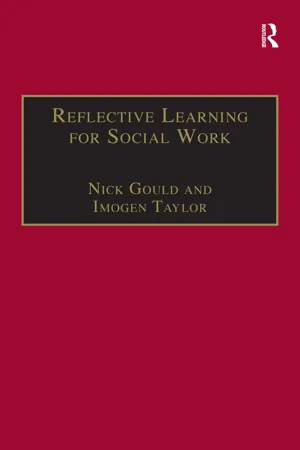
Reflective Learning for Social Work
Research, Theory and Practice
- 176 pages
- English
- ePUB (mobile friendly)
- Available on iOS & Android
eBook - ePub
About this book
Since the publication of Donald Schön's The Reflective Practitioner in 1983 there has been a dramatic growth of research and writing developing the concept of reflective learning. Surprisingly, there has been little application of concepts of reflective learning to social work education. This volume: ¢ makes accessible for the first time to a social work readership a book which focuses on reflective learning in social work ¢ brings together material on reflective learning from both academic and practice settings ¢ creates a seminal text for educators and trainers in universities and practice settings ¢ has relevance to an international readership, with contributions from the UK, USA, Canada and Australia.
Information
1 Introduction: social work education and the ‘crisis of the professions’
Nick Gould
What kinds of knowledge do skilled social work practitioners bring to bear on their practice? What are the components of this knowledge - is it cognitive, behavioural, attitudinal, affective or multidimensional? How is this knowledge acquired, maintained and developed? Such questions inevitably become the pre-occupation of social work educators, whether they are academics located in institutions of higher education, or trainers based in practice agencies with a responsibility for student practice learning or staff development. This volume presents an international collection of writing by authors whose interest in such questions - whether arising from educational research, teaching social work, or practice as specialists in adult education has led them to engagement with the concept of reflective learning.
The reflective learning paradigm starts from an attempt to understand how social workers make judgements and decisions in domains which are uncertain and complex. There is considerable empirical evidence, based on research into a variety of occupations, suggesting that expertise does not derive from the application of rules or procedures applied deductively from positivist research. Instead, it is argued that practice wisdom rests upon highly developed intuition which may be difficult to articulate but can be demonstrated through practice. On the basis of this reconstructed epistemology of practice, reflective learning offers an approach to education which operates through an understanding of professional knowledge as primarily developed through practice and the systematic analysis of experience. This is sometimes referred to as a theory of experiential learning, although this is a term open to misunderstanding in social work, being often trivialized as a general reference to techniques such as role play and simulation exercises. Although already influential in other areas of professional education, reflective learning as a distinct educational theory has so far only been tentatively examined in the social work literature but is indicated by reference to such concepts as reflective learning', reflective practice', reflection-in-action' and 'the reflective learning environment'.
There is always a danger that a concept such as reflective learning will become little more than a slogan. The contributors to this volume offer a range of definitions of what they mean by reflection, but the commonality is that they are all engaging at some level with the application in social work of the ideas of Donald Schon, but often refracted through other influences. For instance, there is the work of John Dewey, who identified the centrality of reflection as a process through which learning from experience takes place (Dewey 1933). Experience, Dewey argued, is the organizing focus for learning; observations and actions are synthesized with conceptual ideas leading to higher-order practice. Kolb has more recently been highly influential in formalizing these ideas into a cyclical model of experiential learning, a feedback loop by which experience is acted upon through reflective observation, leading to abstract conceptualization, on the basis of which active experimentation produces modified practice intervention (Kolb 1984). Critical theory has also provided inspiration for approaches to reflective learning; in particular, Carr and Kemmis, influenced by Habermas's conception of communicative action, have extended the idea of the practitioner as an action researcher who is constantly testing and critiquing theories of action through situated practice (Carr and Kemmis 1986).
However, above all the concept of reflective learning has become associated with the work of Donald Schön, through his seminal works, The Reflective Practitioner (1983) and Educating the Reflective Practitioner (1987). Schön's work is based upon qualitative, idiographic case studies of practitioners in the fields of engineering, town planning, architecture, management and clinical psychology, but his ideas have been applied in many other areas of professional education, in particular teacher education. Schön's work begins from a critique of those classical models of technical rationality which suggest that positivist knowledge can be applied to real-life problems in a deductive and direct way. Schon has inverted this conventional understanding of the relationship between theory and practice (the simplistic idea that theory is applied deductively to practice), demonstrating that significant dimensions of 'theory' are only revealed through skilled practice, are implicit in action and often beyond conscious articulation. Similarly, professional 'problems' are not ontologically pre-defined, but have to be constructed through engagement by the practitioner with the 'indeterminate zone of practice' which is typically characterized by uncertainty, uniqueness and value conflict (Schön 1987, p. 6). A not uncommon illustration of this might be a duty social worker, called to the police station to assess someone arrested for a breach of the peace because the arresting officer thinks the person may be suffering from a mental disorder. Whether the professional social work issues raised by this situation relate primarily to criminality, a mental health crisis or some other problem still to be discovered such as homelessness, is not pre-determined at the point of referral, but is negotiated via a complex series of transactions between the worker, the detained individual and possibly other actors such as police or psychiatrists.
From this perspective, positivist knowledge and formal theory are not neutral resources which can be drawn down and directly applied, but are only of use when mediated through the complex filters of practice experience. In order to become a tool for practice, the practitioner has to transform theory in the light of learning from past experience (reflection-on-action), and through improvisation during the course of intervention (reflection-inaction). As Michael Eraut has commented, practitioners are directly engaged in the processes of knowledge creation, there is not a one-way transmission of knowledge from academia to practice. This requires academics responsible for professional studies to re-direct at least some of their skills so that they are, 'enhancing the knowledge creation capacities of individuals and professional communities' (Eraut 1985, p. 117).
Social work and the crisis of social work education
Schön placed his own work within a discussion of an apparent crisis of the professions', produced by growing public scepticism as to the infallibility of practitioners, a reduction in automatic deference to professionals, and the inevitable extension of this mood to the belief that the education and preparation of new professionals has become inadequate. Some might think that social work has had more than a fair share of its own crises. Commentators have sought to locate the malaise of social work education within various explanatory frameworks. One argument is that the difficulties lie in the particular nature of social work practice, that it typically requires practitioners to integrate the instrumental and the expressive, the affective and the cognitive. This habitually brings academic social work departments into conflict with their host institutions where universities have traditionally supported a status hierarchy of knowledge. Experimental research is the exemplar of seal' academic work, and applied knowledge is accorded an inferior position and only tolerated insofar as it can demonstrate a technical-rational approach to the application of scientific knowledge in practical settings. The impact of this form of institutionalized epistemological discrimination is often manifested in the insecurity of academic social work departments and difficulties of individual staff attaining tenure.
Studies of reflective practice bear out many of the lessons of recent research in the sociology of scientific knowledge (e.g. Collins 1992,2nd edn), showing that in fact the supposedly rigorous scientific disciplines such as medicine or laboratory research are just as contingent upon the mediation of practice skills, human judgement, intuition, artistry and tacit knowledge as the supposedly 'fuzzy' vocations such as teaching and social work. Schön's analysis of skilled practice in a range of disciplines is also a meta-theory of practice which shows the commonalities between disciplines which have traditionally occupied different points in the academic status hierarchy. The reflective model collapses the cognitive-affective dichotomy by showing that practice knowledge is organized around experientialJy -based schema which transcend oppositions of feeling and fact.
The reflective learning debates also incorporate the ongoing controversies about the relationship between theory and practice which dispute the content of the academic disciplinary knowledge base for social work; for instance, is it a form of applied social science to which any combination of psychology, sociology or social policy make a foundational contribution, or should the humanities, e.g. literary criticism, provide a more appropriate knowledge base for social work (England 1986)? Or, from the reflective perspective, should theories be seen as providing alternative frames or metaphors which are more or less helpful positions from which practice can be reviewed and deconstructed, but without any one discipline constituting a bedrock of knowledge which can be said to be foundational?
A further critique within the crisis of social work education has been the functionalist argument that the problems of social work education are a product of organizational expansion and transformations of social work bureaucracies. This argument is advanced on two fronts: first, that the profession has broadened its definition of social work to become a highly diversified activity; and secondly, social work organizations have increased dramatically in size, incorporating a wider range of social service activities than were within earlier definitions of social work. The newly-qualified social worker is expected to operate competently not only in a variety of settings with a multiplicity of client groups, but also at various levels of the organization.
Within British social work these tensions seem to have produced at least two effects. The first is the concerted attempt by employers to gain control over qualifying social work education, in the belief that the employer knows what social workers really need to know and do. The second (and related) effect has been the ascendancy of the competency-based approach to learning which suggests that complex activities such as social work intervention can be digitized into discrete actions or competencies, which are measurable outcomes of any training programme. Although its genealogy has become glossed over and submerged, the origins of competency-based approaches to education lie both in positivist behaviourism and also new managerialist demands for accountability in public services (Richardson 1990). The effect, at least in British social work education in the 1990s, has been pressure to accept a severe intellectual reductionism which treats everything from professional ethics to legal knowledge as 'competencies' to be ticked off from a functionalist checklist. The consequences of these trends are a downgrading of critical analysis as an educational objective and a short-term view of practice to suit the supposed labour force requirements of agencies. A recent review of the quality of social work education in English universities concluded that, 'this focus [upon competence] may sometimes limit the provision of a broader and broadening professional education, which takes a longer-term view of personal and professional development' (Higher Education Funding Council for England 1995, p. 10). In contrast to this, reflective learning recognizes that a purpose of education is to facilitate people as (in Bateson's terms) double-loop learners who are able to challenge the normative context of practice, and to be non-defensive and adaptive learners within a constantly evolving professional environment (Bateson 1973).
All this is not to suggest that Schön's model of reflective learning is a finished project, written in tablets of stone. If reflective learning is to be a dynamic influence then the theory has to be seen as reflexive, being itself transformed by the processes of educators using the ideas and learning through that experience. This collection of writings is part of that process, as social work and adult educators describe and evaluate their own experience. Indeed, social work's continuous preoccupation with the configuration of the person in the social environment makes it a particularly interesting site for the exploration of organizational, social and political implications of reflective learning. Schön's work is process orientated and methodologically individualistic, but many of the following chapters shows the apparent paradox that the creation of personal knowledge is a very social process. This inevitably brings into the conceptual frame issues of power relationships, both in the professional setting and the classroom. A potent aspect of those power relationships is gender, and these studies frequently draw upon feminist theories as centrally important in understanding not only these connections between personal and public knowledge, but also in legitimizing research methodologies which are sensitive and alert to the challenges of empowerment and emancipation. Similarly, professional education invariably occurs within an organizational context, be it the agency or classroom; the challenges and opportunities which exist as a consequence of organizational structure, management approaches, culture and not least of all the design of the curriculum, are all constitutive of the concerns of reflective learning.
The themes introduced in this chapter become amplified and extended by Catherine Papell in Chapter 2 where she considers implications of reflective learning for contemporary social work education. Although these are instanced within a North American context, the issues raised are internationally relevant. The reflective paradigm carries implications for social work education in relation to three issues discussed by Papell. First, it confirms the centrality of experiential learning within the formation of practice knowledge. Intellectually, this recognition receives validity from challenges to the dominance of positivism which come from research methodologies which are qualitative and heuristic. Secondly, reflective learning brings to attention the relationship between generalist perspectives and specialism, and the academic levels at which these are appropriately developed. Thirdly, it reconstructs understanding of the relationship between theoretical knowledge and the nature of social reality. All these issues influence not only processes of learning and teaching, but also the way curricula are created, and the relationship of professional education to the wider system of higher education.
This last theme is taken up in David Boud and Susan Knights' chapter on course design for reflective practice. Writing from their experiences as university-based adult educators in Australia, they argue that the encouragement of reflective practice requires more than the piecemeal adding on of ways of debriefing periods of field work; it requires deeper level integration of appropriate ways to build notions of reflective practice into the processes of teaching and learning through programmes. Reflection should not be seen as something which is separate from the normal teaching and learning practices of a course; Boud and Knights outline a range of strategies for incorporating reflective practice into activities which serve other teaching values and content objectives. These approaches support a three-stage model of learning from experience which involves learners in returning to the experience, attending to feelings connected with the experience and revaluating the experience. As part of this process the learning milieu is given particular prominence, within which the curriculum and the teacher figure strongly.
A concluding thought from Boud and Knights is that if reflection is not to be just an uncritically received 'hurrah' concept then good research evidence is needed to help understand the processes acting upon reflective learning. In Chapter 4 Alma Harris reports findings from a two-year longitudinal study into experiential learning in social work. Types of experience which proved significant to students choosing social work as a career are explored, along with the experience of students during their placement and their effect on professional development. In particular Harris concentrates on the ways in which students conceptualize their learning from experience. She finds that initially students have very technicist views of how their past life experience provides opportunities for rehearsal and practice of professional skills. The experience of supervised practice in fieldwork placements led to students developing more extended repertoires of 'knowing-in-action', but the process by which this occurs is highly dependent on the cues and opportunities for reflection provided by a mentor. The outcome of such exploration is likely to be a more complex but coherent model of practice.
Boud and Knights also draw attention in Chapter 3 to the importance of integrating strategies for promoting reflection within teaching programmes, and Chapters 5, 6 and 7 provide illumination of contrasting aspects of this task. There are few examples within the social work education literature of description and analysis of the actual classroom teaching process. As a corrective to this Ken Moffatt offers from Canada both a conceptual framework and description of his experience of teaching social work practice as a reflective process to final year undergraduates. He locates his approach to teaching within a theoretical synthesis which draws together feminist writing on caring, social work literature on interpretive methods, and Bourdieu's work on the concept of social fields, in order to characterize the position of social work practitioners within bureaucratic welfare institutions. Moffatt then shows how these sources were drawn upon in working with students in a three-stage programme of lecture and discussion, reflection on practice through role play and journal writing, and further lecture and discussion. His experience shows how students develop complexity in their analysis of their own practice, bringing forward judgements which had seemingly been based on unproblematic 'common-sense' for rigorous analysis and deconstruction. The author shows how the reflective approach can provide a sophisticated form of critique which overcomes the static and reductionist oppositions of micro- and macro-level interventions, or subjective and objective factors.
The limitations of categorical and dichotomous thought is a cen...
Table of contents
- Cover
- Half Title
- Dedication
- Title
- Copyright
- Contents
- List of contributors
- Acknowledgements
- Chapter 1 Introduction: social work education and the 'crisis of the professions'
- Chapter 2 Reflections on issues in social work education
- Chapter 3 Course design for reflective practice
- Chapter 4 Learning from experience and reflection in social work education
- Chapter 5 Teaching social work as a reflective process
- Chapter 6 Using imagery in reflective learning
- Chapter 7 Facilitating reflective learning
- Chapter 8 'Patterns that connect': opportunities for reflective practice in network placements
- Chapter 9 Managing for reflective learning
- Chapter 10 Team and management consultation: reflections on the world's third oldest profession
- Chapter 11 Finding meaning for social work in transitional times: reflections on change
- Chapter 12 Reflective learning, social work education and practice in the 21st century
- Index
Trusted by 375,005 students
Access to over 1.5 million titles for a fair monthly price.
Study more efficiently using our study tools.
Frequently asked questions
Yes, you can cancel anytime from the Subscription tab in your account settings on the Perlego website. Your subscription will stay active until the end of your current billing period. Learn how to cancel your subscription
No, books cannot be downloaded as external files, such as PDFs, for use outside of Perlego. However, you can download books within the Perlego app for offline reading on mobile or tablet. Learn how to download books offline
Perlego offers two plans: Essential and Complete
- Essential is ideal for learners and professionals who enjoy exploring a wide range of subjects. Access the Essential Library with 800,000+ trusted titles and best-sellers across business, personal growth, and the humanities. Includes unlimited reading time and Standard Read Aloud voice.
- Complete: Perfect for advanced learners and researchers needing full, unrestricted access. Unlock 1.5M+ books across hundreds of subjects, including academic and specialized titles. The Complete Plan also includes advanced features like Premium Read Aloud and Research Assistant.
We are an online textbook subscription service, where you can get access to an entire online library for less than the price of a single book per month. With over 1.5 million books across 990+ topics, we’ve got you covered! Learn about our mission
Look out for the read-aloud symbol on your next book to see if you can listen to it. The read-aloud tool reads text aloud for you, highlighting the text as it is being read. You can pause it, speed it up and slow it down. Learn more about Read Aloud
Yes! You can use the Perlego app on both iOS and Android devices to read anytime, anywhere — even offline. Perfect for commutes or when you’re on the go.
Please note we cannot support devices running on iOS 13 and Android 7 or earlier. Learn more about using the app
Please note we cannot support devices running on iOS 13 and Android 7 or earlier. Learn more about using the app
Yes, you can access Reflective Learning for Social Work by Nick Gould,Imogen Taylor in PDF and/or ePUB format, as well as other popular books in Social Sciences & Social Work. We have over 1.5 million books available in our catalogue for you to explore.