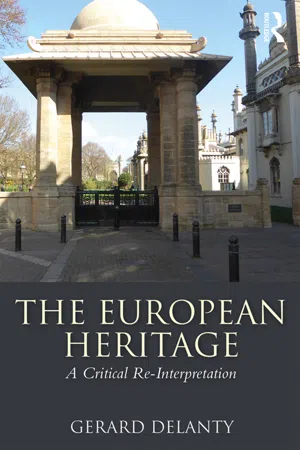
Gerard Delanty offers a critical interpretation of the European heritage today in light of recent developments in the human and social sciences, and in view of a mood of crisis in Europe that compels us to re-think the European past. One of the main insights informing this book is that a transnational and global perspective on European history can reorient the European heritage in a direction that offers a more viable way for contemporary Europe to articulate an intercultural identity in keeping with the emerging shape of Europe, and with its own often acknowledged past. He argues that the European heritage is based less on a universalistic conception of culture than on a plurality of interconnecting narratives. Such a perspective opens up new directions for scholarship and public debate on heritage that are guided by critical cosmopolitan considerations that highlight contention, resistances, competition, and dissonance. He argues that the specificity of the European dimension of culture is in the entanglement of many cultures rather than in an original culture. The cultures of Europe are not separated but have been shaped in close interaction with each other and with the non-European world. Nations are not therefore unique, exceptional, or fundamentally different from each other. The outcome of such intermingling is a multiplicity of ideas of Europe that serve as shared cultural reference points.
- 230 pages
- English
- ePUB (mobile friendly)
- Available on iOS & Android
eBook - ePub
About this book
Information
1
Introduction
The past in the present
Over the past two decades the human and social sciences have witnessed a significant shift towards transnationalism.1 Cultural phenomena are no longer seen as products of national histories but as formed out of transnational encounters and exchange. Consequently they lose their claim to uniqueness and exceptionality. The analysis of national culture and the study of identity more generally has been fundamentally transformed as a result.
The field of transnational and global history has changed how we view the world.2 National histories are now seen in much wider contexts than the traditional narratives that postulated unique paths. However, when it comes to the troubled question of Europe, and how we should view its cultural heritage and the wider legacy of history itself, the implications have not been fully considered. In this book I argue that a transnational approach is essential for an understanding of the European heritage, which should be cast in terms of processes of entanglement whereby different histories and memories become tied up in each other.
I argue that the notion of entanglement is the key mechanism by which the transnational unfolds and that nations are themselves transnationalised. It is the analytical perspective that informs this book. In normative terms, such a transnational approach can be situated in a broader cosmopolitan framework of analysis that discloses a plural notion of European heritages rather than a dominant singular one. By cosmopolitan, I mean the possibility of there being different interpretations of common referents leading to the possibility of reciprocal recognition and mutual understanding. The entanglement of different traditions, histories, and cultures produces common reference points and a space for dialogue.3 Such entanglements also offer spaces for counter-memories and the possibility that societies can learn from such encounters.
Invoking the notion of a European cultural legacy or heritage is beset by many problems, especially in light of the more critical approaches to culture of recent times: on the one side, there has been considerable attention given to the idea of the European heritage in terms of identity, values, and history as carried by nations or something like ‘Western civilisation’, and, on the other side, some of the dominant intellectual trends since the 1970s question if not the very possibility of a European order of values, at least the capacity of culture to provide enduring points of reference for the present. The notion of a common European historical heritage is often either uncritically appealed to as an alternative to nation-centric accounts of history and heritage or, in more critical accounts, it is rejected as irrelevant for the present or something that can only be related to in terms of trauma. What is left is at most a choice of facing up to the ‘dark side’ of the European past or celebrating the diversity of Europe. Yet, there has not been as yet any comprehensive attempt to reconcile the critique of the European heritage with the apparent need for contemporary Europe to articulate its identity and values in relation to the past in a way that is more inclusive of all European traditions. This is a major challenge for research on memory and heritage today not least in light of widespread cultural alienation felt by many minorities. Put differently, a key normative question is whether it is possible to create a conception of heritage for Europe that can maintain a critical and reflective stance towards the past and a positive orientation towards the future.
This challenge, which can be described in more political and ethical terms as a cosmopolitan task, is important since the question of how the present should relate to the past continues to be posed at national and European levels, and very often the answers that are found are based on old-fashioned and discredited notions of history and heritage deriving from group-specific memories. The European heritage has been widely appealed to, but has been inconclusive as regards substantive content (Lähdesmäki 2016). It can refer to something that transcends national cultures; it can refer to values that national cultures have in common; it can even be an aspiration to create a new culture. This opacity resides to a large part on the vagueness of the very notion of heritage, which can be something that is handed down from the past and manifest in largely tangible forms or resides in intangible domains such as values or ways of life.
While questions about the past in the present have long been central to definitions of national identity around memory, mourning, and commemoration, they are now integral to European self-understanding, as in, for example, controversies over disputed legacies of history, the status of the Christian tradition, whether Islam is part of the European heritage, colonialism, the persecution of minorities, contested definitions of persecutors and perpetrators, the traditions of thought that shaped the rise of fascism, notions of peoplehood and ‘European values’, the repatriation of antiquities, the naming of streets and public monuments and so forth. Museums and monuments were once ways in which the national culture was affirmed and reproduced for mass adoration. Today they are sites of exchange, often forums of discussion, and reflect reinterpretations of the past that have arisen as a result of new controversies and more engaged publics.
Underlying all these controversies is the basic question of what narrative of the past should be privileged, who tells the story and what purpose should it serve. In light of the resurgence of nationalism and various kinds of populism, as well as new divisions that capitalism has given rise to, such public discussion is more urgent than ever if the European past is to be a relevant reference for the present day. It is possible that a more explicitly transnational approach to the European heritage might reveal a different and more compelling account of the past that would give substance to the European cultural heritage. I argue that a transnational approach offers a double critical lens through which to view the European heritage: it draws attention to how national histories are interconnected and it shows that such interconnections must be situated in a yet broader and more global context. For this reason, I disagree with the view that the idea of Europe entails the rejection of national culture.
The term transnational is in need of some clarification. As used in this book it signifies a view of nations as shaped by their inter-relations with other nations and are therefore not unique or exceptional. In Chapter 1 I outline the background in historical sociology and comparative global history, which is the tradition that generally informs this study.
My broad aim in this book, then, is to assess reinterpretations and contentious positions on the European heritage today in light of recent developments in the human and social sciences and in view of a mood of crisis in Europe that compels us to re-think the European heritage in ways that might make it more relevant for the present day. One of the main insights informing this book is that a transnational and global perspective of European history can reorient the European heritage in a direction that offers a more viable way for contemporary Europe to articulate an intercultural identity in keeping with the emerging shape of Europe and with its own often acknowledged past. It can thus be proposed that the European heritage is based less on a universalistic conception of culture than on a plurality of interconnecting narratives and the inclusion of new voices, such as those of post-migration communities, and is being forged in new spaces of critical dialogue. This suggests less a universalistic conception of heritage than a dialogic or cosmopolitan one wherein the various voices can speak to each other and thus admit the possibility of a process of learning taking place. Such a perspective might open up new directions for scholarship and public debate on heritage that are guided by critical cosmopolitan considerations that highlight contention, resistances, competition, and dissonance.
Memory, history, and heritage
To make a very great generalisation: national memories have been traditionally seen in terms of forgetting. As Ernst Renan argued in a classic essay in 1882, the nation is based on the forgetting of history, especially where the nation was born out of violence.4 Oblivion was the necessary condition to begin anew especially in the aftermath of civil war. National identities were forged on the basis of a selective memory of the past enabling then to be imagined and often in ways that were fabrications and contrary to the facts of history. History and memory were thus in tension. But oblivion cannot last forever, for there comes a time when the next generation will want to call the old one to account. There has been a shift today in the direction less of forgetting than remembering that which has been forgotten. The desire to create new unitary memories is less prevalent and amnesia is no longer a source of strength. Such acts of commemoration, which are related to the problem of violence, are also of course characterised by imagining and can be fabricated. While this shift is taking place on the level of national identities, it can be seen as particularly pertinent to the wider European cultural heritage. It raises the central question whether the European heritage should be seen in terms of remembering that which has been forgotten or whether it should be seen as the expression of a new kind of memory that might reconcile memory with history. New kinds of remembrance, more receptive to critique, may be more in tune with the critical function of history.
A relevant example here is the controversy in 2016 around demands for the removal of the statue of one of the symbols of British colonialism in Africa, Cecil Rhodes, at Oriel College, Oxford University (see Figure 1.1). Here the question is how the memory of colonialism is handled, whether it is to be wilfully forgotten and rendered invisible through removal and renaming as symbolic acts or remembered in ways that challenge the physical presence of an older memory that has now been reinterpreted. The cultural politics of memory around symbols of colonialism is also an illustration of the impact of the global movement, ‘Rhodes Must Fall’, that began at the University of Cape Town in 2015 and had world-wide impact on cultural heritage, since so much of heritage is under the shadow of colonialism.
The dark shadow of the past is everywhere present in Europe and is part of the present. There is a paradox to this as David Lowenthal has commented in a classic work in 1988, ‘the past is a foreign country’ but it is everywhere present. It is a creation of the present and serves the present and exists only in ways defined by the present. Modernity itself was to be the overcoming of the past in the name of a new present. But it did not eradicate the past, which was put to use in the modern age to fulfil the needs of the present. By separating the present from the past, the present could redefine itself as different, but to do that it had to redefine the past. The past is the basis of identity, for without a past there is no present. The modern age saw the rise of numerous attempts to shape present time – whether in nation-state building, political movements of all kinds, radical experiments in the design of societies and collectives – which all required an account of their origin and trajectory. One of the first creations of the revolutionary government in France after 1793 was the construction of a new calendar, the French Revolutionary Calendar. Remembering the past is essential for a sense of identity. This is because memory is a way in which order is established and a means for the self to distinguish itself from that which it is not. The past also serves the present with a means of validation. Political orders, artistic movements, social movements have always appealed to history for legitimacy, very often a very distant history. The past valorises the present and gives to the present a sense of superiority over the very past to which it appeals. It is perhaps because of the permanent revolution of the modern age that the past came to be such an integral part of Europe. The paradox of the modern age in Europe is that it is obsessed with memory, including the memory of modernity and has created a new tradition, the tradition of the modern (see Matsuda 1996, see also Terdman 1993). The roots of this relation to the past may lie in Christianity.

Figure 1.1 Cecil Rhodes statue at Oriel College, Oxford University
Photo: Alyson Claffey
Le Goff has commented that Judeo-Christianity was a religion of remembrance that gave a special place to the past through the commemorative liturgy and the commemoration of the saints. Remembrance played an important role in the monastic orders that laid the foundations of Europe in creating new modes of knowledge, including historiography, through separating written from oral memory.5 As a civilisation based on writing and the commemoration of the saints, Europe could not escape the past. Such memories were inscribed in the names of places and in the names of people. But Christianity also made possible the sense of distance from the past and the overcoming, in this case, of the pagan culture of antiquity. This was repeated by the Renaissance culture of humanism which also was formed on the recognition of the passage of a vast gulf of time from antiquity, which was to be revived but in ways that were to serve the needs of the present.
One of the challenges for heritage today is to allow the past to speak. For this to be possible, the present will need to re-examine itself. Pierre Nora in Realms of Memory believes that this is not possible, since history has silenced memory, which is now confined to the nostalgic ‘lieux de mémoire’, or ‘sites of memory’ as effectively dead remnants of cultural heritage: ‘Memory is constantly on our lips because it no longer exists.’6 Modernity has brought about an acceleration of history that makes more or less impossible a ‘milieux de mémoire’ in the sense of collective memories that are part of everyday life and give life to the nation. The argument of this book in contrast is that it is possible to pursue ways of thinking about heritage as a form of memory that is informed by history without being silenced by history. History may entail an acceleration of time, but it is also about the intersection of temporalities and their spatial realities. Nora wrote about the decline of the unitary national memory of the nation, but he did not consider that the national m...
Table of contents
- Cover
- Title
- Copyright
- Dedication
- Contents
- List of illustrations
- Preface and acknowledgements
- 1 Introduction: the past in the present
- Part I Making sense of a transnational world
- Part II Encounters, routes, transfers, and entanglements
- Part III Looking to the future
- Select bibliography
- Index
Trusted by 375,005 students
Access to over 1.5 million titles for a fair monthly price.
Study more efficiently using our study tools.
Frequently asked questions
Yes, you can cancel anytime from the Subscription tab in your account settings on the Perlego website. Your subscription will stay active until the end of your current billing period. Learn how to cancel your subscription
No, books cannot be downloaded as external files, such as PDFs, for use outside of Perlego. However, you can download books within the Perlego app for offline reading on mobile or tablet. Learn how to download books offline
Perlego offers two plans: Essential and Complete
- Essential is ideal for learners and professionals who enjoy exploring a wide range of subjects. Access the Essential Library with 800,000+ trusted titles and best-sellers across business, personal growth, and the humanities. Includes unlimited reading time and Standard Read Aloud voice.
- Complete: Perfect for advanced learners and researchers needing full, unrestricted access. Unlock 1.5M+ books across hundreds of subjects, including academic and specialized titles. The Complete Plan also includes advanced features like Premium Read Aloud and Research Assistant.
We are an online textbook subscription service, where you can get access to an entire online library for less than the price of a single book per month. With over 1.5 million books across 990+ topics, we’ve got you covered! Learn about our mission
Look out for the read-aloud symbol on your next book to see if you can listen to it. The read-aloud tool reads text aloud for you, highlighting the text as it is being read. You can pause it, speed it up and slow it down. Learn more about Read Aloud
Yes! You can use the Perlego app on both iOS and Android devices to read anytime, anywhere — even offline. Perfect for commutes or when you’re on the go.
Please note we cannot support devices running on iOS 13 and Android 7 or earlier. Learn more about using the app
Please note we cannot support devices running on iOS 13 and Android 7 or earlier. Learn more about using the app
Yes, you can access The European Heritage by Gerard Delanty in PDF and/or ePUB format, as well as other popular books in Psychology & Ethnic Studies. We have over 1.5 million books available in our catalogue for you to explore.