- 320 pages
- English
- ePUB (mobile friendly)
- Available on iOS & Android
eBook - ePub
In Search of Hospitality
About this book
'In Search of Hospitality' is a unique contribution to the study of hospitality, exploring the practice of hospitality across disciplines, and adopting an international perspective where appropriate.
'In Search of Hospitality':
*brings together an extraordinary collection of leading researches and writers in hospitality, sociology, philosophy and social history, providing a truly global perspective on hospitality
* focuses the study of hospitality across the range of human, social and economic settings
* provides a reference point for the future development of hospitality as an academic discipline.
This text is ideal for students and academics in both the applied fields of hospitality and tourism studies, and general academic fields in business studies and behavioral sciences. For practitioners in hospitality, leisure and tourism businesses the text provides a provocative and informative guide to understanding and providing hospitality in commercial contexts.
CHAPTER 1
Towards a theoretical understanding
Key themes
- Background to the book
- Hospitality in the social domain
- Hospitality in the private domain
- Hospitality in the commercial domain
For a couple of decades now, both higher education providers and industrial organizations in English speaking countries have used ‘hospitality’ to describe a cluster of service sector activities associated with the provision of food, drink and accommodation. Reflecting changes in the industrial descriptor used by practitioners, both academic and industry journals have adopted the notion that hospitality was a term which better described activities which had previously been known as hotel and catering. The academic community have increasingly used ‘hospitality’ in degree course titles, and in several countries, educators describe their professional association using this term. Without wishing to explore the emergence of hospitality and its appeal to both practitioners and academics, it does open up potential avenues for exploration and research about hospitality which hotel and catering discourages. That said, the current research agenda and curriculum could still be described as hotel and catering under a new name. It is the contention of this chapter that the topic of hospitality is worthy of serious study and could potentially better inform both industrial practice and academic endeavour.
In the UK, several senior academics from universities across the country have been considering the meaning of hospitality as an academic discipline. This chapter attempts to co-ordinate and expand the themes which have been emerging from our discussions and papers written by various colleagues keen to build a theoretical framework for the study of ‘hospitality’ and hospitality management. There have been a number of attempts to define hospitality in the past, for example the work of Burgess (1982) explores some of the social psychology of mutuality and reciprocity associated with hospitality. Cassee (1984) suggests that the study of hospitality needs to be both multi-disciplinary and informed by an array of social sciences. More recently, the work of Heal (1990) examines issues associated with hospitality in early modern England. A number of writers not immersed in hospitality education have written other texts within the discipline of anthropology, sociology (Mennell et al., 1992), philosophy (Telfer, 1996) and culture (Visser, 1991), though none have brought these contributions together into one unifying schema.
This chapter aims to distil some of the arguments and debates which have emerged amongst UK academics, and draw together other writings from the wider social sciences. It suggests a number of lines of enquiry for future research and indicates a range of perspectives that may further develop the discipline. Fundamentally, the industrial provision and management of hospitality services can be better focused when informed by a broad understanding of hospitality and acts of hospitableness. At root, studies need to establish a breadth of definition which allows analysis of hospitality activities in the ‘social’, ‘private’, and ‘commercial’ domains.
Background to the book
Several recent definitions of hospitality activities are interesting because they confirm the current preoccupation with commercial provision. The hospitality industry's umbrella organization, The Joint Hospitality Industry Congress, for example, defines hospitality in its 1996 report as ‘The provision of food andjor drink and/or accommodation away from home’ (p.13). Similarly the Higher Education Funding Council – England's Hospitality Review Panel – defined hospitality as ‘The provision of food and/or drink and/or accommodation in a service context’. Even the Nottingham group (see Introduction) started with a definition which stated that ‘Hospitality is a contemporaneous exchange designed to enhance mutuality (well being) for the parties involved through the provision of food andjor drink, andjor accommodation’. All these definitions are located in what academics have traditionally perceived of, researched, and taught about hospitality. It is a definition largely determined by hospitality as an economic activity – sets of consumers and suppliers, market niches, and occupations.
These definitions also, to varying degrees, reflect the origins of the academic study of hospitality as it is currently researched in universities and colleges. The HEFCE's (1998) Review of Hospitality Management was set up to explore the distinctiveness of the subject, and particularly the funding needs of programmes in this academic subject. At the time of the study, there were two somewhat contradictory strands of concern about the hospitality management provision in higher education. In some universities academics felt that hospitality management was not a suitable academic subject, it was ‘just cooking’ or ‘learning how to boil an egg’. Other critics were not convinced that the subject was different from business studies and therefore required only the same levels of funding as straight management programmes. The HEFCE's report described hospitality management as ‘… a small but distinctive part of higher education provision which serves a large, rapidly growing and increasingly diverse industry’ (Chairman's Summary).
The links between research activities by academics and the curriculum in hospitality management programmes, and the ‘hospitality industry’ is an important feature of the antecedents of the subject. Originally most managers within hotel, restaurant and catering businesses were developed through experiential learning at work, and practical experience was highly valued in manager training. The first degree courses started in the late 1960s and reflected the wishes of many in the industry to combine a thorough appreciation of the industry's practical skills together with a suitable grasp of an array of management disciplines. In Chapter 15, Airey and Tribe's provide a detailed account of the origins of hospitality management programmes and the curriculum of programmes in the subject as these have been devised thus far.
As a result of the debates flowing from the Nottingham meeting (see Introduction), chapters provided by contributors from within and external to the hospitality management educational community have encouraged the consideration of hospitality in the wider social, anthropological and philosophical contexts. Thus hospitality can be conceived as a set of behaviours which originate with the very foundations of society. Sharing and exchanging the fruits of labour, together with mutuality and reciprocity, associated originally with hunting and gathering food, are at the heart of collective organization and communality. Whilst later developments may have been concerned with fear of and need to contain strangers, hospitality primarily involves mutuality and exchange, and thereby feelings of altruism and beneficence.
Fundamentally there is a need for a breadth of definition which allows analysis of hospitality activities in ‘social’, ‘private’, and ‘commercial’ domains. Put simply each domain represents an aspect of hospitality provision which is both independent and
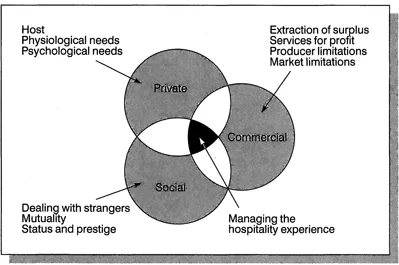
Figure 1.1 Hospitality activities.
overlapping. The social domain of hospitality considers the social settings in which hospitality and acts of hospitableness take place together with the impacts of social forces on the production and consumption of food/drink/and accommodation. The private domain considers the range of issues associated with both the provision of the ‘trinity’ in the home as well as considering the impact of host and guest relationships. The commercial domain concerns the provision of hospitality as an economic activity and includes both private and public sector activities.
Figure 1.1 attempts to show these relationships in visual form. This Venn diagram is perhaps somewhat crude, and may ultimately prove to be an early stage attempt to map these settings and the potential domains of the subject. The following discussion expands on the diagram and hopes to build an agenda through which the boundaries of hospitality can be extended.
Hospitality in the social domain
The social domain of hospitality activities suggests the need to study the social context in which particular hospitality activities take place. Writing about hospitality in early modern England, Heal (1990) makes an important general point, ‘Whilst hospitality was often expressed in a series of private actions and a particular host, it was articulated in a matrix of beliefs that were shared and articulated publicly’ (p.2). With the exceptions mentioned earlier (Burgess, 1983; Cassee, 1984) few hospitality academics have, until this text, considered hospitality and hospitableness from historical, cultural or anthropological perspectives. Again, consideration of hospitality and the value placed on being hospitable to strangers varies through time and between societies. Thus current perspectives and definitions of hospitality represent but one of a range of possibilities. This section aims to provide a flavour of some of the issues which might add theoretical perspectives to the study of hospitality and provision of food, and drink and accommodation.
Current notions about hospitality are a relatively recent development. In pre-industrial societies hospitality occupies a much more central position in the value system. In the UK and other Western societies, ‘… hospitality is preponderantly a private form of behaviour, exercised as a matter of personal preference within a limited circle of friendship and connection’ (Heal, 1990, p.l). In contemporary pre-industrial societies, and earlier historical periods in developed Western societies, hospitality and the duty to entertain both neighbours and strangers represents more of a moral imperative. Frequently the duty to provide hospitality, act with generosity as a host and to protect visitors was more than a matter left to the preferences of individuals. Beliefs about hospitality and obligations to others were located in views and visions about the nature of society and the natural order of things. Thus any failure to act appropriately was treated with social condemnation. The centrality of hospitality activities have been noted in a wide range of studies of Homeric Greece, early Rome, medieval Provence, the Maori, Indian tribes of Canada, early modern England and Mediterranean societies (Heal, 1990). Selwyn (Chapter 2, this volume) notes that even in ‘hunting and gathering communities’ there are rituals and values associated with receiving strangers in to the band, reflecting ‘a slight but significant act of hospitality signifying the acceptance by the band of a new member’.
One rich strand in the study of hospitality relates to the treatment of strangers. Beardsworth and Keil (1997) state, ‘In all the social anthropological and historical accounts of traditional societies there is strong emphasis on the importance of hospitality. Such hospitality would extend to travellers (many societies had particularly strong culturally defined obligations to welcome strangers)’ (p.101). Certainly anyone who has been the recipient of the lavish hospitality extended by people off the main tourist trails in southern European countries can testify to the genuine and universally shared cultural commitment to being hospitable to strangers. Heal (1990) states that there is a link between these societies' strong belief in the integrity of the household and the honour given to alien visitors as a way of expressing that belief.
The duty to not only be charitable to strangers but offer them protection is also an important feature of this strand of hospitality. In many cases this was seen as a sacred duty of the host to protect not only immediate family but also guests. In Bedouin communities, these duties were taken to include all threats to the guest, and this was extended to include relationships afterwards. People who had eaten salt together would not fight each other (Visser, 1991).
Heal (1990) also points to the significance of hospitality and particularly the treatment of travellers as an important value in early modern England. She reminds us of the status accorded to Julian the Hospitaller whose name was frequently invoked as an exemplar. Particularly, ‘His qualities of charitable giving and selfless openness to the needs of other, were those constantly commended in late medieval and early modern England whenever hospitality was discussed’ (1990, p.vii). Certainly contemporary audiences to Shakespeare's play would have recognized a dimension to Macbeth's regicide which would have made the crime more heinous, perhaps lost on modern audiences. That is, Duncan is killed whilst a guest in Macbeth's house. Thus the villain is guilty of not only failing to protect his guest but actually doing him harm. The idea that the host has a solemn duty to protect the guest is well established in many myths and legends. Telfer reminds us of Wagner's opera The Valkyrie in which Hunding the jealous husband cannot kill Siegmund whilst the latter is a guest in his house. Siegmund must leave the house before Hunding can pursue him (Telfer, 1996).
The expression of hospitality in early modern England (1400–1700) had much in common with classical Rome. A powerful ideology of generosity was formulated in an ius hospitii but which was based on practical benefits. It assisted in the integration of strangers and through the inclusion of guests-friends formed a necessary part of the system of clientage. In both Rome and early modern England, ‘good entertainment provided a necessary part of the everyday behaviour of leading citizens’ (Heal, 1990, p.2). Even today in contemporary Turkey, many traditional families still lay an extra place at table, ‘in case Allah sends us a stranger’.
Heal highlights a number of roles which hospitality played at the time. Apart from values relating to the treatment of strangers and travellers, hospitality played an important part in the local political economy. The redistributing food and drink to neighbours and to the poor helped to build social cohesion. Feasts played an important part in ensuring that mutuality and social obligation were met in medieval England, and the ‘open door’ was given high social value. Hospitality assisted in maintaining power relationships based on elite families; by feeding neighbours, tenants and the poor, the feudal lords were able to expect a mutual obligation from the recipient. Chapter 2 in this volume explores in more detail, the significance that hospitality plays, specifically the sharing and giving of food, in reproducing and reinforcing social relationships between status groups in society.
With one notable exception (Wood, 1995) hospitality academics have not engaged with sociological and cultural dimensions of human food and drink systems, nor with the role which the consumption of food and drink plays in communicating the consumer's position in the social world (Corrigan, 1997). Apart from the general cultural expectations about hospitality made above, Telfer (1996) states that’… food is of central importance in hospitality’ (p.83). First, related to the general duty to protect travellers, the needy and the unprotected, food is an essential part of what they need. Second, the giving and receiving of food is of a symbolic significance that hints at a bond of trust and closeness between host and guest. Apart from meals in domestic settings, the business lunch continues to have a symbolic role. Third, giving food is an act of friendliness. In particular, the added symbolic role of food and the rituals associated with it create an added significance to the occasion. In addition food needs to be a key element in academic study of hospitality because of the significance the avoidance of hunger and celebration of plenty plays in human social and cultural life.
The production and consumption of food and drink, and to a lesser extent accommodation, play a deep seated role in establishing important differences between human beings and the rest of the animal world. The role of food production, distribution and...
Table of contents
- Cover
- Half Title
- Title Page
- Copyright Page
- Table of Contents
- Foreword
- Introduction
- About the authors
- 1 Towards a theoretical understanding
- 2 An anthropology of hospitality
- 3 The philosophy of hospitableness
- 4 The hospitality trades: a social history
- 5 Putting up? Gender, hospitality and performance
- 6 Home and commercialized hospitality
- 7 Mediated meanings of hospitality: television personality food programmes
- 8 Hospitality and hospitality management
- 9 Managing hospitality operations
- 10 Social scientific ways of knowing hospitality
- 11 Humour in commercial hospitality settings
- 12 Consuming hospitality: learning from post-modernism?
- 13 Consuming hospitality on holiday
- 14 Working in the hospitality industry
- 15 Education for hospitality
- Index
Trusted by 375,005 students
Access to over 1.5 million titles for a fair monthly price.
Study more efficiently using our study tools.
Frequently asked questions
Yes, you can cancel anytime from the Subscription tab in your account settings on the Perlego website. Your subscription will stay active until the end of your current billing period. Learn how to cancel your subscription
No, books cannot be downloaded as external files, such as PDFs, for use outside of Perlego. However, you can download books within the Perlego app for offline reading on mobile or tablet. Learn how to download books offline
Perlego offers two plans: Essential and Complete
- Essential is ideal for learners and professionals who enjoy exploring a wide range of subjects. Access the Essential Library with 800,000+ trusted titles and best-sellers across business, personal growth, and the humanities. Includes unlimited reading time and Standard Read Aloud voice.
- Complete: Perfect for advanced learners and researchers needing full, unrestricted access. Unlock 1.5M+ books across hundreds of subjects, including academic and specialized titles. The Complete Plan also includes advanced features like Premium Read Aloud and Research Assistant.
We are an online textbook subscription service, where you can get access to an entire online library for less than the price of a single book per month. With over 1.5 million books across 990+ topics, we’ve got you covered! Learn about our mission
Look out for the read-aloud symbol on your next book to see if you can listen to it. The read-aloud tool reads text aloud for you, highlighting the text as it is being read. You can pause it, speed it up and slow it down. Learn more about Read Aloud
Yes! You can use the Perlego app on both iOS and Android devices to read anytime, anywhere — even offline. Perfect for commutes or when you’re on the go.
Please note we cannot support devices running on iOS 13 and Android 7 or earlier. Learn more about using the app
Please note we cannot support devices running on iOS 13 and Android 7 or earlier. Learn more about using the app
Yes, you can access In Search of Hospitality by Conrad Lashley,Alison Morrison in PDF and/or ePUB format, as well as other popular books in Business & Hospitality, Travel & Tourism Industry. We have over 1.5 million books available in our catalogue for you to explore.