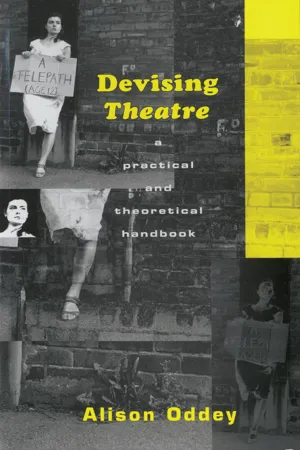
Devising Theatre is a practical handbook that combines a critical analysis of contemporary devised theatre practice with descriptions of selected companies, and suggestions for any group devising theatre from scratch. It is the first book to propose a general theory of devised theatre.
After identifying the unique nature of this type of performance, the author examines how devised theatre is perceived by professional practitioners, and provides an historical overview illustrating how it has evolved since the 1960s. Alison Oddey examines the particular working practices and products of a number of professional companies, including a Reminiscence theatre for the elderly and a theatre-in-education group, and offers ideas and exercises for exploration and experimentation.
- 272 pages
- English
- ePUB (mobile friendly)
- Available on iOS & Android
eBook - ePub
About this book
Information
1
AN INTRODUCTION TO DEVISED THEATRE
Devised theatre can start from anything. It is determined and defined by a group of people who set up an initial framework or structure to explore and experiment with ideas, images, concepts, themes, or specific stimuli that might include music, text, objects, paintings, or movement. A devised theatrical performance originates with the group while making the performance, rather than starting from a play text that someone else has written to be interpreted. A devised theatre product is work that has emerged from and been generated by a group of people working in collaboration.
Devising is a process of making theatre that enables a group of performers to be physically and practically creative in the sharing and shaping of an original product that directly emanates from assembling, editing, and re-shaping individuals' contradictory experiences of the world. There is a freedom of possibilities for all those involved to discover; an emphasis on a way of working that supports intuition, spontaneity, and an accumulation of ideas. The process of devising is about the fragmentary experience of understanding ourselves, our culture, and the world we inhabit. The process reflects a multi-vision made up of each group member's individual perception of that world as received in a series of images, then interpreted and defined as a product. Participants make sense of themselves within their own cultural and social context, investigating, integrating, and transforming their personal experiences, dreams, research, improvisation, and experimentation. Devising is about thinking, conceiving, and forming ideas, being imaginative and spontaneous, as well as planning. It is about inventing, adapting, and creating what you do as a group.
Contemporary British devised theatre practice embraces a broad diversification of professional companies. They include The People Show, Trestle Theatre, Belgrade Theatre-in-Education Company, Red Ladder, and Welfare State International, all of whose artistic, educational, or political intentions initiate, shape, and realise the making of very different kinds of theatre products. Their work includes experimental visual performances integrating various art forms, physical mask theatre, participatory theatre-in-education programmes for primary schoolchildren with severe learning difficulties, shows for young people that encourage the exploration of difficult questions facing them as young adults, and celebratory, community-based large-scale spectacles or site-specific theatrical events. Initially, I chose thirteen professional devising companies for detailed research purposes, whose work interested me for various reasons. (See Appendix I for a brief description of these companies.) There was no scientific approach to selecting them, and I could have easily made an alternative list of companies, equally impressive and worthy of attention.
Companies devising theatre constantly have to address the changes brought about by the socio-political and cultural climate of the time. The preoccupations and changes in attitudes of contemporary society are reflected in the themes, content and form of devised theatre products. A group cannot devise in a vacuum; work originates and progresses within the broadest context of culture and society, the changing world and all its events.
VIRTUE IN ECLECTISM?
What identifies and defines devised theatre as a separate form worthy of consideration is the uniqueness of process and product for every group concerned. The significance of this form of theatre is in the emphasis it places on an eclectic process requiring innovation, invention, imagination, risk, and above all, an overall group commitment to the developing work. However, it is the very nature and eclecticism of the devising experience that makes it impossible to articulate any single theory of how theatre is devised, when every professional company or group works in a unique way with different intentions, interests, and concerns. What makes devising so special is the potential freedom or opportunity to move in a number of different directions through a collaborative work process, developing an original theatre product to be performed. It can produce more creative solutions than other forms of theatre, although this is fundamentally determined by group dynamics and interaction.
Any definition of devised theatre must include process (finding the ways and means to share an artistic journey together), collaboration (working with others), multi-vision (integrating various views, beliefs, life experiences, and attitudes to changing world events), and the creation of an artistic product. Sometimes devised theatre is made for, with, or from a particular audience. However, there are some unclear boundaries within the subject of devised theatre, around which there are many areas of disagreement amongst theatre practitioners. Must devised theatre always be considered as a group activity, for instance, if a solo performer collaborates with another artist but is not part of a company? How do we define a devised play script in terms of authorship and ownership between a writer and company? What is the value and relationship of process to product, and the significance of the process in relation to accessibility and the creation of a performance?
Devised theatre also raises some fascinating questions for other forms of theatre, which are ultimately concerned with areas of content, form, or audience, as well as preliminary aims and objectives. I am intrigued by the differences and similarities in methodologies of devising theatre; how the process of making theatre relates to a particular working practice, ideology, and product; how a company's intentions or objectives influence and determine significant decisions of content, form, and audience; and why the process of devising, or the creation of a unique form of theatre product appeals to such a variety of companies devising theatre in Britain today.
TRADITION
It is important to record the work of devised theatre as evidence of our ever-changing culture and society. The People Show, for instance, is a company that has devised theatre for over twenty-seven years, and witnessed numerous performers proceed into the various traditional roles of conventional theatre. Devised theatre is an alternative to the dominant literary theatre tradition, which is the conventionally accepted form of theatre dominated by the often patriarchal, hierarchical relationship of playwright and director. This dominant tradition revolves around and focuses on the interpretation of the playwright's text by a director, culminating in a performance which is realised through a production process (within a prescribed period of time and means) in a theatre building. British post-war theatre has almost always been text-led, originating with the playwright and emphasising the written word. The written play script has been the starting point and basis of British theatre production. Therefore, the dominant tradition of theatre and criticism has always been about the relationship of writing and performance. Conventional or text-based theatre is a large, diverse category of theatre. When I refer to the dominant form, I am not suggesting a homogenisation of traditional forms of theatre into one, nor am I promoting devised theatre as a form in opposition.
Devised theatre is not always in contradistinction to ‘straight’ theatre. Devised work is a response and a reaction to the playwright-director relationship, to text-based theatre, and to naturalism, and challenges the prevailing ideology of one person's text under another person's direction. Devised theatre is concerned with the collective creation of art (not the single vision of the playwright), and it is here that the emphasis has shifted from the writer to the creative artist. Thus, all too often, a devised performance is perceived as a sub-genre of theatre in the sense that it is not constructed in the established, accepted way of making theatre — from playwright, via director and actors, to performance. In the late 1960s and early 1970s, numerous companies were evolving with the common desire of considering different ways of creating a theatrical performance. This was the birth of new forms or styles of theatre, including the start of the theatre-in-education movement in 1965 with the founding of the first British theatre-in-education team at the Belgrade Theatre, Coventry;1 the beginnings of community theatre, exemplified by Red Ladder Theatre Company, who started in 1968 as a political theatre group — the Agitprop Street Players;2 the development of performance art, as evident in Welfare State International's celebratory, theatrical spectacles originating in 1968;3 and experimental multi-disciplinary visual theatre.4
With changes in attitudes towards sexuality, the existing political and social climate in Britain, and censorship of the stage abolished, it is hardly surprising that theatrical expression found new ways of reflecting political upheaval and discontent. Devised theatre offered the opportunity to groups of artists to try out ideas or notions that were not text-led. It provided the potential for a designer, choreographer, or performer to initiate a concept or starting point for performance. In turn, this encouraged the development of a performance language that included non-verbal forms.
An example
The company claiming to be in at the start is The People Show, a group of artists (not actors) who came together in 1966 to work collaboratively towards devising a visual theatre product in performance. A touring performing group, The People Show offered an alternative to text-based theatre, in terms of providing experimental visual performance rather than productions of new plays and writing. The company's early work experimented with various aspects of both visual and performing arts, combining written words, music, improvisation, and environmental settings. By 1971, their shows had developed a more image-based, visual emphasis, described here by founder member Mark Long as:
Now the shows are not so loose as they were, but they don't depend on word structures, or script structures, or plots. We are working around visual structures. A series of visual images is worked on beforehand and then we embroider these — with our bodies, with our words and with our reactions — to enlarge the images for the audience. In the last year, we've done six entirely different shows, all quite structured visually.5
David Gale, a founder member of Lumiere & Son in 1973, describes The People Show in the 1970s as ‘turning out consistently impressive, surreal, poetic work that derived from the most daring devising process I have ever come across’.6 The People Show's method of working relied on the differences and conflict between individual artists within the group, which changed with every new show's situation, conditions and circumstances. Every show was a unique devising experience, resulting in an original product that changed with every performance. The relationship of process to product was determined by the individual artists' interests and interpretation of ideas, rather than an agreed group vision of a show. A key characteristic of their working method was to place great emphasis on the relationship between actor and audience, which meant that the ‘first night’ was simply the beginning of a show. Long observes:
The presence of the audience is one of the biggest factors in the creative process itself. When an audience sees the show, your feeling and understanding for the show is inevitably altered. The audience reaction offers that feeling or understanding. It's part of the process, as is the performance as much part of the process as the rehearsal.7
The People Show is illustrative of a group of individual artists in collaboration with each other, taking risks, having a sense of the unknown at the start of the devising process, exploring and experimenting with ideas, form, structure, and the nature of visual performance. This company has established a particular approach to making visual theatre that uses lighting, sound, music, and technical resources to discover the possibilities of image and spectacle within the performance space. The exploration and experimentation with technical facilities in the theatre are an important part of the group's work. In a 1982 article, Long comments:
The other thing which I think is very important, which we try to do with all new members of the group, not always very successfully, but which I think is absolutely vital, is that everybody in the group has to have an understanding of lighting, an understanding of building and a definite visual comprehension of costume.8
Since 1966, The People Show has developed a unique visual and aural style of theatre, recruiting members from a multi-disciplinary background with interests in the visual arts, music, and technical theatre. The People Show and its early shows were significant in establishing a unique working process of individual artists in collaboration with each other, using the resources within the group to make, construct, and continually develop a theatre product in performance. This particular process of devising embraces the use of images, a structured environment, the contribution of individual artists' ideas, and a conscious awareness of the interaction with the audience in performance.
In order to examine in later chapters the nature of a devised performance, the actor–spectator relationship, and the desire to create theatre for a particular audience, community, or site-specific location, I intend to identify and establish the specific challenges of the subject of devising theatre by asking what differentiates devised theatre from the dominant literary theatre tradition, and why do people want to devise theatre? I want to suggest the distinguishing characteristics of devised theatre, as well as speculate about some of the reasons why companies or groups evolve to pursue this alternative form of theatre.
BEGINNINGS
What initially identifies devised theatre is that the creative process originates in ways different from traditional theatre. Questions arise about where and how to start making a performance, and what kind of product is to be created. Devised theatre can start from an infinite number of possibilities, such as an idea, image, concept, object, poem, piece of music, or painting, and the precise nature of the end product is unknown. In conventional theatre, however, everyone knows the production is, for example, Shakespeare's Hamlet from the outset. The script dictates the plot or narrative line, the number of characters, the setting, the scene directions, and the length of the piece. In devised theatre, at one end of the spectrum is an open book with only unmarked pages, whilst at the other end is a skeletal outline of the proposed piece to be devised. It may be a large-scale community event with local participants in Bradford, a participatory secondary theatre-in-education programme, a piece of reminiscence theatre for the elderly in south London, or a performance piece exploring the notion of reality, fiction, and contemporary culture.
Devised theatre demands decisions about how and where to begin. This is different from text-based theatre, where the play script defines and determines the parameters of the performance, however abstract the content might be. In chapter two, I look at how and where a group begins to devise theatre, and the kind of stimuli or starting points that may initiate a devised theatrical product, arguing that form, content, or audience (in any number of combinations) determine the devising route to be taken.
Value in democracy?
The way a group or company operates, is organised structurally, identifies roles or responsibilities, and works together differs from traditional theatre. A central reason for the large number of companies devising theatre in the 1970s was the strong desire to work in an artistically democratic way. The ‘collective’ grew out of a socio-political climate that emphasised democracy, so that many groups were interested in breaking down the patriarchal and hierarchical divisions of the traditional theatre company. The growth of collectives in the British alternative theatre since 1970 has been written about in various books, such as Catherine Itzin's Stages in the Revolution or Michelene Wandor's Carry on Understudies, Theatre and Sexual Politics, and Rob Ritchie's The Joint Stock Book9 provides important documentation of one successful model of collective theatre. This book illustrates the various approaches taken to redefining the relationship of writer, director, and actor, and how they differ from the hierarchy of conventional theatre.
The influence of the Women's Liberation Movement and feminism in the 1970s encouraged a change of attitudes, gave women an improved position as theatre workers, and supported the development of experimental theatre to explore the social and sexual attitudes of society. The introduction to Monstrous Regiment, A Collective Celebration, edited by Gillian Hanna,10 provides a useful insight into how this women's collective operated from the mid-1970s, initially as a democratic collective, and later as a more skills-specialised division of roles within the group. Companies founded in the 1970s established different ways of devising theatre, which are illustrated in the diverse examples of Forkbeard Fantasy (1974), Gay Sweatshop (1975), and IOU (who broke away from Welfare State International in 1976 to work as a collective).
In the 1970s devising companies chose artistic democracy in favour of the hierarchical structures of power linked to text-based t...
Table of contents
- Cover
- Half Title
- Title Page
- Copyright Page
- Dedication
- Table of Contents
- List of illustrations
- Preface
- Acknowledgements
- 1 AN INTRODUCTION TO DEVISED THEATRE
- 2 BEGINNINGS: How and where to start
- 3 PROCESS: Ways and means of making theatre
- 4 FROM PROCESS TO PRODUCT: Relationship and practice
- 5 FROM PROCESS TO PRODUCT: The participatory theatre-in-education programme
- 6 SPACE: Site-specific theatre
- 7 THEORY AND PRACTICE
- 8 LEARNING TO DEVISE: Practical ideas and suggestions
- Appendices
- Notes
- Bibliography
- Index
Trusted by 375,005 students
Access to over 1.5 million titles for a fair monthly price.
Study more efficiently using our study tools.
Frequently asked questions
Yes, you can cancel anytime from the Subscription tab in your account settings on the Perlego website. Your subscription will stay active until the end of your current billing period. Learn how to cancel your subscription
No, books cannot be downloaded as external files, such as PDFs, for use outside of Perlego. However, you can download books within the Perlego app for offline reading on mobile or tablet. Learn how to download books offline
We are an online textbook subscription service, where you can get access to an entire online library for less than the price of a single book per month. With over 1.5 million books across 990+ topics, we’ve got you covered! Learn about our mission
Look out for the read-aloud symbol on your next book to see if you can listen to it. The read-aloud tool reads text aloud for you, highlighting the text as it is being read. You can pause it, speed it up and slow it down. Learn more about Read Aloud
Yes! You can use the Perlego app on both iOS and Android devices to read anytime, anywhere — even offline. Perfect for commutes or when you’re on the go.
Please note we cannot support devices running on iOS 13 and Android 7 or earlier. Learn more about using the app
Please note we cannot support devices running on iOS 13 and Android 7 or earlier. Learn more about using the app
Yes, you can access Devising Theatre by Alison Oddey in PDF and/or ePUB format, as well as other popular books in Media & Performing Arts & Theatre. We have over 1.5 million books available in our catalogue for you to explore.