
- 288 pages
- English
- ePUB (mobile friendly)
- Available on iOS & Android
eBook - ePub
Statistical Thermodynamics Of Surfaces, Interfaces, And Membranes
About this book
Understanding the structural and thermodynamic properties of surfaces, interfaces, and membranes is important for both fundamental and practical reasons. Important applications include coatings, dispersants, encapsulating agents, and biological materials. Soft materials, important in the development of new materials and the basis of many biological systems, cannot be designed using trial and error methods due to the multiplicity of components and parameters. While these systems can sometimes be analyzed in terms of microscopic mixtures, it is often conceptually simpler to regard them as dispersions and to focus on the properties of the internal interfaces found in these systems. The basic physics centers on the properties of quasi-two-dimensional systems embedded in the three-dimensional world, thus exhibiting phenomena that do not exist in bulk materials. This approach is the basis behind the theoretical presentation of Statistical Thermodynamics of Surfaces, Interfaces, and Membranes. The approach adapted allows one to treat the rich diversity of phenomena investigated in the field of soft matter physics (including both colloid/interface science as well as the materials and macromolecular aspects of biological physics) such as interfacial tension, the roughening transition, wetting, interactions between surfaces, membrane elasticity, and self-assembly. Presented as a set of lecture notes, this book is aimed at physicists, physical chemists, biological physicists, chemical engineers, and materials scientists who are interested in the statistical mechanics that underlie the macroscopic, thermodynamic properties of surfaces, interfaces, and membranes. This paperback edition contains all the material published in the original hard-cover edition as well as additional clarifications and explanations.
Information
CHAPTER 1
Mixtures and Interfaces
1.1 INTRODUCTION
In this chapter, we begin with some remarks on the technological and scientific importance of complex materials and interfaces and motivate the study of interface and surface properties. We then review some of the physical and mathematical methods that are used in the subsequent discussions of interface and membrane statistical thermodynamics. Many of these topics are discussed more fully in the references and throughout this chapter. We begin with a review of classical statistical mechanics1,2,3,4, including a description of fluctuations about equilibrium and of binary mixtures. The mathematical description5 of an interface is then presented (using only vector calculus) and the calculation of the area and curvature of an interface with an arbitrary shape is demonstrated. Finally, the chapter is concluded by a brief summary of hydrodynamics6.
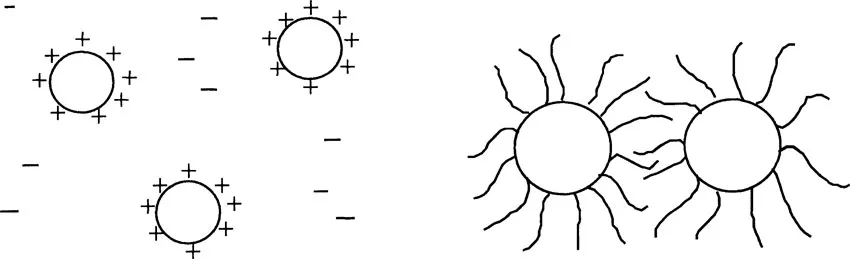
Figure 1.1 Colloidal particles in solution stabilized by electrostatic repulsion due to surface charges (left) or by steric repulsion of grafted long-chain, polymeric molecules (right).
1.2 COMPLEX MATERIALS AND INTERFACES
Complex materials refer to either composite solids or to fluid dispersions where the individual molecular species are organized into structures with long (tens of Angstroms to microns) length scales (compared with atomic or simple molecular dimensions). These materials7,8, which include9,10 solid colloidal dispersions (see Fig. 1.1), polymers11,12, and self-assembled amphiphiles13,14,15 such as micelles, vesicles, and microemulsions are important technologically and as generic models for biological systems. Milk, blood, paint, soaps, and detergents are familiar examples where the properties of dispersion, encapsulation, and cleaning are utilized. While the study of single-component systems such as simple fluids or solids focuses on the behavior of the bulk, serious consideration of the multicomponent nature of complex fluids16 requires an understanding of the interfaces between materials. The unique properties of the dispersion are then often determined by the behavior of the interface. This often leads to considerable simplification in the study and understanding of the system, since instead of analyzing the behavior of a comple...
Table of contents
- Cover
- Half Title
- Title Page
- Copyright Page
- Dedication
- Table of Contents
- Preface
- Chapter 1 Mixtures and Interfaces
- Chapter 2 Interfacial Tension
- Chapter 3 Fluctuations of Interfaces
- Chapter 4 Wetting of Interfaces
- Chapter 5 Interactions of Rigid Interfaces
- Chapter 6 Flexible Interfaces
- Chapter 7 Colloidal Dispersions
- Chapter 8 Self-Assembling Interfaces
- Index
Trusted by 375,005 students
Access to over 1.5 million titles for a fair monthly price.
Study more efficiently using our study tools.
Frequently asked questions
Yes, you can cancel anytime from the Subscription tab in your account settings on the Perlego website. Your subscription will stay active until the end of your current billing period. Learn how to cancel your subscription
No, books cannot be downloaded as external files, such as PDFs, for use outside of Perlego. However, you can download books within the Perlego app for offline reading on mobile or tablet. Learn how to download books offline
Perlego offers two plans: Essential and Complete
- Essential is ideal for learners and professionals who enjoy exploring a wide range of subjects. Access the Essential Library with 800,000+ trusted titles and best-sellers across business, personal growth, and the humanities. Includes unlimited reading time and Standard Read Aloud voice.
- Complete: Perfect for advanced learners and researchers needing full, unrestricted access. Unlock 1.5M+ books across hundreds of subjects, including academic and specialized titles. The Complete Plan also includes advanced features like Premium Read Aloud and Research Assistant.
We are an online textbook subscription service, where you can get access to an entire online library for less than the price of a single book per month. With over 1.5 million books across 990+ topics, we’ve got you covered! Learn about our mission
Look out for the read-aloud symbol on your next book to see if you can listen to it. The read-aloud tool reads text aloud for you, highlighting the text as it is being read. You can pause it, speed it up and slow it down. Learn more about Read Aloud
Yes! You can use the Perlego app on both iOS and Android devices to read anytime, anywhere — even offline. Perfect for commutes or when you’re on the go.
Please note we cannot support devices running on iOS 13 and Android 7 or earlier. Learn more about using the app
Please note we cannot support devices running on iOS 13 and Android 7 or earlier. Learn more about using the app
Yes, you can access Statistical Thermodynamics Of Surfaces, Interfaces, And Membranes by Samuel Safran in PDF and/or ePUB format, as well as other popular books in Physical Sciences & Biophysics. We have over 1.5 million books available in our catalogue for you to explore.