- 594 pages
- English
- ePUB (mobile friendly)
- Available on iOS & Android
eBook - ePub
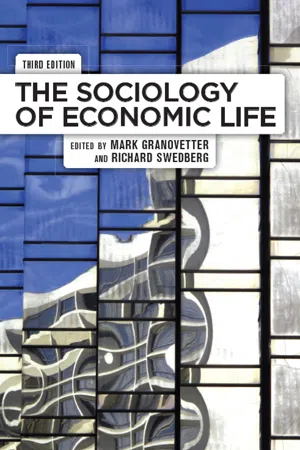
The Sociology of Economic Life
About this book
This book incorporates classic and contemporary readings in economic sociology and related disciplines to provide students with a broad understanding of the many dimensions of economic life. It discusses Max Weber's key concepts in economics and sociology.
Information
PART ONE
Foundations of Economic Sociology
CHAPTER 1
The Economy as Instituted Process
Our main purpose in this chapter is to determine the meaning that can be attached with consistency to the term “economic” in all the social sciences.
The simple recognition from which all such attempts must start is the fact that in referring to human activities the term economic is a compound of two meanings that have independent roots. We will call them the substantive and the formal meaning.
The substantive meaning of economic derives from man’s dependence for his living upon nature and his fellows. It refers to the interchange with his natural and social environment, in so far as this results in supplying him with the means of material want satisfaction.
The formal meaning of economic derives from the logical character of the means-ends relationship, as apparent in such words as “economical” or “economizing.” It refers to a definite situation of choice, namely, that between the different uses of means induced by an insufficiency of those means. If we call the rules governing choice of means the logic of rational action, then we may denote this variant of logic, with an improvised term, as formal economics.
The two root meanings of “economic,” the substantive and the formal, have nothing in common. The latter derives from logic, the former from fact. The formal meaning implies a set of rules referring to choice between the alternative uses of insufficient means. The substantive meaning implies neither choice nor insufficiency of means; man’s livelihood may or may not involve the necessity of choice and, if choice there be, it need not be induced by the limiting effect of a “scarcity” of the means; indeed, some of the most important physical and social conditions of livelihood such as the availability of air and water or a loving mother’s devotion to her infant are not, as a rule, so limiting. The cogency that is in play in the one case and in the other differs as the power of syllogism differs from the force of gravitation. The laws of the one are those of the mind; the laws of the other are those of nature. The two meanings could not be further apart; semantically they lie in opposite directions of the compass.
It is our proposition that only the substantive meaning of “economic” is capable of yielding the concepts that are required by the social sciences for an investigation of all the empirical economies of the past and pres ent. The general frame of reference that we endeavor to construct requires, therefore, treatment of the subject matter in substantive terms. The immediate obstacle in our path lies, as indicated in that concept of “economic” in which the two meanings, the substantive and the formal, are naively compounded. Such a merger of meanings is, of course, unexceptionable as long as we remain conscious of its restrictive effects. But the current concept of economic fuses the “subsistence” and the “scarcity” meanings of economic without a sufficient awareness of the dangers to clear thinking inherent in that merger.
This combination of terms sprang from logically adventitious circumstances. The last two centuries produced in Western Europe and North America an organization of man’s livelihood to which the rules of choice happened to be singularly applicable. This form of the economy consisted in a system of price-making markets. Since acts of exchange, as practiced under such a system, involve the participants in choices induced by an insufficiency of means, the system could be reduced to a pattern that lent itself to the application of methods based on the formal meaning of “economic.” As long as the economy was controlled by such a system, the formal and the substantive meanings would in practice coincide. Laymen accepted this compound concept as a matter of course; a Marshall, Pareto or Durkheim equally adhered to it. Menger alone in his posthumous work criticized the term, but neither he nor Max Weber, nor Talcott Parsons after him, apprehended the significance of the distinction for sociological analysis. Indeed, there seemed to be no valid reason for distinguishing between two root meanings of a term which, as we said, were bound to coincide in practice.
While it would have been therefore sheer pedantry to differentiate in common parlance between the two meanings of “economic,” their merging in one concept nevertheless proved a bane to a precise methodology in the social sciences. Economics naturally formed an exception, since under the market system its terms were bound to be fairly realistic. But the anthropologist, the sociologist or the historian, each in his study of the place occupied by the economy in human society, was faced with a great variety of institutions other than markets, in which man’s livelihood was embedded. Its problems could not be attacked with the help of an analytical method devised for a special form of the economy, which was dependent upon the presence of specific market elements.1
This lays down the rough sequence of the argument.
We will begin with a closer examination of the concepts derived from the two meanings of “economic,” starting with the formal and thence proceeding to the substantive meaning. It should then prove possible to describe the empirical economies—whether primitive or archaic—according to the manner in which the economic process is instituted. The three institutions of trade, money and market will provide a test case. They have previously been defined in formal terms only; thus any other than a marketing approach was barred. Their treatment in substantive terms should then bring us nearer to the desired universal frame of reference.
THE FORMAL AND THE SUBSTANTIVE MEANINGS OF “ECONOMIC”
Let us examine the formal concepts starting from the manner in which the logic of rational action produces formal economics, and the latter, in turn, gives rise to economic analysis.
Rational action is here defined as choice of means in relation to ends. Means are anything appropriate to serve the end, whether by virtue of the laws of nature or by virtue of the laws of the game. Thus “rational” does not refer either to ends or to means, but rather to the relating of means to ends. It is not assumed, for instance, that it is more rational to wish to live than to wish to die, or that, in the first case, it is more rational to seek a long life through the means of science than through those of superstition. For whatever the end, it is rational to choose one’s means accordingly; and as to the means, it would not be rational to act upon any other test than that which one happens to believe in. Thus it is rational for the suicide to select means that will accomplish his death; and if he be an adept of black magic, to pay a witch doctor to contrive that end.
The logic of rational action applies, then, to all conceivable means and ends covering an almost infinite variety of human interests. In chess or technology, in religious life or philosophy ends may range from commonplace issues to the most recondite and complex ones. Similarly, in the field of the economy, where ends may range from the momentary assuaging of thirst to the attaining of a sturdy old age, while the corresponding means comprise a glass of water and a combined reliance on filial solicitude and open air life, respectively.
Assuming that the choice is induced by an insufficiency of the means, the logic of rational action turns into that variant of the theory of choice which we have called formal economics. It is still logically unrelated to the concept of the human economy, but it is closer to it by one step. Formal economics refers, as we said, to a situation of choice that arises out of an insufficiency of means. This is the so-called scarcity postulate. It requires, first, insufficiency of means; second, that choice be induced by that insufficiency. Insufficiency of means in relation to ends is determined with the help of the simple operation of “earmarking,” which demonstrates whether there is or is not enough to go round. For the insufficiency to induce choice there must be given more than one use to the means, as well as graded ends, i.e., at least two ends ordered in sequence of preference. Both conditions are factual. It is irrelevant whether the reason for which means can be used in one way only happens to be conventional or technological; the same is true of the grading of ends.
Having thus defined choice, insufficiency and scarcity in operational terms, it is easy to see that as there is choice of means without insufficiency, so there is insufficiency of means without choice. Choice may be induced by a preference for right against wrong (moral choice) or, at a crossroads, where two or more paths happen to lead to our destination, possessing identical advantages and disadvantages (operationally induced choice). In either case an abundance of means, far from diminishing the difficulties of choice, would rather increase them. Of course, scarcity may or may not be pres ent in almost all fields of rational action. Not all philosophy is sheer imaginative creativity, it may also be a matter of economizing with assumptions. Or, to get back to the sphere of man’s livelihood, in some civilizations scarcity situations seem to be almost exceptional, in others they appear to be painfully general. In either case the presence or absence of scarcity is a question of fact, whether the insufficiency is due to Nature or to Law.
Last but not least, economic analysis. This discipline results from the application of formal economics to an economy of a definite type, namely, a market system. The economy is here embodied in institutions that cause individual choices to give rise to interdependent movements that constitute the economic process. This is achieved by generalizing the use of price-making markets. All goods and services, including the use of labor, land and capital are available for purchase in markets and have, therefore, a price; all forms of income derive from the sale of goods and services—wages, rent and interest, respectively, appearing only as different instances of price according to the items sold. The general introduction of purchasing power as the means of acquisition converts the process of meeting requirements into an allocation of insufficient means with alternative uses, namely, money. It follows that both the conditions of choice and its consequences are quantifiable in the form of prices. It can be asserted that by concentrating on price as the economic fact par excellence, the formal method of approach offers a total description of the economy as determined by choices induced by an insufficiency of means. The conceptual tools by which this is performed make up the discipline of economic analysis.
From this follow the limits within which economic analysis can prove effective as a method. The use of the formal meaning denotes the economy as a sequence of acts of economizing, i.e., of choices induced by scarcity situations. While the rules governing such acts are universal, the extent to which the rules are applicable to a definite economy depends upon whether or not that economy is, in actual fact, a sequence of such acts. To produce quantitative results, the locational and appropriational movements, of which the economic process consists, must here present themselves as functions of social actions in regard to insufficient means and oriented on resulting prices. Such a situation obtains only under a market system.
The relation between formal economics and the human economy is, in effect, contingent. Outside of a system of price-making markets economic analysis loses most of its relevance as a method of inquiry into the working of the economy. A centrally planned economy, relying on nonmarket prices is a well-known instance.
The fount of the substantive concept is the empirical economy. It can be briefly (if not engagingly) defined as an instituted process of interaction between man and his environment, which results in a continuous supply of want satisfying material means. Want satisfaction is “material,” if it involves the use of material means to satisfy ends; in the case of a definite type of physiological wants, such as food or shelter, this includes the use of so-called services only.
The economy, then, is an instituted process. Two concepts stand out, that of “process” and its “institutedness.” Let us see what they contribute to our frame of reference.
Process suggests analysis in terms of motion. The movements refer either to changes in location, or in appropriation, or both. In other words, the material elements may alter their position either by changing place or by changing “hands”; again, these otherwise very different shifts of position may go together or not. Between them, these two kinds of movements may be said to exhaust the possibilities comprised in the economic process as a natural and social phenomenon.
Locational movements include production, alongside of transportation, to which the spatial shifting of objects is equally essential. Goods are of a lower order or of a higher order, according to the manner of their usefulness from the consumer’s point of view. This famous “order of goods” sets consumer’s goods against producer’s goods, according to whether they satisfy wants directly, or only indirectly, through a combination with other goods. This type of movement of the elements represents an essential of the economy in the substantive sense of the term, namely, production.
The appropriative movement governs both what is usually referred to as the circulation of goods and their administration. In the first case, the appropriative movement results from transactions, in the second case, from dispositions. Accordingly, a transaction is an appropriative movement as between hands; a disposition is a one-sided act of the hand, to which by force of custom or of law definite appropriative effects are attached. The term “hand” here serves to denote public bodies and offices as well as private persons or firms, the difference between them being mainly a matter of internal organization. It should be noted, however, that in the nineteenth century private hands were commonly associated with transactions, while public hands were usually credited with dispositions.
In this choice of terms a number of further definitions are implied. Social activities, insofar as they form part of the process, may be called economic; institutions are so called to the extent to which they contain a concentration of such activities; any components of the process may be regarded as economic elements. These elements can be conveniently grouped as ecological, technological or societal according to whether they belong primarily to the natural environment, the mechanical equipment or the human setting. Thus a series of concepts, old and new, accrue to our frame of reference by virtue of the process aspect of the economy.
Nevertheless, reduced to a mechanical, biological and psychological interaction of elements that economic process would possess no all-round reality. It contains no more than the bare bones of the processes of production and transportation, as well as of the appropriative changes. In the absence of any indication of societal conditions from which the motives of the individuals spring, there would be little, if anything, to sustain the interdependence of the movements and their recurrence on which the unity and the stability of the process depends. The interacting elements of nature and humanity would form no coherent unit, in effect, no structural entity that could be said to have a function in society or to possess a history. The process would lack the very qualities which cause everyday thought as well as scholarship to turn toward matters of human livelihood as a field of eminent practical interest as well as theoretical and moral dignity.
Hence the transcending importance of the institutional aspect of the economy. What occurs on the process level between man and soil in hoeing a plot or what on the conveyor belt in the constructing of an automobile is, prima facie a mere jig-sawing of human and non-human movements. From the institutional point of view it is a mere referent of terms like labor and capital, craft and union, slacking and speeding, the spreading of risks and the other semantic units of the social context. The choice between capitalism and socialism, for instance, r...
Table of contents
- Cover
- Half Title
- Title Page
- Copyright Page
- Table of Contents
- List of Figures, Tables, and Charts
- Introduction to the Third Edition
- PART ONE: Foundations of Economic Sociology
- PART TWO: The Sociology of Markets
- PART THREE: The Sociology of Firms and Industries
- PART FOUR: Comparative and Historical Economic Sociology
- Index
Trusted by 375,005 students
Access to over 1.5 million titles for a fair monthly price.
Study more efficiently using our study tools.
Frequently asked questions
Yes, you can cancel anytime from the Subscription tab in your account settings on the Perlego website. Your subscription will stay active until the end of your current billing period. Learn how to cancel your subscription
No, books cannot be downloaded as external files, such as PDFs, for use outside of Perlego. However, you can download books within the Perlego app for offline reading on mobile or tablet. Learn how to download books offline
Perlego offers two plans: Essential and Complete
- Essential is ideal for learners and professionals who enjoy exploring a wide range of subjects. Access the Essential Library with 800,000+ trusted titles and best-sellers across business, personal growth, and the humanities. Includes unlimited reading time and Standard Read Aloud voice.
- Complete: Perfect for advanced learners and researchers needing full, unrestricted access. Unlock 1.5M+ books across hundreds of subjects, including academic and specialized titles. The Complete Plan also includes advanced features like Premium Read Aloud and Research Assistant.
We are an online textbook subscription service, where you can get access to an entire online library for less than the price of a single book per month. With over 1.5 million books across 990+ topics, we’ve got you covered! Learn about our mission
Look out for the read-aloud symbol on your next book to see if you can listen to it. The read-aloud tool reads text aloud for you, highlighting the text as it is being read. You can pause it, speed it up and slow it down. Learn more about Read Aloud
Yes! You can use the Perlego app on both iOS and Android devices to read anytime, anywhere — even offline. Perfect for commutes or when you’re on the go.
Please note we cannot support devices running on iOS 13 and Android 7 or earlier. Learn more about using the app
Please note we cannot support devices running on iOS 13 and Android 7 or earlier. Learn more about using the app
Yes, you can access The Sociology of Economic Life by Mark Granovetter,Richard Swedberg in PDF and/or ePUB format, as well as other popular books in Social Sciences & Social Theory. We have over 1.5 million books available in our catalogue for you to explore.