Revealing the human side of economic life
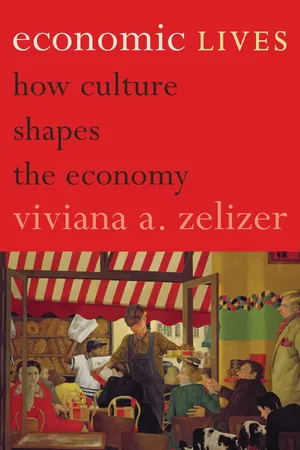
Over the past three decades, economic sociology has been revealing how culture shapes economic life even while economic facts affect social relationships. This work has transformed the field into a flourishing and increasingly influential discipline. No one has played a greater role in this development than Viviana Zelizer, one of the world's leading sociologists. Economic Lives synthesizes and extends her most important work to date, demonstrating the full breadth and range of her field-defining contributions in a single volume for the first time.
Economic Lives shows how shared cultural understandings and interpersonal relations shape everyday economic activities. Far from being simple responses to narrow individual incentives and preferences, economic actions emerge, persist, and are transformed by our relations to others. Distilling three decades of research, the book offers a distinctive vision of economic activity that brings out the hidden meanings and social actions behind the supposedly impersonal worlds of production, consumption, and asset transfer. Economic Lives ranges broadly from life insurance marketing, corporate ethics, household budgets, and migrant remittances to caring labor, workplace romance, baby markets, and payments for sex. These examples demonstrate an alternative approach to explaining how we manage economic activity—as well as a different way of understanding why conventional economic theory has proved incapable of predicting or responding to recent economic crises.
Providing an important perspective on the recent past and possible futures of a growing field, Economic Lives promises to be widely read and discussed.
- 496 pages
- English
- ePUB (mobile friendly)
- Available on iOS & Android
eBook - ePub
About this book
Information
Publisher
Princeton University PressYear
2010Print ISBN
9780691158105
9780691139364
eBook ISBN
9781400836253
PART ONE

Valuation of Human Lives
Pricing life raises daunting questions: How can we establish monetary equivalents for human existence? Should we? Are all lives worth the same, or are some more valuable than others? Who decides? Is giving money to compensate for death proper recognition of a serious loss, or is it a morally corrupting practice? Is accepting payment evidence of a recipient’s greediness or a legitimate way to seek justice? Who is entitled to receive money for the death of others? Which others?
After the terrorist attacks of September 11, 2001, Kenneth Feinberg, appointed by Congress as special master of the Victim Compensation Fund, faced such troublesome issues. As he recounts in his book, What Is Life Worth?, “I realized what a huge responsibility I confronted, putting price tags on lost loved ones’ lives. . . . It was not just about the money, about providing bereaved families with a cash lifeline. It was about compensating for a catastrophic emotional loss—trying to fill the hole in a family’s life with money” (2005, xxi, xxiii). Yet he managed to successfully apportion almost $7 billion to settle 2,900 claims for death and 4,400 claims for personal injury. It was an arduous process. Feinberg repeatedly faced deep hostility from outraged survivors offended by what they perceived as pitifully inadequate awards. At the same time, indignant critics accused him of cheapening human life with his crass economic ledgers.
A few 9/11 survivors opted out of the fund. Michelle and Clifton Cottom, for instance, sued the airlines instead. Their eleven-year-old daughter Asia died on American Airlines flight 77 when hijackers crashed the plane into the Pentagon. She was heading to Los Angeles on a school trip. Because Feinberg’s compensation scheme used lost economic value as its main standard, survivors of victims with low or no earning potential received significantly less compensation than high earners. Michelle Cottom sued the airlines because she found the victim compensation calculations unfair and offensive. As she put it in a New York Times interview, “To me, it just smelled of dishonesty. How do you justify, O.K., an 11-year-old is worth $2, but because you’re the pilot of the plane, that’s worth $2 million?” (Hartocollis 2007).
Other tragedies brought their own dilemmas on pricing life and death. The Iraq War, for example, raised the issue of compensation for the death of U.S. service members but also for Iraqi civilians killed. In 2005, partly as a result of embarrassing comparisons to the much higher 9/11 awards, the so-called death gratuity for survivors of military personnel killed in combat operations was increased from $12,000 to $100,000. Although a welcome relief for most families, some women, as one Navy widow put it, “feel like they were paid off for their husband’s life” (Foderaro 2008).
Compensating for Iraqi civilian casualties created its own complexities. Legal scholar John Fabian Witt suggests that “American-style damages payments are fast becoming one of the ways the twenty-first-century U.S. military attempts to win the hearts and minds of civilians in war zones” (Witt 2008, 1456). Besides damages paid through the Foreign Claims Act, the United States offers condolence or “solatia” payments to Iraqis killed or injured by U.S. armed forces. According to Department of Defense estimates, between 2003 and 2006, the United States distributed about $30 million in such payments to Iraqi as well as Afghan civilians. Individual awards, however, remain paltry. After an American missile killed his brother, sister, wife, and six children, Said Abbas Ahmed received $6,000 compensation. According to a New York Times report, he complained, “This war of yours costs billions . . . are we not worth more than a few thousand?” (Gettleman 2004).
What is striking about all these cases is that the solutions typically rely on some formula built on economic value: so much money to compensate for a given death. Yet they all repeatedly raise questions of justice and fairness. Is the compensation fair? For whom? What defines fairness? Who defines it? Pricing lives thus sets up a problem for economic analysis. No straightforward price-setting market exists for valuation of human life—and therefore for the loss of life—the way a price-setting market values gold or other commodities. No magical calculator yields a neat ranking of human lives.
We find three frequent responses to the dilemmas posed by pricing life: cost-benefit accounting, a moral justice ledger, and separate-spheres/hostile-worlds purism. Cost-benefit analysts provide efficient calculations gauging life’s value by its past and future economic potential. Here life is treated as another commodity. Feinberg’s compensation awards, for instance, used lost economic value as their main standard, not only computing the victim’s likely future earnings but also estimating the market price of lost services. In the same way, government agencies routinely assign monetary values to human lives that may be saved by a particular piece of legislation. For that purpose, agencies calculate the value of a statistical life based on people’s willingness to pay in order to avoid specific risks.
Impatient with the emotional neutrality of cost-benefit estimates, moral justice advocates add outrage to the ledger. In cases of wrongful death they not only seek compensation from the perpetrators but also demand retribution. As Charles Tilly eloquently explains in his Credit and Blame, justice-seekers “become indignant if authorities assign too light a penalty, or say that no one was to blame. They ask for justice in something like the old lex talionis: an eye for an eye, a tooth for a tooth, tit for tat” (2008, 94). That’s why juries frequently award enormous settlements for the loss of life, including compensation for survivors’ pain and suffering.
In sharp contrast, separate-spheres/hostile-worlds critics decry any economic valuation of life as an unseemly profanation of the sacred. In this view, life is priceless; it should therefore be kept apart from any market calculation. Otherwise, the logic of the market will inevitably swallow up and soil life’s preciousness. Such concern places survivors who claim compensation for the death of loved ones in a morally uncomfortable spot. Indeed, in the case of 9/11 payments, critics often accused victims’ families of distasteful greed. Most outrageously, in 2007 conservative author Ann Coulter sparked a controversy when she described a group of 9/11 widows who backed the Democratic Party as the millionaire “witches of East Brunswick” enjoying their newfound celebrity, adding: “I’ve never seen people enjoying their husbands’ deaths so much.” Chastising these women turned into millionaires by compensation funds, Coulter blamed them for “reveling in their status as celebrities and stalked by grief-arazzis” (Coulter 2007, 112).1 Because they accepted money from their husbands’ death, Coulter accused the widows of being mercenary.
The essays in this section go beyond these standard responses to pricing life. While all three approaches introduce crucial considerations, they ultimately fall short of explaining what exactly is going on. Treating the valuation of life as an ordinary market transaction will not do: it denies the specific meanings of that transaction and occults the process by which people arrive at appropriate compensation. Seeking moral justice is certainly a vital element in some forms of economic calculations of life’s worth, but it surely does not exhaust the process. Segregating life from market contamination fails as well. In fact, in less extreme cases than terrorist attacks and contentious wars, people are constantly attaching economic value to human lives and making strong claims based on those values—most notably when they take out a life insurance policy, but also in cases of medical malpractice, wrongful death settlements, or compensation for on-the-job injuries.
I came to the study of pricing life indirectly. Having moved from Buenos Aires to the United States in a series of adventures with unanticipated consequences, I became fascinated with three related questions: (1) How do people manage uncertainties? (2) How is it that so much human action ends up producing effects different from those that people intended? (3) How do people nevertheless seem to live relatively orderly lives? As I struggled to find a way to turn these questions into a doctoral dissertation, my father, an Argentine lawyer and book lover, sent me a copy of a small 1924 French legal treatise, L’aléas dans le contrat, a fascinating philosophical discussion of gambling and insurance contracts as rational mechanisms to deal with fortuitous events.
That’s how I started reading about life insurance and soon discovered that beneath its dull veneer, insurance raised fascinating questions about the valuation of life and death. Why did Americans at first resist this formidable economic institution? How did the industry go from a stigmatized gamble on human life to a widely praised arrangement to secure a family’s future? What did the case of life insurance reveal about the construction of new markets, especially those trading in sacred products? More generally, how do shared meanings and social relations inform people’s economic activities?
I published my first article on life insurance in a 1978 issue of the American Journal of Sociology. Based on extensive analysis of historical documents, I show how the industry, initially shunned as a sacrilegious enterprise, was later adopted as a new form of contemporary death ritual. Pricing life became part of an American’s “good death.” Insurance thus provided a revealing test case of how morals and markets mingle in practice.
Although the article as well as the subsequent dissertation and book were well received, at least one major sociologist expressed concern about my excursion into economic territory. In a friendly letter he sent me in March 1979 (a couple of months before his death), Talcott Parsons, whom I had met during a year he spent at Rutgers University, worried about my article’s argument concerning the greater legitimacy of economic definitions of death. That notion could, in Parsons’s view, be confused with those promulgated by economic ideologists such as Gary Becker, against which he was on a “warpath.” “I like your approach so much,” Parsons wrote, “I would hate to have it identified with the kind of position these people are putting forward” (personal communication).
The next two chapters extend the analysis of how economic value gets constructed by tackling the valuation of children’s lives. An obscure footnote in a 1900 insurance history book provided the catalyst for “The Price and Value of Children.” The note referred to a little-known controversy surrounding the sale of low-cost children’s insurance at the turn of the century. Between 1870 and 1930, as child labor laws removed most children from the labor market, the economic valuation of young lives turned into a problematic and sensitive task. If children were economically worthless but emotionally priceless, how could insurance companies determine the economic loss created by a child’s death? What explains the fact that they did so with remarkable success? How could poor parents justify taking a policy on their child’s life?
The article documents how the child insurance market was shaped by the changing economic and sentimental valuation of children. Child policies did not sell as an opportunistic contrivance for cashing in on a child’s death but at first as a way of providing the “sacred” child with a proper burial, and later as a prudent investment in his or her future education. Intrigued by the paradoxes involved in the economic valuation of children, I expanded my analysis into a book, Pricing the Priceless Child, published in 1985.
“From Baby Farms to Baby M” is a further extension of these issues. It examines the impact of children’s changing economic and sentimental value on turn-of-the-twentieth-century baby markets, including profound transformations in the sale and exchange value of “priceless” children in foster care and adoption. Why is it that today’s infertile parents eagerly offer thousands of dollars to obtain a baby, but in the late nineteenth century unwanted babies found no buyers? The essay then traces the late-twentieth-century emergence of a controversial surrogacy market.
“The Priceless Child Revisited” closes this section with a view of what is happening to children in our own times. It examines children’s current economic value with a different slant. While the earlier study focused on the emergence of new cultural conceptions defining children’s productive activities, here I lay out a framework for understanding two other persistent questions: (1) When and why does thinking about children’s productive activities make us uncomfortable? (2) In what ways do children generate immediate economic value but also contribute to their own financial, human, social, and cultural capital as well as that of their families and communities? Drawing mostly from household carework and immigrant enterprises, the chapter focuses on children’s economic practices.
In different ways, the papers in this section provide an account of the valuation of human life as a historically contingent, socially organized, deeply meaningful process. They trace the particular kinds of cultural work involved in organizing markets that deal in sacred products. People certainly worry about the pricing of life and whether economic considerations violate moral precepts. That is why widows at first rejected life insurance benefits as unseemly “blood money” and why turn-of-the-century parents insuring their children were often suspected of mercenary intent. So, too, must surrogate mothers protect themselves against accusations of reprehensible greediness for “renting” out their bodies. As we will see later, similar concerns arise in other markets for human goods, such as blood, organs, or eggs. At the same time, these essays contest what I call “boundless market” models that assume the inevitable commodification of any good introduced into the market. Instead, what results is the emergence of multiple markets, differentially shaped by shared understandings and varying social relations.
NOTES
1. See also “Plugging New Book in Latest Solo Today Appearance, Coulter Attacked Liberals, 9-11 Widows,” Media Matters for America, http://mediamatters.org/research/200606060006 (accessed June 7, 2009).
REFERENCES
Coulter, ...
Table of contents
- Cover
- Halftitle
- Title
- Copyright
- Dedication
- Contents
- Preface
- Introduction: The Lives behind Economic Lives
- Part One: Valuation of Human Lives
- Part Two: The Social Meaning of Money
- Part Three: Intimate Economies
- Part Four: The Economy of Care
- Part Five: Circuits of Commerce
- Part Six: Appraising Economic Lives: Critiques and Syntheses
- Published Works of Viviana A. Zelizer on Economic Sociology
- Index
Trusted by 375,005 students
Access to over 1.5 million titles for a fair monthly price.
Study more efficiently using our study tools.
Frequently asked questions
Yes, you can cancel anytime from the Subscription tab in your account settings on the Perlego website. Your subscription will stay active until the end of your current billing period. Learn how to cancel your subscription
No, books cannot be downloaded as external files, such as PDFs, for use outside of Perlego. However, you can download books within the Perlego app for offline reading on mobile or tablet. Learn how to download books offline
Perlego offers two plans: Essential and Complete
- Essential is ideal for learners and professionals who enjoy exploring a wide range of subjects. Access the Essential Library with 800,000+ trusted titles and best-sellers across business, personal growth, and the humanities. Includes unlimited reading time and Standard Read Aloud voice.
- Complete: Perfect for advanced learners and researchers needing full, unrestricted access. Unlock 1.5M+ books across hundreds of subjects, including academic and specialized titles. The Complete Plan also includes advanced features like Premium Read Aloud and Research Assistant.
We are an online textbook subscription service, where you can get access to an entire online library for less than the price of a single book per month. With over 1.5 million books across 990+ topics, we’ve got you covered! Learn about our mission
Look out for the read-aloud symbol on your next book to see if you can listen to it. The read-aloud tool reads text aloud for you, highlighting the text as it is being read. You can pause it, speed it up and slow it down. Learn more about Read Aloud
Yes! You can use the Perlego app on both iOS and Android devices to read anytime, anywhere — even offline. Perfect for commutes or when you’re on the go.
Please note we cannot support devices running on iOS 13 and Android 7 or earlier. Learn more about using the app
Please note we cannot support devices running on iOS 13 and Android 7 or earlier. Learn more about using the app
Yes, you can access Economic Lives by Viviana A. Zelizer in PDF and/or ePUB format, as well as other popular books in Social Sciences & Economic Theory. We have over 1.5 million books available in our catalogue for you to explore.