- 336 pages
- English
- ePUB (mobile friendly)
- Available on iOS & Android
eBook - ePub
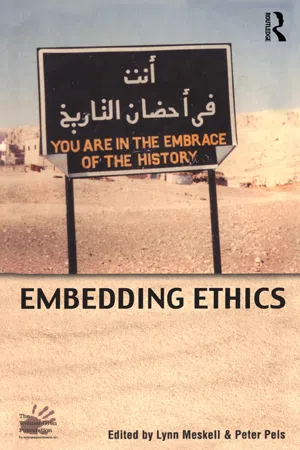
Embedding Ethics
About this book
Anthropologists who talk about ethics generally mean the code of practice drafted by a professional association for implementation by its members. As this book convincingly shows, such a conception is far too narrow. A more radical approach is to recognize that moral judgments are made at every juncture of scientific practice and they require a negotiation of responsibility with all stakeholders in the research enterprise.Embedding Ethics questions why ethics have been divorced from scientific expertise. Invoking different disciplinary practices from biological, archaeological, cultural, and linguistic anthropology, contributors show how ethics should be resituated at the heart of, rather than exterior to, scientific activity. Positioning the researcher as a negotiator of significant truths rather than an adjudicator of a priori precepts enables contributors to relocate ethics in new sets of social and scientific relationships triggered by recent globalization processes - from new forms of intellectual and cultural ownership to accountability in governance, and the very ways in which people are studied. Case studies from ethnographic research, museum display, archaeological fieldwork and professional monitoring illustrate both best practice and potential pitfalls.This important book is an essential guide for all anthropologists who wish to be active contributors to the discussion on ethics and the ethical practice of their profession.
Information
Part 1
Rethinking Ethics
one
Your Body, My Property: The Problem of Colonial Genetics in Postcolonial World
Until its annual meeting in 2003, the American Association of Physical Anthropologists was the only major professional anthropological organization that lacked a code of ethics. The specifics of its reluctance to adopt such a formal code may be obscure, but there is a considerable extent to which it may be at least understandable. As the anthropological field that self-consciously represents the scientific approach to human studies, biological anthropology would seem to be ideally situated to take the lead in establishing ethical standards to help establish the Baconian promise of better living through science. Yet obviously that is not occurring.
Biological anthropology is not methodologically unified-as archaeology and cultural anthropology are unified by excavation and ethnography, respectively. Rather, it borrows methods from biomedical research and cross-cultural ethnographic, ecological, and historical fields in studying the evolution and natural diversity of our species. Consequently, the development of an ethical code would necessarily reflect the extraordinary methodological diversity practiced under the banner of biological anthropology. But, such a practical matter aside, the field sits in a historical and philosophical trajectory that merits consideration.
Writing in the American Anthropologist in 1900, George A. Dorsey reviewed the progress that had been made at his institution, the Field [Columbian] Museum in Chicago, shortly after the Columbian Exposition in 1893:
Naturally much osteological material of great ethnic value was procured, along with many of the collections donated by the Exposition, as well as with many of the collections obtained by purchase. As a result the department was in possession of skulls and skeletons from Alaska, the Northwest coast, and several of the Plains tribes; from Ohio, New Jersey, and Arkansas mounds; from prehistoric graves in Costa Rica, Colombia, Peru, Bolivia, and Chile; and through the Boas and Ward purchases many specimens from America, Europe, Asia, Africa, and the Pacific islands.
A few years later, “From the Blackfeet, Bloods, and Haida was also collected a large amount of osteological material, while a small amount of similar material was obtained from the Kootenay, Tlingit, and Tsimshian.” For 1897–98 he reports, “In the division of physical anthropology more than 150 skeletons were accessioned, the most important single collection being one of fifty-two Papuan skulls from Gazelle peninsula, New Britain, received in exchange from Dr Parkinson.”
Over a century later, I read these words in conjunction with a project I was undertaking for the American Anthropological Association’s Centennial Commission involving the field’s history. What jumped out at me was the sterility of the descriptions: the material was “procured,” “obtained,” “collected,” and “accessioned.” No description was given of where the bones actually came from or how they were acquired. Of course, it is not hard to figure out. As Franz Boas famously wrote to his sister from the field in 1888, “It is most unpleasant work to steal bones from a grave, but what is the use, someone has to do it” (Freed, Freed, and Williamson 1988; Starn 2004). Boas, it is worth noting, indeed made his initial mark as a collector of skeletal remains, such that his faculty appointment at Columbia in 1897 was as a physical anthropologist.
Thus, the dirty little secret of modern physical anthropology: it began as little better than the metaphorical hunchbacked assistant supplying anthropological science with the gory body parts it used for data. At least this was something of an advance over the premodern version of the field, which was most famously represented by the proslavery polygenism of Samuel George Morton, Josiah Nott, and George Gliddon (Hrdlicka 1914; Stanton 1960) and also based on the “collection” of skulls. As science, the field developed a sterile vocabulary to conceal the macabre nature of its work. Following the medical model (whose early founders, such as Vesalius, were dogged by accusations of grave-robbing but nevertheless worked ultimately toward the noble goal of healing the sick), physical anthropologists lexically transformed erstwhile people into specimens, materials, and parts of collections. The transformation was sufficiently complete that some contemporary practitioners are able to deny, with an apparently straight face, that their intimate study of dead people’s parts is gruesome and rather distasteful to ordinary sensibilities (Killion et al. 1999).
The passage in 1990 of the Native American Graves Protection and Repatriation Act, 25 U.S.C. 3001 et seq. (NAGPRA), which deals with both cultural and biological remains, can be seen as the culmination of half a century of progress in biomedical ethics. Although the Hippocratics enjoined each other to “first do no harm,” the twentieth century saw the development of a formal concept of responsibility on the part of the scientist to the subject. This of course came in reaction to the excesses of the Nazis in the name of science (the notorious Auschwitz camp doctor Josef Mengele had a doctorate in physical anthropology from Theodor Mollison in addition to his medical degree [Muller-Hill 1988; Robert Proctor, personal communication]) and was formally articulated as the Nuremberg Code in 1947.
The Nuremberg Code assumes that the research in question is medical and invasive and that there is a common cognitive framework shared by the scientist and subject that permits the scientist to assume the responsibility of obtaining the “voluntary consent” of the subject. It assumes further that the only relevant party aside from the scientist is the subject. It is, therefore, and was intended to be, a first step. We now recognize, for example, that a geneticist has a responsibility not just to the patient with a diagnosed genetic disease but also to other family members who are at risk for it. Thus, in the 1990s, successful medical malpractice lawsuits established a “duty to warn” for people whose personal health decisions had been adversely affected by virtue of not having been informed about a dose relative’s genetic condition (Dolgin 2001).
The recognition of scientific responsibility beyond simply the experimental subject, when combined with the Nuremberg Code’s appreciation of “mental suffering and injury” as meriting consideration, implies that NAGPRA is very harmonious with modern biomedical sensibilities when it protects Native Americans from the callous disposition of their dead relatives. Thus, when an archaeologist conservatively objects to the repatriation of Ishi’s brain on the grounds that Indian remains “care no more what happens to them than a dead stick off a tree” (Whittaker 2000:4), the point is correct but moot. Other parties do care profoundly what happens to Ishi, and the scientific value of the brain may indeed need to be balanced against their rights. The scientifically valueless brain of the famous California Indian (“the last of his tribe”), long in the possession of the Smithsonian Institution, was ultimately repatriated under the National Museum of the American Indian Act to the Yana-speaking Redding Rancheria and Pit River tribes in August 2000 (Starn 2004).
The Human Genome Diversity Project
My own interest in ethics stems from my involvement with the Human Genome Diversity Project, a consortium of population geneticists who proposed a scheme for collecting genetic material from indigenous people on a grand scale in 1991 (Cavalli-Sforza et al. 1991). One might anticipate that a proposal for establishing a repository of biological materials from indigenous peoples might merit some intense prior ethical reflection about the collection and disposition of such materials, especially coming just a year after the passage of NAGPRA. Yet it did not: virtually all the relevant considerations were reactive, articulated by critics, and only subsequently addressed by the HGDP (Marks 2003).
And yet NAGPRA and the HGDP are obviously linked. The issues that stimulated the passage of NAGPRA-the existence and management of osteological repositories of indigenous peoples-certainly are paralleled in the proposal to establish a DNA repository of indigenous peoples, in the questions of just how such “specimens” are to be “acquired,” the discomfort promoted by having strangers take and control powerful, magical, tabooed things, and the ease with which political or economic power can be exercised to obtain and control valuable objects over the reservations of their rightful owners.
An anecdote may serve here: A distinguished senior anthropologist took me aside a few years ago to express his mystification at the ethical issues being raised against the HGDP. He explained that many years ago he had brought blood back from the field for a physical anthropologist to analyze and that it was simply a matter of course. I asked him whether “his people” had taboos about their blood, and he assured me that they did-and howl So how did he manage to get them to give up their blood? Simple, he told me; they traded it to him for penicillin, and if they didn’t give him blood they didn’t get their antibiotics. Suffice it to say that the blood was acquired in a highly coercive fashion. And while I would not presume to judge this senior colleague’s behavior with the aid of several decades of hindsight any more than I would judge Boas’s grave-robbing over a century ago, I can certainly speculate that the same sympathies that lay behind NAGPRA would hold sway in a debate over the ownership of the blood.
Indeed, the ties between blood and bones for physical anthropologists are very intimate. Both are studied as markers of ancestry, and both are-or have been-considered as causes or at least physical manifestations of behavioral tendencies. Earnest Hooton, for example, carried out the skeletal analysis of Pecos Pueblo (recently repatriated from Harvard’s Peabody Museum) in 1930, and less than a decade later he published the extraordinary work The American Criminal (Hooton 1939), purporting to discover physical differences between criminals and volunteer firemen that he believed underlay the development of the criminalistic tendency. Hooton believed that he was discerning a constitutionally inferior human type that could only be dealt with eugenically, through segregation or extirpation.
While Hooton’s work sold so poorly (because of its statistical naiveté, among other things) that Harvard University Press declined to publish its successor volumes, there is remarkable intellectual continuity between his work and modern investigations into the neurobiology or genetics of criminality (Allen 1999). The technology changes and the methods change, but the basic questions, assumptions, and approaches remain: studying the body in one era was a means of probing deeper constitutional pathologies, as in another era studying the genes is.
In other words, the bones and the blood are connected by scientific epistemologies stretching across the decades. And although the architects of the HGDP were not themselves concerned with behavioral genetics, one need hardly look far to find its relevance. Dean Hamer, discoverer of the (apparently nonexistent) homosexuality gene on Xq28 (Hamer et al. 1993; Rice et al. 1999) tells us that “since the discovery of the gay gene, my lab has gone on to find genes for two other personality traits: novelty seeking and worry” (Hamer and Copeland 1998:11). And naturally “there is still such great variation in the [novelty-seeking] gene in modern day humans …. Different ethnic and racial groups, who evolved under different environmental circumstances, have noticeably different frequencies of the different variations” (Hamer and Copeland 1998:49).
The point is simply that the accumulation of genetic material at the turn of the twenty-first century entails a research program similar to the accumulation of osteological material at the turn of the twentieth century-biobehavior and biohistory-that was judged inadequate to justify the human rights violations now perceived in the collection of the bones. (To these research programs we may add the medical knowledge that grew as a result of these skeletal collections, which is paralleled in the genetic research as well, even though in both cases that is not what the materials were principally collected for.)
The offspring of human genetics and anthropology, anthropological genetics exists in the shadow of the eugenic legacy of one parent and the colonial legacy of the other. For all its muddled and inflammatory allegations, Darkness in El Dorado raises a key issue about the control of biological remains of a sacred nature when it observes (Tierney 2000:51):
Uames Neel, for the Atomic Energy Commission] purchased twelve thousand Yanomami blood samples, dispensing a steel gift for each vial of blood …. Today, those vials are located in an old refrigerator at Penn State University, where Chagnon once taught, and are the property of the Human Genome Diversity Project of the U.S. government.
They are actually in the custody of a former protege of Neel’s at Penn State who was involved in trying to start up the HG DP-which is itself of questionable status and in any event is certainly not a part of the federal government. But there are indeed vials of blood collected years ago under circumstances that would not pass bioethical muster today, and if one wishes to do a genetic study of the Yanomami one need not contact any Yanomami or any representative of the Yanomami. Somehow that just doesn’t seem right.
The HGDP became aware of these issues shortly after it coalesced, and it attempted to deal with them by developing an idea of “group consent” (Greely 1997). Since the project was formulated as population genetics, it was interested in people specifically as group members. The idea of requiring the consent of the group as well as that of the individual would serve both to create the appearance of a heightened concern for ethics and to reify the group as a natural, bounded unit. Juengst (1998) challenges the value of group consent on the basis of the fluid and hierarchical structure of human populations. Additionally one may well ask whether the consent of the group undermines the ability of the individual to give consent voluntarily.
The most critical issue faced by the diversity project, however, is one that osteologists were spared: the value of the biological object itself as a commodity (Cunningham 1997). (Here, of course, pothunters and other looters of cultural artifacts would have a common ground with the geneticists.) Patent law in biotechnology strongly favors scientists, as the unsuccessful cases of John Moore (Greely 1998) and the descendants of Henrietta Lacks (Jackson 2000) showed (these plaintiffs were denied the right to share in the profits made from cell lines derived from their bodies). In the case of the blood of indigenous people, the National Institutes of Health applied for patents for cell lines derived ultimately from the blood of a Hagahai (New Guinea), a Solomon Islander, and a Guaymi (Panama).
When confronted with possible financial issues arising from the ownership of indigenous people’ blood, the HGDP replied meekly that it was interested in the blood solely for science’s sake (“The Project is not a commercial enterprise” [http://www.stanford.edu/group/morrinst/hgdp/faq.html]). And yet, the people to whom they were avowing this were well aware of the development of “bio-colonialism” on the part of agribusiness (see Stone, this volume). Availing themselves of indigenous people’s knowledge freely given, large agricultural corporations were making considerable profits in which the people whose knowledge they needed were not sharing. If there is economic value in the blood of indigenous people (why else would biotechnology companies be so acutely interested in it?), then what is a fair price?
I suggest that the same guidelines as govern the disposition of osteological specimens should govern genetic specimens as well. If bones belong to people rather than to science, then blood and its derivative products should as well. The collection and use of genetic samples have been flying under the radar for a long time, but the same principles of dignity and respect for indigenous rights should govern them. The market value of blood or DNA makes it even more crucial to recognize ownership and control of these materials.
Four Concerns of Buman Genetic Research
Contemporary ethical concerns in human genetics generally focus on four issues: autonomy, beneficence, nonmaleficence, and justice (from the WHO Meeting on Ethical Issues in Medical Genetics, Geneva, December 15–16, 1997). These are directly applicable to anthropological genetics and raise significant issues about whether and how they can be met in a cross-cultural context.
Respect for the autonomy of persons centers on the ability of an individual to make a free and informed decision about participating. In particular, it is a safeguard for those with diminished autonomy, notably children and impaired adults. The spirit of this guideline surely extends to people whose diminished autonomy is a result of their isolation from the communities of modern science and business.
Beneficence is a requirement to ensure that scientific research delivers some good to the people participating. While there are theoretical benefits that may accrue as a result of population genetic research-a cure for diabetes in Native Americans is sometimes brandished in this context (e.g., Kidd, Kidd, and Weiss 1993)-it is a far-fetched proposition given the way in which the project was designed. Its objective was to collect samples for microevolutionary studies-hence the desire to include some Hopis, some Navajos, some Inuit, and so on. In order to utilize the genetic sample, a researcher interested in, say, diabetes among the Navajos would have to be able to correlate the phenotype, the trait, with the genetic variant. In other words, the researcher would have to know which samples came from people with diabetes. Further, if the samples had in fact been collected by a researcher who recorded whether they came from diabetics or not, making it possible to use them to study the possible genetic etiology of diabetes, they would be of use to the next researcher, who might be interested in the genetic etiology of gallstones, only if there was a record of which samples came from people w...
Table of contents
- Cover
- Half Title
- Series Page
- Title Page
- Copyright Page
- Contents
- List of Figures
- Participants at the 2002 Wenner-Gren Symposium
- Dedication Page
- Introduction: Embedding Ethics
- Part 1: Rethinking Ethics
- Part 2: Relocating Ethics in Current Research
- Part 3: Exemplars and Warnings
- References
- Index
Trusted by 375,005 students
Access to over 1.5 million titles for a fair monthly price.
Study more efficiently using our study tools.
Frequently asked questions
Yes, you can cancel anytime from the Subscription tab in your account settings on the Perlego website. Your subscription will stay active until the end of your current billing period. Learn how to cancel your subscription
No, books cannot be downloaded as external files, such as PDFs, for use outside of Perlego. However, you can download books within the Perlego app for offline reading on mobile or tablet. Learn how to download books offline
Perlego offers two plans: Essential and Complete
- Essential is ideal for learners and professionals who enjoy exploring a wide range of subjects. Access the Essential Library with 800,000+ trusted titles and best-sellers across business, personal growth, and the humanities. Includes unlimited reading time and Standard Read Aloud voice.
- Complete: Perfect for advanced learners and researchers needing full, unrestricted access. Unlock 1.5M+ books across hundreds of subjects, including academic and specialized titles. The Complete Plan also includes advanced features like Premium Read Aloud and Research Assistant.
We are an online textbook subscription service, where you can get access to an entire online library for less than the price of a single book per month. With over 1.5 million books across 990+ topics, we’ve got you covered! Learn about our mission
Look out for the read-aloud symbol on your next book to see if you can listen to it. The read-aloud tool reads text aloud for you, highlighting the text as it is being read. You can pause it, speed it up and slow it down. Learn more about Read Aloud
Yes! You can use the Perlego app on both iOS and Android devices to read anytime, anywhere — even offline. Perfect for commutes or when you’re on the go.
Please note we cannot support devices running on iOS 13 and Android 7 or earlier. Learn more about using the app
Please note we cannot support devices running on iOS 13 and Android 7 or earlier. Learn more about using the app
Yes, you can access Embedding Ethics by Lynn Meskell,Peter Pels in PDF and/or ePUB format, as well as other popular books in Social Sciences & Anthropology. We have over 1.5 million books available in our catalogue for you to explore.