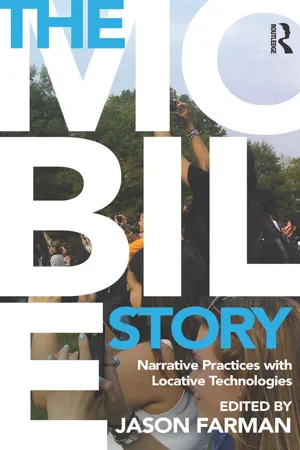
What happens when stories meet mobile media? In this cutting-edge collection, contributors explore digital storytelling in ways that look beyond the desktop to consider how stories can be told through mobile, locative, and pervasive technologies. This book offers dynamic insights about the new nature of narrative in the age of mobile media, studying digital stories that are site-specific, context-aware, and involve the reader in fascinating ways. Addressing important topics for scholars, students, and designers alike, this collection investigates the crucial questions for this emerging area of storytelling and electronic literature. Topics covered include the histories of site-specific narratives, issues in design and practice, space and mapping, mobile games, narrative interfaces, and the interplay between memory, history, and community.
- 326 pages
- English
- ePUB (mobile friendly)
- Available on iOS & Android
eBook - ePub
About this book
Information
Narrative and Site-Specific Authorship
1
Site-Specificity, Pervasive Computing, and the Reading Interface
Jason Farman
How do the examples in this chapter help us understand the practice of storytelling in the mobile media age?
This chapter serves, in part, as an introduction to The Mobile Story and offers a historical grounding for the projects analyzed throughout the rest of the book (which are discussed in more detail at the very end of this chapter). By linking mobile storytelling projects to the larger history of attaching narratives to specific places, these projects build on practices that have been done for millennia. From stone inscriptions to the stories that accompany religious pilgrimages, from graffiti in early Rome to historic walking tours of cities, the practice of sited narratives has many precedents. The desire to attach story to space is found in the connection between the historical context of a community and the need to determine the character of that space. Around these two points arises a contention over who is actually allowed to tell the story of a location. A site’s dominant narrative is often told through durable media such as stone inscriptions, while the narratives on the margins are relegated to ephemeral media such as graffiti or the spoken word. These tensions persist in the era of site-specific digital storytelling, as elaborated in the subsequent chapters in this collection.
Keywords
- Site-specificity: The emphasis on the unique qualities of a particular location that cannot be transferred onto another place. When practiced in mobile storytelling projects, site-specificity embraces the characteristics of the location, including its histories, cultural conflicts, communities, and architectures (to name only a few) and makes these aspects foundational for the experience of the space.
- Urban markup: The various ways that narrative gets attached to a specific place in a city. Urban markup can be done through durable inscriptions (like words carved into the stone façade of a building or a statue) or though ephemeral inscriptions (ranging from banners and billboards to graffiti and stickers).
- Creative misuse: Creatively using a technology in a way in which it was never meant to be used, the results of which offer a thoroughly transformed view of the technology, its place in society, and future practices with the technology.
Introduction
As I look at the ways that people use their mobile devices in different regions around the world, one thing becomes obvious: these devices are being used in vastly diverse ways from community to community and from person to person. There is no single way that people use their cell phones, their tablet computers, their laptops, or other mobile media. There is no “correct” way of using mobile media; instead, we see a wide range of uses globally. There are contrasting—and even contradictory—uses of mobile media worldwide. For example, the idea of multiple people sharing a single cell phone, while out of the ordinary in a place like the United States, where the cell phone epitomizes technology designed for individual use, is a much more common feature in certain communities in India, where cell phones are shared even among strangers.1 Another example of contradictory approaches to the use of mobile media involves location awareness: some people use their mobile devices to broadcast their location throughout the day, yet this might seem like a tremendous invasion of privacy to others. For example, Sam Liang (co-founder of the company Alohar, which designed an application called “ Placeme”), leaves the location-aware services and GPS running on his smartphone in order to track his every move throughout the day (and share it with a broad group of people). Others, such as women who seek protection at a domestic abuse shelter, attempt to limit the amount of data that leaves their cell phones. Here, once a woman checks in, the organization takes her old cell phone (that poses a potential threat of exposing her now-secret location) and replaces it with an emergency-only phone that is able to only call the police or the shelter.
The vast number of ways that people use their mobile devices deeply resonated with me on an afternoon this past summer. I was sitting in the audience of a conference on mobile media listening to many international scholars and practitioners describe the ways they (and the people they study) use their devices. I heard about people in agricultural parts of Africa who use their mobile phone as a banking system, sending payments via text message to transfer money from one account to another when they sell their goods. I heard about people in London who leave the Bluetooth on (and “discoverable” by others) in order to send semi-anonymous flirtatious messages with others while riding the Underground. I heard about artists who create drawings the size of a city by letting the GPS capabilities of their phones create traces of the pathways they journey as they walk out images across a large area. I heard about tourists who hold their phones up to signs in a foreign language and see real-time translations on their screens through augmented reality. From the creation of flash mobs in New York City with thousands of participants to the Red Cross using text messages as a way to track down people in crisis after a natural disaster, our mobile phones are being used in an amazing number of ways.
I had become so comfortable with my own mobile media practices that it hadn’t dawned on me that others would see a phone just like the one I own and imagine such vastly different uses for it. The mobile device is, for many of us, one of our most intimate technologies. For me, it’s one of the first things I touch in the morning (when my alarm goes off); thus, I often end up touching my cell phone before I even touch another human being! As I get ready for work in the morning, I put the phone in my pocket, and it sits close to my body nearly all day long. When I wait in line during lunch, I pull out my phone and check several social media feeds or my email. The mobile phone is now deeply woven into my everyday life, and I’ve become so comfortable with the ways I use it that I have gotten to a point where I don’t think of my mobile media practices as noteworthy. These practices are so commonplace that I rarely take notice of them. The interface often even disappears into my actions throughout the day.2
When our perspectives of our mobile media practices go from being so familiar that they seemingly disappear and instead shift to a perspective where we see entirely new ways of using these devices, the results can be revolutionary. This shift is a transformative one. This book is about such shifts taking place around us. Emerging storytelling projects offer some of the best examples of the transformative potential of mobile media. The projects discussed in this book typically take the mobile device out of the realm of the everyday and insert it into practices that reimagine our relationship to technology, place, and our own sense of self in the spaces through which we move.
However, such shifts in perspective can be challenging to accomplish. Getting people to reimagine a technology they are extremely familiar with (and the places transformed by these technologies) is similar to asking them to get lost in their own homes. The goal, therefore, of some of the storytelling projects detailed in this book is to “defamiliarize” people with their places and the technologies that mediate these places. In order to accomplish this defamiliarization, artists, authors, and scholars often turn to what is called “creative misuse,” or finding a way to use mobile media and software, like iPhone apps, in ways that they were never intended for. The result is often a deeper sense of place and a stronger understanding of our own position within that place.
Ultimately, the level of depth and personal engagement offered by defamiliarization and creative misuse counters much of the contemporary distrust over mobile media. Over the last several years, we have seen a deluge of messages that argue that mobile media are disconnecting us from “real” and genuine interactions with our loved ones and with the places we move through. For example, a 2010 commercial for the Windows phone showed a series of short clips in which people were staring at their phones rather than connecting with the people immediately around them. A woman getting married walks down the aisle while texting. A man on a rollercoaster is seemingly oblivious to the ride while he browses the Internet. A spouse is unaware of his wife’s sexual advances (as she stands next to the bed in lingerie) while he stares at his phone. Joggers who stare at their phones run into each other. People fall down stairs or sit in seats already occupied by someone else—all because they are seemingly somewhere else when they’re staring at their phones. What mobile media storytelling projects demonstrate, in contrast, is that someone can be staring at a mobile device and be more deeply connected to the space and to others in that space than other people might perceive. Storytelling with mobile media takes the stories of a place and attaches them to that place, offering an almost infinite number of stories that can be layered onto a single site. Readers of these stories can stand at a location, access the stories about that site, and gain a deep connection to that space (and the various histories of that space). Thus, not everyone staring into a smartphone is disconnected from his or her surroundings and from the other people in those spaces.
The History of Site-Specific Storytelling
People have attempted to tie stories to places for as long as stories have existed. The meaning of a story is affected by the place in which the story is told and, similarly, the meaning of a place tends to be told through stories. Pervasive computing scholar Malcolm McCullough has explained these practices by pointing out the various historical ways site-specific stories have been told. McCullough has contrasted “durable” inscriptions—such as those carved into stone or into the side of a building—to “ephemeral” inscriptions like graffiti, banners, and billboards that aren’t as long-lasting and are characterized by their transitory nature.3 He categorizes both of these forms of site-specific storytelling as “urban markup.” Interestingly, these two forms of site-specific storytelling also demonstrate the power dynamics and hierarchies involved in who gets to tell the story of a space. Those with economic wealth and political clout tend to be the ones who are able to place durable inscriptions throughout a city. They can afford the statue of a particular war hero or politician, linking the life of this figure to the place where the statue is located. In contrast, graffiti functions similarly to tell a certain story or life of a place but tends to be done by those without the power or political clout to create durable inscriptions. These inscriptions often serve to stand in opposition to the legal and “authorized” ways of storytelling about a place.
There have been variations on these two forms of site-specific storytelling throughout history. Examples include stories that are intimately tied to the place they describe, such as the Stations of the Cross. Born out of religious pilgrimages (many of which also fall under the category of site-specific narratives), the Stations of the Cross emerged around the late fourteenth century as a practice in which Christian pilgrims would visit Jerusalem and walk the Via Delarosa, walking the path that Jesus took on the final days of his life.4 At each of these sites, pilgrims would recount the story of the site (e.g., the place where Simon of Cyrene was compelled to carry the cross for Jesus) and meditate in prayer about the significance of the events and the fact that these events happened in the very place at which they stood. Eventually, these sites were duplicated in regions around the world in an attempt to allow Christians the experience of the Stations of the Cross without the pilgrimage to Jerusalem (thus removing the site-specificity of this place-based narrative).
There are many examples of site-specific stories in contemporary society. Many of us have experienced the link between narrative and site-specificity when we have taken a historic tour of a city or a building, when we’ve gone on ghost tours of places like London or New Orleans, or engaged in historic reenactments of events like Civil War battles. Ultimately, these forms of site-specific storytelling aim to capitalize on the idea that there is value in standing at the site where an event took place; far more than simply reading about an event, being in the place where that event happened offers experiential value that gives us a deeper sense of the story and the ways that story affects the meaning of the place.
As McCullough notes, contemporary mobile media narratives fall somewhere along the spectrum between the durable and ephemeral inscriptions that characterize such urban markup. New forms of urban markup that utilize mobile technologies are “neither organized ‘media’ as the twentieth century knew them, nor random graffiti as all the ages have witnessed.” These forms of site-specific markup are seen in the “new practices of mapping, tagging, linking, and sharing [that] expand both possibilities and participation in urban inscription.”5 Thus, while it is vital to situate th...
Table of contents
- Cover
- Title
- Copyright
- Contents
- List of Figures
- PART I Narrative and Site-Specific Authorship
- PART II Design and Practice
- PART III Space and Mapping
- PART IV Mobile Games
- PART V Narrative Interfaces
- PART VI Memory, History, and Community
- Acknowledgments
- Contributors
- Index
Trusted by 375,005 students
Access to over 1.5 million titles for a fair monthly price.
Study more efficiently using our study tools.
Frequently asked questions
Yes, you can cancel anytime from the Subscription tab in your account settings on the Perlego website. Your subscription will stay active until the end of your current billing period. Learn how to cancel your subscription
No, books cannot be downloaded as external files, such as PDFs, for use outside of Perlego. However, you can download books within the Perlego app for offline reading on mobile or tablet. Learn how to download books offline
Perlego offers two plans: Essential and Complete
- Essential is ideal for learners and professionals who enjoy exploring a wide range of subjects. Access the Essential Library with 800,000+ trusted titles and best-sellers across business, personal growth, and the humanities. Includes unlimited reading time and Standard Read Aloud voice.
- Complete: Perfect for advanced learners and researchers needing full, unrestricted access. Unlock 1.5M+ books across hundreds of subjects, including academic and specialized titles. The Complete Plan also includes advanced features like Premium Read Aloud and Research Assistant.
We are an online textbook subscription service, where you can get access to an entire online library for less than the price of a single book per month. With over 1.5 million books across 990+ topics, we’ve got you covered! Learn about our mission
Look out for the read-aloud symbol on your next book to see if you can listen to it. The read-aloud tool reads text aloud for you, highlighting the text as it is being read. You can pause it, speed it up and slow it down. Learn more about Read Aloud
Yes! You can use the Perlego app on both iOS and Android devices to read anytime, anywhere — even offline. Perfect for commutes or when you’re on the go.
Please note we cannot support devices running on iOS 13 and Android 7 or earlier. Learn more about using the app
Please note we cannot support devices running on iOS 13 and Android 7 or earlier. Learn more about using the app
Yes, you can access The Mobile Story by Jason Farman in PDF and/or ePUB format, as well as other popular books in Computer Science & Digital Media. We have over 1.5 million books available in our catalogue for you to explore.