- 248 pages
- English
- ePUB (mobile friendly)
- Available on iOS & Android
eBook - ePub
About this book
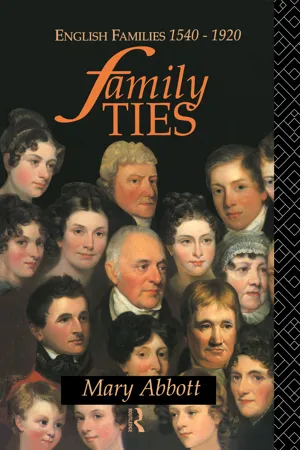
r s1mily Ties provides a vivid and accessible introduction to the dynamics of life in English families of all ranks from the mid-sixteenth century to the end of World War I. Sections on methods, approaches and sources allow readers new to the study of the past to explore some of the historian's fundamental concerns: cause and effect; continuity and change and the nature and reliability of evidence. The chronological and thematic organization of the book enables readers to examine a number of sub-themes such as the history of childhood or of marriage. Combining extensive contemporary quotations and an unusual variety of illustrations with a wide range of written and material sources, the book provides a fascinating insight into the history of the family and encourages the reader to become a sceptical and imaginative investigator, prepared to venture beyond the historian's traditional documentary sources.
1
APPROACHES TO THE HISTORY OF THE ENGLISH FAMILY
TRADITIONAL APPROACHES
The earliest and most persistent strain of family history is that compiled by or for a family concerned to celebrate its bloodline and antiquity. Eminent ancestors were and remain objects of desire. The urge to list and document those who share a family name has also proved powerful.
Woodrow Wyatt’s recollection illustrates the desire to embellish a descent by incorporating noble and romantic ancestors.
When I was a child there was much talk in the family about our being descended from Sir Thomas Wyatt, the poet, and his son Sir Thomas Wyatt the younger who led an unsuccessful rebellion against Queen Mary . . . Was not our Coat of Arms, properly registered and granted to John and James Wyatt in 1780 by the College of Arms, the same? . . . Pictures of both the Thomas Wyatts hung in the hall . . . There was occasional mention of James Wyatt and some of Thomas Henry Wyatt, but the other architects and inventors, manufacturers, sculptors, artists in the family, were never spoken of. In esteem they were far below a courtier of Henry VIII once in difficulties because he was attracted by Anne Boleyn before she met the king.
As I grew more interested in the architects I looked closer at our connection with Sir Thomas. There is none, or if there is it can only be a distant cousinage . . . Even the most desperate genealogical attempt to establish a descent from Sir Thomas relies on someone being married, with progeny, at the age of four or thereabouts.
Woodrow Wyatt’s family was by no means unusual. When Sir Henry Harpur (b.1763) married a lady’s maid by the name of Nanette Hawkins he kitted her out with the Elizabethan seadog’s coat of arms to camouflage her humble origins.
In Wedgwood Pedigrees, published in 1925, Josiah and Joshua Wedgwood, descendants of the eighteenth-century potter and entrepreneur, set out to reconstruct ‘the complete family’ which, they believed, could be traced back to Wedgwood near Tunstall in Staffordshire, using a combination of archival research and direct communication with ‘all existing bearers of that name’, who were ‘sought out, written to, catechised and traced back to the parent stock’. The History of the Battelle Family represents a convergence of these two approaches. Lucy Catherine Battelle (b.1903), who amassed an extraordinary archive of material relating to her surname, tentatively identified a pair of brothers who came over with William the Conqueror as the family’s founding fathers. Curiosity about their families extends to people with very much less to go on. The staff of the Office of Population Censuses and Surveys recalled an ‘old lady’ from Lancashire who came to consult the records of the Registrar General to discover the ‘full names’ of her fifteen older brothers and sisters and ‘the order they came in’.
Woodrow Wyatt, the Wedgwood cousins, Miss Battelle and the ‘old lady’ were concerned with their own descent. Seventeenth-century antiquarians worked on a wider canvas. The great manuscript collections of medieval family papers held in the British Library and the Bodleian in Oxford owe much to the industry of men like Sir William Dugdale, Sir Christopher Hatton and Sir Thomas Shirley. Their enthusiasm was a product of the new style of education which familiarised the sons of landowners with the traditions of history writing in ancient Greece and Rome, and a reflection of the unquiet times before the outbreak of the Civil War.
The nineteenth century saw the application of scientific concepts and new technology to family history. Francis Galton (b.1822) sought to apply the results of work on genetics, which his cousin Charles Darwin had pioneered, to the breeding of human beings with superior intellectual and physical attributes. The starting point for the development of his eugenic thesis was his analysis of Foss’s Lives of the Judges, which suggested that legal ability was an inherited characteristic. Given the power of patronage, the conclusion that this was a genetic effect was debatable. In 1882 Galton enlisted the help of amateur photographers in developing composite portraits which would embody ‘ideal family likenesses’.
RECENT APPROACHES TO THE HISTORY OF THE ENGLISH FAMILY
Only within the last thirty years have academic historians embarked on an exploration of family life and behaviour. This activity has provoked, sometimes bitter, arguments. In Approaches to the History of the Western Family (1980), Michael Anderson reviewed the developments of the two preceding decades. His pamphlet remains a convenient introduction to family historians’ preferred sources and perspectives. Anderson identified four lines of enquiry which he labelled the psychohistorical, the demographic, the sentimental and the household economics approaches.
He summarily dismissed the speculations of psychohistorians, who apply Freudian or Jungian principles to the study of relationships in times past. A majority of historians would endorse his verdict. Not only are historians ‘usually unable to penetrate the bedroom, the bathroom or the nursery’, but most have strong reservations about the value of applying theories developed on the basis of observations of bourgeois subjects in an industrial, urban society to the men, women and children reared in different contexts and cultures.
Peter Laslett, Tony Wrigley and Roger Schofield were the English sponsors of what Anderson described as the demographic approach. They aimed to redress what they perceived as the elitism and subjectivity of studies based on literary sources. Building on techniques developed in France in the 1950s, Laslett and his colleagues coordinated the work of a team of professional and lay researchers who transcribed and processed entries from parish registers and local listings. Wrigley and Schofield’s Population History of England is the most substantial product of this massive investigative programme. The meticulous analysis of data from the registers of 404 English parishes has exploded the myth, innocently promoted by Shakespeare’s Romeo and Juliet and, apparently, confirmed by scattered records of child betrothals and marriages in Tudor and Stuart England, that people married very young. Far from it, the average age of a first-time bride was 25 or 26; the average age of a first-time groom a couple of years older. Fertility, life expectancy, the rate of illegitimacy are among other topics central to the history of the family that have been subjected to scrutiny.
Yet the demographers’ results must be treated with a measure of caution, both because of the nature of their sample and because of the distorting consequence of averaging. Other things being equal, 404 would be a very respectable sample of the 10,000-odd English parishes. But the 404 were neither selected as representative communities nor pulled out of a hat at random. They were chosen because their registers were reasonably carefully kept over a long run of years. London parishes are among those under-represented. If historians are right in identifying occupation and region as major influences on family life, these gaps may be important. Averages are often misleading because they conceal variations across rank and over time. Thus aristocrats tended to marry young or not at all, business and professional men were often substantially older than their wives, while there is evidence that the age at which poor couples married was strongly influenced by local economic circumstances. Similarly, the conclusion that the average number of people per household remained steady at 4.75 over the best part of three centuries masks the more significant information that gentry households generally far exceeded the average and labourers’ often fell short of it.
Historians using what Anderson labelled the sentiments approach have chiefly been concerned with the emergence of an introspective and affectionate ‘modern’ family. Their inspiration, like the demographers’, was French. Philippe Ariès pioneered the study of childhood, drawing on the evidence of art as well as on the more traditional literary sources. Lawrence Stone’s The Family, Sex and Marriage, which concentrates on the sixteenth, seventeenth and eighteenth centuries, is based on a similar range of evidence. This is one of the most entertaining and thought-provoking books published in the last two decades: it provides an excellent opportunity for a reader to pit her, or his, critical skills against the arguments of an historian of stature. Stone’s interest and sympathies lie with the formally educated and articulate. His substantial and continuous work on the aristocracy gives his commentary on their experience particular authority. The character of his source material precluded effective coverage of the poor.
Anderson’s preference is for what he describes as the household economics approach, an approach which employs perspectives developed by social scientists. Historians working within this framework see the family as a flexible and responsive mechanism for acquiring and handing on property and for maximising the chances of surviving in hard times. Anderson, whose academic interests straddle the boundary between Sociology and Economic History, is a leading exponent. His account of Family Structure in nineteenth-century Preston illustrates the range of sources available for that place and period. The Census enumerators’ books for 1841, 1851 and 1861 were Anderson’s ‘prime source of quantitative material’.
These quantitative data are supported by a mass of descriptive material abstracted from contemporary sources of all kinds . . . Some use is made of material from novels. Severe limitations were, however, applied to such data. All material used must have been entirely incidental to the plot of the novel. The work must have been by a writer familiar with working class life and, if possible, the work must have been one known to have been read by working class contemporaries.
In spite of his own contribution to its development, Anderson is not an uncritical advocate of this approach. As he acknowledges, there is a ‘danger . . . of over-romanticising the picture by exaggerating continuity and cohesion’ and neglecting the tension between the interests of the family as a whole and the interests of individual younger members. It is striking that his discussion ignores what is, for us in our own time, the central question of the breakdown of marriages.
Though a useful starting point, Anderson’s system of classification is not definitive. Alan Macfarlane’s anthropological analysis of the family life of Ralph Josselin (b.1617), an Essex parson, one of the most instructive examples of the application of social science methodologies to the history of the family, does not sit comfortably in any of his categories. Peter Laslett rejected ‘the notion of approaches’ altogether: ‘People may overemphasise demographic fact in the past of the family and so lack balance, but they are not doing so by adopting a demographic approach.’
Anderson’s analysis emphasises sources. Alternatively, and perhaps as usefully, historians of the family can be categorised by the stress they place on change and continuity. As Ralph Houlbrooke put it:
Some historians believe that the Western family has undergone a fundamental transformation in the past few centuries; others, while readily admitting that changes have taken place, believe that they have been, at any rate until recent years, much slower and less profound than in most other human institutions.
Among the changes he points to ‘during the last century and a half’ are dramatic falls in fertility and mortality.
In The Family, Sex and Marriage Lawrence Stone claimed to have identified several phases in the evolution of the family between 1500 and 1800, phases which reflected the decline in the importance of aristocratic lineage and the impact of Reformation theology. This ambitious typology found little favour; but his propositions that companionate marriages emerged and that childhood was ‘invented’ after the Restoration in the families of gentle- and professional men have been endorsed. Randolph Trumbach, who investigated aristocratic kinship and domestic relations in eighteenth-century England, and John R. Gillis, whose survey of marriage in England from 1600 to the present day concentrated on the plebeian experience, both identified the eighteenth century as a period of increasing warmth in family relationships.
Linda Pollock is an advocate of continuity, arguing that parents have always recognised children as in need of special care and protection and instruction, a view recently underwritten by Keith Thomas who has, however, stressed shifts in the methods employed. Alan Macfarlane has argued that a distinctive individualism characterised English behaviour as far back into the Middle Ages as records allow researchers to reach. This is a controversial thesis. Paul Monod posed the question:
Is selection of a spouse ‘individualistic’ if it takes place within determined social, economic and political boundaries and has to win the approval of parents, friends and community?
and answered himself in the negative. Yet, as Monod’s own work indicates, the determination to marry like people or not at all was a prescription for ‘gradual extinction’.
In a paper published in 1986, Michael Anderson set an agenda for work on the history of the family:
We need to know much more about the conditions under which households were established, about the minimum resources which had to be obtained before marriage at different periods, and how they were obtained (for example, the relative importance of inheritance, loans and savings from earnings); about courtship and matchmaking, and the role of sex in precipitating or retarding movement into matrimony; about the situations under which remarriages occurred and about the changes in the distribution of ages at marriage. We need, if possible, to explore how these factors varied regionally, occupationally and by socioeconomic circumstances.
It is a checklist well worth bearing in mind.
THE APPROACH ADOPTED IN THIS BOOK
My sympathies lie with those historians who believe that family relationships were governed by customs and practices resistant to change. In this survey I stress the part played by rank, gender and occupation in determining these obligations. Hierarchy pervaded all aspects of life. Until late in the eighteenth century, at formal meals, the host and hostess sat at opposite ends of the table, flanked respectively by their male and female guests ranked in strict order of precedence. With the spread of the fashion for ‘promiscuous seating’, ladies and gentlemen alternated round the table. The order of service was unaffected: ladies were ‘served in order, according to their rank or age, and after, the gentlemen in the same manner’. Ladies who knitted took the opportunity to display the delicacy of their fingers; the priority of working knitters was to produce garments as fast as possible. Until 1962 cricket scoreboards distinguished between the amateur ‘gentleman’ and the professional ‘player’. Railway workers, like their passengers, were divided into three classes.
The precise shape of English society is difficult to discern. P. N. Furbank observed that the seating plan of the parish church at Myddle in Shropshire in 1700, which contemporaries would have recognised as a mirror of the community’s social structure, looked ‘extremely unlike a ladder, and more like a rather intricate piece of knitting’. Knitted fabric is, I think, a useful metaphor, not just for Myddle, but for English society as a whole. Strands of kinship connected people apparently ranks apart. Samuel Pepys (b.1633) was the son of a London tailor and a former laundress. The relatives he mentioned in his diary of the 1660s range from the Earl of Sandwich to an itinerant musician who scraped a living with his fiddle. Pepys had kin who were lawyers and kin who were farmers. He owed his entry to royal service, and thus ultimately his wealth, to Sandwich’s patronage, and, in his turn, he patronised his humbler relatives. He bought his mousetraps from a kinsman and, when his busking cousin’s fiddle broke, it was to the affluent, music-loving Pepys that he looked for a replacement.
Pepys’s diary is an exceptionally rich source, but the kind of wide-ranging network of active kinship tha...
Table of contents
- Cover
- Title page
- Copyright page
- Contents
- Introduction
- 1 APPROACHES TO THE HISTORY OF THE ENGLISH FAMILY
- 2 ENGLAND 1540—1920
- 3 THE FAMILIES OF LANDOWNERS
- 4 PLAIN FOLK: THE FAMILIES OF FARMERS AND CRAFTSMEN
- 5 MIDDLE-CLASS FAMILIES
- 6 THE INARTICULATE: THE FAMILIES OF THE LABOURING POOR
- 7 THE LOWER MIDDLE CLASSES: THE FAMILIES OF BLACKCOATED WORKERS
- 8 SOURCES FOR THE HISTORY OF THE ENGLISH FAMILY
- Index
Trusted by 375,005 students
Access to over 1.5 million titles for a fair monthly price.
Study more efficiently using our study tools.
Frequently asked questions
Yes, you can cancel anytime from the Subscription tab in your account settings on the Perlego website. Your subscription will stay active until the end of your current billing period. Learn how to cancel your subscription
No, books cannot be downloaded as external files, such as PDFs, for use outside of Perlego. However, you can download books within the Perlego app for offline reading on mobile or tablet. Learn how to download books offline
Perlego offers two plans: Essential and Complete
- Essential is ideal for learners and professionals who enjoy exploring a wide range of subjects. Access the Essential Library with 800,000+ trusted titles and best-sellers across business, personal growth, and the humanities. Includes unlimited reading time and Standard Read Aloud voice.
- Complete: Perfect for advanced learners and researchers needing full, unrestricted access. Unlock 1.5M+ books across hundreds of subjects, including academic and specialized titles. The Complete Plan also includes advanced features like Premium Read Aloud and Research Assistant.
We are an online textbook subscription service, where you can get access to an entire online library for less than the price of a single book per month. With over 1.5 million books across 990+ topics, we’ve got you covered! Learn about our mission
Look out for the read-aloud symbol on your next book to see if you can listen to it. The read-aloud tool reads text aloud for you, highlighting the text as it is being read. You can pause it, speed it up and slow it down. Learn more about Read Aloud
Yes! You can use the Perlego app on both iOS and Android devices to read anytime, anywhere — even offline. Perfect for commutes or when you’re on the go.
Please note we cannot support devices running on iOS 13 and Android 7 or earlier. Learn more about using the app
Please note we cannot support devices running on iOS 13 and Android 7 or earlier. Learn more about using the app
Yes, you can access Family Ties by Mary Abbott in PDF and/or ePUB format, as well as other popular books in History & British History. We have over 1.5 million books available in our catalogue for you to explore.