- 294 pages
- English
- ePUB (mobile friendly)
- Available on iOS & Android
eBook - ePub
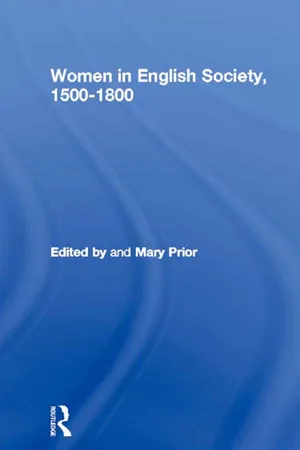
Women in English Society, 1500-1800
About this book
Provides a systematic analysis of various aspects of women's lives between 1500 and 1800, concentrating on detailed research into specific groups of women where it has been possible to build up a picture in some detail.
1
Marital fertility and lactation 1570–1720
DOROTHY McLAREN
There is no doubt that the fertility of rich women between 1570 and 1720 was often appallingly high. It was not uncommon for a rich woman to bear twenty children, and at least one gave birth to thirty infants.1 This knowledge has led some to believe that in the eighteenth century ‘a rise in fertility could not have occurred simply because fertility behaviour was already unrestricted and had always been so’.2 However, at local level, it has long been recognized that the majority of women in pre-industrial society did not have large families.3
For many years the families of the élite have been reconstituted by heralds and genealogists. Now that the method may be extended to all families in a given parish, it is possible to say that the majority of women had a fertility rate that lagged far behind their fecundity—that is, their reproductive capacity. Although abstention, coitus interruptus, abortion and infanticide are frequently canvassed as causes of low fertility, obviously none of these can be well documented. Nuns and many single women, as well as the wives of seamen and other absentees, did abstain, coitus interruptus did take place,4 and abortion and infanticide did occur, though in the last case often outside marriage.5 It is clear that infertility was not artificially induced by abstaining from sexual intercourse while suckling an infant. The view that one ought to abstain was held in some circles, but was by no means general:
A nurse that lives with her husband is allowed coition and congress with him, lest she be disturbed by the desire of it, and by experience we see that Mothers that live with their Husbands, and use congress, Nurse the Child without hurt.6
This study will deal with the natural control of female marital fertility. The aim is, first, to show that the amenorrhoea of lactation (the period of infertility during breastfeeding) is a biological fact revealed by worldwide research and is more intense than the amenorrhoea of malnutrition; although amenorrhoea of lactation was recognized in the seventeenth century, the old knowledge and the new scientific evidence have not yet been adequately used by historians to explain family and population change. The second aim is to show that prolonged and non-exclusive breastfeeding was customary and woven into the English economy and society during the pre-industrial period, and was a basic part of the reproductive pattern for the majority of women. The third aim is to show from demographic evidence from various parishes in Oxfordshire, Buckinghamshire and Hertfordshire, and from recent family reconstitution in Somerset, that the majority of normal, healthy women, well proven to be fecund, had long birth intervals; shorter intervals did occur, however, when an infant died. The fourth and final aim is to show that rich women of the period had an entirely different reproductive pattern, which was mainly due to their having abandoned maternal breastfeeding.
The results indicate that the majority of women could control their fertility in a natural way, but how far the women themselves consciously exercised this control we may never know.
THE SCIENTIFIC EVIDENCE
It was stated at Geneva in 1982 that ‘The changing history of breastfeeding is the history of the human population explosion.’7 For at least a quarter of a century it has been recognized by scientists that fertility is delayed in women who suckle their infants. Biologists have now clarified the process whereby the hormone prolactin, a product of the pituitary gland, promotes the production of milk and inhibits the ovarian function. Empirical studies involving lactating and non-lactating mothers have led Professor Short to state that ‘throughout the world as a whole more births are prevented by lactation than all other forms of contraception put together.’8 Space does not permit discussion of these investigations; the literature is voluminous, and the references given here are highly selective.9 It is hardly surprising that, while historical demographers had noted the effect of lactation on fertility quite early they were slow to attach much weight to it,10 for prolactin was not discovered in humans until recently, and there was some justification for believing that the contraceptive effect of breastfeeding was ‘a myth of the working class’.11
The scepticism is understandable. In our society it is not uncommon for women to conceive while breastfeeding, but the western habit of scheduled feeding, rather than feeding on demand, the abandoning of night feeding and the early introduction of solids, reduces the extent of the contraceptive effect of the suckling stimulus.12 It is the suckling stimulus that is now thought to be of paramount importance in the process of lactation and ovulation. In the early modern period we are, however, dealing with a society that fed on demand, when the alternatives to breast milk were neither economic nor desirable, and where babies often slept in bed with their mothers or wet-nurses. It was then much easier to suckle during the night. Lady Anne Clifford may have had her daughter Margaret in bed with her all night when she was 3 years old for the first time since she was born, but Margaret had slept in a bed with Mary Hicken, her nurse, before then and did so until she was 5 years old.13 We are dealing also with a society where the majority of women probably believed that by sustaining lactation they could delay the next pregnancy. The idea that this was ‘a myth of the working class’ may have arisen with industrialization, when women had to reduce suckling to work in factories and sweatshops.
Since biblical times the contraceptive properties of lactation have been observed. In Hosea 1:8 it is written of Gomer, the wife of Hosea, who had born him a daughter: ‘Now when she had weaned Loruhamah, she conceived, and bare a son.’ Hints are also found in medical texts throughout the period under discussion. In the seven-teenth century William Petty, Tomlins Professor of Anatomy, wrote that prolonged lactation hindered propagation. His work on fertility was noted by Kuczynski in 1935, along with the opinions of other British demographers on fertility between 1660 and 1760.14 Evidence that women knew that prolonged lactation was nature’s way of protecting them from an early pregnancy is not easy to find outside the medical profession. However, by the end of the seventeenth century, Newcome made a comment that shows it was current, even if not taken seriously by the upper classes:
So vain is that popular pretense that nursing is an impediment to fruitfulness, and to be declin’d by great persons for the better securing of succession, by a numerous posterity: for if those bear faster who dry up their breasts, they that nurse their children commonly bear longer, and bring up more to maturity.
In fact, Newcome wrote at length to persuade mothers of the importance of breastfeeding their infants.15 At the end of the eighteenth century Mary Wollstonecraft wrote:
Nature has so wisely ordered things that did women suckle their children, they would preserve their own health, and there would be such an interval between the birth of each child, that we should seldom see a houseful of babes.16
It seems unlikely that most women in pre-industrial England were unaware that prolonged lactation reduced their fertility.
The possible effect of poor maternal nutrition on fertility must also be considered. Professor Short summarizes his findings in the statement that ‘Even under conditions of frank malnutrition or actual starvation, lactation is scarcely affected.’17 Obviously the quality and quantity of milk is influenced by maternal nutrition, but, while malnutrition affects the duration of lactational amenorrhoea, the difference in fertility between poorly and well-nourished women is slight in developing countries.18 It is now generally agreed that the amenorrhoea of lactation is more intense than the amenorrhoea of famine.19 The very high fertility of the well-nourished Hutterite women of North America who breastfeed has almost certainly given rise to the suggestion that English women before industrialization, whose fertility was much lower than that of Hutterite women, were undernourished.20 However, although twentieth-century Hutterite women breastfeed their infants,21 they do not practise the prolonged, non-exclusive breastfeeding of English women in our period. Probably the suckling habits of English women were more akin to those of !Kung women of the Kalahari who suckle on demand for three to four years.22 The !Kung women use no artificial contraception, menarche comes late, and the amenorrhoea of lactation keeps birth intervals at about four years. The majority of English women at this time had a somewhat similar pattern of reproduction, as had many Japanese women of the same period.23
Before leaving scientific fact and turning to historical interpretation, we may look very briefly at two important and very relevant properties of prolactin. First, strenuous exertion leads to a greater release of prolactin.24 No one can doubt the amount of physical labour required of poorer English women in rearing their infants and performing numerous other duties expected of wives of the period. Their intense activity increased the secretion of the hormone prolactin and protected them from early pregnancy while they were breast-feeding. Second, when prolactin was discovered in animals it was called ‘the mother-love hormone’.25 Animals who were prevented from suckling consistently rejected their young. Breastfeeding is now said to be important in creating a bond between mother and infant. However, the apparent maternal indifference to their babies of women who did not breastfeed may well be a matter of chemistry rather than being purely psychological in origin. The suppression of the flow of milk to their breasts enabled them to produce infants annually but may have restricted their maternal instincts. We shall note later Mary Verney’s concern about her infant’s journey to the wet-nurse. Mary, for all her problems during the Civil War and her own ill health, appears to have been a caring, gentle mother. How, then, we may ask, could she put her infant aside, knowing the risks? Of his second wet-nurse, she writes:
She lookes like a slatterne but she sayeth that if she takes the child she will have a mighty care of itt, and truly she hath toe as fine children of her owne as evor I sawe. The nurse is to have 4s a week and two loads of wood; truly tis as little as we can offe...
Table of contents
- Cover
- Half Title
- Full Title
- Copyright
- Contents
- List of plates
- List of contributors
- Acknowledgements
- List of abbreviations
- Preface
- Foreword
- 1 Marital fertility and lactation 1570-1720
- 2 The remarrying widow: a stereotype reconsidered
- 3 Women and the urban economy: Oxford 1500-1800
- 4 Reviled and crucified marriages: the position of Tudor bishops' wives
- 5 Recusant women 1560-1640
- 6 Stuart women's diaries and occasional memoirs
- 7 Women's published writings 1600-1700
- Index
Trusted by 375,005 students
Access to over 1.5 million titles for a fair monthly price.
Study more efficiently using our study tools.
Frequently asked questions
Yes, you can cancel anytime from the Subscription tab in your account settings on the Perlego website. Your subscription will stay active until the end of your current billing period. Learn how to cancel your subscription
No, books cannot be downloaded as external files, such as PDFs, for use outside of Perlego. However, you can download books within the Perlego app for offline reading on mobile or tablet. Learn how to download books offline
Perlego offers two plans: Essential and Complete
- Essential is ideal for learners and professionals who enjoy exploring a wide range of subjects. Access the Essential Library with 800,000+ trusted titles and best-sellers across business, personal growth, and the humanities. Includes unlimited reading time and Standard Read Aloud voice.
- Complete: Perfect for advanced learners and researchers needing full, unrestricted access. Unlock 1.5M+ books across hundreds of subjects, including academic and specialized titles. The Complete Plan also includes advanced features like Premium Read Aloud and Research Assistant.
We are an online textbook subscription service, where you can get access to an entire online library for less than the price of a single book per month. With over 1.5 million books across 990+ topics, we’ve got you covered! Learn about our mission
Look out for the read-aloud symbol on your next book to see if you can listen to it. The read-aloud tool reads text aloud for you, highlighting the text as it is being read. You can pause it, speed it up and slow it down. Learn more about Read Aloud
Yes! You can use the Perlego app on both iOS and Android devices to read anytime, anywhere — even offline. Perfect for commutes or when you’re on the go.
Please note we cannot support devices running on iOS 13 and Android 7 or earlier. Learn more about using the app
Please note we cannot support devices running on iOS 13 and Android 7 or earlier. Learn more about using the app
Yes, you can access Women in English Society, 1500-1800 by Mary Prior in PDF and/or ePUB format, as well as other popular books in History & British History. We have over 1.5 million books available in our catalogue for you to explore.