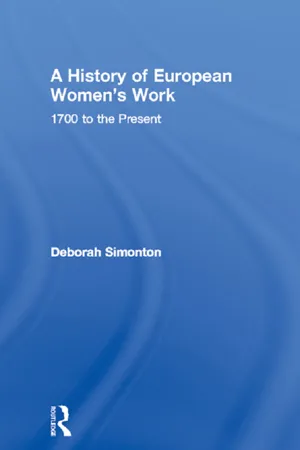
The work patterns of European women from 1700 onwards fluctuate in relation to ideological, demographic, economic and familial changes. In A History of European Women's Work, Deborah Simonton draws together recent research and methodological developments to take an overview of trends in women's work across Europe from the so-called pre-industrial period to the present.
Taking the role of gender and class in defining women's labour as a central theme, Deborah Simonton compares and contrasts the pace of change between European countries, distinguishing between Europe-wide issues and local developments.
- 352 pages
- English
- ePUB (mobile friendly)
- Available on iOS & Android
eBook - ePub
About this book
Information
1
Introduction
All societies and cultures redefine the gender roles of their society. Although some argue that women’s position and image in European society have always been subordinate and inferior, this is patently not the case. The concept of womanhood is complex and highly nuanced. Thus the image of woman as persistently subordinate to man was always mediated by a range of influences, while women’s experience often belied stereotypes. Notions of women exist in tension with other prevailing views in society. Values and motivations of society change virtually generation to generation, often very subtly, so that perceptions of women by any given culture similarly vary. Indeed, views of women and their role are part of society’s perception of itself, and not always the least important. So, while women affect the character of change as active participants, as workers, mothers, wives, daughters and consumers, their experience is also shaped by the nature of change. This is both about gender construction and about the way we view any society from our own vantage point. Views of women are constructed from a range of materials and on a number of levels. The variations and balances in these facets build up a society’s view of ‘woman’. Frequently, that view is constructed as an absolute, regardless of class, sometimes of nation. Values, aspirations and goals can be universally ascribed to women, so that those who do not meet, or at least approximate, an ideal are seen as ‘unwomanly’ or ‘unfeminine’—as failures. The root of women’s perceived inferiority often was due to their physical and biological weakness. Not only were they lighter, smaller, shorter and less muscular, they were subject to their own little-understood gynaecological being. They were seen as subservient to their reproductive organs, and therefore as unruly and uncontrollable creatures. These notions shaped more than medical practice; women’s political, social and economic roles were circumscribed by interpretations of female physiology. Physical weakness was transmuted into a corresponding belief in mental inferiority.
The relationship between woman and her labour is similarly mediated by a number of issues. Some, such as the nature of work available, its urban or rural character and the work process, affect men as well. In addition, key issues for women concern family and female life cycle. But work is mediated by ideology and concepts of gender, status and power. These are less about the work itself than about relationships and psycho-social needs which work fills above and beyond its economic role. While women’s work is delineated by factors such as economy, class and demography, society’s notions about woman’s place and its beliefs about gender roles are significant determinants. Thus domestic roles and relationships with partners and family are central to understanding their contribution to the labour market. Similarly definitions of work reflect society’s perception of the values placed on different forms of labouring activity. The most obvious of these is whether unpaid work in support of the home is construed as work. Woman’s place in society is also the result of a complex of ideas about what women are capable of and should do. Thus their intellectual capacity, the character of that capacity, and their sexual, moral and religious duties shape how women are perceived. They also shape women’s self-perception. In these ways, women’s work, its types, locations and structures are gendered. But gender is not only the result of ideologies about women. Masculinity itself supplements and complements ideas about femininity. Frequently predicated on ideas of male superiority, the male protector, the provider, the head of the family, and on beliefs about male libido, male views of the world further define lines of demarcation between sexes, not only domestically but in terms of the labour market. Thus a number of dyads are created, such as male strength, female frailty; male provider, female helpmeet; and male wage, female pin-money. Practices and precepts of women’s work are determined also by obligations, such as childcare and nurturing. Ideology is of fundamental importance in shaping perceptions of the nature and level of those responsibilities. It can be argued that the development of a notion of ‘childhood’ and an emphasis on the importance of early childhood influences restricted women’s options for their children’s benefit and not their own. Similarly, companionate marriage may have tended to subsume women under men with a resultant loss of identity. As the role of the state increased, state systems tended to perpetuate and entrench the role of women as wives and mothers. These factors, outside of purely economic considerations, influenced women of all classes, though with varied effects determined partly by class and partly by culture.
Understanding of women’s activities is usually situated within male definitions of work, while important ideas about women’s work were derived from their positions within the household. They often performed jobs to help support the family, such as growing vegetables, raising animals, making clothing or assisting in farm and craft work, thus having ‘use value’ rather than ‘exchange value’. As waged labour became more prominent and wage earning came to be the measure of productivity, because women’s work merged with household chores, it came to be seen as non-productive. At the same time, the term ‘work’ came to represent productive market-orientated activity, often dissociated from the home. Activities customarily carried out by women are often laden with a pejorative connotation. For example, when housewifery or other female activity around the household is defined as not being ‘work’ because it is unwaged, a status or hierarchy is automatically implied. The locus of female work does not determine its importance. Whether work is described as female or as situated at home is not by itself necessarily significant. It becomes significant as part of a cluster of ideas about women, work and family; the importance of ‘work’ is dependent on the cultural values associated with it. Thus what matters is the value placed on that work or the meanings ascribed to being at home. Working at home did not always imply inferior tasks or domesticity. Even where division of labour existed, it was not always couched in the cultural terms associated with the nineteenth century. Thus ‘work’ as a concept is both historically specific and relative to the context and value systems in operation.
Similarly, gendered division of labour is historically specific. It can be seen to derive from an idea of the ‘traditional’, to be based on the ‘partnership of working-class families’, to arise from the needs of the family economy with origins in agriculture and crafts. It is argued that this division is carried into capitalist activities and becomes more pronounced as work moves out of the home, a process usually linked to mechanization, technological change and the factory system. It has important implications for waged labour and the idea of the ‘family wage’. But division of labour along sexual lines was not simply because it was ‘practical’. Nor is it only about protecting jobs from cheap unskilled labour; it is about power, status, position and masculinity. We have to ask why it happens and with what language women were excluded from processes, trades and workplaces, yet included in others. Possibly, the argument should be reversed: the creation of the domestic female was as much a result of division of labour and exclusion as it was a cause.
Shifting notions of gender at work can be demonstrated in the ways that ‘skill’ is defined and used to redefine work patterns, in particular, sexual division of labour. Skill has been perceived in terms of strength, training, intelligence, custom and control. Analysing patterns and structures of women’s work, terms like technology, skill and expertise regularly appear. There is no doubt that differing notions of ‘skill’ underpin many analyses. What is disturbing is the imprecision with which such terms are used, so that they obscure or undercut the argument itself and make building up a coherent epistemological argument over time difficult if not impossible. Using terms like ‘skill’ in relation to ‘technology’ leads to a limited notion of what skill might have meant. Learning theory emphasizes ‘transferable skills’ which include a range of abilities unrelated to technology. John refers to ‘skilled tasks’ which rely on ‘knack, opportunity to train, experiment and experience’. This implies the importance of knowledge, while Cockburn’s ‘know-how’ suggests a more tangible relationship to tools. She delineates it further, writing ‘Women may push the buttons but they may not meddle with the works.’ Connection between the language and, consequently, the concepts of skill and technology is not surprising. Since Braverman and others linked technology to deskilling as partial explanation of division of labour, male control of technology and by implication their control of skill have been essential elements in analysing the gendered nature of work. Linn isolated the central point that technology is not inert hardware but a cultural product: ‘it is always constituted in the social practices of language and other forms of representation, in traditions of use, with associated techniques and training procedures, in domains of knowledge, and in relations of production and consumption.’1
There have been few unified attempts outside of economics to deal with issues surrounding women’s work. Similarly, research which places the experience of work in the context of other aspects of female experience are relatively recent. In particular, linking women, work and family has been the focus of analyses over the last twenty years at the same time as issues of gender, domesticity, femininity and family have become the centre of vigorous discussion. In 1981, John Rule justified brief treatment of women’s labour in The Experience of Labour in Eighteenth-century Industry because ‘Women already have their historian’. He was referring to Pinchbeck’s Women Workers and the Industrial Revolution, 1750–1850 (1930). For the previous century, that claim might be made for Clark’s Working Life of Women in the Seventeenth Century (1919) and, for France, Abensour’s section on ‘La Femme du peuple’ in La Femme et le Féminisme en France avant la Révolution (1923) stands as an important contribution, often unsurpassed for detail. These books, now over sixty years old, are starting points for many contemporary women’s historians.
The central focus of Pinchbeck and Clark is the question of whether women benefited from capitalist expansion and how industrial and structural economic change affected women’s productivity. Clark presented seventeenth-century women’s activities as evidence of their vigour, competence and enterprise, stemming from their active and valued role in the pre-capitalist household, a theme echoed by Abensour. To Clark, the shift in capitalized work disadvantaged women with regard to skill and devalued them as equal contributors to the family. To Pinchbeck, on the other hand, the industrial revolution represented an advance for women. She argued that agrarian and industrial change combined to deprive women of their earning capacity in the home, but in the longer view such change was beneficial by leading to greater leisure in the home and relieving women from the monotony and drudgery of the domestic system. For woman workers outside the home, capitalism brought better conditions, a greater variety of openings and improved status. In some ways, Pinchbeck and Clark disagree more in interpretation than in specifics. In the intervening years, women’s history as well as family and economic history have found new ways of framing questions, new models of economic life, new empirical bases and new approaches to evaluating their material. Historians of women have raised issues of definition, ideology, gender and periodization which cast earlier methodology into new relief. Adding significantly to historical debates about women’s work was Tilly and Scott’s Women, Work and Family (1978), which explicitly identified and analysed relationships between various role expectations for women. It addressed life cycle, demography and familial obligations and linked these to meanings of work and women’s decisions about ‘gainful employment’. In some ways, it was a pioneering book on a narrow empirical base. This was necessarily the case in 1978, when so much basic research was yet to be carried out. Notably it presents a European case, which is not defined primarily by British experience. One major flaw in writing about economic and industrial change in Europe is a tendency to measure growth and changes against a British yardstick. The result is that European issues are in danger of being measured and judged by British experience rather than their own.2
A great deal has been published on women’s work and the related parameters of family, gender and ideology over the last twenty years. These consist largely of individual studies which focus on particular periods or countries, regions or cultures. Debates about women’s work also figure in survey articles which highlight research developments or which argue aspects of ideology or methodology. A significant component of published material is collections, which though not always focused on work, deal with important related issues, often attempting to put female labour into context. In Boxer and Quataert’s Connecting Spheres (1987), three substantial overview chapters synthesize European women’s history since 1500. Demonstrating the interdependency of the so-called public and private spheres, they took an important step in surveying and exploring links between European cultures and women’s experience. Hudson and Lee’s Women’s Work and the family Economy in Historical Perspective (1990) made a timely contribution to a number of debates ranging around issues of proto-industry, female economic contribution and the role of women’s history in relation to the established practices of social and economic history. The book gains significantly from the editors’ introductory essay which tackles the need to bring key issues together and indicates the salience of notions of gender, skill and regional and temporal variation to our understanding of economic development and patterns of work throughout the European economy.
Old questions and debates…all now need to be reassessed in the light of the vital role played by gender. As long as research about women’s lives remains largely separate from wider issues such as these, the importance which society has attached to female activities and agency in the past (and in the present) will not change.3
More recently, de Groot and Schrover’s Women Workers and Technological Change in the Nineteenth and Twentieth Centuries (1995b) explicitly grapples with many fundamental issues of technology, skill and status, using empirical research from across Europe, while Frader and Rose’s Gender and Class in Modern Europe (1996) turns to wider issues and points to newer approaches of rewriting the record with a gendered perspective. Both of these books contain excellent introductions which contextualize their subject in current developments in historical thought.
There is a need to draw together recent research and methodological developments. Recent surveys of women’s history have begun the process of rethinking women’s history, notably, Anderson and Zinsser’s A History of Their Own (1988), Wiesner’s Women and Gender in Early Modern Europe (1993) and Hufton’s The Prospect Before Her (1995). The present book begins to fill the gap with an overview of trends in women’s work across Europe from the so-called preindustrial period to the present. It will contextualize patterns of women’s work within ideological, demographic, economic and familial changes, focusing on gender and class in defining and understanding women’s labouring role in European society. In doing so it must, therefore, compare and contrast the pace and patterns of change between European countries, identifying distinct patterns while locating trends which held across Europe. Necessarily, it is a balancing act both to tell the story of women’s work primarily in Western Europe and to analyse the dynamic of the gendered workplace. Thus there is relatively little detail about specific kinds of work, even quite important ones, and country histories are not attempted. The focus is on the overall picture, the characteristics of change and constants, on similarities and differences. In an attempt to put the woman’s experience at the centre, the political and legal context probably has been given briefer coverage than some may wish. Despite an increasing literature on women, family and their work, and a wide range of in-depth studies, much work remains to be done. In many respects our knowledge is still patchy, so that the present book is a progress report, an attempt to use newer research to ‘update’ earlier significant contributions to the debate on women’s work.
A historical study of women’s work poses problems of periodization, since the course of life flows on without much regard for artificial points of reference. Political reference points, such as wars, elections or even revolutions can be of limited use, since women’s lives were not governed primarily by these demarcations. Periods associated with economic shirts, such as pre-industrial, protoindustrial, industrial, also have problems. First, historians are not agreed about what each of these terms means. Second, if they are meant as stages in development, the stages were reached at different times in different parts of Europe. Third, when described as ‘stages’, these terms suggest a necessary progression from one to the other. In this way, the framework of Women, Work and Family highlights one debate in economic history circles: the transition from preindustrial, through proto-industrial to industrial development. Tilly and Scott took a relatively unproblematic approach to the shift from ‘family economy’ through ‘family wage economy’ to ‘family consumer economy’. However, such transitions and periodization require disentangling and reexamination with regard to women’s labour. They are useful terms which focus attention on varying patterns of income and family structure. Because they are about the nature of work, the way it was organized and where it was located, they also describe the overall shape of an economy. But they also suggest progression to a ‘modern’ conception of family, work and women’s roles which tends to obscure differentials which existed at all times across Europe as a whole, but also within individual countries. There is a subtle danger in employing such terms, even as a shorthand, because they become a straitjacket which constrains the discussion, tending to exclude variations and permutations which need to be explored.
Elizabeth Fox-Genovese made the point that, ‘Notoriously, historians love to find traditional society, in all its reassuring stability, in the century that preceded the one they are studying.’ In fact, we frequently use ‘traditional’ as a shorthand to refer to times we know little about, or to provide us with a model for comparison. In the same way, debates about the industrial revolution, and particularly women’s role and status before, during and after, have led some to suppose that there was a golden age, when women were independent and powerful, characteristics which were destroyed by capitalism, mechanization, specialization and the ‘industrial revolution’. Or they perceive ‘bad old days’, days of drudgery and subordination which existed before the liberating effects of capitalism and industrialization. The so-called ‘traditional’ woman probably never existed any more than some sort of ‘golden age’ for women did. Each of these views, in their own way, contains elements of modernization, implying that there is a continual progression to the modern age. Such an orientation in historical writing is dangerous and misleading. It suggests, first, that there is something perfect and resolved in our own age, which events hardly justify, and, second, tends to ignore the variations not only over time but across regions, which make it obvious that there is not just one route to the present, nor is the view of the past so simple.
This book is divided into three parts, each roughly coinciding with a century, but with blurred edges. They approximate a predominant structure and shape to women’s lives, but the text also reflects the extent to which there are important overlaps. Part I centres on the eighteenth century (c. 1700–90), a primarily rural economy, but one which witnessed changes in craft and industrial organization. Several patterns overlapped so that people could be working for themselves or others, for wages, piece rates, barter or accommodation. They were mainly involved in small-scale operations, in both town and country, though larger workplaces developed and with them more division of labour and specialization. Ideas about women began to shift as a legacy of Enlightenment thought such that new and durable ideological restrictions on women’s lives signalled a new direction in thinking about women and their place in society and economy. At the same time, scientific and Enlightenment thought, and the notion of ‘improvement’ began to influence economic concepts and society as a whole. The nineteenth century (1790–1880) saw a further evolution of large-scale industry, and the establishment of the factory system in a number of industries. Society became far more urban and consumer based at the same time, and yet a large part of the population of Europe was still rural. Mechanization had not revolutionized all aspects of life, and craft trades continued to operate in small-scale workshops. Views of womanhood became more solidified within a domestic view of woman, but the same middle-class women who had given definition to the ‘Angel in the House’ began to spread their wings, seeking alternatives. By the end of the nineteenth century, challenges to legal and social restrictions for women and the working classes began to bear fruit in legal changes and political emancipation. And yet, if from the 1880s...
Table of contents
- Cover
- Half Title
- Title Page
- Copyright
- Dedication
- Contents
- List of illustrations
- Acknowledgements
- 1. Introduction
- Part I: The eighteenth century, c. 1700–90
- Part II: The nineteenth century, c. 1790–1880
- Part III: The twentieth century, c. 1880–1980
- Notes
- Bibliography
- Index
Trusted by 375,005 students
Access to over 1.5 million titles for a fair monthly price.
Study more efficiently using our study tools.
Frequently asked questions
Yes, you can cancel anytime from the Subscription tab in your account settings on the Perlego website. Your subscription will stay active until the end of your current billing period. Learn how to cancel your subscription
No, books cannot be downloaded as external files, such as PDFs, for use outside of Perlego. However, you can download books within the Perlego app for offline reading on mobile or tablet. Learn how to download books offline
Perlego offers two plans: Essential and Complete
- Essential is ideal for learners and professionals who enjoy exploring a wide range of subjects. Access the Essential Library with 800,000+ trusted titles and best-sellers across business, personal growth, and the humanities. Includes unlimited reading time and Standard Read Aloud voice.
- Complete: Perfect for advanced learners and researchers needing full, unrestricted access. Unlock 1.5M+ books across hundreds of subjects, including academic and specialized titles. The Complete Plan also includes advanced features like Premium Read Aloud and Research Assistant.
We are an online textbook subscription service, where you can get access to an entire online library for less than the price of a single book per month. With over 1.5 million books across 990+ topics, we’ve got you covered! Learn about our mission
Look out for the read-aloud symbol on your next book to see if you can listen to it. The read-aloud tool reads text aloud for you, highlighting the text as it is being read. You can pause it, speed it up and slow it down. Learn more about Read Aloud
Yes! You can use the Perlego app on both iOS and Android devices to read anytime, anywhere — even offline. Perfect for commutes or when you’re on the go.
Please note we cannot support devices running on iOS 13 and Android 7 or earlier. Learn more about using the app
Please note we cannot support devices running on iOS 13 and Android 7 or earlier. Learn more about using the app
Yes, you can access A History of European Women's Work by Deborah Simonton in PDF and/or ePUB format, as well as other popular books in Historia & Mujeres en la historia. We have over 1.5 million books available in our catalogue for you to explore.