- 224 pages
- English
- ePUB (mobile friendly)
- Available on iOS & Android
eBook - ePub
About this book
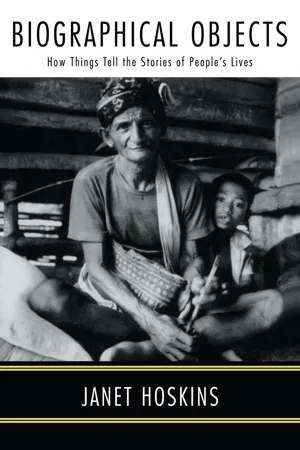
In this innovative study, six women and men from Eastern Indonesia narrate their own lives by talking about their possessions--domestic objects used to construct a coherent identity through a process of identification and self-historicizing. Janet Hoskins explores how things are given biographical significance and entangled in sexual politics, expressed in dualistic metaphors where the familiar distinctions between person and object and female and male are drawn in unfamiliar ways. Biographical Objects is an ethnography of persons which takes the form of a study of things, showing how the object is not only a metaphor for the self but a pivot for reflexivity and introspection, a tool for autobiographic elaboration, a way of knowing oneself through things.
Information
1.
INTRODUCTION
Ordinary objects which have long been used by one master take on a sort of personality, their own face, I could almost say a soul, and the folklore of all nations is full of these beings more human than humans, because they owe their existence to people and, awakened by their contact, take on their own life and autonymous activities, a sort of latent and fantastic willfulness.
—Paul Claudel, Meditation on a pair of shoes,
Prose works, Bibliotheque de la Pleiade, 1965, p. 1243
Prose works, Bibliotheque de la Pleiade, 1965, p. 1243
There are no ideas but in things.
—William Carlos Williams, Paterson, 1947
Recent theoretical interest in the study of personal narrative has highlighted the extent to which storytelling is a formative process: Through “telling their lives,” people not only provide information about themselves but also fashion their identities in a particular way, constructing a “self” for public consumption. Anthropologists have long had an interest in personal narratives, but earlier accounts of “life histories” have operated as if they existed “out there,” already formed, and needed only to be “collected,” recorded, and transcribed.
More recent ethnographic writing has recognized that neither narratives nor selves are so easily “discovered.” An ethnographic interview, whether conducted at one time or over many years, is a complex dialogue, a co-creation of a narrative that is in part structured by the listener's questions and expectations. The context of the story told has come back to center stage, as well as the hidden relationship between the storyteller and the person to whom the story is told—the “biography in the shadow” (Frank 1979, 1985). A number of recent experiments in ethnographic writing (Abu-Lughod 1993, Behar 1993, Kondo 1990, Lavie 1990, Visweswaran 1994) play with the old genres of life history in new ways, and offer us vivid portraits of persons with multiple identities, allegorical personas, and complex hidden agendas.
My own contribution to this literature comes from the paradoxical experience of frustration at not receiving the hoped-for “life history’” from informants I first interviewed with that intention. I began fieldwork with the Kodi, at the western tip of the Eastern Indonesian island of Sumba, because they lived on the last island in the Malay archipelago to preserve a pagan majority throughout the 1980s. Steeped as they still were in an animist tradition, Kodi narrators could tell us about more radically different notions of self and personhood than those peoples more thoroughly absorbed in Indonesia's rapid development. But the notion of telling one's life directly to another person did not exist in Kodi. From men, especially prominent ones, I often heard a list of accomplishments, offices, or ceremonies performed. From women, the question “Tell me about your life” usually initally produced little more than a list of children. But I did get some insight into personal experience and subjective reactions through a set of interviews that I was conducting on another topic—the history of exchange objects and of ritually important domestic objects.
What I discovered, quite to my surprise, was that I could not collect the histories of objects and the life histories of persons separately. People and the things they valued were so complexly intertwined they could not be disentangled. The frustrations I experienced in trying to follow my planned methodology proved to be an advantage in disguise: I obtained more introspective, intimate, and “personal” accounts of many peoples’ lives when I asked them about objects, and traced the path of many objects in interviews supposedly focused on persons.
In studying a society so deeply steeped in exchange, a “person-centered” ethnography (Levy 1994) has to be rethought as one that uses objects as metaphors to elicit an indirect account of personal experience. Kodi is a society in which the origins and circulation of valuables are crucial to a sense of time and even of history. The role of named “history objects” in demarcating and perserving a sense of the past and collective memory I have examined elsewhere in some detail (Hoskins 1993 a). In this work, I want to move to the more intimate level of individual actors and domestic objects— ordinary household possessions that might be given an extraordinary significance by becoming entangled in the events of a person's life and used as a vehicle for a sense of selfhood. I argue that the stories generated around objects provide a distanced form of introspection, a way of discussing loaded sexual politics in an ironic mode, and a form of reflection on the meaning of one's own life.
This book explores how identities and biographies are formed around objects in a society that has not been “psychologized” in a confessional tradition. The narcissistic preoccupation with telling and retelling about their own lives is not well developed in Kodi, where direct questions seem either indiscreet or uninformed. But these people, although bashful and tongue-tied when asked to describe themselves, were often great storytellers when asked to talk about their possessions.
Kodi is a language rich both in conventional metaphors (the paired couplets of ritual language) and in idiosyncratic variations on these themes (often “speaking against the grain” of a conventional metaphor to highlight an unconventional meaning). The conventional dualism of ritual speech is gendered, and plays on notions of masculinity or feminity to “finish” an image as somehow composed of both elements. Sexual politics are rarely discussed in Kodi, and sexual feelings almost never. But the nuanced language of gender dualities made it possible for many people to communci-ate about these things through metaphors focused on objects. In my work on life stories and exchange histories, I became increasingly fascinated by the problem of personal symbolism and the idiosyncratic significance of objects.
A young girl I knew well never confessed her feelings of romantic longing and later disappointment to me directly, but she was fascinated by the story of a magic spindle that flew through the air to snare a beloved. When later her own hopes were cut off, she sent a message to her lost lover through the secret gift of the object. A famous singer and healer who also wanted a female companion composed long ballads to his drum, introducing each ritual session with a history of efforts to cover the drum properly so it could be pierced by a male voice and travel up the heavens.
A respected older man who had served as the Raja in colonial times identified his heritage of spiritual power with the snake depicted on the cloth he chose to be his funeral shroud. Instead of writing an autobiography, he wrote for me an account of his ancestor's encounter with the snake and a gift of cloth that he interpreted as the “basis” of his power to rule.
Another man, famed as a storyteller and bard, said he received his “gift of words” in the simple, woven betel bag he carried with him at all times. His wives, who had sat in respectful silence to listen to him during his lifetime, invited me to hear their own stories after his death—and revealed fables about domestic animals, stories transparently critical of masculinist privilege.
Finally, a young woman who died tragically in a traffic accident was associated with the image of a green bottle, the disposable modern object no longer capable of regeneration. She never narrated her own story to me, but the associations of her death and the disruptive influence of modern technology continued to haunt the area, and my own fieldwork, for many years.
The stories I tell here, and try to make sense of, are stories I played a part in creating, but I did not create the idiom that they were articulated in—it is a cultural propensity to speak about such issues indirectly, and to use objects as a metaphor for the self. I am especially interested in trying to understand how these narratives are constructed, and how the object can mediate for the person.
Sometimes this mediation is direct: In Kodi life-crisis rituals, a spindle or a knife can substitute for a man, a cotton board or a gold pendant can take the place of a woman. A betel bag can be buried instead of a person, and the burial of someone's betel bag in his or her absence can signify their social death—a disinheriting curse by close kin, or a legal sanction by more distant ones. More often, the mediation is somewhat more subtle: A metaphoric alter ego may initially be proposed as part of the elaborate word play that characterizes all formal interactions, and only later come to carry more weight as metaphoric connections are extended to new domains.
A well-known definition of autobiography is “a retrospective account in prose that a real person makes of his own existence stressing his individual life and especially the history of his personality” (Lejeune 1975: 14). By this definition, only some of the stories I recorded in Kodi would qualify, because several took the form of songs or sections in parallel verse, and others revealed their more personal content only through an interpretation of the allegorical message of a fable or folktale. But I prefer to use the term loosely and heuristically, to suggest an autobiographical content to stories that, on the surface, might be said to be about other things as well.
I will try to argue that the Sumbanese narrators of these stories used the objects autobiographically, as the cornerstone of a story about themselves, a vehicle to define personal identity and sexual identity. In a way, the object becomes a prop, a storytelling device, and also a mnemonic for certain experiences. However, such devices are never innocent.
“TELLING ONESELF”: THE RELATION OF AUTOBIOGRAPHY AND MEMORY
Any narrative device does not so much reflect “the truth” as construct it in a particular way. As Frank Kermode notes in discussing his own memoir,
The honest truth, insofar as this suggests absolute fidelity to historical fact, is inacccessible; the minute you begin to write it you try to write it well, and writing well is an activity which has no simple relation to truth. For memory cannot do the necessary work independendy of fantasy; and if it tries, the result will be a dull report. (1995: 37)
Making a life into a story involves crafting it, editing it, giving a form and finality that is always to some extent fictional. Because every book based on fieldwork is also a memoir of shared time and space, my fictions blend with theirs. But most of us who tell stories do so with the intention of offering some truth about ourselves. Freud remarked with surprise, “The urge to tell the truth is much stronger than is usually supposed” (quoted in Kermode 1995: 37), and the popularity of confessional writing in the West certainly bears him out. Though my Indonesian subjects were less overtly confessional, they also insisted on accuracy when it came to autobiographical reflections.
Kermode describes the dominant model of autobiography as St. Augustine's notion that the past can be usefully reworked in present memory, rather than Freud's idea that memory invents a past to defend us against the appalling timelessness of the unconscious. The revelation of unpleasant secrets is not the goal, but the creation of a certain integrated interpretation. “The analyst tries to open the box so that all its contents will eventually fly out; the autobiographer has a notion that his life, as memory reconstructs it, can by certain skills be made to hang together; so, needing the contents, he closes the box and snaps the catch on the lid” (Kermode 1995: 43).
This is an arresting image of why each story has to come to an end. A coherent narrative constructs a unified image of the self out of the disparate, messy fragments of daily experience. It is perhaps significant that the “biographical objects” my informants selected were often containers (the betel pouch, the hollow drum, the funeral shroud), which served as “memory boxes” for holding certain things inside or (in the case of the green bottle) creating anxiety about their capacity to escape.
The closure offered by the well-told story offers “a kind of substitute timelessness, or a time that has a stop, with its own benefits, its own felicity” (Kermode 1995: 43). Kermode points out perceptively that closure is so attractive to writers that “when they go out of their way to avoid it you can tell they are thinking about it but are being rebellious and avant-garde” (43).
In a classic article, the literary critic James Olney defined autobiographies as “metaphors of the self” (1972) and noted that the analysis of life stories now has come to focus less on the bio, the events that occurred throughout the lifetime, and more on the auto, the construction of self through narrative. In recent years the burgeoning interest in these narratives (Gullestad 1996, Personal Narrative Group 1989, Watson and Smith 1992, Krupat 1985, Linde 1993, Rosenwald and Ochberg 1992) has carried that orientation still further. Perhaps because many of the “grand” narratives of science, progress, and politics have lost their credibility, “little” narratives situated in the particular experience of individuals have resurfaced. Third World authors are publishing their own personal accounts of the rise to nationhood (Rodgers 1995), and “alphabetization increasingly seems to imply autobiographization” (Gullestad 1996: 14). Within the academy, interest in people's own stories has been spurred by a new hermeneutic self-concious-ness in criticism and history, and the struggles of feminists and minorities to be heard on a personal as well as a political level.
One of the disappointments of the new trend to reflexivity in anthropology has been the realization that accounts of the anthropologist in the field are still heavily edited and crafted. Indeed, they must be, but the pretended candor of many such accounts can be no more than an engaging stylistic device that makes ethnographies better reading than technical reports are. Anthropology is based on eyewitness accounts, and it is nice to render the immediacy of the field experience, but vividly written first-person ethnographies may hide as much as they reveal of fieldwork dynamics.
The anthropologist writing an ethnography is, of course, telling a tale that is in part an autobiography (Okley 1992). It exists because there was a time when the fieldworker shared time and space with the people who spoke to her, and she shared in their lives. However, if we dismantle the realist position that the life history is the mirror of life events, we must also do the same for the ethnography. Every graduate student trying to finish a dissertation becomes painfully aware of the fact that there is no coherence that dwells within events or social structures themselves. Coherence is imposed by the work of story makers, and much of what the anthropologist does in writing up her material is to try to devise a coherent story line that will shape fragmentary episodes of experience into something intelligible to an academic audience.
Our informants, the people we call the “subjects” of life histories, must go through a similar process when we ask them to narrate aspects of themselves, to give a direction to their lives by explaining them to an outsider. The stories I collected were told in a series of conversations with each of the people I write about. Some include more self-consciously produced “texts”—a ritual song, a long deathbed oration in parallel verse, a fable, or a typed manuscript—but the text is then supplemented by contextualized commentary. In correcting successive versions of stories about themselves and objects, these people were revising and refining their own sense of connection between the events of yesterday and today. As Rosenwald and Ochberg note: “The subjective conviction of autobiographic coherence is intrinsic to a sense of identity” (1992: 6).
They note, however, that from a modern narcologist's perspective, this coherence is an illusion—even a tactical maneuver. We tell our lives in ways that suit the predicaments in which we find ourselves at the moment, and we edit and revise them for other audiences. We may want our listeners to admire us, to understand us, to forgive us, or perhaps to become converted to something that we value very highly. The telling of the tale turns the person listening into someone who may affirm or approve the story told, perhaps even helping to identify and explain discordant accounts.
For this reason, some poststructuralist textual analysts have treated accounts that people give of their own lives as pure fictions, invented more or less of whole cloth. Kamala Visweswaran speaks of “fictions of feminist ethnography” (1994), and Pierre Bourdieu calls the study of life histories “the biographic illusion” (1986). But even if we accept the highly invented and constructed nature of any such narrative, we must address the relationship between experience and representation.
Anthropologists distinguish between a life as lived, a life as experienced, and a life as told. The first refers to what happens to a person; the second to images, feelings, sentiments, desires, and meanings the person may ascribe to these events; and the third to a narrative, influenced by the context in which it is told, the audience, and cultural notions of storytelling (Bruner 1984: 7). More recently, they have also come to define the self as constructed through narrative, in a process of enactment and rhetorical assertion. This calls into question the commonsense boundaries between “self” and “world,” and makes it possible to examine individual identities not as unified essences but as “a mobile site of contradiction and disunity, a node where various discourses temporarily intersect in particular ways” (Kondo 1990: 47).
Since a life history is not only a recital of events but also an organization of experience, the way memory is rendered in a narration of the self is a part of both individual style and cultural fashioning. Through an examination of six individuals, three men and three women, I try to see both gender differences and cultural similarities. I look at a way of telling lives that is somewhat alien to Western literary genres but that has enough metaphoric force to be intelligible in translation. I try to explain why objects are important as foils for self-definition and an anchor for the self-historicizing subject. And I wonder, finally, about the relations of persons and objects that underlie these stories.
THE BIOGRAPHICAL OBJECT
In 1989, building on the work of Appadurai (1986), Kopytoff (1986), Strathern (1988), and A. Weiner (1985), I tried to define a new category of “biographical objects,” which occupy one pole of the continuum between gifts and commodities and are endowed with the personal characteristics of their owners. My example at the time was an extreme one: the severed head of Rato Malo, a nobleman from Rara who was ambushed by a head-hunting party from Kodi just before the turn of the century. His young son was captured and sold as a slave, but he came to work for the first Catholic mission on the island, where he acquired basic literacy and was baptized “Yoseph.” As an adult, he returned to his homeland and began to work for the colonial administration. He used his acquired wealth and political skills to negotiate for the return of his father's skull as part of a counterprestation for bridewealth. The skull was ritually treated first as a female exchange valuable, then “dressed” in male clothes, reunited with the bones of the body, and feburied as a person. The transformations of this “biographical object” show how the lines between persons and things can blur and shift, and also how other inanimate objects (cloth, jewelry, porcelain dishes) are often endowed with the qualities of persons.
The story of Rato Malo's head is a striking example of an object that was once part of a human body and came to be treated as an exchange valuable, and was then ritually retransformed into a part of a person. Its significance for his descendants was easy to understand, and its return was believed to restore honor and fertility to his family. But in arguing that...
Table of contents
- Cover
- Half Title
- Title Page
- Copyright Page
- Table of Contents
- Acknowledgments
- 1. Introduction
- 2. The Betel Bag A Sack for Souls and Stories
- 3. Domesticating Animals and Wives Women’s Fables of Protest
- 4. The Royal Snake Shroud Local Weaving and Colonial Kingship
- 5. Spindles and Spinsters The Loss of Romantic Love
- 6. The Drum and Masculinity A Healer’s Story
- 7. Green Bottles and Green Death Modernity and the Ephemeral
- 8. Conclusions Stories and Objects in Lived Dualities
- References
- Index
Trusted by 375,005 students
Access to over 1.5 million titles for a fair monthly price.
Study more efficiently using our study tools.
Frequently asked questions
Yes, you can cancel anytime from the Subscription tab in your account settings on the Perlego website. Your subscription will stay active until the end of your current billing period. Learn how to cancel your subscription
No, books cannot be downloaded as external files, such as PDFs, for use outside of Perlego. However, you can download books within the Perlego app for offline reading on mobile or tablet. Learn how to download books offline
Perlego offers two plans: Essential and Complete
- Essential is ideal for learners and professionals who enjoy exploring a wide range of subjects. Access the Essential Library with 800,000+ trusted titles and best-sellers across business, personal growth, and the humanities. Includes unlimited reading time and Standard Read Aloud voice.
- Complete: Perfect for advanced learners and researchers needing full, unrestricted access. Unlock 1.5M+ books across hundreds of subjects, including academic and specialized titles. The Complete Plan also includes advanced features like Premium Read Aloud and Research Assistant.
We are an online textbook subscription service, where you can get access to an entire online library for less than the price of a single book per month. With over 1.5 million books across 990+ topics, we’ve got you covered! Learn about our mission
Look out for the read-aloud symbol on your next book to see if you can listen to it. The read-aloud tool reads text aloud for you, highlighting the text as it is being read. You can pause it, speed it up and slow it down. Learn more about Read Aloud
Yes! You can use the Perlego app on both iOS and Android devices to read anytime, anywhere — even offline. Perfect for commutes or when you’re on the go.
Please note we cannot support devices running on iOS 13 and Android 7 or earlier. Learn more about using the app
Please note we cannot support devices running on iOS 13 and Android 7 or earlier. Learn more about using the app
Yes, you can access Biographical Objects by Janet Hoskins in PDF and/or ePUB format, as well as other popular books in Social Sciences & Anthropology. We have over 1.5 million books available in our catalogue for you to explore.