![]()
Part 1
Theorizing Wildscapes
![]()
Chapter 1: Learning from Detroit or ‘the wrong kind of ruins’
Christopher Woodward
‘You’ve got to go to Detroit’, said a man in the audience. I was speaking about ruins at the Clark Institute of Art in Massachusetts, USA, in conjunction with their exhibition of Old Master’s drawings of the ruins of ancient Rome. I’d been told that several times: if you like ruins so much, go to Detroit.
The schedule took me to friends at the Museum of Fine Arts in Boston but I changed the ticket, and flew to Detroit. The taxi passed empty brick mansions and rows of wooden houses, then derelict Modernist factories and Art Deco skyscrapers. ‘Why are you here?’ asked the driver. I explained that I’d come to the USA to lecture on the beauty and inspiration of ruins, and we talked about Rome – and Detroit. He shook his head: ‘These are the wrong kind of ruins’.
In my book In Ruins (2001) I tried to understand the process by which ruins – the result of bombs, fires, natural disaster, poverty, abandonment – can become places which are beautiful, uplifting, and even comfortable. What makes old stones and charred bricks feel alive?
Firstly, by the fact of its incompleteness, a ruined structure compels the viewer to supply the missing pieces from their own imagination. Our response is creative, and personal. The reality of a ruin is subjective; put another way, when we write about ruins we cannot escape writing about ourselves. Rose Macaulay’s classic Pleasure of Ruins (1953) is presented as an anthology of other travellers’ experiences but it is also an undeclared autobiography. She chose to write about ruins alive with birds, vines, or noisy peasants as an expression of her own rebirth as a Christian after the nihilism expressed in her novel, The World My Wilderness (1950), in which the bomb sites of London are the backdrop to the lives of a generation brutalized by the war.
Secondly, a ruin represents a contest between people and nature. We watch a battle between the ambitions of the builder and the processes of nature – with nature expressed, above all, by spontaneous vegetation. And, stepping back, we might enjoy ruins integrated into a landscape – whether by design, as in the incorporation of abbeys into eighteenth-century gardens, such as Fountains Abbey in Yorkshire, UK, or by chance, as in the gardens of Ninfa, Italy, ‘discovered’ by romantic travellers in the late nineteenth century. At the same time, vegetation has an ambivalent role: from the 1920s until recent times it was perceived as a destructive threat by state archaeology.
Thirdly, juxtaposition. A Christian chapel built inside the Colosseum, or a shepherd’s hut erected from the rubble of an emperor’s tomb: the dramatic juxtaposition suggests a narrative of change over time. These changes become causes for reflection. Such juxtapositions also suspend, or reverse, normal assumptions of time, and progress; eighteenth-century travellers to Rome were highly conscious that they were treading in the dust of a civilization more magnificent than Paris or London but, nevertheless, in fragments.
We can suggest a formula, therefore, in which these elements of incompleteness, nature, and juxtaposition combine to transform a pile of broken or burned materials into a place of beauty and inspiration. It explains why we climb to a castle on a cliff-top with a picnic basket, or linger in a temple above a Mediterranean seashore. But does it apply to Detroit?
The urban ruins of the twentieth and twenty-first centuries pose a new aesthetic challenge and, I shall argue, writers, artists, planners and designers are at the very beginning of formulating a convincing response. It is a new challenge, most obviously, because for millions of urban dwellers, modern ruins are on our doorstep, staring us in the eye each morning. They are embedded in buildings, traffic, asphalt and chain-link fence, and not in nature, time is not suspended as it might be in a site that is isolated or elusive.
More profoundly, destruction is of a different speed and scale. Bombs flatten cities more quickly than soldiers slaughter citizens with pikes and bayonets. Above all, the nature of the economy means that we construct more, and bigger, buildings more quickly than ever before – and abandon them more quickly than ever before.
Detroit’s population halved over two decades but the most extreme cases of urban shrinkage are in China. Yumen in Gansu province was built for oil under Chairman Mao’s rule; but the oil has stopped, and the bureaucracy relocated to a new city. An English journalist described a city with no jobs, and flats to be bought for US$280 (Graham-Harrison 2008); of 118 towns built by Mao to extract natural resources, 18 are ‘classified as resource-exhausted’ by the Asian Development Bank. What will happen to a concrete and steel city with no jobs, few children, and too many cigarettes?
In the last two decades urban decay has become photogenic and fashionable: it is popular with a new generation of artists, particularly young photographers1; it is even counter-culture chic, as in the eponymous range of cosmetics. However, there is a mismatch between the aesthetic response and the reality of urban decline. It is an aesthetic challenge of a new order. How can we integrate modern ruins with our current ideas of what cities should look like, and accept dereliction as an integral element of the modern city?
*****
In twentieth-century USA, artists, writers, and film-makers have created the most powerful images of future destruction since England, France and Germany in the Romantic age, whether of nuclear war (the shattered Statue of Liberty at the conclusion of Franklin J. Shaffner’s Planet of the Apes (1968)) or of ecological collapse (Cormac McCarthy’s The Road (2006)).
The prophetic fantasies of destruction have not come true, with the exceptions of Chernobyl, 9/11 and Hurricane Katrina. What has happened instead is the ruination of cities by economic and social change. Detroit is the most extreme example. According to the US census its population declined from 1.85 million in 1950 to 911,000 by 2003, a reduction of more than 50 per cent. No city has depopulated so quickly during peacetime since Rome in the century and a half subsequent to its capture by the Goths. And, visually, Detroit is the most dramatic example of modern times because of the ambition and wealth with which it was built: Art Deco skyscrapers with mosaic glittering in their vaulted lobbies, such as the Book Building; factories that rose as luminous, vast cathedrals of mass production; the concrete columns of Albert Kahn’s work are as muscular and determined as the arcades of Karnak. The Book Building is empty; the cathedral glass is shattered; Kahn’s Post Office is burned, a forest self-seeded in the ashes. These are the last great ruins of Western civilization (Figure 1.1).
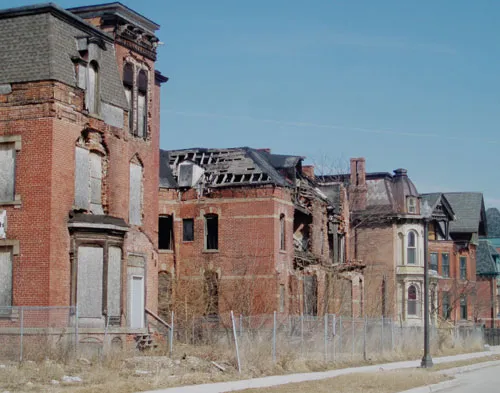
Figure 1.1
Abandoned mansions in Brush Park, Detroit. When Brush Park was built at the end of the nineteenth century it was the most exclusive residential neighbourhood in the city (photograph: Christopher Woodward, 2006)
The city is also a case study of the possibilities created by dereliction, from urban farming to new aesthetics.
*****
All I knew about Detroit was based on the photographs of Camillo Jose Vergara; perhaps the best-known depicts a car park inside the flaking, opulent interior of a cinema. Born in Chile, Vergara came to study engineering at the University of Notre Dame at South Bend, Indiana, USA, in the late 1960s. An article in Time magazine led him to the slums of Gary, Indiana: ‘With my eyes smarting from the smoke of the steel works, I saw people gambling and drinking’ (Vergara 1999: 23). He has revisited Gary a hundred times in the four decades since: ‘Now the city is ruined, but the air is clean’ (Vergara 1999: 23). It was the beginning of a photographic exploration of the US rust belt which he presents as a political and sociological project: he visits and revisits to record changes in the built and social environment.
In addition, Vergara argues that ruins are integral to the story of the USA, and – in contrast to the sanitized narrative of unblemished progress exemplified by their Smithsonian Institution – should be accepted as national heritage. In 1995 he proposed that a section of downtown Detroit become a wildlife park, an ‘American Acropolis’ for the study of skyscrapers:
We could transform nearly 100 troubled buildings into a grand national historic park of play and wonder, an Urban Monument Valley … Midwestern prairie would be allowed to invade from the north. Trees, vines, and wildflowers would grow on roofs and out of windows; goats and wild animals – squirrels, possums, bats, owls, ravens, snakes and insects – would live in the empty behemoths, adding their calls, hoots and screeches to the smell of rotten leaves and animal droppings.
(Vergara 1995)
My expectations of Detroit were as much defined by Vergara’s imagery as eighteenth-century Grand Tourists’ expectations of Rome by Piranesi’s engravings. I shared a taxi from the airport with a man on business, who got out at a blue glass hotel. If I am honest, I was disappointed by the commercial bustle. The riverside has been regenerated: circular benches and steps set against mown grass decorated with silver hoops of abstract sculpture. In the Guardian building, a restored Art Deco masterpiece, you can buy sepia-tinted photographs of 1930s swish, but there are no pictures of ruins available. Outside a woman in a suit climbs into her SUV, locks the door, and rounds the corner with a firm turn of the wheel.
But walk ten minutes and Vergara’s Detroit begins. It is midday but there are no people inside or outside (Detroit is, inter alia, the easiest city in the world in which to find a parking space). My two-and-a-bit days were bewildering. At one point I was so depressed by the dereliction that I walked back to the small island of commercial activity. After miles of cracked concrete, leafless ivy, and congealed litter it was reassuring to see new plastic tables in McDonalds, window-cleaners, doors that opened, and to breathe the new, shiny smell of fresh paperbacks in Borders.
Nevertheless, the ruins are exhilarating. In the Book Building I snuck past the security guard. One of six elevators worked. As it ground its way up thirty-six empty storeys I lost all sense of whether I was rising, or falling. I was too scared to climb into the Central Station by myself but returned the next day with a friend. A thin voice rang out from a high window: ‘Want a tour?’. Sean charges US$10 for a tour of the Central Station and Post Office. Seventeen years old, he is an ‘urban explorer’, one of six or seven – his estimate – active in the city. The tour begins in the Central Station vestibule (like Grand Central Station in New York designed by the architects Carrere and Hastings as an echo of the Baths of Caracalla in Rome). Sean narrates a natural history of the urban ruin. First, the water and electricity are turned off. For a while there will be a security guard. Next come the robbers, many of whom are junkies. They steal the copper, and any ornaments that can be sold. After that, the vandals. In Grand Central they have smashed the marble cladding in the corridors just for the thrill. Finally, the graffiti artists and the urban explorers arrive. And, last of all, I wonder, the tourists?
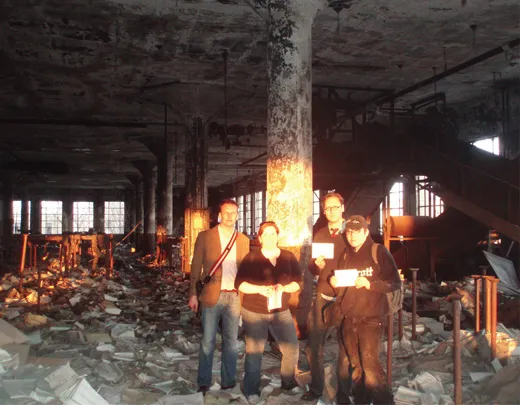
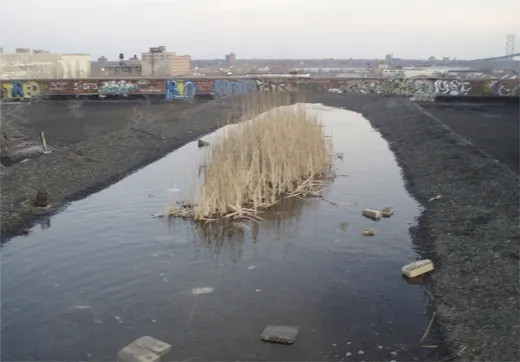
Later, we descend into the basement, and by the light of a torch cross a frozen pool to climb on to an old conveyor belt, which took the mail, underground, to the Post Office across the street, a Modernist structure by Albert Kahn. Hands and knees pattering on the frayed fabric you climb up the belt on to the third floor. The tour was timed so that we emerged at sunset (Figure 1.2). The building, put to new use as the Book Depository for the City’s Public Schools, had (been?) burned and the low sun illuminated piles of charred paper, and books. I stepped onto the top of a mound of molten metal, a metre high. ‘Staples’, said Sean drily. And my friend Tobin was standing on a small hill of melted sellotape. A section of the roof had collapsed and trees had self-seeded and grown through the void. In one corner of the roof water had collected into a pond, and a fringe of reeds had grown at its edge (Figure 1.3).
Figure 1.2
The author with two urban explorers and (centre back) the writer M. T. Anderson in Detroit Central Post Office, designed by Albert Kahn in the 1920s (photograph: Christopher Woodward, 2006)
Figure 1.3
The rooftop at Detroit Central Post Office (photograph: Christopher Woodward, 2006)
The happiest surprise in Detroit was the ebullience of nature. I have never seen so many birds in a city: not pigeons – who leave with the people – but birds that flutter and chirp on traffic lights, and in the tilting porches of the empty houses. The lights change but there is no traffic, and the only sound but for the birdsong was the creak of a bicycle ridden round and round by an old, seemingly homeless, black man.
*****
My friend (a writer) and I stalked through the prairie grass. ‘When Detroit was built America was a place of production’, he observed. ‘Now it’s a country of consumers. Detroit symbolizes that’.
The city has symbolized the fortunes of the USA to an accelerated degree, from the invention of the production line in the Model T age to the Second World War – when a quarter of the tanks that liberated Europe were made here – to the race riots of 1968 and white flight in the 1970s. Since the credit crunch – alleged to have started in sub-prime Detroit – it has been featured as the place to buy a house for US$5. It’s a one-stop shop for TV journalists who want a dramatic backdrop to a punch-line.
In the spring of 2010, Julien Temple’s Requiem for Detroit was broadcast on BBC4, and at a public symposium at the London School of Economics (LSE) Cities Programme. At the end, a panel of four academics flanked a High School Principal from the city, Yalik Makini. What’s the lesson of Detroit? To one, it symbolized the risk of over-dependence on a single industry; London – and he paused to look at the audience – is over-dependent on the financial sector. What has happened is that Detroit has become a sandpit for urban theorists across the world. In the USA it is the epicentre of self-doubt, a place for the nation to navel-gaze.
*****
The makers of Requiem for Detroit chose a happy ending: the new phenomenon of urban farming. Young white men and old black women see orchards beside empty freeways as a vision of ...