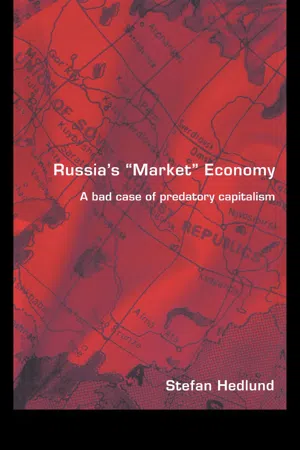
Russia's Market Economy is a seminal account of Russia's transition to the market, its tortuous development as a fledgling market economy through the 1990s, right through to its spectacular collapse in August 1998. Rather than beginning with the economic collapse, the book traces the historical mismanagement of Russian wealth through to the Soviet command economy, and on to Gorbachev. Stefan Hedlund finally discusses what lessons should be learned from the damage inflicted on the Russian economy, as well as its social, legal and political infrastructure, by the race of reform.
- 400 pages
- English
- ePUB (mobile friendly)
- Available on iOS & Android
eBook - ePub
About this book
Information
Subtopic
Political EconomyIndex
EconomicsIII
The reform programme
CHAPTER FIVE
Financial destabilization
The opening signal for shock therapy to commence was given on 2 January 1992, with the announcement of a sweeping liberalization of the previously state controlled prices. As such, there was certainly nothing wrong with this move. Freedom for the market to determine prices was one of the very necessary conditions for a functioning Russian market economy to be established. The problem was that a number of supporting measures would also have needed to be implemented, above all so in the political sphere. And that, as we shall see below, was where the programme went seriously wrong.
In the following chapters much will be said about the role of credibility. Given this focus, there is one feature in the early stage of shock therapy which may be worth emphasizing at this point. In their strongly monetarist rhetoric, the Russian reformers kept repeating the crucial importance of achieving rapid stabilization of the economy. Against this background it is rather striking that one of their main initial shortcomings would be registered in precisely this dimension. By failing to contain the initial pulse of inflationary pressure that was released by price liberalization, the Russian government was simply bound to run into serious credibility problems.
In his 28 October address, President Yeltsin had promised that by the autumn of 1992 “there will be economic stabilization and a gradual improvement in people’s lives”.1
That was not to be. Instead, a process of very high and variable inflation led to a rapid erosion of real incomes and to a destruction of the pre-conditions for normal business activities. Thus, the legitimacy of the reform programme as a whole was seriously undermined.
But how, then, may we explain the initial failures of stabilization? Was it merely a question of bad luck, of unexpectedly tough political opposition, or perhaps indeed even of a “betrayal” by the West, as some of the leading Western advisors would argue? Closer inspection will show that it was none of the above.
In this and in the following two chapters we shall map out a course of events which in the main may be explained only by factors that were endogenous to the political process at the top, i.e. consequences of the way in which the Russian president was to set and enforce his priorities. Let us begin by looking at the political context in which the decision to implement shock therapy was taken.
A shocking decision
The events that unfolded in the time between the failed August 1991 coup and the actual launching of Russia’s economic reform programme, in January 1992, are crucial in the sense that they would be so obviously formative for subsequent developments. This was the “window of opportunity”, when the course for future policy could have been charted in a variety of directions. The frequently heard argument, that what was done was the only thing that could be done, is valid only in the normative sense of accepting that all alternatives were inferior.
From an analytical point of view, the period at hand is of interest mainly because it serves to reveal some of the core preferences of the new political leadership that was now being formed to rule over the future of Russia. And the pattern of behaviour that emerged was clearly marked by a triumph of politics over economics. From the very outset, the leading actors that took part in shaping the structure of the economic reform programme, and in building support for it to be launched, revealed preferences that had little indeed to do with economics.2
It is easy, for example, to agree with the following statement by Lynn Nelson and Irina Kuzes: “Whereas analysts often justify Yeltsin’s consolidation of power as the reforms continued by arguing that presidential power was serving economic reform, we find strong evidence that the reality was quite different—that the kind of economic reform approach that was initiated under Yeltsin placed economics in the service of his political agenda.”3
The pivotal point in this argument concerns constituency building. In a normal, democratic political setting, this is one of the most important functions of politics. Russia in the autumn of 1991 was certainly neither normal nor democratic, and it would be easy to say that no matter how hard it had tried, no constituency of sufficient size could have been found to support the radical reforms that were then envisioned. Yet, this is perhaps too easy a way out, one that smacks a bit more of apologetics than of serious analysis.
In a scathing critique of the way in which the Russian reformers went about their business, Nelson and Kuzes make an important point with respect to the formulation of policy: “It is no justification for shock therapy advocates, however, that their theory did not mesh well with constraints that prevailed in Russia. A key to effective policy is to anticipate such impediments, rather than to use them as excuses in the aftermath of policy misjudgments.”4
The case for the defence at this point would be something along the lines of what Yegor Gaidar had to say in an August 1992 article: “When it is pointed out what Russia was lacking at the end of last year that was needed to create an effective market economy, I want to, not disagree, but add to the list…. But there was no—absolutely no—time to sit around and wait while all of these preconditions were created. The choice was very clear.”5
In support of their own critique of the shock therapists, Nelson and Kuzes quote similar arguments from Pereira, Maravall and Przeworski, whose discussion on the post-communist transition underlines a rather obvious point, namely that if economic reforms are to proceed under democratic conditions, there must be sustained political support:
They continue, “A sound economic strategy is a strategy that addresses itself explicitly to the issue of whether reforms will be supported as the costs set in,” rather than trying to excuse the loss of support for reforms as an effect of irresponsible populism. This “typical argument of economists,” they maintain, “is just bad economics”.6
While ex post rationalizations are certainly not specific to the Russian reform process, there is one important point here that should be brought out. At first impression, the issue would seem to concern whether or not there was sufficient time to engage in constituency building. Since we cannot go back and try again, that question will never have an answer. And, to repeat what has been said above, perhaps it does not matter much any more.
The real crux of the matter concerns whether constituency building was even attempted. And that is something altogether different, because it says something important about the overriding political priorities of the country’s government. Let us return to see how the men who gathered around Boris Yeltsin came to be imbued with their crusading mentality.
As we may recall from our previous account, in the aftermath of the failed August coup, at the time when his authority was at its peak, Boris Yeltsin chose to leave Moscow for a crucial couple of weeks. Leaving the reasons for this little excursion aside, we may also recall that upon his return he displayed great energy. But in which direction? This is where we may find much of the key to understanding the subsequent developments.
First steps
On 10 October 1991, Boris Yeltsin was a president in search of an economic reform programme. On the table he had the remnants of the “Window of Opportunity” programme, which had been worked out within the Harvard group, and the odds were that this would indeed form the platform of the government’s new policy. The latter interpretation was supported by the fact that one of the members of the four-man commission that had been appointed to manage the post-coup transition was Grigorii Yavlinskii, one of the main architects of the Harvard project. His transitional mandate was to propose a new comprehensive economic reform programme.
To most of those involved, including Graham Allison, it seemed logical that Yeltsin would draw on all the work that had already been done.7 But that was not to be. According to Yavlinskii, the president did ask him if he was ready to do the job, but the terms could not be agreed. Again according to Yavlinskii, the reason was that Yeltsin and his closest circle had set such political priorities that successful economic reform would not be possible: “It was necessary to choose—either these political goals, or economics. Then there was a discovery. Another person [Gaidar] came, and said, ‘I’ll do it’.”8
The interesting dimension of this decision making process is concerned not so much with the background of Yegor Gaidar, or with the potential merits of Yavlinskii’s competing programme. The main importance lies in the very speed of events. From 10 October until 28 October, the president of the Russian Federation had a mere 18 days in which to decide on how one of the most important reforms in Russian history should be implemented.
The rise of Gaidar to prominence was made possible by Gennadii Burbulis, one of Yeltsin’s closest aides at the time. Having met Gaidar during the August days, he had become impressed by the concept of “Russia first” and arranged for him to be secluded at an official government dacha in the Moscow suburb of Arkhangelskoe. There Anatolyi Chubais and a few others joined him.9
It would take this small group of very young economists no more than a couple of weeks in which to work out how to implement something that had never been done before. And it would take the president no more than a couple of days in which to decide that theirs was indeed the best proposal. When Yeltsin delivered his big speech on 28 October, it incorporated much of what the Gaidar team had proposed.
Yet, there was even more still to be decided. At a meeting on 4 November, Burbulis proposed that Yeltsin should create a special group within the government, which would be charged with working out a programme for the first steps that needed to be taken. The group was to be headed by Gaidar, a choice that at first did not find the president’s favour: “Who is this? What are you proposing? What are you suggesting? Yeltsin was seriously annoyed, and threw the proposal across the table.”10 Two days later, however, Gaidar had been appointed deputy prime minister and finance minister. And that was that.
Having seen this process unfold, one is inclined to join Marshall Goldman in wondering “just how deep [Yeltsin’s] understanding of or commitment to the market was”. There is also a striking parallel to the crucial negotiations in the late summer of 1990, when the fate of the Shatalin “500-day program” was being decided:
During the intense meetings…Yeltsin was off in Siberia meeting his constituents. Upon his return to Moscow he immediately moved to push the Shatalin plan forward, if need be in Russia alone. However, some of the participants in the discussions suspected that Yeltsin had not even bothered to read much of the program.11
To Yeltsin it was all really just a question of power, personal power. In 1990 he was ready to use the Shatalin plan as a battering ram against Gorbachev, and in 1991 he was equally ready to use Gaidar’s plan to finish off the job. The crucial distinction between Yavlinskii and Gaidar was concerned not with economics, but with the fact that while Yavlinskii worked on the premiss that some form of union structures would be preserved, Gaidar offered “Russia first”.
Parallel agendas
With his decision to back Gaidar, Yeltsin clearly demonstrated that there were two parallel agendas being pursued, one that was designed to further his own personal power and another that focused on the economic aspects of reform. This interpretation has two important implications, which would be brought out by subsequent events. One concerns the president’s personal ranking of the two agendas, and the other their respective audiences. Let us begin by looking at the political agenda.
The choice of “Russia first” certainly had serious merit in its own. Given all the centrifugal forces that had been unleashed by the Soviet break-up, the prospects for a weakened centre in Moscow to enforce its will across the territory of the old union as a whole must have looked bleak indeed. And uniformly enforcing a programme of sweeping reforms in Russia, Central Asia and the...
Table of contents
- Cover Page
- Title Page
- Copyright Page
- Preface
- I. Introduction
- II. Framework
- III. The Reform Programme
- IV. Lessons to Be Learned
- References
Trusted by 375,005 students
Access to over 1.5 million titles for a fair monthly price.
Study more efficiently using our study tools.
Frequently asked questions
Yes, you can cancel anytime from the Subscription tab in your account settings on the Perlego website. Your subscription will stay active until the end of your current billing period. Learn how to cancel your subscription
No, books cannot be downloaded as external files, such as PDFs, for use outside of Perlego. However, you can download books within the Perlego app for offline reading on mobile or tablet. Learn how to download books offline
Perlego offers two plans: Essential and Complete
- Essential is ideal for learners and professionals who enjoy exploring a wide range of subjects. Access the Essential Library with 800,000+ trusted titles and best-sellers across business, personal growth, and the humanities. Includes unlimited reading time and Standard Read Aloud voice.
- Complete: Perfect for advanced learners and researchers needing full, unrestricted access. Unlock 1.5M+ books across hundreds of subjects, including academic and specialized titles. The Complete Plan also includes advanced features like Premium Read Aloud and Research Assistant.
We are an online textbook subscription service, where you can get access to an entire online library for less than the price of a single book per month. With over 1.5 million books across 990+ topics, we’ve got you covered! Learn about our mission
Look out for the read-aloud symbol on your next book to see if you can listen to it. The read-aloud tool reads text aloud for you, highlighting the text as it is being read. You can pause it, speed it up and slow it down. Learn more about Read Aloud
Yes! You can use the Perlego app on both iOS and Android devices to read anytime, anywhere — even offline. Perfect for commutes or when you’re on the go.
Please note we cannot support devices running on iOS 13 and Android 7 or earlier. Learn more about using the app
Please note we cannot support devices running on iOS 13 and Android 7 or earlier. Learn more about using the app
Yes, you can access Russia's Market Economy by Stefan Hedlund in PDF and/or ePUB format, as well as other popular books in Economics & Political Economy. We have over 1.5 million books available in our catalogue for you to explore.