- 328 pages
- English
- ePUB (mobile friendly)
- Available on iOS & Android
eBook - ePub
About this book
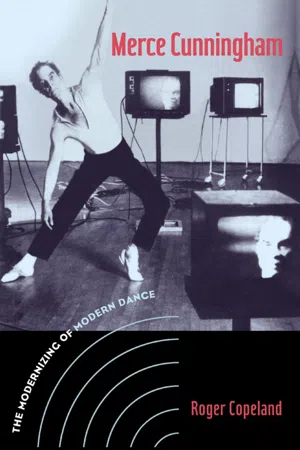
Merce Cunningham and the Modernizing of Modern Dance is a complete study of the life and work of this seminal choreographer/dancer. More than just a biography, Copeland explores Cunningham's life story against a backdrop of an entire century of developments in American art. Copeland traces his own experience of Cunningham's dances-from the turbulent late '60s through the experimental works of the '80s and '90s-showing how Cunningham moved dance away from the highly emotional, subjective work of Martha Graham to a return to a new kind of classicism. This book places Cunningham in the forefront of an artistic revolution, a revolution that has its parallels in music (John Cage, and the minimalist composers who followed him), painting (Jasper Johns, Robert Rauschenberg), theater (the happenings of the '60s), and dance itself (the Judson School of dancers). An iconclastic and highly readable analysis, this book will be enjoyed by all those interested in the development of the American arts in the 20th century.
Information
1
From Graham to Cunningham
An Unsentimental Education
The Persistence of Dandyism
“A person appears comic to us if in comparison with ourselves he makes too great an expenditure on his bodily functions and too little on his mental ones.”
—Sigmund Freud, “Jokes and the Comic” (1965, 255)
“The distinguishing characteristic of the dandy’s beauty consists above all in an air of coldness which comes from an unshakable determination not to be moved.”
—Charles Baudelaire, “The Dandy” (1965, 29)
One would have thought the 1960s an ideal (perhaps the ideal) time for a first encounter with the primitive mysteries of Martha Graham. The cultural signposts all seemed to point in her direction: a renewal of interest in myth and ritual; the meteoric rise of “Dionysian” intellectuals such as Norman O. Brown; the pervasive body-consciousness; a sexualizing of the culture at large. Why then, on first encountering Graham’s choreography, during the summer of 1967 (the notorious Summer of Love, no less), did I find her work rather…unlovable? Why did I behave so inappropriately, biting my tongue in a vain attempt to stifle a bad case of the giggles? No doubt, the narrow (some might say, ideological) confines of my sensibility were at fault. I was a precocious 17-year-old, eager to appear More-Sophisticated-Than-Thou. It was essential to my fragile, stillevolving sensibility that my enthusiasms all be certifiably modern. But Graham’s work seemed most distinctive for its atavism, its willed primitivism. Hers were dances that harked back to the primordial ooze. Thus, it wasn’t altogether apparent to me why modern dance was called modern dance.
What is apparent in retrospect is that I was already one of those fanatical high modernists, those purists who believed in the autonomy and separateness of every art form. I wanted dance to do something unique to dance. I didn’t want choreographers “using” the body to tell stories, especially not stories that had already been given shape and urgency by great playwrights and novelists. So, obviously, there was going to be a “problem” with Graham. The very names of her characters, so literary, so burdened with overly generalized Meaning, tended to put me off: “He Who Summons”; “She of the Ground”; “The One Who Speaks”; “The One Who Dances”…all of which made me feel like “The One Whose Head Ached From Allegory.”
But the real obstacle in my path wasn’t so much this ideological commitment to purity of medium but, rather, my temperamental commitment to coolness, distance, and irony— an “unshakable determination not to be moved.” We think of the 1960s as a very “hot” decade, but that’s only half-true. Those who came of intellectual age in the 1960s wanted to have it both ways (perhaps every which way): immediacy and distance, sensuality and irony. As a result, any adequate account of the 1960s and its cultural context will have to consider the cult of cool, in both the literal and the figurative sense of the term: hip; with-it; the-last-word-in-sophistication; but also cool as a matter of temperament, if not literally, temperature, as in: “Don’t feel anything and if you do, don’t show it.” Graham, it seemed to me at the time, was not cool; worse, she was unfashionably “hot.” (For Marshall McLuhan, one of the decade’s chief taste-makers, “cool” was the ultimate compliment. Hence, television was defined as a “cool” medium; print culture was demonized as “hot.”) From this cool (and distinctly aloof) point of view, Graham’s work struck me as both oversized and overwrought, a casebook example of Freud’s criterion for comedy, where the body is a little too much in evidence (or at least more in evidence than the mind). Stark Young’s notorious wisecrack about Graham (“She looks as though she were about to give birth to a cube”) succinctly summarized my sentiments.
Perhaps because Graham’s work seemed so heavy (literally and figuratively), so humorless and devoid of irony, I seized on any moment that might provide some comic relief, no matter how unintended. Actually…the less intended, the better: Tiresias in “Night Journey” bouncing on his seer’s staff like a pogo stick; or Oedipus, in the same work, throwing his weight around so stiffly that he functioned as little more than a priapic prick. I think, too, of those little agitated knee runs Graham was so fond of. When The Penitent in “El Penitente” or Medea in “Cave of the Heart” pitter-patted to the left or the right on their knees, my response was to either laugh or wince or both.
The situations the characters found themselves in called for emotions of the most elemental sort; but that bourrée-on-the-knees seemed a bit prissy for the occasion. I also had a terrible time figuring out exactly what was supposed to be happening in many of these dances on a strictly narrative level. And a mind unsure of who’s doing what to whom can distract one’s attention from the serious business of looking. This was nowhere more of a problem than in “Deaths and Entrances,” which I found both inscrutable and interminable. “Too many entrances and not enough deaths,” I quipped to myself.
I’m not particularly proud of this behavior. In fact, I now consider it a grave lapse (or under nourishment) of taste. “Dark Meadow”—which I didn’t discover until years later— now strikes me as one of the masterworks of the 20th century. But I hope that this retracing of my own aesthetic learning curve will reveal something of interest about a sensibility that was by no means unique to me, a mode of thinking and feeling that became quite fashionable in the mid-to-late 1960s. (It was of course the very sensibility that Moira Roth disparages as the “Aesthetic of Indifference.” Had I known her essay at the time, I might well have proclaimed, “Vive la Indifference.”) This sensibility can best be portrayed as a latter-day variety of dandyism, the phenomenon that Baudelaire described in his classic essay of 1863. One hundred years later, dandyism, with its “air of coldness,” “its unshakable determination not to be moved,” became a major—if undeclared—theme in the life of the 1960s counterculture. Certainly it was central to the massive transition that had already occurred in the visual arts: a move away from the hot, romantic, angst-ridden ethos of abstract expressionism toward the cooler, more impersonal detachment of pop and minimal art. Indeed, it’s no coincidence that when Moira Roth contrasted the physical appearance of the abstract expressionists with that of the practitioners of the aesthetic of indifference, the image of the dandy figured into her comparison:
In its deliberately apolitical and generally neutral stance, the Aesthetic of Indifference represented a new breed of artist, an alternative to the politically concerned Abstract Expressionists. George Segal, a young artist at this time, has described his memory of the typical abstract expressionist’s heavy set appearance with drooping moustache and corduroy jacket… Duchamp and Cage, who struck him as models for a new ‘slender, cerebral, philosophical, iconoclastic type’, physically and intellectually very different from the Abstract Expressionist one. For Segal and others, the new artist had a dandy-like elegance of body build and a manner which delighted in cool and elegant plays of the mind: playfulness indeed was a key characteristic in most of this new breed of artist. (1977, 49)
References—invariably unflattering—to dandyism occur a number of times in the course of her essay. But what interests me at the moment is the effect that this latter-day dandyism had on the dance-going tastes of people like myself. The dandy’s determination “not to be moved” is, above all, a fear of being emotionally overpowered, a fear of seduction. Perhaps laughter is the inevitable (if lamentable) response of the dandy to work that is unafraid of trafficking in large, overheated emotions. Laughter induces (or is induced by) a distancing of emotion—what Henri Bergson once described as a “momentary anesthesia of the heart” a condition woefully at odds with the “primitive” sense of awe and wonder that Graham was so determined to conjure up. And that’s why Graham, at least at the time, didn’t strike me as “cool.” At least not in the manner of my other, recently acquired, certifiably “modern” enthusiasms (circa 1967, as I was about to enter college): The Peter Hall/RSC production of Pinter’s The Homecoming; Andy Warhol’s silk-screen portraits of Marilyn Monroe and Jackie Kennedy; the music of the Velvet Underground (often thought of as Andy Warhol’s rock group); and films such as Resnais’s Last Year at Marienbad, Antonioni’s Red Desert and Blow Up, Michael Snow’s “underground” classic Wavelength, and virtually everything by that most Brechtian of film directors, Jean-Luc Godard. Favorite novels included Robbe-Grillet’s The Erasers, William Burroughs’s The Ticket That Exploded, and Thomas Pynchon’s study of technoparanoia, The Crying of Lot 49.
Earlier I used the word “Brechtian” in relation to the films of Godard. “Brechtian” was perhaps my favorite adjective of those years (although my ideas about Brecht were derived more from his manifestoes than from his plays). The critic, or, more properly, essayist whom I read with the greatest enthusiasm was Susan Sontag, whose essays “Against Interpretation,” “The Aesthetics of Silence ” and “One Culture and the New Sensibility” had, no doubt, a great deal to do with shaping the sensibility I’ve just sketched. By current standards of taste, this is a highly rarefied catalogue of enthusiasms. (In fact, their collective emotional temperature is so ice-cold that some may wonder about my use of the word “Enthusiasm.”) The shared sensibility is hard-edged, ruthlessly nonsentimental, objectivist, and unapologetically brainy. Dance, you may have noticed, is conspicuously absent from the list. But what sort of dance would have been at home in this celestial pantheon?
Deep down, in my secret heart of hearts, I loved ballet: the spacedevouring leaps, the ultra-high extensions, the superhuman majesty of it all. And, at its best (which is to say, in the work of Balanchine), the speed and the clarity—qualities that both quickened the pulse and sharpened the eye. Frank O’Hara, in a tribute to Maria Tallchief, wrote “…her breathing limbs tear ugliness out of our lives.” I felt much the same way about Suzanne Farrell. But the late 1960s was not the time to admit to a fascination with something as traditional-sounding as “ballet.” I was still intimidated by the externals: its history (the fact that it had a history!), its existence as “an institution “its presumed connection to, and dependence on, the citadels of wealth and power. How, one wondered, could anything performed in a great Edifice Complex like Lincoln Center possibly be relevant (oh, that awful 1960s word!), up-to-the-second, and so on. Of course, I would eventually realize that not being wholly indebted to the present is a virtue rather than a vice. But this, remember, was still the late 1960s…. Where, oh where, could one find the icy, dandified virtuosity of ballet outside the world of institutionalized art and beyond the precincts of tradition? The answer turned out to be the work of Merce Cunningham.
Human Bodies and Inanimate Objects: Savoring the Surface
The timing of my first encounter couldn’t have been more propitious: May 1968, the month of months in the year of years, in the decade of decades (at least it felt that way at the time!). But even from the jaded—and perhaps a wee bit envious—vantage point of the early 21st century, 1968 remains the annus mirabilis of the decade that’s become synonymous with radicalism of every kind, aesthetic as well as political. I don’t mean to imply that the impact Cunningham’s work made on me in May 1968 was entirely attributable to its fortuitous historical context, but the heady, intoxicating, convulsive character of the moment surely played a part. The site of my initiation—my sacre du printemps—was The Brooklyn Academy of Music (BAM). Cunningham’s season at BAM opened on May 15, one day after the official beginning of the “worker-student” alliance on the barricades of Paris.
The political connotations of the moment were full of resonance for me; but I want first to focus on aesthetic impressions that were less dependent on the political passions of the moment. In the course of the next seven days in May, I had the great good fortune to see an astonishing number of the works that I still regard as some of Cunningham’s greatest accomplishments: “Scramble,” “Rainforest,” “How to Pass, Kick, Fall and Run,” “Winterbranch,” “Walkaround Time,” “Untitled Solo,” “Place,” and “Variations V.” Over the course of the next several years, I became acquainted with other works that made a comparably indelible impression: “Tread,” “Crises,” “Canfield,” and “Signals.”
What first struck me about the company—and what distinguished Cunningham’s dancers most clearly in my mind from Graham’s—was their dandified detachment, not an “air of coldness” per se, but their collective sense of hyperalertness: the high carriage, the flexible head, the level gaze, the ultra-articulated feet, the aura of sangfroid. One of Cunningham’s movement signatures was the highly propulsive off-center jeté, in which the dancers seemed to hurl their bodies in several directions simultaneously (but remaining—this is key—supremely balanced all the while). Frequently off-center, but rarely off-balance: that’s one generalization we can safely make about Cunningham’s choreography. Typically, the head cocks backward, the ribcage wrenches to one side, the left arm sculpts the third dimension while the right arm (defying Newton, embracing Einstein) explores the fourth. With Cunningham, body sculpture is not just a matter of which direction the dancer is traveling but also which way the performer faces while moving there. (Many choreographers think in terms of four directions: upstage, downstage, left, and right. Cunningham routinely utilizes at least eight: for example, the legs move on a diagonal upstage left while the head turns downstage left, and so on.)
The company members in 1968 were a remarkably diverse and idiosyncratic lot. Carolyn Brown was the paragon of classical purity, an ice queen who could give Suzanne Farrell a run for her money. Gus Solomons Jr., the only African American member of the company, was a long-limbed, lyrical contortionist. British-born Valda Setterfield displayed an odd mix of regal elegance and blunt prosiness. Watching her was a little like imagining a member of the Royal Family doing her own shopping at the local grocery store; even when dancing with great speed, she never seemed to be in a hurry. Clearly, the emotional temperature of Cunningham style has something in common with British reserve. Sandra Neels, more exuberantly “All American,” was a pert brunette with long, lean legs who excelled at lyrical adagios. Barbara Lloyd, the pip-squeak of the bunch, moved with the greatest abandon, the most convincing appearance of “spontaneity.” She was the only company member who seemed to luxuriate, unselfconsciously, in the sheer act—the sheer joy—of moving. And Cunningham was…well…a cunning ham, a great comic actor as well as a lithe, blithe, impish mover. Unlike the other male dancers who had been featured performers with Martha Graham, Cunningham was always more Ariel than Caliban, light and brainy rather than monumental or “earthy.” The aura of tough-minded intelligence that radiated from the Cunningham company was more than a matter of onstage “attitude.” Reportedly, the sort of conversation one overheard in the studio was a heady brew that freely mixed dance-related matters with philosophical aesthetics and terminology drawn from the visual arts. Gus Solomons Jr.held a degree in architecture from MIT. Carolyn Brown had been a philosophy major at Columbia. This was a brainy bunch. By contrast, the sort of conversation one overheard in other dance studios of the period sounded more like that of the Brady Bunch.
But the most distinctive thing about the Cunningham company’s collective intelligence was the sensuous way it manifested itself in movement. Cunningham wasn’t the only member of the group who exhibited a kind of cunning. Many of his dancers exuded a sly dexterity that called to mind the great tricksters in literature. There was something…ambidextrous about them. The isolation of one part of the body from another made them masters of rubbing the head while patting the stomach. (Typically, one leg would be elevated in demi-pointe while the other was raised in attitude.) The resulting sense of fragmentation began to intensify when one realized that the dancers merely shared the same space and time with the music, but that none of their movements were triggered or guided by it. (I was reminded of that scene in Blow Up in which David Hemmings teaches a very stoned Vanessa Redgrave how to move against the grain of the music she’s listening to: how not to go with the flow.)
In Cunningham’s “Untitled Solo” (originally choreographed in 1953 but revived for the 1968 season), his head, arms, and legs appeared so oblivious to one another that they could have been grafted together from three different bodies, moving at three different speeds. Indeed, “the Cunningham body” often looked as if it had been assembled by a practitioner of cubist collage. It emphasized the flexing and unflexing of the joints. And its great clarity of articulation derived in part from the way its allegro passages called attention to the jointedness of the body. Cunningham’s dancers could move from whiplash fouette to penchee arabesque without apparent transition. (The resulting effect was not unlike those jarring jump cuts in Godard’s Breathless: an exercise in rapid continuity without flow.) Of course, there also were quiet, comparatively tender, adagio sequences in many Cunningham pieces—as well as suspended balances that evoked an eerie tranquillity. Yet the stillness remained pregnant, active—not so much suspended animation as animated suspension. And there were often extended silences that sensitized one’s ears to the soft brushing of feet against floor. The dominant quality was one of darting to and fro, what balletomanes would call “elance.” (The most characteristic moments involved rapid shifts not only of direction, but of weight as well.)
With their unpredictable entrances and exits that seemed to tug at the outermost corners of one’s attention, Cunningham’s dancers seemed to be “here and there and yonder” all at once. And their faces were unlike those of any other dancers I’d seen. They avoided the pert, strained, plastered-on smiles of the ballet dancer as well as the dramatized angst that sometimes made modern dancers look hopelessly melodramatic. What one saw was the thought-process-made-visible: a complete concentration on the task at hand. Above all, they didn’t seem silent in the way that Martha Graham’s dancers did. They looked smart and wise (a little mischievous, no doubt), maybe even “smart ass,” as if they had chosen to be silent, as if it was cool to be silent. In other words, they weren’t silent because they were too emotionally overwrought to speak (or even worse, because they feared they might have nothing to say). No other dance company—certainly none that I knew of at the time—exuded a comparably mute cool, the sort of “advanced” (and highly “dandified”) sensibility that, up until then, I associated almost exclusively with the world of painting and sculpture. This “art world” connection was an essential component of what made the company unique, and it took a variety of forms. For example, even on the most conventional of proscenium stages, it often seemed as if the dancers were performing in an art gallery or museum. Perhaps because the lighting never tried to “partner” the dancers or to focus one’s attention in particular ways, the space felt clean and open. In other words, as in the gallery or museum, one’s eyes enjoyed the liberating freedom to roam, to cruise, to savor those elegant surfaces.
Of course, the museum analogy is no mere metaphor, because the dancers, especially in those days, often shared the space with uncommonly curious objects designed by the same artists whose work was found in the leading galleries: Johns, Rauschenberg, Warhol, Stella, Morris, Nauman, and so on. Décor played an active (never merely decorative) role in many of these dances. Indeed, in a number of the works I first encountered between 1968 and 1970, the décor would interfere in some active way with one’s perception of the dancing, throwing visual obstacles in the path of vision—in effect, demanding that we “look harder.” For “Walkaround Time” (1968), Jasper Johns designed movable vinyl rectangles emblazoned with iconography from Duchamp’s “Large Glass.” These translucent “windows” often mediated the audience’s relationship to the performers. In “Scramble” (1967), one’s view of the dancing was sometimes obscured by Frank Stella’s mobile aluminum frames, over which were stretched pieces of brightly colored cloth. Quintessentially, in “Tread” (1970), with décor by Bruce Nauman, the downstage edge of the proscenium was lined with 10 massive electric fans, half of which whirled at high speeds throughout the course of the performance. (Whenever one would view a dancer through the blades of the spinning fans, his or her body would briefly appear to be vivisected, an apt visual metaphor for the dissociation of body parts so central to Cunningham’s choreographic style.)
I thought of this aspect of Cunningham’s work as his “Antonioni connection,” the practice that linked his handling of objects in space with the visual strategies so evident in some of my favorite Antonioni films from the 1960s. Red Desert (1964) for example, is filled with visual obstacles—railings, beams, furniture—that often come directly between the camera and the actors. Parenthetically, one might compare Antonioni’s composition of the frame with Cunningham’s overall organization of stage space. Antonioni often eschews the resources of m...
Table of contents
- Cover Page
- Title Page
- Copyright Page
- Acknowledgments
- Introduction
- 1 From Graham to Cunningham
- 2 Portrait of the Artist as a Jung Man
- 3 Beyond the Ethos of Abstract Expressionism
- 4 The Limitations of Instinct
- 5 Contemporary Classicism:
- 6 Primitive Mysteries
- 7 The Sound of Perceptual Freedom
- 8 Cunningham, Cage, and Collage
- 9 Dancing for the Digital Age
- 10 Rethinking the Thinking Body
- 11 Modernism, Postmodernism, and Cunningham
- 12 Fatal Abstraction: Merce Cunningham in the Age of Identity Politics
- 13 Dancing in the Aftermath of 9/11
- Bibliography
Trusted by 375,005 students
Access to over 1.5 million titles for a fair monthly price.
Study more efficiently using our study tools.
Frequently asked questions
Yes, you can cancel anytime from the Subscription tab in your account settings on the Perlego website. Your subscription will stay active until the end of your current billing period. Learn how to cancel your subscription
No, books cannot be downloaded as external files, such as PDFs, for use outside of Perlego. However, you can download books within the Perlego app for offline reading on mobile or tablet. Learn how to download books offline
Perlego offers two plans: Essential and Complete
- Essential is ideal for learners and professionals who enjoy exploring a wide range of subjects. Access the Essential Library with 800,000+ trusted titles and best-sellers across business, personal growth, and the humanities. Includes unlimited reading time and Standard Read Aloud voice.
- Complete: Perfect for advanced learners and researchers needing full, unrestricted access. Unlock 1.5M+ books across hundreds of subjects, including academic and specialized titles. The Complete Plan also includes advanced features like Premium Read Aloud and Research Assistant.
We are an online textbook subscription service, where you can get access to an entire online library for less than the price of a single book per month. With over 1.5 million books across 990+ topics, we’ve got you covered! Learn about our mission
Look out for the read-aloud symbol on your next book to see if you can listen to it. The read-aloud tool reads text aloud for you, highlighting the text as it is being read. You can pause it, speed it up and slow it down. Learn more about Read Aloud
Yes! You can use the Perlego app on both iOS and Android devices to read anytime, anywhere — even offline. Perfect for commutes or when you’re on the go.
Please note we cannot support devices running on iOS 13 and Android 7 or earlier. Learn more about using the app
Please note we cannot support devices running on iOS 13 and Android 7 or earlier. Learn more about using the app
Yes, you can access Merce Cunningham by Roger Copeland in PDF and/or ePUB format, as well as other popular books in Media & Performing Arts & Dance. We have over 1.5 million books available in our catalogue for you to explore.